

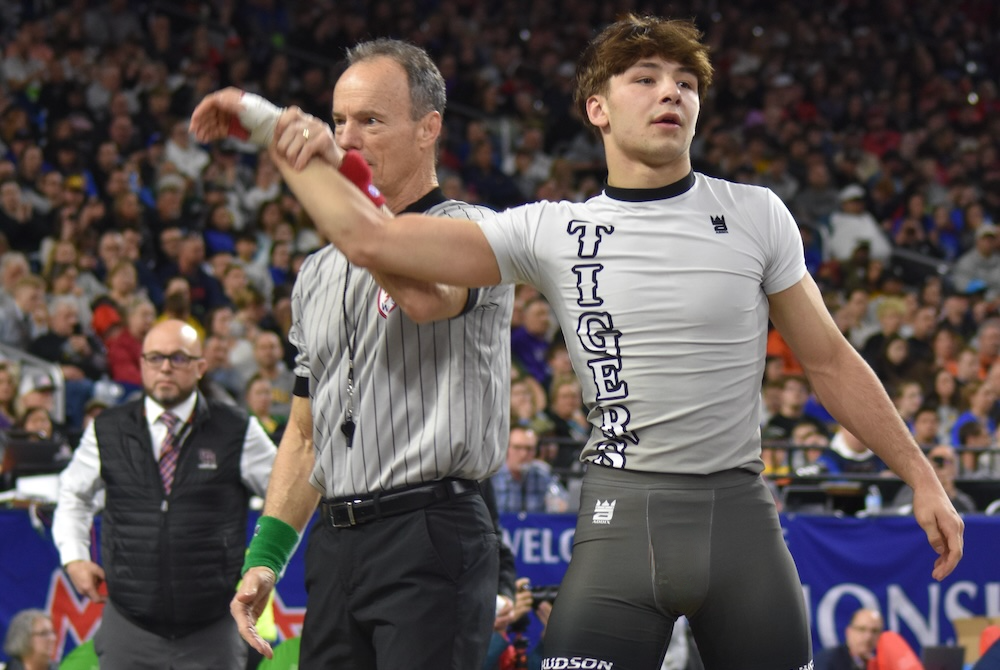
Hudson's Sorrow Enjoys Every Second of Dominant Run to 4th Individual Title
By
Paul Costanzo
Special for MHSAA.com
March 8, 2026
DETROIT – Nicholas Sorrow said he takes every chance he can get to be on the floor at Ford Field during the Individual Wrestling Finals.
Ironic, as he spends so little time on the mat.
The Hudson senior wrapped up his career Saturday by winning his fourth-straight Division 4 individual title with a 55-second pinfall victory against Andrew Frazier of Riverview Gabriel Richard at 132 pounds.
“I got here this morning and watched all our teammates wrestle in the early placement rounds,” Sorrow said. “Anytime I’m here, I like to get my feet on this floor. I just love wrestling, it’s a passion of mine. If I had anything to be remembered by, it’s just how much passion can take you, and dedication and love for the game.”
Sorrow was one of five wrestlers to win a fourth title Saturday, something just 46 wrestlers have now done in state history. He also became the eighth to win four individual titles and four team titles, as Hudson claimed its fifth-consecutive Division 4 Team Finals championship a week ago. He beat Detroit Catholic Central’s Wyatt Lees to the accomplishment by just minutes.
“It’s an incredible feeling,” Sorrow said. “Me and Wyatt were talking before this and I said, ‘You know, if I finish before you I get to be before you with No. 8.’ All those guys on those lists, I grew up watching and admiring and wanting to be like those guys someday. It’s a great honor to get my name up there.”
He is now Hudson’s second four-time champ, joining Jordan Hamdan (2016-19), and the first wrestler from the school to win four individual titles and four team titles. The Michigan State signee won his previous three at 106, 120 and 126.
Sorrow didn’t wrestle a match into the second period on his way to finale, with two first-period pins and a first-period tech fall.
“It’s just something that happened, but that’s the goal every match,” Sorrow said. “Just go in, be aggressive, score points when I can. Sometimes, other tournaments you want to play with them a little bit, let them off their back and try to go neutral. But when I got a guy, you gotta end the match. You’re at state.”
106
Champion: Jaxton Kimling, Hudson, Jr. (42-1)
Decision., 4-1, over Bryce Cartwright, Coloma, Fr. (47-6)
After finishing as a runner-up a year ago, Kimling wasted little time taking control of the match in his second Finals appearance. His first-period takedown stood up.
“Just wrestle smart,” Kimling said of his strategy. “If I could score, obviously work to my scores, don’t get called for stalling, stay active, but don’t force anything.”
The experience of being in the Final a year ago was big for Kimling the second time around.
“All the work finally paid off,” Kimling said. “It feels amazing going out there, wrestling in front of everyone and showing what I’ve done, and going out there and competing. The first time you get there, you always put way more pressure on yourself. All the fans, all the pressure, you feel it. This year, I knew, I’ve already been there once and I put the work in, and it’s not any different than any other tournament.”
113
Champion: Royce Beal, Hudson, Fr. (50-5)
Fall (1:34) over Brody Ashley, Coloma, Soph. (52-3)
Beal came out aggressive in his first Finals appearance, ending things quickly against Ashley, who had taken him to the Ultimate Tiebreaker in their first meeting this season.
“I knew coming in that I was in much better shape than I was in at Super 16,” Beal said of that first meeting. “I was coming off being really sick at Super 16, not making any excuses, but I was pretty sick coming in. I knew I was going to be in good shape (Saturday). I had been working hard, working out with my dad every morning. But I knew I wanted to get some offense early and get him on his heels.”
While there’s still a long way to go for Beal to join Sorrow, having him in the room has been great motivation for the freshman.
“He’s real nice and just helps me every day,” Beal said. “Knowing what I want to work for, Division I commit, I hang out with him a lot on the weekends. The stuff that he goes through is really cool, and it’s just really inspiring to be like that.”
120
Champion: Alex Rodriguez, St. Louis, Sr. (45-0)
Fall (1:24) over Liam McClain, Hudson, Fr. (43-8)
Rodriguez capped off a spectacular career at St. Louis with his second Finals title in his fourth Finals appearance.
He was the champion at 113 as a sophomore, and runner-up at 113 as a freshman and 120 as a junior.
“It’s surreal,” he said. “I finished the season undefeated, haven’t taken a loss all year. I mean, it’s better than the last time I felt this. It just feels good to be back on top my senior year.”
Rodriguez locked in a cradle early in his match for the pinfall victory.
“That’s the move I look for every time,” he said. “That’s the only move I go to.”
126
Champion: Owen Fogel, St. Louis, Sr. (54-3)
Major Decision, 11-0, over Sammy Stewart, Manchester, Sr. (45-4)
Fogel showed his dominance in a matchup of returning Finals champions, jumping out to an early lead and never looking back.
“It was really about just getting the first takedown, no matter how long it took,” Fogel said. “I just knew if I stayed in good position, I was going to score.”
Taking on a fellow returning champion didn’t faze Fogel, who instead relished the opportunity to be part of a marquee match.
“Just have more fun,” Fogel said. “No matter who you are, you breathe the same air, bleed the same color as me, we’re all human. Nobody’s unbeatable.”
138
Champion: Colt Perry, Hudson, Sr. (48-7)
Decision, 2-1, over Luke Harrington, Riverview Gabriel Richard, Sr. (46-7)
After finishing runner-up both of the past two seasons, Perry found his way to the top of the podium for the first time with his win Saturday.
“Being here three times is an accomplishment in itself,” Perry said. “But I wanted to get it done ever since the first time, even when I wrestled (Sorrow in 2024). It was a dream. It feels amazing.”
Perry’s previous two Finals appearances helped prepare him to get over the hump this season against Harrington, himself a runner-up a year ago.
“Managing matches is important here,” Perry said. “At the higher levels, being able to manage a contest, get on your attacks early, score early and often, and then working at the end, making sure you’re still on the attack and leaving it all out there.”
144
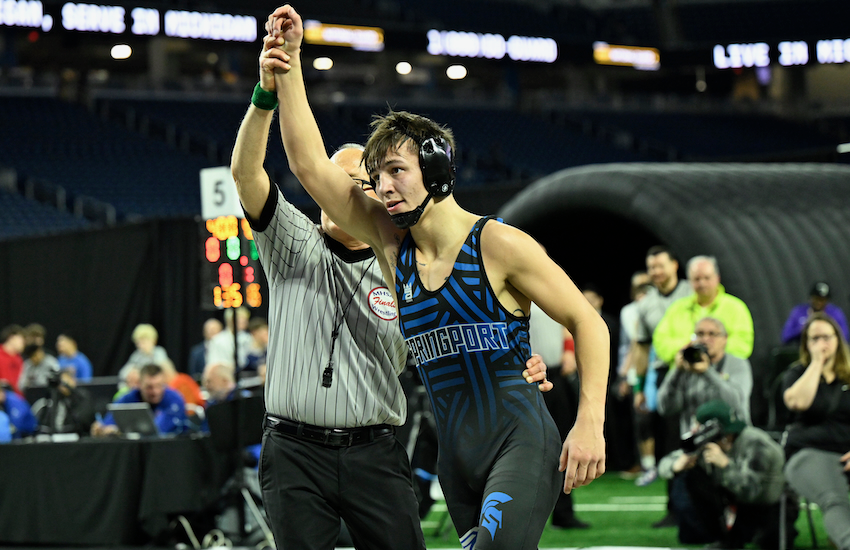
Champion: Wyatt Burns, Springport, Jr. (43-1)
Decision, 8-2, over AJ Barnabei, Riverview Gabriel Richard, Soph. (46-15)
Burns may have broken his ankle on his way to a second-straight Finals title. The junior won at 138 in Division 3 a year ago while wrestling for Dundee, and after taking a big early lead Saturday, he felt something pop with plenty of match still to go.
“I got a takedown, got to my tilt and it was just from there I was going to score again and my ankle got caught somewhere, I don’t know exactly what happened, but I heard a loud pop,” Burns said, while sitting on the trainer’s table getting his ankle wrapped. “I knew I either broke it or something bad, but I couldn’t put any pressure on it the rest of the match. You have to fight through it, it’s state.”
Burns managed to wrestle Barnabei even the rest of the way, despite being clearly hobbled.
“The last one was special for me because it was my first one,” Burns said. “But yeah, this is going to be something to remember, for sure.”
150
Champion: Beckett Campbell, Hudson, Soph. (56-0)
Decision, 4-2, over Blake Sloan, Manchester, Sr. (54-3)
Campbell capped off a perfect sophomore season with his second Individual Finals title. He won at 144 a year ago, and has also been part of two team titles with the Tigers, meaning he’s still in position to join Sorrow in the eight-title club.
“It’s a lot of motivation,” Campbell said. “I think he’s the eighth ever eight-timer. It’s great to have that in my room and know what I have to push for.”
This was another matchup of returning champs, as Sloan had won at 150 a year ago. The difference was a Campbell takedown midway through the third period.
“I’ve always dreamed of (wrestling in a match that big),” Campbell said. “Especially against a kid that I’ve known for so long. I love getting a good match in. It’s just great.”
157
Champion: Tyler Morales, Decatur, Soph. (57-2)
Decision, 9-5, over Wyatt Kimble, Hudson, Fr. (50-6)
Injuries derailed Morales’ freshman year at Decatur, but he made the most of his sophomore campaign, closing it out with a Finals victory.
“I was injured all year last year,” Morales said. “It was always like a dream.”
Kimble, who had pinned his first three opponents in the first period during the tournament, jumped out to a 4-2 lead after the first period this time, but Morales was able to get takedowns in the second and third to pull out the victory.
“I just knew I had to score points,” he said. “I just went for my takedowns.”
165
Champion: Haylen Buell, Martin, Sr. (55-1)
Decision, 14-9, over Cael Tyler, Roscommon, Fr. (57-1)
Buell got back to the top of the podium after finishing as a runner-up his junior year. The four-time finalist completed his career with two titles and two runner-up finishes.
“After losing twice by pin, that was my first full Finals match of my career, it’s either pin or get pinned,” Buell said. “It feels amazing. My gas tank’s a little weak, I had the flu during Team Regionals, so I’m just trying to build it. I just had to keep control of the match. It didn’t look like it, but I was getting to my shots and my ties when I needed to, and that’s how I won that match.”
Buell had four takedowns, including two in the first period to take a 6-2 lead and eventually hand Tyler his first high school defeat.
“We watched a lot of film on him all week,” Buell said. “We even had a four-hour film session on Wednesday before we left. We knew almost everything that was coming. But we got it done, that’s all that matters.”
175
Champion: Jeremy Amrhein, Manchester, Sr. (53-0)
Decision, 12-8, over Eli Roe, Beaverton, Jr. (48-2)
Amrhein capped off an unbeaten season in yet another matchup of returning champions in Division 4.
Amrhein won at 157 in Division 3 a year ago while wrestling for Dundee, while Roe was the Division 4 champ at 157.
“It is very nice,” Amrhein said of getting back to the top of the podium.
He wasn’t all that thrilled with his performance, despite never trailing and recording a takedown in each period.
“I knew he knew my drag was coming because we wrestled before, so I had to switch it up,” Amrhein said. “So I switched to blast doubles, and that seemed to work. Just try your best, control what you can control, stay in position, shoot good shots and don’t do anything stupid.”
190
Champion: Bryce Randolph, Clinton, Sr. (53-2)
Decision, 5-3, over Rowan Bradford, Decatur, Sr. (41-2)
It was like deja vu for Randolph and Bradford, as for the second-straight year the Clinton senior defeated his Decatur opponent 5-3 in the 190-pound Final.
“I wrestled him earlier in the year,” Randolph said. “I knew I’d get the job done. I just had to wrestle my match and get to my attacks.”
This year, Randolph had to overcome not just Bradford but a knee injury he suffered early in the season – which came six months after he had broken his leg.
“It feels amazing,” Randolph said. “It’s definitely a much better feeling than last year with all the adversity I had to go through, breaking my leg, tearing ligaments in my knee. Having to overcome that mentally and physically, it was a journey, and I was all for it.”
215
Champion: Austyn Hocter, Hanover-Horton, Soph. (49-2)
Fall (1:10) over Gradyn Whelan, Clinton, Soph. (45-4)
Hocter came in with a plan and executed it precisely and quickly to claim his first Finals title.
“I knew he wanted the underhook,” Hocter said. “Went for the fireman’s, set up my over (hook), got a little hip bump, over, got him to his base. I knew I could work my top moves and finish the match from there. I had to work on being low; he has a nasty blast double.”
Hocter didn’t have a match get out of the first period, as he finished the tournament with four falls. But he was ready to go as long as needed.
“I wanted to push the pace because I knew I could go all three periods at that pace,” he said. “I knew if I pushed the pace, he was going to make a mistake before I did.”
285
Champion: Sawyer Blaszczyk, Charlevoix, Sr. (50-2)
Decision, 5-2 (2 OT), over Noah Walker, Hesperia, Sr. (48-4)
With the entirety of the Ford Field crowd focused on their match, Blaszczyk put on a show, not only in winning the title in double overtime, but by hitting a split immediately afterward.
“It’s a surreal feeling,” he said. “I wasn’t really focused on the fact that we were in overtime, although I knew I needed to get it done. The fans helped a little bit, but I was just so locked into that match and trying to win it.”
Blaszczyk received a penalty point in each of the 30-second periods of the second overtime, and closed the match out with a reversal.
“I knew he was going to try something big,” he said. “So I’m staying back, just making sure I’m in my positions and wrestling my match.”
PHOTOS (Top) Hudson's Nicholas Sorrow stands with his hand raised in victory Saturday at Ford Field. (Middle) Wyatt Burns' arms is raised in victory after his title triumph. (Click for more from High School Sports Scene.)
Bark River-Harris Honing In on Historic Opportunity
By
John Vrancic
Special for MHSAA.com
March 16, 2021
HARRIS — The Bark River-Harris wrestlers are gearing up for what they hope will be a historic postseason run.
 BR-H will try to take the first step toward its goal when it travels to Manistique for the Division 4 Team District on Thursday.
Reigning District champ BR-H (21-2) faces the host Emeralds, and Iron Mountain meets Newberry at 6 p.m. The winners advance to the championship match at 7:30.
"This is definitely the best season we've had as a varsity program," said fourth-year coach Joe Racicot. "At the beginning of the season with the number of kids we had coming back, we thought we could be up near the top. Although, I wasn't sure we'd be 21-2. Many of the teams are shorthanded, although we're winning more matches than we're losing. We're heading in the right direction."
If the Broncos win the District, they would host the Team Regional for the first time March 24.
"It's going to be a challenge," said Racicot. "I have the utmost respect for the other coaches in our District. I've learned a lot from them. All of them are good friends and mentors to me. I'm one of the few coaches who didn't wrestle in high school because we didn't have a program here at that time. Although, it didn't take me long to fall in love with the sport."
Last year, the Broncos were crowned District champs for the first time in their 10-year history before falling to Onaway in a Regional opener.
Powers North Central sophomore Drew Allgeyer, who wrestles at BR-H through a co-op venture, is 23-0.
"We've been working hard," said Allgeyer, who will be wrestling at 160 pounds in the District and finished seventh at last season’s Finals at 145. "We have good practice partners and push each other every day. We're all helping each other to be the best we can be, which definitely pays off in competition.
"I have the strength for 171. I've been wrestling at 171 most of the year which helps me a lot,” he added. “All I want to do is have good matches. I always say I don't lose, I learn. There's always somebody better than you. That's big motivation right there."
Both of BR-H's losses this winter were to Division 2 Escanaba.
"We lost to them by six and 12 points," said Allgeyer. "They're the best team in the U.P., and they're well-coached. It's good for us to put up as much of a fight as we did, although none of this will mean anything once we get into the postseason when it really counts. Iron Mountain has a solid team. They and all the other teams will put their best lineup out there."
North Central junior Wyatt Raab (215) is 18-0 going into the postseason.
"This is the first time Bark River-Harris has had a chance to go to the state tournament as a team," he said. "We could also have the most individual qualifiers in school history. We're looking to make a lot of special trips this year.”
BR-H freshman Noah Gagne is pleasantly surprised by the Broncos' record.
"We have a lot of young guys this year," he added. "I thought we'd be pretty good, but not this good. Esky was definitely our toughest competition, and I think Iron Mountain is closer to us. “This has definitely been a learning experience for me. The older guys have been teaching me a lot of things. I've learned to be more confident. They told me to 'know what you're doing and try to listen to your coaches and teammates during a match.'"
Junior Avry Corrigan joined Allgeyer at last season’s Individual Finals. The Broncos this winter also have four girls, including junior captain Katie Viau and Melody Racicot who will be wrestling in Sunday's Michigan Wrestling Association girls state tournament at Highland.
"It's nice to see that growing," said coach Racicot. "We hope to eventually get a girls tournament in the U.P."
 John Vrancic has covered high school sports in the Upper Peninsula since joining the Escanaba Daily Press staff in 1985. He is known most prominently across the peninsula for his extensive coverage of cross country and track & field that frequently appears in newspapers from the Wisconsin border to Lake Huron. He received the James Trethewey Award for Distinguished Service in 2015 from the Upper Peninsula Sportswriters and Sportscasters Association.
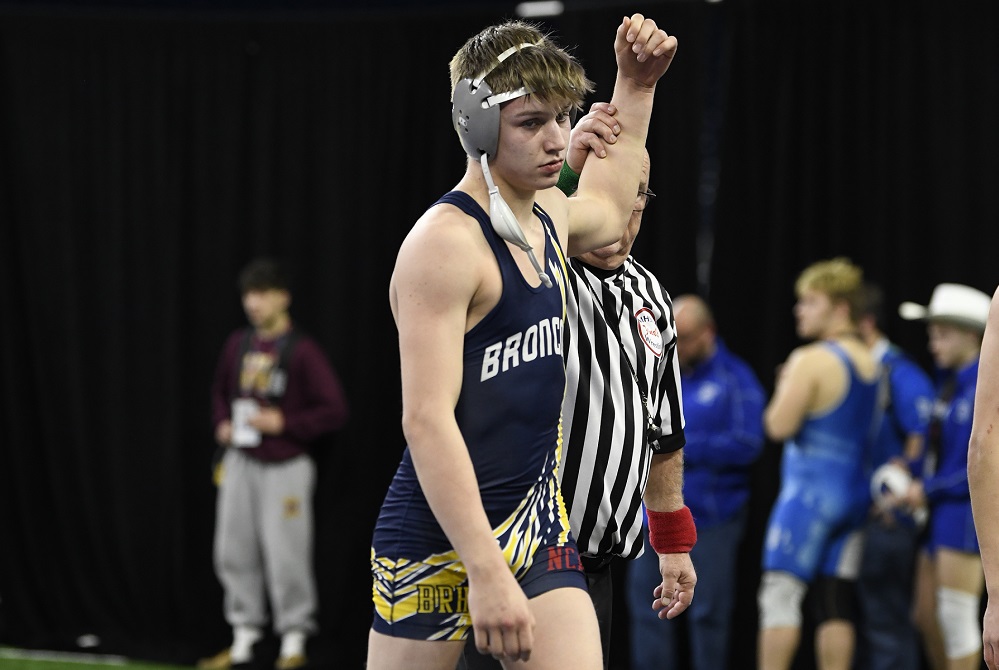
PHOTO: Drew Allgeyer’s arm is raised in victory after one of his wins last season during the Individual Finals at Ford Field. (Click for more from High School Sports Scene.)