

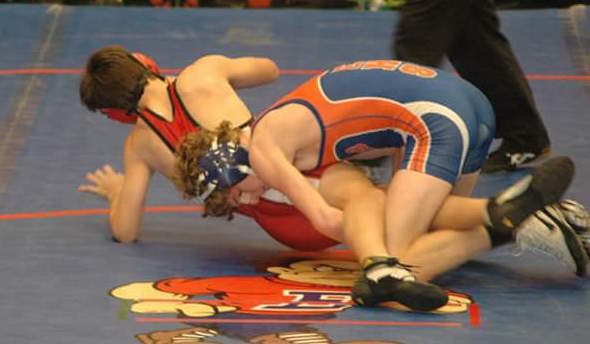
'Little Mike' Builds on Family Legacy
By
Wes Morgan
Special for MHSAA.com
January 8, 2016
Driven but not obsessed, senior Michael Higley has carried the torch for a family that first put Edwardsburg wrestling on the map.
 The senior 119-pounder is stalking his fourth straight trip to the MHSAA Division 2 Individual Wrestling Finals and a title that’s eluded him.
All the while, he’s managed to achieve success without feeling much pressure or sacrificing the other important aspects of student-athlete life.
A third-generation MHSAA Finals qualifier, Higley has added much to his family’s grappling legacy in southwest Michigan. His grandfather, Mike (Big Mike), was the school’s first Finals qualifier as a junior in 1966 — just the third year of the program’s existence.
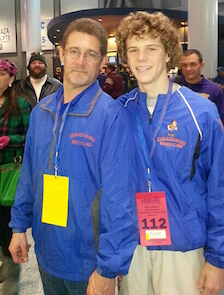
Higley’s father and current Edwardsburg coach, also named Mike (goes by Middle Mike), earned a spot on the podium in 1985 (fourth) and 1986 (third). Other members of the extended family were standout wrestlers in nearby Mishawaka, Ind.
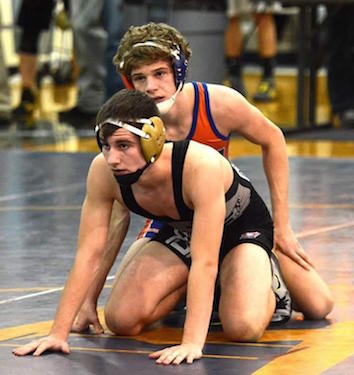
“Little Mike” has had the best career of them all with the biggest prize still up for grabs. Ranked third in his weight class by michigangrappler.com, he boasted a 15-1 record as of Jan. 5.
“It has been awesome,” his father said. “We butt heads from time to time over different things, but it’s a very healthy relationship. We’re good friends and do a lot of hunting and fishing. This is just part of it. This helps create who he is as a young man, but it doesn’t define him as a young man.”
Coach Higley mentioned all the wrestlers he’s seen over the years who have measured their success as a person by what they’ve accomplished on the mat.
“He and I have had a lot of fun enjoying all the things that have come along the way,” Coach Higley added.
 Michael Higley plans to study nursing while competing for NCAA Division II University of Wisconsin-Parkside. He’s looking to graduate with nearly a 4.0 grade-point average and is currently taking college classes. The work he’s put into academics has netted considerable financial aid.
But there’s unfinished business remaining in the prep ranks.
As a freshman at 103, Michael Higley earned Division 2 all-state status with a seventh place finish and 48-6 record. He was fifth overall at his weight in 2014 and placed a third time as a junior in 2015 when he turned in a third-place performance at The Palace of Auburn Hills.
The pattern of improvement would put him at the top of the podium come March.
“I’m really excited for my last chance,” he said. “It has been my goal to get a state title since I was little and started wrestling at the age of 7.”
For nearly that long, he’s been battling with teammate Hunter Vargo, a senior at 125 pounds ranked fifth in Division 2 with a 16-2 record. Vargo is seeking a return trip to the Palace as well. He and Michael Higley have formed a perfect and productive practice partnership over the years on top of a close friendship.
“It’s great having him in the room,” Higley said. “He’s so great at scrambling; we get better every day pushing each other.”
Like any constantly competitive program, it starts at the lower levels. Before “Middle Mike” began coaching the varsity team five years ago, he was heavily involved in running camps, clinics and clubs for well over a decade ago.
 “It was crucial in the development of these kids and getting them exposed at an early age to the fundamentals,” he said. “It has been critical to us in order to maintain that level we’re at.”
The Eddies advanced to the Team Regional Finals in 2014 and fell to Niles. Last winter, Edwardsburg failed to get out of an extremely tough District after losing by five points to a resurgent Sturgis squad. Still, the program made it a close Wolverine Conference race with perennial power Allegan to finish second in the league standings.
Coach Higley expects Edwardsburg to be in the mix again this season, but he’s keeping his fingers crossed that the Eddies don’t suffer any attrition.
“We’ve got some great individual athletes but our depth is thin,” he said of a team still dealing with some football-related injuries.
No matter the outcome for the team or individually, Michael Higley has cherished every minute being able to add to an Edwardsburg wrestling tradition.
“I’m really pleased with what I’ve done so far and what this class has done,” he said. “We all plan on helping when we get out of college and staying involved. I’m glad how we have represented the school overall.”
 Wes Morgan has reported for the Kalamazoo Gazette, ESPN and ESPNChicago.com, 247Sports and Blue & Gold Illustrated over the last 12 years and is the publisher of JoeInsider.com. He can be reached at [email protected] with story ideas for Berrien, Cass, St. Joseph and Branch counties.
PHOTOS: (Top) "Little Mike" Higley, in blue, wraps up an opponent. (Middle) Edwardsburg coach "Middle" Mike Higley and his son "Little" Mike have been their family's second and third generation of MHSAA Finals qualifiers. (Below) "Little Mike" Higley, top, is 15-1 this season. (Photos courtesy of the Higley family.)

Ind. Wrestling Ticket Sales Underway
January 14, 2014
By Geoff Kimmerly
Second Half editor
Fans wishing to purchase advance reserved and group general admission tickets for the 2014 Michigan High School Athletic Association Individual Wrestling Finals, Feb. 27-March 1 at The Palace of Auburn Hills, may now do so exclusively through The Palace Box Office.
The advance reserved ticket sales program allows the discounted purchase of all-tournament tickets, giving the bearer admission to all five sessions of the event, reserving the same seat. Advance all-tournament reserved tickets are $40 each; the ticket price includes in and out parking privileges at The Palace, and there is no limit on the number of seats which may be purchased in a single order. There is a $5 handling charge for each order.
Spectators ordering reserved seat tickets must designate the wrestling division they prefer to watch, which will result in their ticket assignment being in full view of the mats being used for that competition. For Divisions 3 and 4, the seats will be on the side of the arena opposite the mat placement, providing an unobstructed view of those mats.
Group seating is available on a general admission basis in the upper level of The Palace for all sessions. A minimum purchase of 10 tickets per session is required. Group tickets are $4.50 when purchased in quantities of 10 per session, with the price including in and out parking privileges at The Palace. A $5 handling charge will be applied to each group order.
Orders must be postmarked no later than Jan. 31 to qualify for the advance reserved seat discount. Group general admission sales orders must be postmarked no later than Feb. 14 to qualify for that discount. Order forms may be found on the Wrestling page of the MHSAA Website.
General reserved seat ticket sales will begin Feb. 3 exclusively through The Palace of Auburn Hills Box Office. Only all-session reserved seat tickets will be sold at a cost of $45 each, plus applicable Palace Box Office handling charges.
Remaining single-session reserved and general admission tickets will go on sale Feb. 26, exclusively through The Palace of Auburn Hills Box Office. Single-session reserved seat tickets are priced at $10 each, and general admission seats in the upper bowl of the arena are priced at $9 per session, which include in and out parking privileges.