


MHSA(Q&)A: Hudson wrestling coach Scott Marry
February 26, 2012
Although updating the records remains a work in progress, it’s fair to say few have accomplished in Michigan high school wrestling what Hudson coach Scott Marry has over the last 24 seasons.
He’s one of just a handful of coaches who have won more than 600 matches – he’s 630-135 after this Finals weekend – and Hudson is one of only three programs to win four or more consecutive team championships since 1988, the first season MHSAA team titles were decided by dual matches instead of the Individual Finals results. The Tigers beat Shelby 33-22 in Saturday’s Division 4 Final at Battle Creek’s Kellogg Arena.
Marry is a Hudson alum, having graduated in 1983 before attending Adrian College. He also coached the junior varsity football team for 11 seasons.
Of roughly 270 students at Hudson High, 27 were on the wrestling team this season, including Marry’s son Devan – who has signed with Eastern Michigan for next season. We caught up with Scott Marry after Saturday’s championship match.
It’s four titles in a row.
I’m numb right now. I’m lost for words. I’m happy for these seniors. Most of these seniors were on that football team (in 2010) that was a state title also, so they’ve won five state titles. They have five championship rings. They were in another (football) Finals against Traverse City (St. Francis, in 2009). So they’ve been in seven Finals contests.
About 10 percent of your school’s enrollment is on the wrestling team. How were you able to create so much interest in the program?
They want to be part of something successful. The kids know that hard work pays off. They really do. This didn’t start this year. I’ve had these kids in the program for years. Every one of these seniors, I’ve known them seven or eight years. They’re my boy’s best friends. That’s a huge advantage.
And I don’t think that just because the senior class was so good that this is going to be the end of Hudson wrestling, by any means. But those seniors had a big part to do with what happened today.
Although you’ve won four straight titles, is this one more special because you know these seniors so well?
Definitely. We’ve been bawling all day. We’ve been hugging and crying and saying good-bye, and promising each other that no matter what – win, lose or draw – we were going to have these same feelings for each other when we were done. But this is a little bit sweeter. I get to say good-bye to six guys that I’ve shared a lot of time with. And in a good way – it’s a positive saying good-bye, not a negative one. I’m going to miss them all.
What keeps you coming back every year?
The student athletes. The community. … I think, to give these kids something to look forward to, something to work for, that’s the least I can do.
D1 Preview: Davison Seeks Return to Top
February 20, 2014
By Geoff Kimmerly
Second Half editor
Davison is arguably the most storied wrestling program in MHSAA history. And for seven seasons, the Cardinals have looked to add another championship chapter.
This weekend at Kellogg Arena, they are favored to win their first Division 1 title since finishing a string of five consecutive championships in 2006.
Below is a look at all eight teams competing in Division 1, listed by seed. Their Quarterfinal matches begin at 3:15 p.m. Friday, with Semifinals at 9:30 Saturday morning and the championship match at 4 p.m. All matches this weekend will be streamed live on a subscription basis on MHSAA.TV. For results throughout, check the MHSAA Wrestling page. Rankings below are from MichiganGrappler.com.
#1 DAVISON
Record/rank: 23-4, No. 1
League finish: First in Saginaw Valley Association
Coach: Roy Hall, 17th season (426-72-1)
Championship history: Eight MHSAA championships (most recent 2006), two runner-up finishes.
Individual Finals qualifiers: 112 Devon Perez (31-11) soph., 112 Max Johnson (35-7) soph., 125 Lincoln Olson (38-1) jr., 130 Derek Humphrey (36-4) sr., 135 Matt Miller (30-7) sr., 140 Justin Oliver (40-1) sr., 145 Dominic Russ (33-8) sr., 152 Thomas Garty (33-3) sr., 152 Brenden McRill (22-11) fr.,171 Jordan Cooks (36-2) sr., 215 Jake Ellis (25-16) jr.
Outlook: Davison just missed the title last season, falling to Detroit Catholic Central 29-26 in the Final. But 11 starters from that match are back this weekend. The starting lineup features five 30-match winners, with five more 20-match winners able to sub in. Cooks was a repeat individual champion last season, while both Olson and Oliver have won multiple titles during their careers and Miller was a runner-up in 2013. Total, six of this weekend’s probable starters placed at last winter’s Individual Finals.
#2 HARTLAND
Record/rank: 38-2, No. 3
League finish: First in Kensington Lakes Activities Association
Coach: Todd Cheney, 22nd season (601-91-2)
Championship history: Four MHSAA runner-up finishes (most recent 2007).
Individual Finals qualifiers: 125 Sage Castillo (49-7) soph., 130 Nate Hughes (48-7) sr., 135 Austin Eicher (33-1) sr., 145 Jacob Gorial (52-1) jr., 160 Logan Vish (39-15) soph., 285 Josh Charneski (46-8) sr.,
Outlook: Hartland again is contending for its first MHSAA team title, moving up from a third seed a year ago as it makes its 13th straight Quarterfinal appearance. Eicher defeated teammate Gorial in one of last season’s most talked about Individual Finals, at 130, and Gorial is the team wins leader this season. Once again, the path to Battle Creek was a tough one, with No. 4 Brighton and No. 5 Holt among those Hartland downed along the way.
#3 DETROIT CATHOLIC CENTRAL
Record/rank: 15-4, No. 2
League finish: First in Detroit Catholic High School League
Coach: Mitch Hancock, seventh season (146-32)
Championship history: Ten MHSAA championships (most recent 2013), two runner-up finishes.
Individual Finals qualifiers: 112 Parker O’Brien (26-17) sr., 119 Trevor Zdebski (20-2) jr., 130 Evan Toth (27-13) sr., 135 Greg Johnson (32-10) sr., 140 Myles Amine (35-6) jr., 145 Malik Amine (27-3) sr., 152 Nick Bennett (36-0) sr., 171 Drew Garcia (34-1) sr., 189 Nick Giese (19-8) jr., 215 James Russell (36-7) sr.
Outlook: Detroit Catholic Central has won three Division 1 team championships in four seasons, including at the end of the last two, and should be in the hunt again despite the third seed. The Shamrocks’ only losses were to No. 1 Davison, Division 2 No. 1 Lowell and No. 2 St. Johns and Illinois power Oak Park River Forest. Malik Amine and Garcia are reigning individual champions, and Zdebski, Myles Amine and Giese also placed last season.
#4 GRANDVILLE
Record/rank: 17-1, No. 7
League finish: First in O-K Red
Coach: Bubba Gritter, fourth season (66-26)
Championship history: Two MHSAA championships (most recent 1993), three runner-up finishes.
Individual Finals qualifiers: 112 Josh Brower (33-9) soph., 135 Collin Tomkins (32-4) sr., 140 Kameron Bush (39-3) fr., 152 Jake Brower (31-8) sr., 160 Sam Greco (30-11) fr., 215 Eppe Saarenheimo (28-13) jr.
Outlook: Grandville returned to the Quarterfinals last season for the first time since Gritter’s senior year of 2003, and returns four seeds higher this weekend. Half of last season’s lineup is back including returning Individual Finals placer Tomkins. He’s one of five seniors; the probable starters for this weekend also include seven underclassmen looking to make this trip a tradition.
#5 OXFORD
Record/rank: 24-4, No. 8
League finish: First in Oakland Activities Association Red
Coach: Paul McDevitt, 17th season (345-140)
Championship history: MHSAA Division 1 champion 2011, two runner-up finishes.
Individual Finals qualifiers: 112 Alex Hrisopoulos (42-7) soph., 160 Noah Kinne (33-18) jr., 171 Wesley Maskill (46-5) sr., 189 Wyatt Harden (16-4) soph., 189 Grant Krause (31-9) sr., 215 Ben Line (39-7) sr., 215 Jamal Pettiford (18-9) sr., 285 Zach Wood (30-5) sr.
Outlook: Oxford missed the Quarterfinals last season for the first time in six, but returns this weekend after beating No. 10 Clarkston along the way. Hrisopoulos, Maskill and senior Eddie Schlickenmeyer all have won at least 40 matches this season and were Individual Finals placers in 2013. Maskill, Schlickenmeyer, Krause and senior Zab Throne all were in the lineup the last time Oxford wrestled in a championship match, in 2012 against Detroit Catholic Central.
#6 PLYMOUTH
Record/rank: 36-4, unranked
League finish: Second in Kensington Lakes Activities Association
Coach: Quinn Guernsey, sixth season (112-75)
Championship history: Has never finished among the top two teams in Finals competition.
Individual Finals qualifiers: 112 Brandon Harris (47-4) jr., 119 Mohamad Youssef (50-3) sr., 140 Jon Conn (44-7) sr., 145 Sofus Nielson (34-10) sr., 160 Joey Shaver (43-9) sr., 171 Hussein Youssef (45-8) jr.
Outlook: Guernsey, who wrestled at Brooklyn Columbia Central and then Michigan State University and Eastern Michigan University, has led Plymouth to its first Quarterfinal this winter and an increased win total each of the last three seasons. Plymouth defeated No. 6 Temperance Bedford during this run. Mohamad Youssef was an Individual Finals placer last season.
#7 MACOMB DAKOTA
Record/rank: 25-5, No. 9
League finish: First in Macomb Area Conference Red
Coach: Ed Skowneski, second season (62-10)
Championship history: Has never finished among the top two teams in Finals competition.
Individual Finals qualifiers: 119 Zack Prater (39-11) soph., 135 Kyle Cendrowski (29-19) sr., 152 Alex Bozinovski (42-7) sr., 160 Jake Johnson (48-1) sr., 171 Joshua Burnham (39-8) sr., 189 Greg Brohl (32-17) sr., 215 Antonio Balabani (38-7) jr.
Outlook: After making the Quarterfinals last season for the first time, Dakota is back with a lineup of half seniors. Half of the lineup also has at least 30 wins, including returning Finals placers Bozinovski and Johnson. Skowneski was a 2003 individual champion for Clinton Township Chippewa Valley before wrestling at MSU.
#8 LIVONIA FRANKLIN
Record/rank: 16-7, unranked
League finish: Fifth in Kensington Lakes Activities Association
Coach: David Chiola, 14th season (231-97)
Championship history: Has never finished among the top two teams in Finals competition.
Individual Finals qualifiers: 112 Jeremy Nelson (33-23) soph., 119 Nick Robertson (40-14) jr., 125 Nathan Atienza (50-6) fr., 152 Kenneth Steele (32-19) sr., 152 Nick Frazier (42-7) sr., 160 Jordan Atienza (58-0) sr.
Outlook: Franklin is in the Quarterfinals for the first time after winning its ninth straight District title. Jordan Atienza is 166-1 over the last two seasons and was an Individual Finals runner-up at 152 last winter. Chiola has won 292 matches total as a coach, with six more seasons at Garden City.
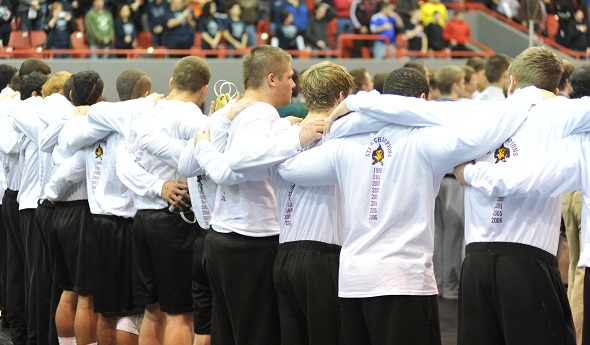
PHOTO: Davison wrestlers participate in the "Grand March" before last season's championship matches at Kellogg Arena. (Click to see more at HighSchoolSportsScene.com.)