


MHSA(Q&)A: Stevensville-Lakeshore wrestling coach Bruce Bittenbender
February 9, 2012
Bruce Bittenbender grew up in Bethlehem, Pa., in the heart of steel country, and worked part-time in a mill as a young adult. That helped land him in Michigan City, Ind., not long after graduating from Milligan College in Tennessee in 1969.
But Bittenbender wanted to teach and coach.
Bittenbender took a teaching job at South Haven that fall, and as an assistant coach helped that school's wrestling team to the MHSAA Class B championship. A year later the wrestling coaching job opened at Stevensville Lakeshore. He says now that he was too young for the job, but Bittenbender applied and was hired. The program was struggling at that point -- but not for much longer.
According to the National Federation of State High School Associations' record book, Bittenbender trailed only Rex Peckinpaugh of New Castle, Ind., in career dual coaching wins heading into this season (796-780). Bittenbender won his 800th match on Jan. 14 -- and has his team just two more victories from MHSAA Finals weekend Feb. 24-25 in Battle Creek.
Bittenbender retired from teaching two years ago after 35 teaching biology and seven more physical education. At 64, he still gets on the mat with his wrestlers from time to time, although perhaps not as much as he once did. But countless wrestlers -- including those who won a combined 20 individual championships -- have benefited from his instruction.
His coaching tree includes current Rockford coach Brian Richardson and former Lowell coach Dave Strejc, who led teams to MHSAA Division 2 championships in 2002 and 2004. Bittenbender was named National Coach of the Year by the National Federation of State High School Associations in 2002 and again by the National High School Athletic Coaches Association in 2010. He is a member of the Michigan Wrestling Association Hall of Fame, and he will be inducted into the Pennsylvania Wrestling Coaches Association Hall of Fame this spring.
Stevensville Lakeshore is ranked No. 7 in Division 2. His team won its District on Tuesday, downing St. Joseph 35-34 with a decision win in the final match.
What keeps you coming back for another season?
Every year, when you think you've seen it all, something else comes up. When I was in middle school, it was junior high school back then, I was on the edge. The coach (Jim McIntyre, who went on to coach at Kutztown University) grabbed me on the back of the neck and said, "What are you doing?" I was hanging out with kids of questionable character, and he said, "You need to come out for wrestling." I still go back and play golf with that guy once in a while. ... I came from a big family. We didn't have much. I have empathy for the kids that were kicked around, misdirected. Somebody took time out for me. I felt maybe I could kick some of that back.
After so many wins, do you still enjoy all of them the same?
I tell ya, last night I certainly enjoyed the win. It was just like I was 23 again. Yeah, I enjoy it. It's addictive. That's what you're out there for.
The NFHS changed its wrestling weight classes this season, but Michigan chose to stay with its current lineup. What is your thought on that switch?
I think it's going to switch back. It makes no sense to me. The average kid graduating from high school is 5-(foot-)9, 155 pounds. Why add a weight class at the top where you have to compete for kids with football and basketball. … Our sport has prided itself on giving the little guy a chance. ... He can be a state champ in wrestling.
Your teams have finished MHSAA Finals runner-up twice. How much would you like to win that first championship?
I would love to. That's the ultimate goal. We've been so close. We were up three points in '94, and got pinned at heavyweight (to lose 28-25 to Fowlerville). In '86 we broke the record for individual number of points scored, but Eaton Rapids broke it too. We were that close.
I'm assuming you're not going to stop coaching any time soon.
Being around people and the community, and working with kids, it keeps you young. Keeps you in shape, keeps you motivated. I think that's one of the reasons. Now that I'm not teaching, my wife and I are able to travel quite a bit in the fall and summer. I think that's basically a motivator, just being around people.
What do you tell, or would you tell, young coaches who are just getting started in high school wrestling?
I tell them to be careful the first few years. It's different today. … I tell coaches you need to set up standards, discipline, goals and objectives, and go by those. You try to accommodate some of these kids, and this and that, but you can go only so far. You’ve gotta stick to the rules and let the cards fall where they are. If you don't, you'll have problems down the line.
And I think communicating with people, making friends, getting out there and strumming up support for the program is important too. I've had the opportunity to speak to the Lions Club, various civic organizations, at hospitals. You have to try to make yourself available. People have to learn to put their trust in you."
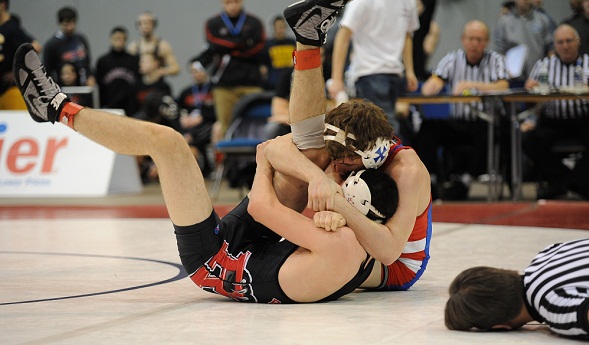
DCC's Mooradian Shoots for One More
February 27, 2012
Championships have become a regular part of Alec Mooradian's high school wrestling career. In each of the last three seasons, he's emerged from the 16 best wrestlers at his weight in Division 1 to stand alone atop the awards podium as an MHSAA individual title winner.
This weekend, the Detroit Catholic Central senior can claim one more of those -- and finish a feat only 15 others have accomplished in the history of the sport in this state.
Mooradian and St. Johns' Taylor Massa -- who also has won three titles over the last three seasons -- can become the 16th and 17th wrestlers in MHSAA history to finish with four individual championships. Mooradian enters the weekend with a 44-2 record this season as he targets the 152-pound title; he's 40 pounds heavier than he was when he captured his first crown. His 206 career victories also rank among the MHSAA all-time career leaders and reflect years of dedication.
“I spend a ton of time doing extra things before or after practice," Mooradian said. "Whether it's working on technique, running, or spending time in the weight room I am always trying to do something extra; trying to outwork everyone."
Mooradian, a recipient of one of this week's Second Half High 5s, began his rise to prominence by capturing the 112-pound medal in 2009 with a 2-0 win over Holts’ Ben Matthiesen. That capped his freshman year with a 48-0 record.
He followed with a 59-1 campaign in 2010, finishing the year with a 119-pound title by downing Davison’s Brandon Shuart 3-1 in the Final. A year ago, Mooradian went undefeated at 55-0 and claimed his third individual MHSAA championship, this time at 135 with a win over Jake Weissend of Flint Carman-Ainsworth.
His latest wins came on two pins and a decision as the Shamrocks again won the Division 1 championship Saturday at Battle Creek's Kellogg Arena. He also played significant roles on the 2010 championship team and last season's MHSAA runner-up.
Technique and physical training make up a big portion of Mooradian's year-round training. But he also works hard to transfer his physical preparation to the mental aspects demanded by the one-on-one nature of wrestling.
“In my mind, matches are won before setting foot on the mat,” he said. “I have always strived to be a composed wrestler. This attribute allows me to stay in every match no matter what the score is, and it keeps me free of any nerves heading into a high pressure situation. Having a chance for a fourth state title is a great opportunity, and I look forward to it.”
Report was compiled by the MHSAA's Rob Kaminski.