

Rep Council Wrap-Up: Spring 2021
By
Geoff Kimmerly
MHSAA.com senior editor
May 6, 2021
The addition of a girls division to the Individual Wrestling Tournament series and approval of a common start date for all Fall sports highlighted actions taken by the Representative Council of the Michigan High School Athletic Association during its annual Spring Meeting on May 3.
The Spring Meeting of the 19-member legislative body of the Association’s more than 1,500 member schools is generally the busiest of its sessions each year. The Council considered 19 committee proposals and dealt with a variety of eligibility rule, postseason tournament and operational issues.
Beginning with the 2021-22 school year, a championship division for female competitors who participate on MHSAA member school teams will be added to the Individual Wrestling Tournament series. There will be 14 champions awarded, based on weight classes established by the National Federation of State High School Associations. Qualifiers will be determined via a sectional format, and girls will continue to compete on boys teams during regular-season and team tournament competition; girls also may choose to compete in the boys individual tournament instead of the girls bracket. A total of 401 girls competed in wrestling for MHSAA member schools during the 2019-20 school year, up from 250 in 2017-18 and then 327 in 2018-19. The girls division proposal had been put forth by the MHSAA Wrestling Committee.
The Council also voted to move the start of all Fall sports practices to the same day. Those sports now may begin on the 16th Monday before Thanksgiving. Previously, football started on a Monday and all other sports began Wednesday. For the upcoming school year, the Fall sports start date is Aug. 9, 2021.
As it has during most meetings over the 2020-21 school year, the Council continued to discuss possible adjustments because of the COVID-19 pandemic and disruption it has caused to Michigan high school athletics. Notably, the Council approved an extension of the waiver of the previous academic record regulation for sports played in Fall 2021. This is the third extension of the waiver. The previous academic record regulation requires participants to have received credit for at least 66 percent of a full credit load during the previous semester. As COVID-19 has resulted in various academic scheduling adjustments, schools will continue to determine if athletes have met the credit level necessary to be eligible for athletics this fall.
The Council also made permanent the allowance for cooperative programs in nine sports among schools of the same public school district regardless of the 3,500-student enrollment maximum. Those co-op programs were first allowed as part of a two-year experiment beginning with the 2016-17 school year to increase possibilities for participation in those sports – baseball, bowling, girls competitive cheer, cross country, golf, soccer, softball, tennis and wrestling. Schools taking part in these co-op programs must continue to show a demonstrated history of inadequate numbers of participants and apply for renewal every two years.
Here is a summary of other notable actions taken by the Representative Council at the Spring Meeting, which will take effect during the 2021-22 school year:
Athletic Equity
• The Council approved an Athletic Equity Committee recommendation to publish the following statement to suggest to local schools that they review nicknames and school logos that are considered offensive or hurtful to minority groups or demonstrate an insensitive bias:
“The MHSAA recognizes the importance of equity in high school sports. Schools and mascots are rich in tradition and unique to each community. Although we understand the tradition of those individual communities, we also wish to support and foster an environment of inclusion. It is in this spirit that the MHSAA encourages member schools and communities to evaluate and reconsider names and mascots that may be offensive to groups of individuals.”
Officials
• The Council approved an Officials Review Committee recommendation to adjust the officials rating system with the hope of encouraging more ratings and providing a more specific understanding of an official’s overall body of work. Instead of the current overall 1-5 rating system, officials will receive specific feedback in four categories: judgment, presence and demeanor, attitude and effort, and administration and communication.
Sport Matters
• In bowling, the Council approved a Bowling Committee recommendation to adopt the Phantom oil pattern for the 2021-22 season.
• In competitive cheer, the Council approved a Girls Competitive Cheer Committee recommendation to study a new choreography chart that will award points based on a variety of skills while also awarding a range of points to benefit both small and large teams which have various skill levels.
• Also in cheer, the Council approved a pair of Committee technical recommendations; the first allows for a connected tumbling skill to be considered a new variety point for Round 3, and the second allows four difficulty points for a one-leg flair at the elevator level for middle school competition.
• In golf, the Council approved the Golf Committee recommendation to require the use of the iWanamaker scoring program and app during the regular season, beginning in Fall 2021. The program and app became required during Regional and Finals play during the Fall 2020 season.
• In softball, the Council approved a Girls Softball Committee recommendation to add a suspended game policy to MHSAA playing rule adoptions in the MHSAA Handbook. This policy – which mirrors that approved for baseball in 2020 – provides a game will be suspended any time it is called before it reaches regulation, or if called any time when the score is tied.
• In tennis, the Council approved a Tennis Committee recommendation regarding instances when a seeded player withdraws from Regional or Finals competition before the first match is played. In those instances, the players seeded lower in that flight than the player who withdrew will move up one seed and be placed on the previously-determined lines for those seeds within the flight bracket. However, non-seeded players already drawn into the bracket will not be moved.
• Also in wrestling, the Council approved a late-arrival skin check on days – especially during weekends – when teams may be competing in multiple regular-season duals. An athlete who misses the scheduled morning skin check may, with coach’s notification to the official beforehand, receive a skin check upon later arrival to the event but prior to the start of the dual in which the wrestler may compete. This will allow an individual the opportunity to participate if that wrestler missed the scheduled morning inspection due to educational reasons or unforeseen circumstances.
The Council also discussed possible topics for presentation during this fall’s Update Meeting statewide tour, and took action to clarify Handbook language regarding a variety of topics. The Association’s $11.5 million budget for the 2021-22 school year also was approved.
The Representative Council is the 19-member legislative body of the MHSAA. All but five are elected by member schools. Four members are appointed by the Council to facilitate representation of females and minorities, and the 19th position is occupied by the Superintendent of Public Instruction or designee.
The MHSAA is a private, not-for-profit corporation of voluntary membership by more than 1,500 public and private senior high schools and junior high/middle schools which exists to develop common rules for athletic eligibility and competition. No government funds or tax dollars support the MHSAA, which was the first such association nationally to not accept membership dues or tournament entry fees from schools. Member schools which enforce these rules are permitted to participate in MHSAA tournaments, which attract more than 1.4 million spectators each year.
Lowell's Boone Ends as 2nd 8-Time Champion
By
Paul Costanzo
Special for MHSAA.com
March 7, 2020
DETROIT – Brent Metcalf. Austin Boone.
That’s it. That’s the list.
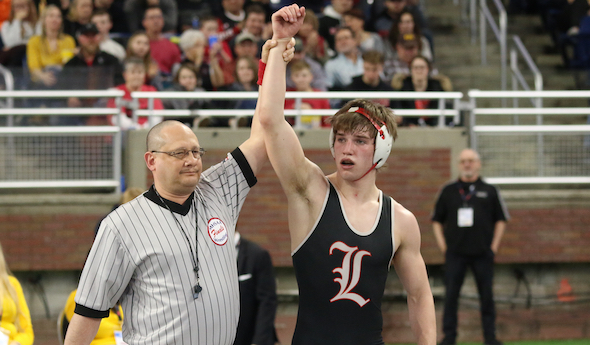
Boone, a senior at Lowell, became the second wrestler in MHSAA history Saturday to win four individual titles while being part of four team titles, as he defeated Gaylord’s Chase LaJoie 4-3 at 145 pounds during the Division 2 Individual Finals at Ford Field.
Metcalf, who eventually became an NCAA champion and competed on the international stage, was the first to accomplish the feat, achieving his at Davison from 2002-05.
“It’s cool,” Boone said. “Like I’ve been telling everybody else, I’m not really thinking about it too much. It’s kind of cool, but I don’t pay attention to stuff like that.”
He and Mendon’s Skyler Crespo became the 27th and 28th four-time individual champions in MHSAA history, nearly simultaneously.
Boone (41-0), who had defeated LaJoie by major decision a week earlier in the Team Finals, had to stave off a late reversal attempt Saturday.
It was a matchup of multiple-time champions, as LaJoie (38-2) had won as a freshman and sophomore. It was also a matchup of Division I talents, as Boone has signed with Penn State, and LaJoie will continue his career at Cornell.
“It’s a great match; it’s my closest finals match I’ve had,” Boone said. “He’s a great wrestler. He’s going to do great things in college. Today I got him.”
103
Champion: Nolan Wertanen, St. Joseph, Soph. (46-2)
Decision, 4-3, over Grant Stahl, Mount Pleasant, Fr. (39-3)
Wertanen couldn’t compete a year ago in the Finals, as he fractured his wrist shortly before the postseason started. He made up for lost time Saturday.
“I’ve been waiting my entire life to do something like this, ever since I started wrestling when I was 4,” Wertanen said. “To go out there and do something my dad could never do – I've just always wanted to win a state championship, and last year it sucked because I couldn’t, because I was hurt. Coming out here and winning it like this, especially after having a few losses that I shouldn’t have earlier in the year, it just feels great.”
112
Champion: Jacob Brya, St. Johns, Soph. (41-0)
Major decision, 19-7, over Jack Parker, Spring Lake, Jr. (44-3)
For the second straight year, Brya put on a dominant display at the Individual Finals. After winning the title at 103 a year ago, Brya had a pair of first-period falls and a technical fall on his way to Saturday’s final, which he dominated from the beginning.
“I wasn’t as nervous this year,” Brya said. “It wasn’t that much different, but I still wasn’t as nervous this year.”
Brya is already thinking of the possibility of joining the growing list of four-time champs.
“I want to be a four-timer,” he said. “That’s why I train two-a-days four days a week.”
119
Champion: Joe Haynes, Warren Woods Tower, Jr. (49-3)
Major decision, 11-2, over Trevor Marsman, Cedar Springs, Jr. (52-2)
Haynes came up one match short of a Finals title a year ago, but he wasn’t about to be denied again.
He wasn’t scored on in his first three matches of the tournament, and dominated the final, allowing only two escapes.
“I just needed to stay in good position and score when the opportunities came,” Haynes said. “I felt like I didn’t want to repeat last year, that was more of the pressure. I didn’t feel like I was the No. 1 kid – rankings don’t matter. I just go in every match thinking everyone’s the same.”
125
Champion: Andrew Hughes, Charlotte, Sr. (50-1)
Decision, 9-5, over John Henry Sosa, Gaylord, Sr. (41-3)
Hughes became Charlotte’s first Finals champion since 1997, knocking off the weight’s top-ranked wrestler.
He was dominant on his feet, setting the tone with a first-period takedown, and adding three more throughout the match.
“I’ve worked my whole season, my whole life for this,” Hughes said. “It just feels huge. I tried to get as early of a lead as I could and keep building on it, really break him. … I feel like I did it for my city, so this is big.”
130
Champion: Micah Hanau, Stevensville Lakeshore, Soph. (41-4)
Decision, 4-1 (OT), over Zeth Strejc, Lowell, Jr. (27-14)
Hanau was very nearly rolled early in overtime, but he was able to not only counter the move and stay alive but fight for the winning takedown.
“I just couldn’t control his hand-fighting – it was hard to keep him off my legs,” Hanau said. “I was able to keep him down and score. It’s fun. There's a lot of pressure, but it’s great to win.”
135
Champion: Shane Williams, Stevensville Lakeshore, Sr. (44-2)
Decision, 6-3, over Nick Matusko, Chelsea, Sr. (48-1)
Two weeks ago, Matusko knocked off Williams in the Regional final.
This time, the Lakeshore senior had a plan to turn things around.
“I think I needed to escape on bottom, because he rode me out for two periods,” said Williams, who picked up his 150th career win. “He would just stop my leg when I stood up, so I worked on that the past two weeks. It helped me out a bit that I got out right away.”
140
Champion: Nate Young, Holly, Sr. (49-1)
Decision, 4-2, over Chris Haynes, Eaton Rapids, Sr. (45-2)
After coming up one match shy of winning a Finals title a year ago, Young was thrilled to get to the top of the podium this year.
Even if the match didn’t feature the amount of points he is accustomed to racking up.
“Last year I came up a little bit short, and it always hurt knowing I was right there but didn’t quite get it done,” Young said. “So, it feels great to come back and finish what I started. I come into every match thinking that I just want to have fun and score points. Obviously, I didn’t score many points, but I still had fun.”
152
Champion: Jacob Gonzales, Holly, Soph. (55-0)
Fall, 5:52, over James Fotis, Lowell, Sr. (29-6)
Gonzales’ unbeaten season and Finals championship dreams were on the ropes in the third period, but the Holly sophomore came up big when it counted most.
Trailing 6-2 late in the match, Gonzales took Fotis to his back and was able to get the pin to claim his title.
“It was pretty amazing,” Gonzales said. “Throughout the whole match, I was thinking about how I was going to score points. I knew I needed a big move, so I went for it. I saw his legs were too close together and he wasn’t moving as he should have, and I capitalized.”
160
Champion: Caleb Fish, Eaton Rapids, Sr. (46-0)
Decision, 2-1 (UTB), over Colton Blaha, Owosso, Sr. (54-2)
After cruising through his first three matches with pins, Fish found himself in a battle against Blaha.
Fish exploded for an escape from the bottom position in the first period of ultimate tie-breaker, and held on in the second to claim his second straight title.
“In my head I was thinking, ‘I ain’t letting him up,’” Fish said. “Holding him down was my train of thought. I knew he wasn’t going to be ready for me to blow off the bottom as fast as I did. It just comes from the heart. Eaton Rapids has only had a few two-timers, so that was my dream.”
171
Champion: Omari Embree, Warren Woods-Tower, Soph. (29-2)
Decision, 3-2, over Cody Brenner, New Boston Huron, Jr. (48-3)
Embree didn’t think he wrestled his best in the Regional final when he lost to Brenner.
He made sure that wouldn’t be the case Saturday as he claimed his second Finals title in as many tries.
“I knew he wasn’t a better athlete than me – a better wrestler than me,” Embree said. “I didn’t wrestle my match when I wrestled him in Regionals. I wrestled my match, now I’m the champ when it mattered. I wanted to just stay low and focus on me.”
189
Champion: Tristan Vance, Clio, Sr. (19-3)
Decision, 8-6, over John Shelton, East Grand Rapids, Sr. (50-1)
Vance held off a late headlock attempt from Shelton, but it was close.
The Clio senior, who missed most of the season with a back injury, was able to stay off his back and not give up a takedown as the final seconds ticked off the clock.
“I gotta get my hips down; I gotta stay flat,” Vance said of what was going through his head. “I wasn’t giving up any back points, no way. I knew I had to get to my offense and not play his game. Do what I do best, and that’s how it goes.”
215
Champion: Hunter McCall, Muskegon Reeths-Puffer, Sr. (47-1)
Major decision, 9-1, over Keegan Nugent, Lowell, Jr. (35-8)
McCall put an exclamation point on a year-long quest to getting to the top of the podium with a dominant Finals performance.
He was third a year ago, which motivated him to take the next step this season.
“This is something I’ve been working for ever since I started,” McCall said. “I always wanted to be the best, always wanted to be on top. I fell short – I fell real short the last few years. I had five coaches telling me, ‘Hunter, you can be the best. You can go out there and win it.’ I just bought into what they said day in and day out. I haven’t stopped wrestling. I’ve been wrestling for 365 days straight since I lost last year.”
285
Champion: Jack Gilchrist, Mason, Sr. (45-2)
Decision, 8-2, over Joe Harper, Imlay City, Sr. (46-2)
Gilchrist said the beatings he took early in his career in the Mason wrestling room paved the way for Saturday’s triumph.
He spent time in practices with 2018 Finals champion Riley Smith, who helped shape his career.
“It’s amazing to follow my best friend Riley who was a state champ two years ago,” Gilchrist said. “He worked with me every day. He was way better than me, he would pin me in 30 seconds, but he would work with me every day. I get to work with all these guys, I’m just fortunate. (Harper) is a Greco guy, so he was trying to throw me or toss me, but it did not work.”
PHOTO: Austin Boone’s arm is raised Saturday after he became the second wrestler in MHSAA history to win four individual and four team Finals championships. (Click for more from HighSchoolSportsScene.com.)