

White Pigeon Emerging as D4 Hopeful
January 10, 2017
Ten years removed from a Regional Finals appearance, the White Pigeon wrestling program has awakened from its hibernation.
 The Chiefs’ 18-7 overall record isn’t particularly astonishing. But given that several losses were to bigger schools outside of the state of Michigan, including three to Indiana squads this past weekend, it’s a solid mark so far.
A victory over third-ranked (in Division 4) Decatur earlier this year opened White Pigeon’s eyes as to how good it could be this winter.
“The kids’ resiliency and perseverance,” 14th-year head coach Jay Sosinski said when asked what has stood out to him this season. “It doesn’t matter to them who they’re going up against. Big or small, good or bad, they go out there and wrestle hard and give it their best. That’s all I’ve ever asked of any of my teams. They do it probably better than any team I’ve had before on a consistent basis.”
To put that statement in context, Sosinski hypes his team as often as most people stick to their New Year’s resolutions.
There’s no denying that confidence has trickled down to the individual wrestlers, four of whom are among the top-10 ranked athletes in their respective weight classes in Division 4 by MichiganGrappler.com.
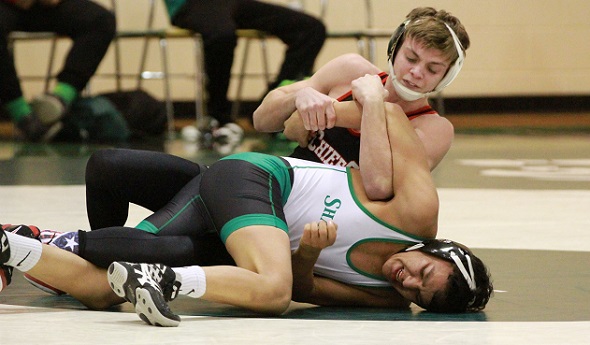
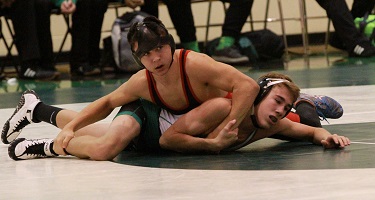
Ranked No. 3 at 130 pounds, sophomore Kyle Black is 22-2 on the year and eyeing a return trip to the MHSAA Finals. He’ll likely drop down to 125 to do so. Classmate Evan Atherton is ranked No. 10 at 130 but has since moved to 125.
“It makes us feel good,” Atherton, who is 20-3, said of the high praise from Sosinski, “because they used to talk about how there used to only be three kids on the team. “I’m pretty excited about it. It pushes me harder.”
Junior Nate Weber is 21-4 and ranked No. 6 at 135. He, too, will probably move down a class by the end of the year in order to try to get back to the Palace of Auburn Hills. Meanwhile, senior Hunter Rummler, ranked No. 7 at 171, just eclipsed the 100-victory mark for his career over the weekend and is pushing toward his first Individual Finals appearance.
 Especially for the young men in the lower weights, stiffer competition is rarely found outside their own practices this year.
“We do a lot of live wrestling in the room, and it sure helps to have those guys around with all the variety it brings,” Weber said. “Me, Evan and Kyle all wrestle different styles. We see all these different techniques, and it sets us up to wrestle all these other teams.”
Black had just one word to describe practice sessions: “Intense.”
The other word that came up frequently was inspiration. The source? Sosinski.
“I would never have guessed that is the answer they would have given,” Sosinski said with a laugh. “As a wrestler myself and growing up in the sport, when people get beat, either as an individual or a team, I know how that feels. They beat themselves up and are upset. Me being upset with them or screaming and yelling at them doesn’t make them feel any better.
“I believe it probably makes them feel worse and can have a negative effect. My goal is to help them reach their goals. I’m happiest when I see them reach their goals and their potential. If being more soft-spoken and more of a fatherly type figure and voice does that, and it has worked so far, that’s what I’ll continue to do.”
With only two seniors on the varsity roster, the Chiefs are undefeated in the Berrien-Cass-St. Joseph Conference. Rummler, who said reaching the century mark “hasn’t really hit me yet,” knows the strength of the team is in the lower and middle weights, which includes stalwarts Hunter Jourdan, Sebastian Castro and Carlos Castro, and feels a responsibility to hold up his end of the bargain.
For Rummler, a gifted running back and sprinter, most of the battle is mental — a fight he admits struggling with last season. Sosinski believes the senior is primed for a noteworthy finish to his career.
“He is confident,” Sosinski said. “I believe he has high goals and expectations of himself. He is confident he will meet those goals. Sometimes you need that swag, I guess. If I had to take a guess at (what’s different this year), just from knowing him for four years, it’s just his mentality.”
The same can be said for the rest of the wrestlers on the team, many of whom have sacrificed for the betterment of the squad.
“They want to be good as a team, and that’s first and foremost,” Sosinski said. “They have their own individual goals in their head, but they’re finding a way to do both.”
 Wes Morgan has reported for the Kalamazoo Gazette, ESPN and ESPNChicago.com, 247Sports and Blue & Gold Illustrated over the last 12 years and is the publisher of JoeInsider.com. He can be reached at [email protected] with story ideas for Berrien, Cass, St. Joseph and Branch counties.
PHOTOS: (Top) White Pigeon’s Kyle Black works to gain control during a match against Berrien Springs. (Middle) Evan Atherton, here working from the top, also powers the Chiefs’ strong lower weights. (Photos courtesy of Wes Morgan.)
D3 Preview: List of Favorites Grows
February 19, 2014
By Geoff Kimmerly
Second Half editor
Dundee returned as champion in Division 3 in 2013 after four runner-up finishes over the previous five seasons. And Richmond, last season’s runner-up after three straight titles, would love to regain the top spot again this weekend.
But it’s no guarantee those two will meet in the championship match for the fourth time in five years. A possible crasher is Allegan, Division 2 Quarterfinalist the last four years and Semifinalist three of those four, back in Division 3 for the first time since making those semis in 2009.
Below is a look at all eight teams competing in Division 3, listed by seed. Their Quarterfinal matches begin at 7:45 p.m. Friday, with Semifinals at 11:45 Saturday morning and the championship match at 4 p.m. All matches this weekend will be streamed live on a subscription basis on MHSAA.TV. For results throughout, check the MHSAA Wrestling page. Rankings below are from MichiganGrappler.com.
#1 DUNDEE
Record/rank: 22-2, No. 1
League finish: First in Lenawee County Athletic Association
Coach: Tim Roberts, 15th season (411-55-1)
Championship history: Seven MHSAA championships (most recent 2013), five runner-up finishes.
Individual Finals qualifiers: 103 Drew Mandell (30-16) soph., 112 Kenny Reinhart (31-9) jr., 125 Zach Blevins (40-8) soph., 130 Brendan O’Connor (42-2) sr., 135 Sean Sterling (33-7) fr., 140 Brad Scholl (20-8) sr., 140 Doug Rojem (41-5) sr., 145 Sean Marogen (22-7) sr., Donny Mandell (35-11) jr., 171 Tye Thompson (37-6) jr., 189 Teddy Warren (19-3) sr.
Outlook: Dundee is back for its 12th straight appearance at Kellogg. Rojem and Warren are reigning individual champions and lead a lineup returning eight from last season’s 35-26 championship match win over Richmond. No postseason opponents, including No. 6 Manchester, have scored double-digit points against the Vikings.
#2 ALLEGAN
Record/rank: 33-2, No. 3
League finish: First in Wolverine Conference
Coach: Murray Rose, 27th season (688-144-2)
Championship history: Two MHSAA championships (most recent 2007 in Division 2), two runner-up finishes.
Individual Finals qualifiers: 112 Liam Noble (39-12) sr., 125 Foster Karmon (52-2) soph., 130 Zane Corey (41-2) sr., 135 PJ Cole (37-8) jr., 145 Kyle Simaz (55-1) sr., 160 Chase Beard (50-7) fr., 171 Levi Sabin (47-8) soph., 189 Austin Farrell (29-11) soph., 215 Jonah Pfau (42-13) sr.
Outlook: Allegan frequently has been a Division 2 power and made last season’s Semifinals in that division. The Tigers have been up to the new competition, giving up a total of nine points in four playoff matches with three shutouts. Simaz has wrestled in three individual championship matches and won the 140 weight at Division 2 in 2013. He’s one of only four senior starters and joins Zane Corey with only one loss this winter.
#3 RICHMOND
Record/rank: 21-4, No. 2
League finish: First in Blue Water Area Conference
Coach: Brandon Day, 10th season (327-68)
Championship history: Six MHSAA championships (most recent 2012), four runner-up finishes.
Individual Finals qualifiers: 103 Connor Behem (24-7) jr., 112 Aaron Kilburn (32-5) soph., 135 Austin Vannatter (29-10) jr., 140 Nick Burg (32-4) sr., 145 Jake Van Scoter (28-12) sr., 152 Devin Skatzka (31-3) jr., 160 Austin Pawlak (23-8) jr., 189 Jake McKiernan (29-5) sr., 285 Adam Boyd (27-11) jr.
Outlook: Richmond made its fourth straight MHSAA Final in 2013 but fell for the first time in a championship match since 2007. Eight starters from that loss to Dundee are expected to start again this weekend, with Skatzka a reigning individual champion and Burg a runner-up last winter. The lineup is deep with three subs winning more than 20 matches this season including freshman 103 Roy Costello (38-9).
#4 SAGINAW SWAN VALLEY
Record/rank: 40-1, No. 7
League finish: First in Tri-Valley Conference Central
Coach: Darrell Burchfield, 12th season (373-70)
Championship history: Has never finished among the top two teams in Finals competition.
Individual Finals qualifiers: 103 Edwin Hernandez (41-8) soph., 112 K.J. Suitor (47-2) soph., 119 Jose Hernandez (29-7) jr., 125 Matt Santos (52-0) soph.; 135 Collin Dole (48-3) jr., 140 Josh Flores (51-5) sr., 145 Sam McLean (54-2) jr., 160 Brody Noykos (33-11) sr., 171 James Dwenger (39-14) sr.
Outlook: Swan Valley is back in the Quarterfinals for the first time since 2010, when it finished a three-year Semifinal run. To get back, the Vikings needed to beat No. 10 Caro and did so by 14 in the Regional Final. Santos was an Individual Finals runner-up last season, and Suitor and Flores also placed. All but one starter from 103-145 has won at least 42 matches this winter, and three from that group have won at least 50.
#5 GRAND RAPIDS CATHOLIC CENTRAL
Record/rank: 14-0, No. 4
League finish: First in O-K Gold
Coach: B.J. Schroder, third season (54-12).
Championship history: Has never finished among the top two teams in Finals competition.
Individual Finals qualifiers: 112 Domenic Ciucci (22-14) sr., 119 Devin Schroder (36-3) soph., 125 Dan Sayfie (32-10) sr., 125 Kole Krauss (32-4) soph., 135 Nate Limmex (19-0) jr., 135 Dominic Forbes (17-9) soph., 152 Jared Tennihill (14-13) jr., 171 A.J. Zervoudakis (27-10) sr., 189 Grant Tennihill (35-6) jr., 215 Danny Drummond (28-9) sr., 285 Ross Hulick (23-13) sr.
Outlook: A group led by six senior starters won the program’s first Regional championship by a point over Allendale and also beat last season Quarterfinalist Belding along the way. Limmex is a reigning individual champion and hasn’t lost a match in two seasons, while Devin Schroder also is a reigning champion and Krauss was a placer in 2013. B.J. Schroder has 308 coaching wins overall having previously led Grand Rapids Northview.
#6 REMUS CHIPPEWA HILLS
Record/rank: 25-4, No. 8
League finish: Second in Central State Activities Association
Coach: Nate Ethridge, 14h season (406-84)
Championship history: Has never finished among the top two teams in Finals competition.
Individual Finals qualifiers: 103 Richie Ostrander (22-6) sr., 103 Keaton Zuern (30-12) fr., 112 Zach King (44-4) sr., 119 Mike Felix (40-11) jr., 125 Austin Spedowski (32-20) fr., 130 Todd Slade (35-12) soph., 145 Kevin Briscoe (34-13) jr., 145 Mason Dey (33-16) jr.
Outlook: Chippewa Hills has become a regular at the Quarterfinals with seven appearances in nine seasons, and it just missed upsetting Birch Run to advance to last year’s Semifinals. King is the only returning Finals individual placer from last season, but also one of only three seniors in the expected starting lineup for the weekend. Eight starters have at least 30 wins this winter, and Zuern is a strong fill-in who will join senior Ostrander in next weekend’s individual field.
#7 MASON COUNTY CENTRAL
Record/rank: 33-3, unranked
League finish: Third in the West Michigan Conference
Coach: Jim Allen, sixth season (99-71)
Championship history: Class C runner-up 1979.
Individual Finals qualifiers: 125 Trever Skinner (46-2) sr., 130 Jacob Shoop (37-6) fr., 140 Logan Merrick (47-5) soph., 145 Jordan Steiger (37-9) jr., 152 Spencer Knizacky (44-9) soph, 189 Josh Quinn (48-2) jr., 285 Doug Wyman (47-3) sr.
Outlook: The Spartans have been building toward this during six seasons under Allen, finishing 6-15 in 2008-09 before increasing their winning percentage every season under his guidance. They’ve beaten their first four playoff foes by an average of 33 points and are seeking their first Semifinal berth since 2004. Mason County Central also hasn’t had an individual champion since 1986, but looks to have a nice chance at breaking that streak as well before the end of this winter.
#8 LAKE FENTON
Record/rank: 33-5, No. 9
League finish: Second in Genesee Area Conference
Coach: Vance Corcoran, fourth season (124-35)
Championship history: Division 3 runner-up 2011.
Individual Finals qualifiers: 119 Jared Corcoran (48-9) sr., 130 John Barry (46-7) sr., 152 Cody Sanders (36-9) sr., 160 Carson Whaley (49-6) sr., 171 Trent Hillger (53-5) fr., 171 Andy Donoho (48-6) sr., 215 Chase Hull (28-3) sr.
Outlook: Lake Fenton has won District titles all four seasons under Vance Corcoran after reaching the championship match in his first as head coach. The Blue Devils finished behind only Division 4 second-seeded New Lothrop in the GAC this season. Jared Corcoran is a returning Individual Finals placer and helps key a lineup with six seniors, but also six freshmen. Hillger is one of three freshmen with at least 38 wins.
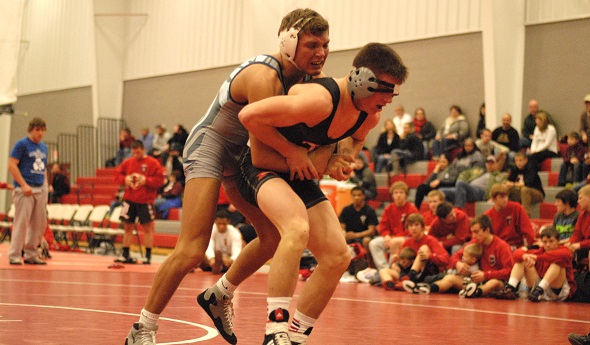
PHOTO: Richmond’s Devin Skatzka works against a Lowell opponent during a match this season at Olivet College. (Click to see more at HighSchoolSportsScene.com.)