


Wrestling’s Next Big Thing
August 13, 2013
“The next big thing” is what marketers often seek. But it’s what school sports administrators usually dread because the “next big thing” is routinely a problem.
And so it is with the sport of wrestling which, at the high school level, has had an admirable record of solving the big issues that have threatened the sport’s existence.
School-based wrestling addressed unhealthy practices for weight loss, first with rules about what could not be done – e.g., rubber suits were banned from practices – and then with rules about what must be done, including a weight management program.
Twenty years ago, MHSAA member schools became one of the early adopters of policies and procedures that include the training of skinfold assessors who are employed to do measurements of all wrestlers, from which each wrestler learns his/her lowest allowed weight and the rate at which he/she may descend to that weight and still remain eligible to compete. These rules, and a nutrition education program, saved interscholastic wrestling from much public criticism and, possibly, from continuing drops in participation.
In addition, the Wrestling Committee has been unique among MHSAA sport committees in recognizing that a season that is too long is neither healthy for nor desired by student-athletes; and the committee has reduced the length of season and number of matches. All of this, combined with the MHSAA team tournament, have greatly increased the sport’s popularity among both participants and spectators.
But in spite of all this, the sport of wrestling is “one communicable skin disease outbreak from extinction,” according to those discussing the state of high school wrestling at a national meeting in June. We’ve already seen an outbreak lead to the suspension of all interscholastic wrestling for two weeks in Minnesota during the 2006-07 school year.
To avoid this next big thing, the rule makers have banned taped headgear, because tape can’t be properly cleaned. The NFHS Sports Medicine Advisory Committee, which is the MHSAA’s advisory body as well, is urging schools to mandate that all participants shower or perform an antiseptic wipe-down after every match.
The MHSAA will make this issue a point of special emphasis in its online, print and face-to-face communications this fall. In addition, an excellent free webinar is provided by the National Wrestling Coaches Association. Click here for the webinar.
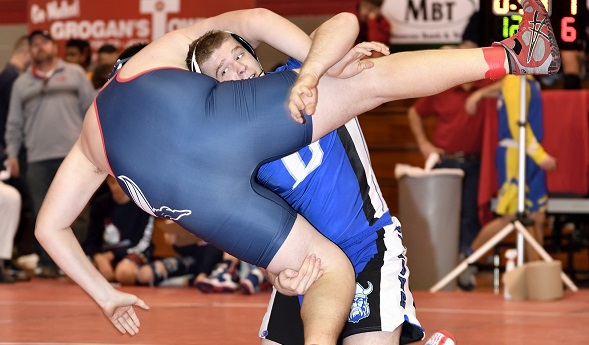
Performance: Dundee's Brandon Whitman
January 26, 2018
 Brandon Whitman
Dundee senior – Wrestling
Whitman is fast approaching an opportunity to join one of the elite groups of achievers in any sport in MHSAA history. With a chance at becoming the 23rd four-time individual wrestling champion a little more than a month away, Whitman continued his undefeated run of this season by winning the Most Valuable Performer at the upper weights at last weekend’s Hudson Super 16 – earning this week’s Michigan Army National Guard “Performance of the Week.”
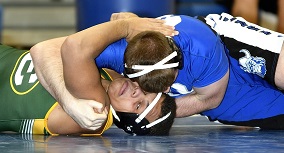
Whitman, wrestling last weekend and mostly this season at 215 pounds, and occasionally as a heavyweight, is 27-0 this season and 180-3 over his high school career. He is ranked No. 3 nationally at 220 pounds by InterMat, with MHSAA Division 3 championships the last two seasons at 189 pounds and a win at 171 as a freshman. His most impressive victories this winter arguably are against Cody Howard of Lakewood St. Edward (Ohio), a nationally-ranked 195-pounder headed for Virginia Tech, and twice over Temperance Bedford heavyweight Austin Emerson, another nationally-ranked foe who will continue next season at Eastern Michigan University. Whitman also earned the 100th pin of his high school career in Wednesday’s dual meet win over Hudson.
 Dundee as a team is ranked No. 1 in Division 3 this season and competing for its fourth MHSAA title in six seasons after finishing runner-up at last year’s Final on a tie-breaker in the championship match. Whitman will continue his academic and wrestling careers at the University of North Carolina. He carries a 3.9 grade-point average and intends to study physical therapy.
Coach Tim Roberts said: “It isn't about him. It's about all of us. He's doing his best to get better, and his ego has never gotten in the way of his success. He’s endlessly getting better, (asking) ‘how can I learn more about this sport and get better?’ I feel lucky; I’ve been able to coach a lot of great people, and he ranks as one of best people inside and outside of it. … Watching him come out of his shell more, how he treats other people, it’s great. As a freshman he was really good, obviously; he’s even better now. Even yesterday, he was asking questions trying to get better. It’s very impressive, how he handles himself. I’m just really happy I’ve had the opportunity to have this four years with him.”
Performance Point: “It’s been fun. I’ve been trying to get the best matches I could get so I can see what areas I need to improve on. … One of the big things with Emerson is I learned that I need to relax a little bit more. In some of those bigger matches, I tend to go out and try to sprint pretty much the whole match – and I get tired towards the end because the body’s not really meant to sprint for that long. The first time I wrestled him, I went out there and I got a takedown right away, took out a lot of energy. The second time I was a lot more relaxed. I picked and chose where I went and made my attacks, and it worked out a lot better. I ended up beating him 8-1 instead of 3-2, and I felt like I competed and I was able to go a lot longer than I usually am.”
On the verge of history: “It’s nice. It’s cool. But the ultimate goal is to just to keep getting better and better, and improving where you need to improve. Being the best that you can be. It will set goals for other kids coming up to try to work towards that and try to beat my records. That’s kinda cool.”
 Humility counts: “(It’s) just the way I’d say my parents raised me. Nobody really likes when kids are cocky. They like a humble person who can compete at high levels but they are nice to people and can carry themselves well, and that’s how I’ve been raised.”
In this together: “This year I feel we’re having a lot more fun. We’re going out there and scoring points, and competing a lot harder than I think previous years too. Doing it for a cause greater than yourself, I think that’s helped a lot too. Because if you’re doing it for yourself, you can get nervous. But if you’re doing it for your team and for your friends, that can help take some of the pressure off.”
Ready to help: “I want to go into physical therapy. My brother’s been in physical therapy quite a few times. I’ve been in it quite a few times now. It’s interesting, and I want to being able to help other sports people, or anyone be able to recover as fast as they can to get them back doing what they do.”
- Geoff Kimmerly, Second Half editor
Every week during the 2017-18 school year, Second Half and the Michigan Army National Guard will recognize a “Performance of the Week" from among the MHSAA's 750 member high schools.
The Michigan Army National Guard provides trained and ready forces in support of the National Military Strategy, and responds as needed to state, local, and regional emergencies to ensure peace, order, and public safety. The Guard adds value to our communities through continuous interaction. National Guard soldiers are part of the local community. Guardsmen typically train one weekend per month and two weeks in the summer. This training maintains readiness when needed, be it either to defend our nation's freedom or protect lives and property of Michigan citizens during a local natural disaster.
Previous 2017-18 honorees:
January 18: Derek Maas, Holland West Ottawa swimming - Read
January 11: Lexi Niepoth, Bellaire basketball - Read
November 30: La'Darius Jefferson, Muskegon football - Read
November 23: Ashley Turak, Farmington Hills Harrison swimming - Read
November 16: Bryce Veasley, West Bloomfield football - Read
November 9: Jose Penaloza, Holland soccer - Read
November 2: Karenna Duffey, Macomb L'Anse Creuse North cross country - Read
October 26: Anika Dy, Traverse City Central golf - Read
October 19: Andrew Zhang, Bloomfield Hills tennis - Read
October 12: Nolan Fugate, Grand Rapids Catholic Central football - Read
October 5: Marissa Ackerman, Munising tennis - Read
September 28: Minh Le, Portage Central soccer - Read
September 21: Olivia Theis, Lansing Catholic cross country - Read
September 14: Maddy Chinn, Pontiac Notre Dame Prep volleyball - Read
PHOTOS: (Top) Dundee's Brandon Whitman scores a takedown during the Temperance Bedford Tournament this season. (Middle) Whitman pins Lakewood St. Edward's Cody Howard during the Detroit Catholic Central Super Duals. (Photos courtesy of Dundee wrestling.)