


Did you see that? (9/10-9/16)
September 18, 2012
One of the state's premier regular-season cross country events plus some big-time volleyball in the Upper Peninsula highlight the non-football highlights from the week that was Sept. 10-16.
(Click for the Drive for Detroit football report.)
Cross country
Elite meet at MSU: The Spartan Invitational, run at Michigan State's Forest Akers East Golf Course, is arguably the most competitive regular season event in this sport and draws a number of top teams from all over the state for a series of races. Champions on Friday were the Waterford Mott boys and Grosse Pointe South girls in the Elite races, the Ithaca boys and North Muskegon girls in the White division, the Haslett boys and the Spring Lake girls in the Bronze division, and Bloomfield Hills Lahser boys and Jenison girls in the Green division. Click the "Playmakers" link for results and the others for coverage. (Playmakers.com) (Grand Haven Tribune) (Lansing State Journal)
Volleyball
Capital of UP volleyball: Calumet, ranked fourth in Class C this week. defended its title at the Articatz Invitational Autumn Classic in Marquette by winning all 12 of its games. The field also included Marquette, Houghton and Escanaba among others. (Marquette Mining Journal)
Trojans at home above the net: More of the Upper Peninsula's top teams met nearer the Wisconsin border. Crystal Falls Forest Park, ranked No. 6 in Class D, defended its home tournament title with a 2-1 win over No. 10 Lake Linden-Hubbell in the final. (Iron Mountain Daily News)
Golf
Lakeview owns Battle Creek: Lakeview continues to rank among the state's best teams in Division 2, at No. 3 this week. And there's no question it's the best in Battle Creek, as evidenced by a sixth-straight All-City championship won with a score of 176 -- 45 strokes better than runner-up Harper Creek. (Battle Creek Enquirer)
Recognition
Clawson names Judy Hacker Field: Hacker, who died in 2011, was a pioneer of girls sports in the southeastern corner of the state during her time at the school from 1963-95. She coached basketball, volleyball, softball, track and field and field hockey at the school. The school dedicated its softball diamond in her name Saturday. (Oakland Press)
Bay City John Glenn focused on Fun with Goals Accomplished, Legacy Secure
By
Paul Costanzo
Special for MHSAA.com
October 16, 2024
JT Breen and his Bay City John Glenn tennis teammates already have achieved all the goals they set for themselves this season.
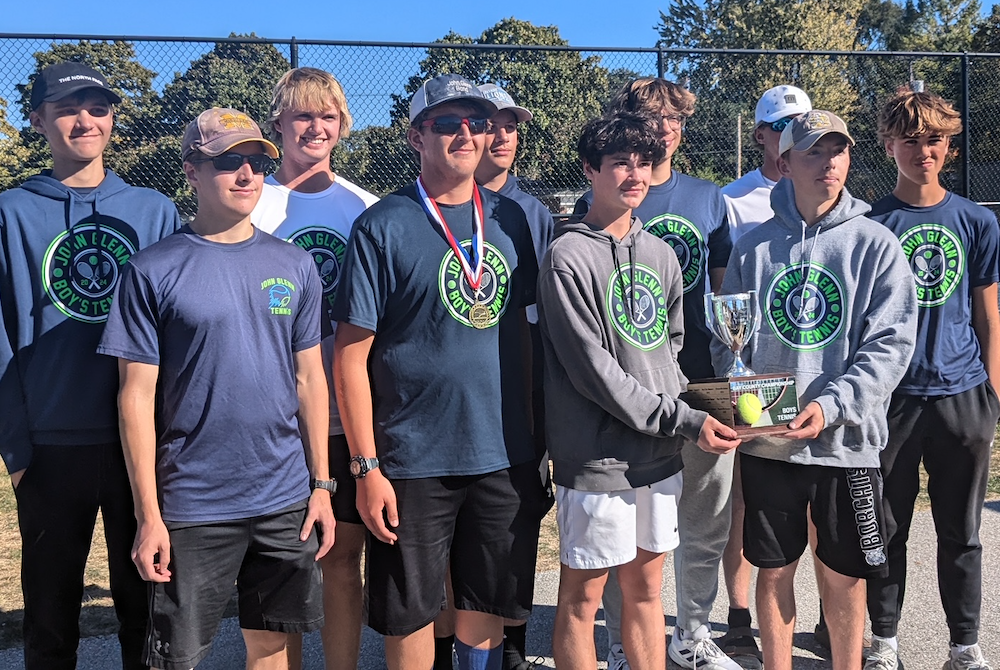
 The Bobcats won the Tri-Valley Conference title. They won the Bay County title. They even accomplished the goal that seemed most far-fetched at the time: Becoming the first John Glenn boys tennis team to qualify for the MHSAA Finals – they made the Lower Peninsula Division 3 field that will play Friday and Saturday at Bloomfield Hills Cranbrook Kingswood.
So now what?
“The goal for me (this weekend) is to play as many games as I can and have fun playing those games,” said Breen, a senior who plays No. 2 singles for John Glenn. “The legacy I want to leave is helping everyone know that the gift of playing tennis is a gift in and of itself. Having fun is the most important part of the game, and I think that’s something I’ve tried to cement into the younger players.”
John Glenn has had plenty of fun in what coach Kevin Miller called a “season dreams are made of,” and no matter the results at Cranbrook, that’s going to continue.
Not because the Bobcats don’t care about winning. But because having fun with one another on and off the court is just what they do.
“We just want to go out there and end our senior year for tennis on a good note,” said senior Nick Naylor, who plays No. 3 doubles with senior Will Gallagher. “We want to have fun with it, and not worry much about what happens. Honestly, I want to win, but it’s just amazing that we got here.”
Led by six seniors, John Glenn placed third at their Regional, also held at Cranbrook, to qualify for the Finals. Miller admitted he wasn’t sure if that would be enough to get his team to championship weekend, and the Bobcats left the tennis courts that day unsure. They had finished with 13 points, behind champion Cranbrook and Goodrich, and two points ahead of Auburn Hills Avondale, St. Clair and Clio.
It wasn’t until Lee Thompson of MLive contacted Miller for an interview later that night that he became aware. And for some Bobcats, it wasn’t until that story published that they knew.
 “Our captain (Breen) said something about it in the middle of the season, and we kind of looked at him like, ‘Yeah right, keep dreaming,’” senior No. 4 singles player Lance Neigh said. “In the middle of the season, I didn’t think we were going to get there. Even now, it’s kind of surreal.”
Neigh joined the program as a sophomore, while four of his classmates – Breen, Owen LaCourt (No. 3 singles), Collin Meyer (No. 2 doubles) and Will Gallagher (No. 3 doubles) – are in their fourth year.
Senior number six, Nick Naylor, is in his first season and playing No. 3 doubles along with Gallagher. A three-year varsity baseball player, Naylor said he hadn’t picked up a racket in nearly five years before Gallagher convinced him to play. He’s taken to the game quickly, though, and he and Gallagher advanced to the Regional Final. While Miller and Breen marveled at Naylor’s ability to translate his baseball experience and athleticism to tennis, Naylor added that the chemistry he and Gallagher have from years of friendship also played a big role.
“We’re not afraid to call each other out or bring each other up,” he said. “We’re not afraid to talk to each other. We can have a good conversation when we’re down and get back up and forget about it.”
Sophomore Thomas Dwan is at No. 1 singles for the Bobcats, while junior David Ferrio and freshman Jack Pfifer are at No. 1 doubles. Sophomore Patrick Dwan plays No. 2 doubles with Meyer, and the No. 4 doubles team is made up of junior Dylan Werner and sophomore Corbin Sanborn.
So, while half the team will move on after this season, the well is far from dry for the Bobcats. Add in a group of 45 middle school players who have been practicing under the direction of Miller and several of his boys and girls varsity players, and the future is actually pretty bright.
“Honestly, I think it’s pretty inspiring,” Meyer said. “When I came in freshman year, we barely had enough for a varsity team. There’s so many people interested in playing tennis right now, I think it’s amazing. I’m happy to be able to help out and give them what I know.”
Their goals are accomplished, and they’re helping build the future of the program. You can see why this weekend, the Bobcats aren’t focused on results, but on enjoying every point they get to play.
“There’s not many more accolades these guys can do,” Miller said. “We’re going to go to states and do the best we can. But they’ve already left their legacy.”
 Paul Costanzo served as a sportswriter at The Port Huron Times Herald from 2006-15, including three years as lead sportswriter, and prior to that as sports editor at the Hillsdale Daily News from 2005-06. He can be reached at [email protected] with story ideas for Genesee, Lapeer, St. Clair, Sanilac, Huron, Tuscola, Saginaw, Bay, Arenac, Midland and Gladwin counties.
PHOTOS (Top) The Bay City John Glenn boys tennis team shows off its newly-won Bay County championship trophy this season. (Middle) Seniors Nick Naylor and Will Gallagher have teamed up to form a Regional runner-up pair at No. 3 doubles. (Photos courtesy of the Bay City John Glenn boys tennis program.)