

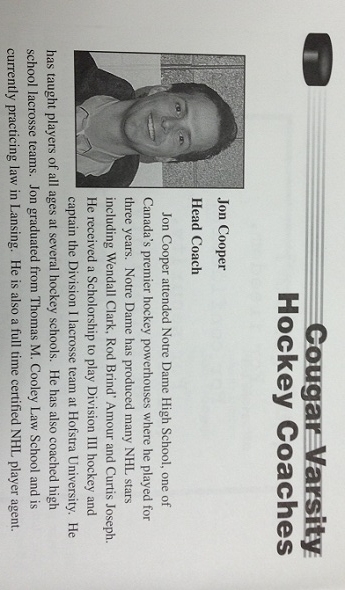
Former MHSAA Coach Lands in NHL
By
Geoff Kimmerly
MHSAA.com senior editor
April 5, 2013
This week in the year 2000, Jon Cooper had just finished his first season coaching at any level, having guided the Lansing Catholic hockey team to its first Regional championship in 25 seasons.
 It would be the only season Cooper – a local lawyer and former player at Hofstra – would coach the Cougars. But it also was the start of a nearly unimaginable rise that saw him hired to coach the NHL’s Tampa Bay Lightning two weeks ago.
As the saying goes, it couldn't have happened to a nicer guy. Cooper always was friendly and helpful to this then just-starting local media member, and despite his lone season coaching the Cougars quickly built a local fan base that continues to cheer him on from afar.
An NHL.com piece last week led with the high school angle. Click here to check it out. He took over a team 16-18-2 and near the bottom of the Eastern Conference, but Cooper surely will have plenty rooting him on from the MHSAA hockey ranks as he works to bring the franchise back to the playoffs – and we’ll work to catch up with him this summer during his first NHL offseason.
Grand Haven athletics 'Exemplary'
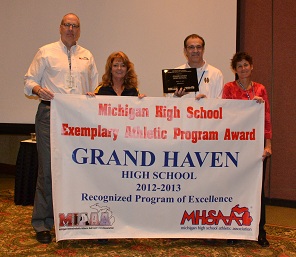 The Grand Haven High School athletic department received this year’s Exemplary Athletic Program Award from the Michigan Interscholastic Athletic Administrators Association during its annual conference last month in Traverse City.
The program was established in 1998 to recognize outstanding athletic programs and give high school administrators a vehicle by which to self-assess their practices and measure improvements.
Characteristics of “exemplary” programs include district-wide commitment, excellence in advancing the growth of well-rounded participants and serving the needs of all involved including parents and staff, and sustained success in teaching the values of high school athletics.
Click for more details on award criteria and a list of previous winners, and additional coverage by Grand Rapids’ WZZM.
Volleyball teams 'dug' deep
Michigan high school volleyball teams playing "Dig Pink" matches combined to raise more than $50,500 for cancer research last fall to rank sixth nationally, according to the Side-Out Foundation, a non-profit organization that heads up the “Dig Pink” initiative.
Class D Engadine raised the most among MHSAA schools – $5,200 – with Kent City, Bronson, Grand Ledge, Allendale, Stevensville Lakeshore, Monroe, Waterford Mott, Coldwater and Grand Blanc also contributing to the grand total. Also, Grand Ledge’s Katie Everts received a Side-Out Ambassador Program award, one of 10 handed out to individuals nationally.
Total, more than $1.1 million was raised nationwide.
Name that trophy
 Few if any schools in Michigan have done more work in researching and identifying the trophies in its case than Orchard Lake St. Mary’s, which will celebrate its 100th season of boys basketball in 2013-14.
It's rare the Eaglets historians can’t determine what a trophy celebrated. In this case, hopefully you can help.
We believe it’s a basketball trophy from the 1930s – but haven’t been able to pin down a season or a level of the MHSAA tournament. A few things that make this one unique are the plaque presentation, as opposed to a standard trophy, and the large MHSAA seal in the center. Any ideas? Email me at [email protected].
Giving back to those who gave
Those from the U.S. 23/I-94 area surely remember the tornado that tore through Dexter a little more than a year ago, on March 15, 2012.
Dexter track coaches Bob and Katie Jazwinski are remembering those who helped them rebuild after their home was destroyed by the storm.
In a Second Half report last year, Bob Jazwinski said he’d seen athletes and coaches from Adrian, Ann Arbor Pioneer, Pinckney, Chelsea, Ann Arbor Skyline, Whitmore Lake and the USA junior hockey team among the many who flocked to the community to lend a hand in the cleanup.
The Jazwinskis began repaying the favor three weeks ago on the storm's one-year anniversary with the Dexter F 3.1 Tornado Run/Walk that benefited non-profit organizations that had donated for storm recovery the year before.
Click to read the March 30, 2012 story about Adrian athletes’ contributions to the clean-up.
Last call for basketball
We got off to a late start on entering basketball schedules for this winter – but thanks to some incredibly helpful school, official and fan inputters, we were able to catch up quickly and finish with a nearly-complete list of results and standings for this season.
Still, there are some schools with incomplete schedules or a few scores missing. And before everyone forgets completely about this season, we’re hoping for a little help in finishing this enormous task.
Please check out your team’s page on MHSAA.com and help us fill in missing scores and fix inaccuracies. The latter could include just about anything – an incorrect game date, incorrect opponent or score, team missing from league standings, etc. For corrections, please email me directly at [email protected]. (Note: If a game was cancelled, don’t just delete it – contact me and I’ll add “cancelled” to avoid confusion.)
Why is this important? Two big reasons. First, MHSAA.com publishes the most complete statewide scoreboard with results from every corner of Michigan. And we have the most complete archive of basketball seasons available, currently dating to 2009-10. Help us fill in the blanks, and they’ll be saved for everyone’s benefit for years to come.
I thank you in advance for any help you are able to provide.
PHOTOS: (Top) Jon Cooper's bio appeared in the Lansing Catholic hockey team's yearbook for the 1999-2000 season. (Middle) Grand Haven athletic director Robin Bye (second from right) poses with Gull Lake athletic director and MIAAA Exemplary Committee co-char Marc Troop, Grand Haven athletic secretary Rita Way and Ann Arbor Greenhills athletic director and MIAAA Exemplary Committee co-chair Meg Seng after the Buccaneers received this year's award. (Bottom) Orchard Lake St. Mary's is hoping to identify the championship recognized by this trophy, believed to be from the 1930s.

Today in the MHSAA: 10/19/26
By
Geoff Kimmerly
MHSAA.com senior editor
October 19, 2026
2. GIRLS GOLF Grand Rapids Forest Hills Central and Bath won their first Finals championships, Grand Rapids NorthPointe Christian won its second straight but in a new division, and Northville ran its Division 1 winning streak to three as Lower Peninsula titles were awarded at four sites – MHSAA.com
2. BOYS TENNIS Detroit Country Day edged Bloomfield Hills Cranbrook Kingswood by a point for the Lower Peninsula Division 3 title after finishing a point back of Cranbrook in 2025 – MHSAA.com
3. GIRLS VOLLEYBALL Division 1 No. 4 Byron Center won the 32-team Beast of the East Tournament, finishing 5-1 on the day and defeating four ranked opponents – MHSAA.com
4. CROSS COUNTRY The LPD2 No. 6 DeWitt girls and LPD1 No. 10 Grand Ledge boys won Greater Lansing Invitational championships – Lansing State Journal Girls | Boys
5. GIRLS VOLLEYBALL Division 3 No. 5 Muskegon Western Michigan Christian locked up the Greater Muskegon Athletic Association Tournament title with a five-set win over Muskegon Mona Shores – Local Sports Journal
6. CROSS COUNTRY Romeo’s girls and boys teams continued their area dominance with Macomb County championships – Macomb Daily
7. GIRLS VOLLEYBALL Division 3 No. 1 Saginaw Valley Lutheran defeated Cadillac in three sets to win the M3 Mayhem – Cadillac News
8. CROSS COUNTRY The Harbor Springs girls and LPD3 No. 7 Charlevoix boys secured Northern Shores Conference championships – Athletic.net
9. CROSS COUNTRY The Fruitport girls and Western Michigan Christian boys won GMAA titles – Athletic.net
10. CROSS COUNTRY Adrian swept girls and boys Lenawee County championships; Adrian’s girls are No. 10 in LPD2, and the boys are ranked No. 13 – Athletic.net