

Former MHSAA Coach Lands in NHL
By
Geoff Kimmerly
MHSAA.com senior editor
April 5, 2013
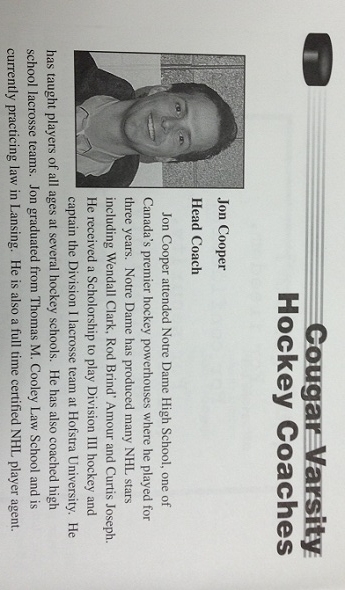
This week in the year 2000, Jon Cooper had just finished his first season coaching at any level, having guided the Lansing Catholic hockey team to its first Regional championship in 25 seasons.
 It would be the only season Cooper – a local lawyer and former player at Hofstra – would coach the Cougars. But it also was the start of a nearly unimaginable rise that saw him hired to coach the NHL’s Tampa Bay Lightning two weeks ago.
As the saying goes, it couldn't have happened to a nicer guy. Cooper always was friendly and helpful to this then just-starting local media member, and despite his lone season coaching the Cougars quickly built a local fan base that continues to cheer him on from afar.
An NHL.com piece last week led with the high school angle. Click here to check it out. He took over a team 16-18-2 and near the bottom of the Eastern Conference, but Cooper surely will have plenty rooting him on from the MHSAA hockey ranks as he works to bring the franchise back to the playoffs – and we’ll work to catch up with him this summer during his first NHL offseason.
Grand Haven athletics 'Exemplary'
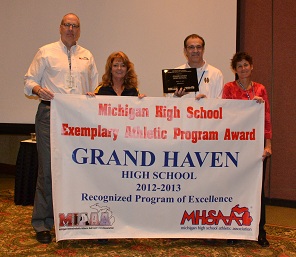 The Grand Haven High School athletic department received this year’s Exemplary Athletic Program Award from the Michigan Interscholastic Athletic Administrators Association during its annual conference last month in Traverse City.
The program was established in 1998 to recognize outstanding athletic programs and give high school administrators a vehicle by which to self-assess their practices and measure improvements.
Characteristics of “exemplary” programs include district-wide commitment, excellence in advancing the growth of well-rounded participants and serving the needs of all involved including parents and staff, and sustained success in teaching the values of high school athletics.
Click for more details on award criteria and a list of previous winners, and additional coverage by Grand Rapids’ WZZM.
Volleyball teams 'dug' deep
Michigan high school volleyball teams playing "Dig Pink" matches combined to raise more than $50,500 for cancer research last fall to rank sixth nationally, according to the Side-Out Foundation, a non-profit organization that heads up the “Dig Pink” initiative.
Class D Engadine raised the most among MHSAA schools – $5,200 – with Kent City, Bronson, Grand Ledge, Allendale, Stevensville Lakeshore, Monroe, Waterford Mott, Coldwater and Grand Blanc also contributing to the grand total. Also, Grand Ledge’s Katie Everts received a Side-Out Ambassador Program award, one of 10 handed out to individuals nationally.
Total, more than $1.1 million was raised nationwide.
Name that trophy
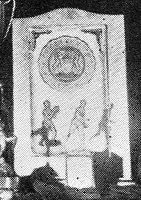 Few if any schools in Michigan have done more work in researching and identifying the trophies in its case than Orchard Lake St. Mary’s, which will celebrate its 100th season of boys basketball in 2013-14.
It's rare the Eaglets historians can’t determine what a trophy celebrated. In this case, hopefully you can help.
We believe it’s a basketball trophy from the 1930s – but haven’t been able to pin down a season or a level of the MHSAA tournament. A few things that make this one unique are the plaque presentation, as opposed to a standard trophy, and the large MHSAA seal in the center. Any ideas? Email me at [email protected].
Giving back to those who gave
Those from the U.S. 23/I-94 area surely remember the tornado that tore through Dexter a little more than a year ago, on March 15, 2012.
Dexter track coaches Bob and Katie Jazwinski are remembering those who helped them rebuild after their home was destroyed by the storm.
In a Second Half report last year, Bob Jazwinski said he’d seen athletes and coaches from Adrian, Ann Arbor Pioneer, Pinckney, Chelsea, Ann Arbor Skyline, Whitmore Lake and the USA junior hockey team among the many who flocked to the community to lend a hand in the cleanup.
The Jazwinskis began repaying the favor three weeks ago on the storm's one-year anniversary with the Dexter F 3.1 Tornado Run/Walk that benefited non-profit organizations that had donated for storm recovery the year before.
Click to read the March 30, 2012 story about Adrian athletes’ contributions to the clean-up.
Last call for basketball
We got off to a late start on entering basketball schedules for this winter – but thanks to some incredibly helpful school, official and fan inputters, we were able to catch up quickly and finish with a nearly-complete list of results and standings for this season.
Still, there are some schools with incomplete schedules or a few scores missing. And before everyone forgets completely about this season, we’re hoping for a little help in finishing this enormous task.
Please check out your team’s page on MHSAA.com and help us fill in missing scores and fix inaccuracies. The latter could include just about anything – an incorrect game date, incorrect opponent or score, team missing from league standings, etc. For corrections, please email me directly at [email protected]. (Note: If a game was cancelled, don’t just delete it – contact me and I’ll add “cancelled” to avoid confusion.)
Why is this important? Two big reasons. First, MHSAA.com publishes the most complete statewide scoreboard with results from every corner of Michigan. And we have the most complete archive of basketball seasons available, currently dating to 2009-10. Help us fill in the blanks, and they’ll be saved for everyone’s benefit for years to come.
I thank you in advance for any help you are able to provide.
PHOTOS: (Top) Jon Cooper's bio appeared in the Lansing Catholic hockey team's yearbook for the 1999-2000 season. (Middle) Grand Haven athletic director Robin Bye (second from right) poses with Gull Lake athletic director and MIAAA Exemplary Committee co-char Marc Troop, Grand Haven athletic secretary Rita Way and Ann Arbor Greenhills athletic director and MIAAA Exemplary Committee co-chair Meg Seng after the Buccaneers received this year's award. (Bottom) Orchard Lake St. Mary's is hoping to identify the championship recognized by this trophy, believed to be from the 1930s.
Flashback 100: Rice's Championship-Winning Ways Started at Flint Northwestern
April 11, 2025
Walter Clayton Jr. led Florida to the 2025 NCAA men’s basketball championship, scoring a tournament-high 134 points over six consecutive victories. Despite his impressive performance, Clayton’s total still fell 50 points short of the all-time record for a single NCAA Tournament — held by Glen Rice, who scored 184 points during Michigan’s title run in 1989.
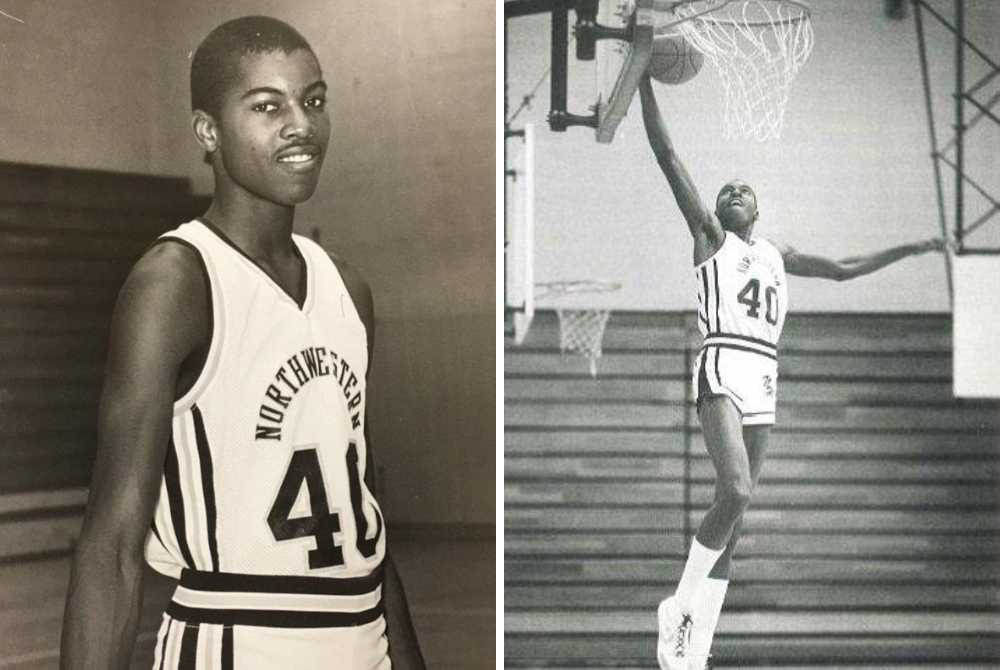
That 1989 NCAA championship wasn’t Rice’s first taste of victory. Before his college success, he led Flint Northwestern to back-to-back MHSAA Class A state titles in 1984 and 1985. The Wildcats compiled a dominant 55-1 record over those two seasons — a mark that stood as an MHSAA record until Powers North Central went 55-0 over the 2014-15 and 2015-16 seasons. In 1985, Rice averaged 28.6 points per game, finishing the season with 802 points — still the 22nd-highest total in state history.
Flint Northwestern’s 1984 boys’ basketball championship was the first in school history. That same year, the girls team also claimed the Class A title — marking its first championship as well — and repeated in 1985.
After winning titles in both high school and college, Rice went on to enjoy a 15-year NBA career, highlighted by an NBA championship with the Los Angeles Lakers in 2000. A three-time NBA all-star, he averaged 18.3 points per game over his career.
Rice remains the all-time leading scorer at University of Michigan, where his No. 41 jersey has been retired. Flint Northwestern High School closed its doors in 2018.
Previous "Flashback 100" Features
March 28: Youngquist's Times Still Among MHSAA's Fastest - Read
March 18: After 40 Years, Coles' Shot Remains Among Century's Most Famous - Read
March 7: Walled Lake Northern's Hellebuyck Reigns as NHL's Elite Netminder - Read
Feb. 27: Zeerip's Mat Stats Remain Rarely-Challenged Chart Toppers - Read
Feb. 21: Before TV Stardom, Kerwin Excelled as All-State Skier - Read
Feb. 14: Detroit Central Star Voted into Pro Football Hall of Fame - Read
Feb. 6: Multi-Sport Star Look Becomes Super Bowl Officiating Legend - Read
Jan. 31: Johnson Family Put Magical Stamp on Michigan High School Hoops - Read
Jan. 24: Future Hall of Famers Face Off First in MHSAA Class A Final - Read
Jan. 17: First-Ever WNBA Draft Pick Rocked at Salem, Won Titles at Tennessee - Read
Jan. 10: Despite Launching Before 3-Point Line, Smith Still Tops Scoring List - Read
Jan. 3: Edison's Jackson Earns Place Among State's All-Time Elite - Read
Dec. 20: Future Olympian Piper Leads Grosse Pointe North to Historic Heights - Read
Dec. 13: The Other Mr. Forsythe in Michigan School Sports - Read
Dec. 6: Coleman's Legendary Heroics Carry Harrison Through Repeat - Read
Nov. 29: Harbaugh Brothers' Football Roots Planted in Part at Pioneer - Read
Nov. 22: 8-Player Football Finals Right at Home at Superior Dome - Read
Nov. 15: Leland Career Helps Set Stage for Glass' International Stardom - Read
Nov. 8: Future Baseball Pro Led Escanaba's Legendary Football Title Run - Read
Nov. 1: Michigan High School Baseball Trio Provide World Series Voices - Read
Oct. 25: Before Leading Free World, Ford Starred for Champion GR South - Read
Oct. 18: Mercy Links Legend Becomes World Golf Hall of Famer - Read
Oct. 11: Fisher Races to Finals Stardom on Way to U.S. Olympic First - Read
Oct. 4: Lalas Leaves High School Legacies on Ice & Pitch - Read
Sept. 27: Tamer's History-Making Run Starts in Dexter, Continues to Paris - Read
Sept. 20: Todd Martin’s Road to Greatness Starts at East Lansing - Read
Sept. 13: James Earl Jones, Dickson High Hoops to Hollywood Legend - Read
Sept. 6: Pioneers' Unstoppable Streak Stretches 9 Seasons - Read
Aug. 30: Detroit dePorres Rushes to 1995 Class CC Football Championship - Read
(Photos courtesy of MLIVE/Flint Journal.)