


High 5s: 11/7/12
November 7, 2012
This past Saturday saw eight teams and eight individuals crowned MHSAA champions, and this week we feature a few who will be listed among the best for all time.
 Erin Finn
West Bloomfield senior
Cross country
Finn won her second straight MHSAA individual Lower Peninsula Division 1 championship, this time in 17:07.9. Her finish was the fastest from any of the four divisions that raced Saturday at Michigan International Speedway, and gave her the victory in hers by 27 seconds. Finn’s time was the fourth-best ever at an MHSAA Final. She has three of the top 15 times ever run at MIS, more than any other runner.
On track for more: Finn also won an MHSAA Track and Field championship last season, setting an all-division/class record in the 1,600 with a time of 10:17.86. That time was nearly five seconds better than the previous best.
Maize and Blue: Finn will run next season at the University of Michigan. The Wolverines cross country team is ranked No. 7 nationally heading into Friday's NCAA Great Lakes Regional.
Scientifically speaking: Finn intends to study biomechanical engineering at U-M. "My junior year, I found out I love physics, and I already knew I loved bio and chemistry. So, what's better than to combine those?"
Runners to chase: “I looked up to Megan Goethals (of Rochester), number one, and Shannon Osika (of Waterford Mott). They’re people I competed with. I know that one day I can be like that. It’s more real to me.”
 Nick Raymond
Erie Mason senior
Cross country
After dashing to the lead last season and finishing fourth, Nick Raymond dominated the Lower Peninsula Division 3 Final at MIS with a time of 15:05.1 – the second-fastest time for a Division 3/Class C MHSAA Final to only Maverick Darling's 14:52.8 for Ovid-Elsie in 2007. Raymond is the first individual cross country champion from Erie Mason (not counting another who finished first among individuals before team and individual placers were combined for one race beginning in 1997) and also placed in both the 1,600 and 3,200 at the spring's Lower Peninsula Division 3 Track and Field Final.
A long drive: "I've been working hard, since the first time (I ran) in sixth grade. Working hard and training hard over the summer and during mandatory practices too."
Brotherly influence: Raymond began running cross country in the footsteps of his older brother Andrew Raymond, a 2010 graduate. "He told me, 'If you just keep working hard, just look forward at your dream, your goal, you will achieve it.'"
Now the pool, then the track: Raymond swims during the winter, specializing in butterfly and breaststroke. Then it's on to track. Raymond finished fourth in the 1,600 (4:21.84) and seventh in the 3,200 (9:44.91) at last season's Lower Peninsula Division 3 Final.
Looking up to Pre: Like many in the running community, Raymond considers former Oregon and international star Steve Prefontaine a major influence. "I liked how he had a lot of faith in himself."
 East Kentwood soccer
The top-ranked Falcons edged Grand Blanc 1-0 at Troy Athens to claim their fourth Division 1 championship in six seasons. They finished 22-1-4, their seventh with at least 20 wins in the last eight years.
Previous 2012-13 honorees:
- Julia Bos, Grand Rapids Christian cross country - Click for more
- Morgan Bullock, Zeeland swimming - Click for more
- Nathan Burnand, Waterford Mott cross country - Click for more
- Aaron Chatfield, Burt Lake Northern Michigan Christian soccer - Click for more
- Billy Heckman, Portage Central tennis - Click for more
- Codi Jenshak, Escanaba tennis - Click for more
- Amanda McKinzie, Battle Creek St. Philip cross country - Click for more
- Connor Mora, Cedar Springs cross country - Click for more
- Kelsey Murphy, Plymouth golf - Click for more
- Dewey Lewis, Rockford soccer - Click for more
- Jacqueline Setas, Lansing Catholic golf - Click for more
- Michael Sienko, Williamston tennis - Click for more
- Beal City volleyball - Click for more
- Grand Blanc boys soccer - Click for more
- Ithaca football - Click for more
- Lansing Everett football - Click for more
- Ludington boys tennis - Click for more
- Muskegon Mona Shores girls golf - Click for more
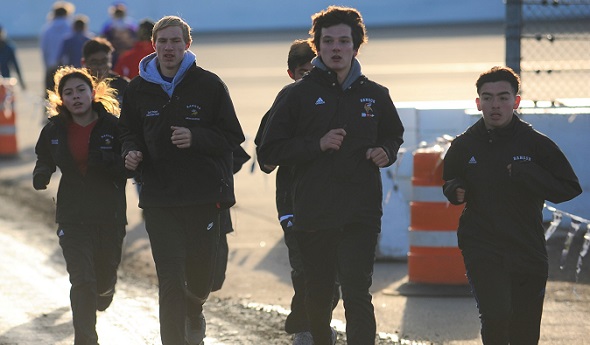
Workout Basics: Warm-Ups & Cool-Downs
February 3, 2021

By Nick Parkinson, M.Ed., AT, ATC, TSAC-F
Henry Ford Health Systems
You may know a good warm-up — and cool-down — are essential to getting a good workout. You may also know that warming up your muscles and stretching them out after exercise can help prevent injury and keep you at the top of your game.
They’re the two bookends that help maximize a workout. Unfortunately, a lot of exercise enthusiasts don’t know how to warm up and cool down correctly.
Warm-Up Basics
A warm-up is exactly what it sounds like: The goal is to warm up your muscles and prepare your body for whatever you’re asking it to do. Warming up increases your body temperature and helps blood flow to the muscles that you’re using.
So if you’re going to play soccer, your warm-up should touch all of the muscles in your legs and core. Shooting hoops? You’ll need to add shoulders and arms to your routine. Circuit training at the gym? Choose a warm-up that flexes all of the muscles you’re about to use.
The thing that all warm-ups have in common is that they require dynamic (or constantly moving) motion, not static stretching (holding poses for a certain amount of time). In fact, static stretching prior to a workout can inhibit power and strength, especially if you’re doing something like weightlifting.
The anatomy of a solid warm-up:
• Before any activity, do about 10 minutes of light cardiovascular activity, whether walking, biking or jogging.
• Dynamic stretches. After you get your muscles moving, do a series of lunges, jumping jacks or toe touches to stretch a bit.
• Dive in. When you start your workout, begin slowly and gradually increase power and speed.
Cool-Down Basics
After you’ve put your body through a challenge, a good cool-down is essential. It helps slow down your heart rate gradually, relax your muscles and stretch them out.
Cool-down routines should always include some type of motion before you get to static stretching, especially if you’ve just finished a high-intensity workout. Static stretching improves flexibility and performance and it can also help stave off future injury.
As with warm-ups, the right cool-down exercises depend on the activity you engaged in. If you biked for 20 miles, you might coast on your cycle for a while before coming to a stop. If you ran, you might jog or walk before you begin stretching. As with your warm-up, the key is addressing every muscle group you worked during your workout.
The anatomy of a solid cool-down:
• At the end of your workout, slow the pace and intensity of whatever activity you’re doing. So, if you’re running, slow to a jog and then a walk for 5 to 10 minutes before stopping.
• Stretch out the muscles you work, but don’t push past the point where you feel tight. Then, hold the position for at least 30 seconds. That’s how long it takes for the body to overcome its stretch reflex.
• Breathe through your stretches and make sure to finish your cool-down with deep, belly breaths.
Running short on time? Target muscle groups you may have injured in the past or that tend to get sore after activity. Cooling down will preserve your athleticism — and your ability to participate in daily activities — over the long term.
Be Good to Your Body
While there’s some controversy about whether warming up and cooling down can help prevent injury, there’s little dispute that they can help you ease in and out of activity.
The key is to find something that works for you. Your warm-up could be as simple as walking to the gym and doing a set of jumping jacks when you arrive. Your cool-down might just involve ending your workout 10 minutes early so you can slow down.
It doesn’t have to be complicated. It just has to give your heart and blood vessels a chance to breathe before and after activity.
Nick Parkinson, M.Ed., AT, ATC, TSAC-F, is the Supervisor of Athletic Training with Henry Ford Sports Medicine and also leads Sports Performance training at the William Clay Ford Center for Athletic Medicine. Learn more about Nick.
Want to learn more? Henry Ford Health System sports medicine experts are treating the whole athlete, in a whole new way. From nutrition to neurology, and from injury prevention to treatment of sports-related conditions, they can give your athlete a unique game plan.
Visit henryford.com/sports or call (313) 972-4216.