


High 5s: 11/7/12
November 7, 2012
This past Saturday saw eight teams and eight individuals crowned MHSAA champions, and this week we feature a few who will be listed among the best for all time.
 Erin Finn
West Bloomfield senior
Cross country
Finn won her second straight MHSAA individual Lower Peninsula Division 1 championship, this time in 17:07.9. Her finish was the fastest from any of the four divisions that raced Saturday at Michigan International Speedway, and gave her the victory in hers by 27 seconds. Finn’s time was the fourth-best ever at an MHSAA Final. She has three of the top 15 times ever run at MIS, more than any other runner.
On track for more: Finn also won an MHSAA Track and Field championship last season, setting an all-division/class record in the 1,600 with a time of 10:17.86. That time was nearly five seconds better than the previous best.
Maize and Blue: Finn will run next season at the University of Michigan. The Wolverines cross country team is ranked No. 7 nationally heading into Friday's NCAA Great Lakes Regional.
Scientifically speaking: Finn intends to study biomechanical engineering at U-M. "My junior year, I found out I love physics, and I already knew I loved bio and chemistry. So, what's better than to combine those?"
Runners to chase: “I looked up to Megan Goethals (of Rochester), number one, and Shannon Osika (of Waterford Mott). They’re people I competed with. I know that one day I can be like that. It’s more real to me.”
 Nick Raymond
Erie Mason senior
Cross country
After dashing to the lead last season and finishing fourth, Nick Raymond dominated the Lower Peninsula Division 3 Final at MIS with a time of 15:05.1 – the second-fastest time for a Division 3/Class C MHSAA Final to only Maverick Darling's 14:52.8 for Ovid-Elsie in 2007. Raymond is the first individual cross country champion from Erie Mason (not counting another who finished first among individuals before team and individual placers were combined for one race beginning in 1997) and also placed in both the 1,600 and 3,200 at the spring's Lower Peninsula Division 3 Track and Field Final.
A long drive: "I've been working hard, since the first time (I ran) in sixth grade. Working hard and training hard over the summer and during mandatory practices too."
Brotherly influence: Raymond began running cross country in the footsteps of his older brother Andrew Raymond, a 2010 graduate. "He told me, 'If you just keep working hard, just look forward at your dream, your goal, you will achieve it.'"
Now the pool, then the track: Raymond swims during the winter, specializing in butterfly and breaststroke. Then it's on to track. Raymond finished fourth in the 1,600 (4:21.84) and seventh in the 3,200 (9:44.91) at last season's Lower Peninsula Division 3 Final.
Looking up to Pre: Like many in the running community, Raymond considers former Oregon and international star Steve Prefontaine a major influence. "I liked how he had a lot of faith in himself."
 East Kentwood soccer
The top-ranked Falcons edged Grand Blanc 1-0 at Troy Athens to claim their fourth Division 1 championship in six seasons. They finished 22-1-4, their seventh with at least 20 wins in the last eight years.
Previous 2012-13 honorees:
- Julia Bos, Grand Rapids Christian cross country - Click for more
- Morgan Bullock, Zeeland swimming - Click for more
- Nathan Burnand, Waterford Mott cross country - Click for more
- Aaron Chatfield, Burt Lake Northern Michigan Christian soccer - Click for more
- Billy Heckman, Portage Central tennis - Click for more
- Codi Jenshak, Escanaba tennis - Click for more
- Amanda McKinzie, Battle Creek St. Philip cross country - Click for more
- Connor Mora, Cedar Springs cross country - Click for more
- Kelsey Murphy, Plymouth golf - Click for more
- Dewey Lewis, Rockford soccer - Click for more
- Jacqueline Setas, Lansing Catholic golf - Click for more
- Michael Sienko, Williamston tennis - Click for more
- Beal City volleyball - Click for more
- Grand Blanc boys soccer - Click for more
- Ithaca football - Click for more
- Lansing Everett football - Click for more
- Ludington boys tennis - Click for more
- Muskegon Mona Shores girls golf - Click for more
After Sending Every Flight to Championship Day, Seaholm Boys Secure 1st Title
By
Fred Kelly
Special for MHSAA.com
October 23, 2025
MIDLAND – Birmingham Seaholm had been knocking on the door of a first Finals boys tennis championship for the past couple of seasons.
This year, the Maples just busted it right down.
Seaholm entered this week’s Lower Peninsula Division 2 Finals as the top-ranked team in the state, and the Maples made that ranking hold up, finishing with 31 points Thursday to top a 21-team field and outlast second-place Byron Center (26 points) and second-ranked Midland Dow (22).
“Last year, we were right there in the end, tied with Dow with 24 points (heading into day two). This feels good, because these returners were motivated, and they worked their butts off in the offseason,” said Seaholm eighth-year coach Nick Shaheen, whose Maples were Division 2 runners-up the last two years.
“We knew it was going to be a tough tournament. Midland Dow is a great team, and I’ve got a lot of respect for their program, and for Byron Center as well,” Shaheen added. “It took a team effort. To get eight flights into the semis is tough. We felt like we were playing our best tennis at the end of the season, and sometimes that’s what you need to win a state championship.”
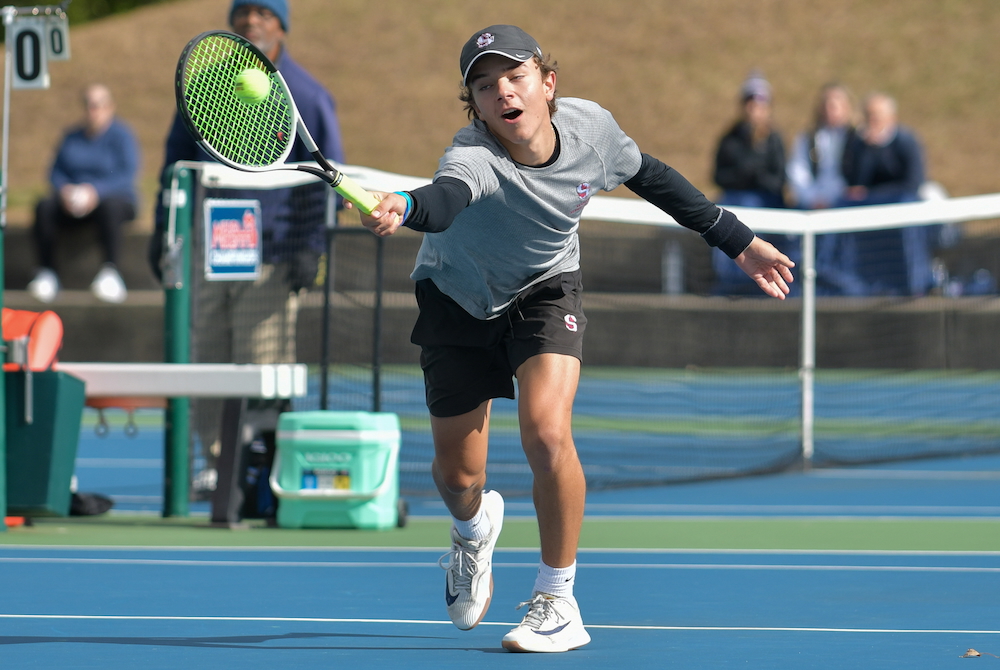
The Maples won titles at three flights, as second-seeded Charlie Griffith won the No. 3 singles championship, top-seeded Joaquim Flory earned the No. 4 singles title, and the second-seeded duo of Britton Leo and Alex Ting clinched the No. 1 doubles crown.
Griffith defeated third-seeded Ryan McKendry of Byron Center 6-3, 7-5 in Thursday’s semifinals, then edged top-seeded Roman Vuljaj of Detroit U-D Jesuit 3-6, 6-4, 7-6(6) in a thrilling three-set upset to clinch the title.
Flory won a tough three-setter 6-2, 6-7(4), 6-2 over fifth-seeded Oscar DeLuca of Grosse Pointe South in the semifinals, then beat third-seeded Cole Krauss of Byron Center 7-5, 6-4 in the title match.
Leo and Ting rallied to beat third-seeded Rylan Vandenberge and Casey Schans of Byron Center 2-6, 6-2, 6-4 in the semifinals before going on to upset top-seeded Matt McGaugh and Nathan Song of Dow 6-2, 6-2 in the final.
Shaheen said that advancing to the semifinals in four singles flights – and to the finals in three of them – helped his Maples get over the hump this year.
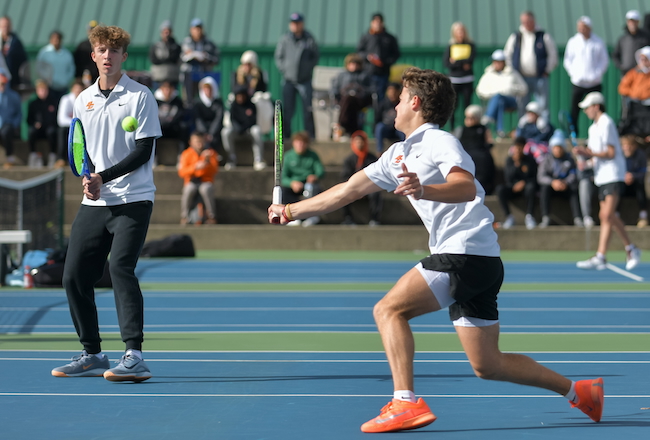 “Traditionally, we’ve been known as more of a doubles power, so for us to send three flights into the singles finals was big. We really relied on the depth of our team,” he said.
“In past years, when we’ve had good runs, our singles haven’t been quite deep enough to get us there,” he added. “But on the first day (of this tournament), we went perfect, which is not easy to do. We benefitted from getting some serious all-year-around players at singles, and that helps.”
Seaholm had a Finals runner-up at No. 2 singles, as top-seeded Giorgio Materazzo beat Rei Hitachi of Grand Rapids Forest Hills Central 6-2, 6-2 in the semifinals, then lost 6-3, 6-1 to third-seeded Vikram Krishnan of Grand Rapids Forest Hills Northern in the title match.
In other action for the Maples on Thursday, second-seeded Carter Griffith lost 6-1, 6-2 to third-seeded Mason Crosby of South Lyon East in the No. 1 singles semifinals; fourth-seeded Saajan Mahadevan and JJ Bastani lost 6-2, 6-1 to top-seeded and eventual champion Nolan Booth and Brayden Slot of Byron Center in the No. 2 doubles semifinals; third-seeded Roger Harris and Kalil Wahab lost 6-4, 6-4 to second-seeded Aidan Banchoff and Ben Vander Stelt of Byron Center in the No. 3 doubles semifinals; and second-seeded Ryan McArdle and Gabe Christman lost 6-3, 7-6(1) to third-seeded Zeke Sandholm and Brady Slot of Byron Center in the No. 4 doubles semifinals.
In Thursday’s other flight finals, top-seeded Sam Schumacher of Portage Central beat Crosby 6-2, 0-6, 6-1 at No. 1 singles, Booth and Slot beat third-seeded Joseph Song and James Notarnicola of Forest Hills Central 6-1, 6-2 at No. 2 doubles, fifth-seeded Marcus Bernard and Drew Decker of Forest Hills Northern beat Banchoff and Vander Stelt 6-3, 6-3 at No. 3 doubles, and top-seeded Ethan Clark and Vettel Xu of Dow beat Sandholm and Slot 6-1, 2-6, 7-6(2) at No. 4 doubles.
According to Shaheen, Seaholm’s first team title on the boys tennis side has been a long time coming.
“I’m extremely proud of our guys. This is something our senior leaders have wanted for a long time,” he said. “They see on our fence back at Seaholm all of the girls state championships, and they so badly wanted to put one on the fence for themselves. We are extremely proud of the effort they put in.”
Shaheen was particularly pleased with how his Maples adjusted to the unpredictable weather in Midland, which prompted play to be bounced back and forth between the Greater Midland Tennis Center’s indoor and outdoor courts.
“For them to come out here and be adaptable – playing indoors, outdoors, indoors, outdoors – I give our boys a lot of credit, because that’s not easy,” he noted. “They were super tough this week. It's a tough, emotional week, so for them to handle that pressure and the ups and downs and come out on the other side is really awesome.”
(PHOTOS by High School Sports Scene.)