


Michel Finishes with Story to Tell
June 11, 2013
By Geoff Kimmerly
Second Half editor
Andrew Michel received the heart-breaking news only moments before leaving his golf team’s Regional on Friday to get ready for that night’s Brownstown-Woodhaven prom.
But missing making the MHSAA Finals by a stroke was not the first thing he shared with those who asked about his day at West Shore Golf and Country Club in Grosse Ile.
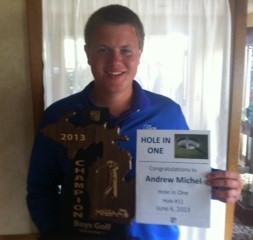 Instead, the graduating senior told of the 132-yard shot he dropped for a hole-in-one on the par-3 12th hole, his second ace but first in competition.
Michel finished with a season-best 76, missing the cut for this weekend’s Lower Peninsula Division 1 Final by a stroke despite firing another eagle during the final holes of his round.
“At the start of the day, I told myself don’t leave anything on the table. Go for it on every hole, make every shot and just have fun at your last tournament,” Michel said Tuesday afternoon as he readied for that night’s graduation ceremony. “Being a senior, I went for everything.”
The best part might’ve been how he came back from a disappointing previous hole.
Michel had just finished off a triple bogey on No. 11, and admitted he was down on himself. He stepped to the next tee with his pitching wedge, and “I didn’t really care what happened. I chose the club I like to hit on that hole, and in the air I was thinking it was really good,” he said.
The ball touched down on the green and spun back into the hole.
Michel also played golf and soccer at Brownstown-Woodhaven. He’ll attend Grand Valley State University in the fall, study engineering, and will try to walk-on the Lakers’ golf team.
“Deep down inside,” he said he’s disappointed he won’t be playing at Michigan State’s Forest Akers West on Friday. But he’s got a quite a highlight to take with him from his final high school round.
“It was very bittersweet. I really wanted to go to state,” Michel said. “But the hole-in-one balanced it out a bit.”
Eye on the official
Hopefully you caught our MHSAA benchmarks piece (also published on Second Half) on longtime official Lamont Simpson, who has worked not only MHSAA Finals but NCAA tournaments and is one of 32 officials in the WNBA. (Here’s the link in case you missed it.)
He also became that league’s first to wear the referee cam, debuting the new gear during a recent game between the Phoenix Mercury and Indiana Fever.
The camera provides plenty of ref’s-eye views. Click the video below to check it out.
Wheels of Steele
We’ve been watching the inspiring progress of Frankenmuth runner Bobby Steele especially over the last few years as his story became known across the Lower Peninsula.
Steele, who is visually impaired, has run cross country and track for the Eagles, thanks to the help of guides who ran with him to help him stay on course.
If you haven’t heard Steele’s awesome story, check out this 8-minute video. Not only did Steele run, but he cut roughly 12 minutes off his first cross country times over the course of his career.

Skiing Climbs Toward 70 Years on Slopes
By
Ron Pesch
MHSAA historian
January 31, 2020
A glance at the MHSAA record books shows 45 years of MHSAA skiing championships, beginning in 1975.
But did you know the Association has sanctioned an Upper Peninsula Regional meet since 1952? And a Lower Peninsula Regional was added in 1954?
 Skiing had been a favorite winter sport across the state long before that. The city of Ishpeming lays claim as the “birthplace of organized skiing in America.” In 1888, the Norden Ski Club sponsored their first formal tournament. Renamed the Ishpeming Ski Club in 1901, the group hosted its 133rd Annual Ski Jumping Tournament this year.
In 1905, the National Ski Association, rechristened the United States Ski Association (USSA) in 1962, was formed in Ishpeming to oversee jumping tournaments and in later years ran meets to develop the sport. The city also was home to the “Flying Bietilas,” a family of world renowned ‘ski riders’ – jumpers – including four who would make the U.S. Olympic team. During the late 1930s and early 1940, Pine Mountain in Ironwood hosted the biggest ski jumping event in the Midwest, with crowds swelling toward 20,000. Ski Clubs have long existed at high schools across the state.
Sugar Loaf Resort, located in Cedar not far from Traverse City, opened in 1947 and inaugurated a High School Invitational Ski meet in 1949. The event was sponsored by the Leelanau School of Glen Arbor and sanctioned by the Michigan High School Athletic Association. Students at Cadillac High school first formed a ski club during the 1948-49 school year.
“With the Caberfae ski area so near, skiing is the up-and-coming winter sport,” wrote the staff in the Cadillac High School annual. The club numbered about 50, and competed that first year in an “inter-scholastic ski meet” with teams from Traverse City, Manistee, and Leelanau. “Events for both boys and girls were downhill, slalom and cross country. Held at Caberfae in February, Cadillac won the meet and was presented with a trophy.”
So, it was with little surprise that the MHSAA was petitioned with “consistent requests of a large number (from) the (Iron Mountain) student body who desired to form a ski team and compete against other Upper Peninsula schools,” according to the Ironwood Daily Globe in 1951. Requests from other U.P. schools followed.
Recognition by the MHSAA
“Skiing has won a spot in the Upper Peninsula’s high school athletic program,” announced the Detroit Free Press on January 3, 1952. “The first Upper Peninsula skiing meet sanctioned by the Michigan High School Athletic Association will take place at Iron Mountain Feb 2. Teams scheduled to compete include Iron Mountain, Kingsford, Houghton and Hancock and more entries are expected.”
According to the Daily Globe, the boys competition consisted of Alpine downhill and slalom racing, and Nordic events, jumping and cross-country. For the girls, competition featured only Alpine events. The second U.P. Regional was held in early 1953.
The total number of ski sites in Michigan had grown to 41, with 33 in the Lower Peninsula, and the sport was considered the fastest-growing in Michigan. Prior to the 1953-54 school year, the MHSAA decided to sanction skiing as a sport in the Lower Peninsula as well, and to sponsor a second Ski Regional.
 “Both boys and girls teams are authorized by the state association, making skiing the only opportunity for a girl to win a major sports award,” noted the Petoskey Evening News in June of 1953.
“Personally, I feel it is one of the fine sports which should receive attention in those areas of the state where the activity is available,” said Charles Forsythe, the MHSAA’s Executive Director at the time. “I am quite sure that the MHSAA will continue to be interested in it.”
Lower Peninsula Joins the Fun
The Manistee boys grabbed the inaugural L.P. Regional title in 1954 without winning a single first place in the meet. Hosted at Sugar Loaf, it included 10 participating schools and 92 competitors. The gathering differed from the U.P. competition in that it included only Alpine races, consisting of two runs by riders in both the slalom and downhill events, with combined times determining team and individual scores.
Leelanau School for Boys finished second, followed by Cadillac and Traverse City. A pre-event favorite, Traverse City’s Larry Bensley won the downhill competition. However, iced conditions caused him to fall “in each of two runs through the slalom gates … (and) cost him the championship title,” according to the Traverse City Record Eagle. Ben Boutell Jr. of Bay City Central ended the day with the best time in the combined slalom and downhill events to win the boys individual championship, followed by his brother Bill in second place.
 Senior Barbara Sherberneau led Traverse City to the downstate girls team title. She finished first in the downhill, covering the course in 66.2 seconds while 15-year-old schoolmate Joey Cowell placed second. Freshman Patrice Freel of Gaylord won the slalom, followed by Sherberneau and Myra Turner from Lowell. (Interestingly, the Traverse City boys and girls teams were instructed by future football coaching legend, Jim Ooley, who would guide the Trojans to three MHSAA Class A football titles).
With “winter recreation areas in Hickory Hill and Holiday Hills, and other facilities … such as Sugar Loaf, Briar Hill, Caberfae and Boyne Mountain” nearby, to little surprise, the Traverse City teams would emerge as a hotbed for prep skiers in the coming years.
Cadillac swept both the boys and girls Lower Peninsula tournaments in 1955, this time hosted at Caberfae. Cowell of Traverse City returned to the slopes from an injury earlier in the season to earn the girls individual title while Ross Hohn of the Leelanau School just slipped past Bay City’s Ben Boutel for top boys accolades.
Two weeks later, at the 4th Annual Upper Peninsula Regional hosted at Michigan Tech Ski Area at Houghton, seven schools competed for team honors with individual competitors coming from Calumet, Lake Linden and St. Ignace. Houghton High School “copped top honors for the meet,” with both boys and girls teams taking first place in every event for the second year in a row. Houghton had now won each of the team titles since the initiation of state-sponsored Regionals.
Changes Above the Bridge
In 1959, a decision was made by the U.P. Ski Coaches and Principals to do away with combined scoring and separate the Regional into Nordic and Alpine events held over two days, with trophies given to the winners in each category. Girls would continue to compete in only the Alpine events. Iron Mountain boys and girls squads earned the Alpine meet championships, while Ishpeming grabbed the Nordic title.
 A total of 133 skiers from 10 high schools – 52 boys and 36 girls in the Alpine events, 27 boys in the cross country race and 18 boys in jumping – were scheduled to compete in the U.P event in February of 1961. Icy conditions postponed the Alpine events, but the Nordic events were run as planned. Coach Theron Peterson’s Ironwood Ski Devil team won both the team jumping and cross country competitions.
Individually, Dave Engstrom, the lone senior on the Ironwood team, “captured first place in Saturday’s jumping with leaps of 77 and 79 feet for a total of 80 distance points and he received 61.5 form points for a grand total of 141.5. His 79-foot jump was the longest of the meet and his form rating was the highest of any entry,” noted the Daily Globe. Veikko Lapinoja of Ishpeming won the cross country event with a time of 17 minutes flat, topping Ironwood’s Chris Vizanko by four seconds. The event was hosted at Quarry Hill in Ironwood.
In March at Indianhead Mountain in Wakefield, Ironwood’s boys swept the Alpine competition, winning their second of three straight U.P. Regional titles, while the Hancock girls won their fifth title in six years, dating back to 1956.
Ski Landscape Continues to Change
In December 1963, the MHSAA and the United States Ski Association ironed out a plan to officially allow student-athletes to compete in USSA Central Division meets without affecting prep eligibility. “Forsythe said the association recognized skiing ‘as a fine activity and one that has a long carryover value’” according to a United Press International report. The Association’s “outside participation rule,” in place since 1946, had been loosely applied to skiing prior to the agreement.
The Nordic competition was eliminated from the 13th Annual U.P. Regional in 1964 due to limited interest. Only three teams participated in the jumping event in 1963, while just two schools had skiers racing in cross country. Marquette Graveraet’s boys and girls teams, winners of the Alpine games in 1963, again swept the meet.
In March, guided by ski writer Paul Preuss and a panel of ski coaches, the Detroit News introduced its 1st Annual All-State Ski squad: “First and second teams of six boys and six girls each were selected by a panel of 10 coaches and ski experts.” The honors would become a fixture of future ski seasons.
The 1965 event saw 25 teams and 138 competitors in the boys division in the Lower Peninsula. The Traverse City girls picked up their fourth Regional win in a row and ninth overall. The Trojans boys grabbed their sixth consecutive crown. The giant slalom had replaced the downhill event in both peninsula competitions. In the U.P. Regional, nine teams – two fewer then the year previous – battled it out for honors. Ironwood won the boys division, while Marquette grabbed the girls title.
 Talked about since at least 1959, the idea of a ski state championship was pitched to the MHSAA in 1966 by the Ski Coaches Association from both peninsulas. The idea was “for a meet between the two top boys’ teams and the two top girls’ teams and all of the medal winners from each of the two regionals.” Iroquois Mt Ski Area near Sault Ste. Marie would serve as the site. Reflecting the growth in the sport across the state, the MHSAA Representative Council instead opted to add a second Regional in the Lower Peninsula, representing southern Michigan for the 1966-67 school year.
Geographic Expansion
In February 1967, 20 prep teams met at Sugar Loaf for the Northern Michigan Regional, at Mt. Holly in the Pontiac area for the South Regional, and at Mount Ripley in Hancock for the Upper Peninsula Regional.
Led by brothers Marty and Brock Walker, Gaylord snagged its first title, breaking the seven-year stronghold that the Traverse City boys teams had held on the Regional. In turn, Cadillac’s squad interrupted the five-year parade of Traverse City girls titles. It was the fourth title for Cadillac in the 14 years of the L.P. Regional, with the other 10 won by the Trojans.
West Bloomfield won the first of four straight Southeastern Regionals titles, besting Rochester, Southfield, Walled Lake and entries from 16 other schools.
In the Upper Peninsula, Ironwood’s boys and girls teams emerged as champions. The boys squad slipped past Hancock by a mere 1.7 seconds, while the girls eked out victory over the Hancock team by one tenth of a second. The meet consisted of two runs of the slalom and one run of the giant slalom. The first 10 individuals in each event were awarded medals. Mike Porcarelli of Wakefield, skiing with the Iron Mountain team, won both the slalom and giant slalom. Porcarelli would go on to earn four NCAA titles while skiing for the University of Colorado.
Finally, a State Championship
In 1972, 59 high schools sponsored ski teams and the state was now broken into four regions – three in the Lower Peninsula at Mt. Brighton in Brighton, Pine Nob in Clarkston and Schuss Mountain in Bellaire; and Cliff’s Ridge near Marquette in the U.P.
 Beginning in 1970, teams were hosting a postseason invitational meet that included the top two teams from each Regional competing to determine an unofficial state champion. Following the 1972 Regionals, the winning boys and girls teams from the various schools gathered at Timberlee Ski Area near Traverse City for the ‘Bloomfield Invitational’ meet – a runoff to identify a state ski champion for each gender. Houghton finished with the boys title, topping Bloomfield Hills Andover and Waterford Kettering. Marquette emerged as the girls champion, edging Traverse City by 4.5 seconds. The Houghton girls finished third.
During the 1973-74 school calendar, 72 schools across the state sponsored skiing, and in June of 1974, MHSAA Executive Director Allen Bush announced plans to sponsor the first state ski meet.
“This is the first year that we’ve had an official state meet,” said Lyn Salathiel, coach of the Traverse City squads at the time. “Previously they were not state-sponsored events. Now they’ll have eight boys and eight girls teams competing, which is the top two from each of the four regionals.”
Mike O’Brian of Houghton won both the slalom and giant slalom events, but the depth of the Traverse City boys team meant victory in the first MHSAA ski championship. “… Without placing a skier in the top three,” wrote the Associated Press, “… Traverse City raced 502.4 seconds to clinch their title.” Houghton ended second with 506 seconds, followed by East Lansing at 513.3. The event was held at Cliff’s Ridge.
The Trojans girls, led by Judy Kramer, topped Cadillac, clocking in at 384.5 to 405.9. Hancock ended third with 407.1 seconds. Kramer won the slalom with a time of 63.844. Mimi Petritz of Benzie Central grabbed the giant slalom title with a time of 26.868 seconds.
To little surprise, Salathiel was named “Coach of the Year” by the News.
In 1996, the MHSAA moved from a single team champion for each gender to two titles per year for each, classifying schools by enrollment, and also began naming individual champions for the slalom and giant slalom. Currently, Marquette’s boys have won seven straight Division 1 championships, and Petoskey’s boys won eight straight from 2011-18. Marquette’s girls have won four straight in Division 1, while a different program has won the girls title the last seven seasons in Division 2.
Special thanks to Debbie Lindblom, Tim Boutell, Tracy Welch and the Bay County Library System for assistance in gathering the above images and information.
 Ron Pesch has taken an active role in researching the history of MHSAA events since 1985 and began writing for MHSAA Finals programs in 1986, adding additional features and "flashbacks" in 1992. He inherited the title of MHSAA historian from the late Dick Kishpaugh following the 1993-94 school year, and resides in Muskegon. Contact him at [email protected] with ideas for historical articles.
PHOTOS: (Top) Canonsburg Ski Area, northeast of Grand Rapids, hosts a high school ski event. (2) A Muskegon patch from the 1960s is among mementos from earlier years of the sport at the high school level. (3) Traverse City's Barb Sherberneau in 1954. (4) Bill Boutell [43] and brother Ben Jr. [44], with dad Ben Sr., were mid-century standouts for Bay City Central. (5) Houghton's girls provided half of a school sweep of the 1954 Upper Peninsula Regional titles. (6) The 1961 Hancock teams were among powerhouses during Upper Peninsula Regionals at that time. (7) The 1967 West Bloomfield boys ski team sets up on the slopes for a yearbook shot. (Photos gathered by Ron Pesch, with permission, from his personal collection, yearbooks from Traverse City, Hancock Central and West Bloomfield high schools, along with other sources mentioned above.)