


Preview: Classic Clashes and Broken Records Expected
By
Geoff Kimmerly
MHSAA.com senior editor
June 5, 2021
The attention that will be paid to one of the Lower Peninsula Boys Track & Field Finals on Saturday will go past usual interest in just a local school or single division.
Many eyes will be turned to the Division 1 meet, featuring among many Ann Arbor Skyline senior Hobbs Kessler, who has made national news over the last few weeks by setting the national high school record in the 1,500 (3:34.36) and qualifying for the Olympic Trials in the event.
But he’ll be facing some familiar competition in his distance races at East Kentwood – including Hartland junior Riley Hough, who edged Kessler by two seconds in the Division 1 cross country final this past fall.
Their matchup is just one of many stories worth tuning in for this weekend. Events at all four sites begin at 10 a.m. (EDT) and tickets to attend can be purchased online only at GoFan. The meets also will be broadcast on MHSAA.tv and viewable with subscription. Click to watch each division: LPD1 | LPD2 | LPD3 | LPD4.
Below is a glance at team contenders and individuals to watch in all four divisions.
Division 1 at East Kentwood
Top Regional scores: Macomb Dakota 160, Traverse City West 145½, Northville 136, Novi 136.
Team forecast: East Kentwood won the last three championships before COVID, with Ann Arbor Pioneer finishing runner-up in both 2018 and 2019. Dakota is an interesting possibility this time with qualifiers throughout the meet. Fenton has top-three seeds in six events, and Zeeland West is another team with scoring opportunities in a variety of events.
Trey Gardette, Ann Arbor Huron: The senior sprint star has taken amazing strides over the last two years and may be on the verge of an unforgettable finish to his high school career. Gardette’s top-seed 10.5 in the 100 is a blink faster than the LPD1 Finals record of 10.53, and he’s second-seeded in the 200 and also will run on the 400 relay.
Riley Hough, Hartland: The I-96 corridor has been the center of distance running this school year, and Hough hopes to follow his Division 1 cross country championship in the fall with titles in the 1,600 and 3,200. He’s seeded first in the former with a 4:13.93.
Hobbs Kessler, Ann Arbor Skyline: He’s slated to run the 800, 1,600 and 3,200 and on the top-seeded 3,200 relay (7:53.30) Saturday. He won all three of those open races at his Regional, and so while he isn’t top-seeded in any that likely means little as he could drop major time.
Tamaal Myers II, Detroit Cass Tech: The Technicians standout junior has the top 110 hurdles seed time (14.06) by nearly a second and is tied for the top seed time in the 300 (39.32). He’ll also run the 400 and on the 1,600 relay.
Brandon Miller, Fenton: He finished fifth in the 200 as a sophomore in 2019, but he can take a massive leap Saturday as his top seed time in that race (21.25) is five hundredths of a second off the meet record. He’s also the second seed in the 100 with a seed time of 10.60 that is seven hundredths of a second off that meet record. And he’ll also run on contending 400 and 800 relays.
Division 2 at Zeeland
Top Regional scores: Orchard Lake St. Mary’s 216½, Dearborn Divine Child 186, Frankenmuth 164.
Team forecast: Four teams have won this championship over the last four seasons. Flint Powers Catholic is a possibility to make it five as it runs for its first team title led by sprint standouts and relays. Frankenmuth with top qualifiers in the sprints, relays and field events is another to watch in what lines up to be a low-scoring team race. A total of 10 schools won championships in this division over the previous 11 seasons before 2020 was canceled.
Ryan Brenner, Frankenmuth: The senior Eagles hurdler is the top seed in the 300 with a time of 40.1 and also will run on the top-seeded 1,600 relay (3:28.44) and high jump.
Jamal Hailey, Berrien Springs: The standout junior sprinter has the top seed time in the 100 (11.04) and the third-fastest in the 200, and he’ll also run on the second-seeded 400 relay.
Austin Hamlin, Flint Powers Catholic: The Chargers sophomore would play a major role in any team title pursuit, entering with the top seed in the 200 (22.5), third-fastest in the 100 and as part of the top-seeded 400 relay (43.3) and fourth-seeded 800 relay. That 400 relay time is a second off the meet record.
Alex Mansfield, Monroe Jefferson: The junior thrower is another who has made a major move over the last two years. He enters Saturday with the top seed in the shot put (56-3) by two feet and the top seed in the discus (163-11) by nearly 10.
Luke Stowasser, Edwardsburg: The junior Eddies jumper also is top-seeded in both of his events, with a 22-6½ in the long jump and 6-10 in the high jump. That high jump is six inches better than the field and two off the meet record. He was the high jump runner-up as a freshman.
Division 3 at Jenison
Top Regional scores: Grass Lake 132, Caro 129, Pewamo-Westphalia 126 1/3.
Team forecast: Grass Lake will be pursuing its first team title since 1970 and has six top-four seeds leading the way. Figuring the next few contenders is difficult with points looking to be spread among a number of teams.
Brennan Bargesser, Grass Lake: A drive for the team championship would include significant points from Bargesser, who is seeded first in the 200 (21.98) and 400 (49.34) and second in the 100 for his final high school meet. He’ll also run on the top-seeded 400 relay (44.14) – that seed time is one second off the meet record.
Hunter Jones, Benzie Central: The sophomore standout has two Division 3 cross country championships to his credit and will make his Track Finals debut as the top seed in the 3,200 (9:37.42) and a likely contender in the 1,600 and 800 as well.
Josh Jones, Harrison: He’ll close his high school career running the 800, 1,600 and 3,200, with his 1,600 seed time (4:19.84) topping that event list.
Brenden Quackenbush, Chesaning: He’s set to establish himself in both throws at this level Saturday, with the top seed in the discus (143-0) by nearly two feet and the third seed in the shot put.
Derrick Voltz, Carrollton: A qualifier in the 100 as a freshman in 2019, he could cap his junior season as a two-event champion. He’s seeded first in the long jump (23-2) by nearly a foot with that leap only five inches off the meet record. He’s also the top seed in the 100 (11.11) just ahead of Bargesser.
Division 4 at Hudsonville
Top Regional scores: Lutheran Westland 171, Reading 170, Carson City-Crystal 147.
Team forecast: Kalamazoo Hackett Catholic Prep was the back-to-back champion before COVID, and Saugatuck was the Division 3 runner-up in 2019 but is back in Division 4. Saugatuck won’t run a relay this weekend but has favorites in the hurdles and distance events, and Breckenridge’s strengths in the sprints and relays should make it a team title contender as well as it seeks its first championship.
Coleman Clark, Carson City-Crystal: The lone returning champion in this division won the 3,200 as a sophomore in 2019 and will run that race along with the 800 and 1,600 and as part of the top-seeded 3,200 relay (8:19.40).
Benny Diaz, Saugatuck: The junior sprint/hurdles standout could make a run at four individual titles Saturday or next season. He’s the top seed in both hurdles races this time (15.01 in the 110 and 40.59 in the 300), and the fourth seed in the 200 and seventh in the 100. He was third in Division 3 in the 300 as a freshman.
Zane Forist, Carson City-Crystal: He was the runner-up in the discus and eighth in the shot put as a freshman two years ago, and he’s aiming for much more this time. His top-seed throws of 196-8 and 64-4, respectively, would both set LPD4 championship meet records – both by roughly six feet.
Nik Pettinga, Saugatuck: A top distance runner in cross country the last few seasons, he is looking to finish as a champion in his last high school meet and enters as the top seed in the 1,600 (4:26.99) and second seed (to junior teammate Max Sharnas) in the 3,200.
Charlie Steinhaus, Breckenridge: The speedy senior would help lead any charge for a team championship, entering as the top seed in the 100 (11.01) and second in the 200. He’ll also run on the top-seeded 400 relay (44.51) and second-seeded 800 relay.
PHOTO: Carrollton’s Derrick Voltz, right, breaks across the finish line during the 100-meter preliminaries at his Division 3 Regional at Shepherd last month. (Click for more from High School Sports Scene.)
Soccer, Hoops Next to Seed Using MPR
August 6, 2019
By Rob Kaminski
MHSAA benchmarks editor
As the topic of seeding for MHSAA Tournaments continues to swirl in the air of numerous committee meetings on an annual basis, one of the primary concerns continues to focus on the simple question: “How?”
The MHSAA for years has been working behind the scenes on potential formulas which could best be used as a standardized tool to assist in measuring strengths of teams in a given sport.
This spring, the MHSAA introduced the Michigan Power Rating in the sport of Boys Lacrosse. The Representative Council approved limited seeding beginning in 2019-20 for girls and boys soccer and girls and boys basketball, and MPR will be the metric to determine which two teams must be seeded on opposite sides of District brackets in those sports.
“The boys lacrosse tournament has been seeded since it was added as an MHSAA-sponsored sport in 2005. The seeding is done by committee based on several criteria, one of which was statewide power rankings generated by a third-party website. In the Fall of 2018, that website ceased operation – it was the perfect opportunity for the MHSAA to develop its own data-driven, purely objective ratings system and incorporate that data into the seeding criteria,” said Cole Malatinsky, administrative assistant for the sport.
“The benefits of the new MPR system have been already mentioned – it is MHSAA controlled, simple, objective, and transparent, and it can be used by other MHSAA sports in the future.”
MPR is a computer rating formula similar to the popular RPI rating. MPR provides a way to measure a team’s strength relative to other teams, based on games played against other MHSAA tournament teams, largely on the strength of their opponents’ schedules. MPR is purely objective using only the game results listed on MHSAA.com – there is no subjective human element.
What is the basic MPR formula?
MPR is calculated using wins, losses and ties for games played between teams entered into the MHSAA tournament. The final MPR number is 25% of the team's winning percentage, plus 50% of its opponent's winning percentage, plus 25% of its opponent's opponent's winning percentage.
MPR = (.25 x W%) + (.50 x OW%) + (.25 x OOW%)
The MPR formula can be applied easily to other MHSAA team sports.
What game data is included in the formula? What game data is not?
MPR looks only at results between opponents entered into the MHSAA postseason tournament. Wins, losses and ties in multi-team shortened game tournaments (lacrosse, soccer) also count. Forfeits also are counted as wins and losses.
MPR does not use the specific scores of a game or the margin of victory in a game. The location of a game is not included in the MPR formula, and the formula weighs results at the beginning of the season the same as results at the end of the season. Scrimmages are not included.
Why use the MPR formula?
Different rating systems have been used in the past or have been recommended to the MHSAA. We wanted to have a rating system where the data was controlled and stored in house and could be used for any sport featuring head-to-head competitions.
With its own rating system the MHSAA also can control the different components of the formula, thus keeping the tenets of scholastic competition at the forefront (like not including margin of victory in the formula). Finally, by listing all scores and team schedules online, as well as showing the MPR calculator on each team schedule page, the ratings are transparent and can be replicated easily.
CALCULATING MPR
What are the detailed components of the MPR formula?
You need three numbers to calculate your MPR: winning percentage (W%), opponent’s winning percentage (OW%) and opponent’s opponent’s winning percentage (OOW%).
How do you calculate winning percentage (W%)?
Divide the number of wins by the number of total games played. A tie is worth half a win. For MPR purposes, find the winning percentage against all teams that will play in the MHSAA tournament (MPR W%). Games played against out-of-state teams, varsity “B” teams, junior varsity teams, non-school club teams, and any other non-MHSAA tournament participants should not be included when calculating winning percentage. W% should be an easy number to calculate.
How do you calculate opponent’s winning percentage (OW%)?
Average the winning percentages of a team's opponents. When calculating the winning percentage of a specific opponent, use the opponents "Adjusted Winning Percentage" (ADJ W%). Adjusted winning percentage eliminates all games the team played against that opponent (as well as its games against non-MHSAA opponents).
For instance, if the team beat an opponent with an overall record of 4-1, use a record of 4-0 (1.000) for that opponent. If the team lost to an opponent, use a record of 3-1 (.750). Find the ADJ W% for all opponents, and then take the average. If a team plays an opponent team twice, that opponent’s ADJ W% will be counted twice.
OW% is not calculated via the combined record of the opponents; instead take the average of all opponent’s winning percentages.
How do you calculate opponent’s opponent’s winning percentage (OOW%)?
Use the same process described above, except calculated for the opponents of a team's opponents. This number is much harder to manually calculate, so the OW% for every team is listed on the MPR page of the MHSAA website.
Again, simply take the average of all opponent’s OW%.
How often is MPR calculated?
MPR is calculated about every five minutes. Enter a score and a minutes later the team MPR and the MPR of all the team's opponents will update.
How much will my MPR change throughout the season?
You will see wild MPR swings in the beginning of the season, but after about 10 games played your MPR will start to level out. At 20 games played you will see very little movement with each additional game played.
My score is missing. How can it be added?
This is a crowd-sourced system. Any registered user of MHSAA.com can add a missing score. ADs, coaches, parents, students and fans all can login and enter a score for any game.
What are some common errors when calculating MPR?
When calculating your team’s winning percentage, only include games against MHSAA-tournament teams. When calculating your opponent’s winning percentage, don’t include the games they played against you. When calculating ties, count the game as a half-win and half-loss.
What happens if a game is cancelled?
Because the MPR system works off of averages, it will not make a difference in the final MPR if a game cannot be rescheduled. It would not penalize, nor benefit, any team involved in that scenario.
USING THE WEBSITE
Where can I find game scores?
A list of statewide scores for all sports can be found in the MHSAA Score Center. To find a schedule for any team click on “Schools & Schedules” in the top navigation bar, search for the school, then once on the school page click the sport. You can also see a list of all schools (with links to schedules), on the statewide MPR list.
“We continue to have great success in score reporting for varsity boys lacrosse contests. While we state that schedule submission and score reporting to MHSAA.com are required, athletic directors and coaches understand that in order for MPR data to be accurate, we need consistent and accurate score reporting,” said Malatinsky. “MHSAA.com is now the primary site for high school boys lacrosse schedules, results and ratings in the state.”
How should I use the statewide list of teams and MPR?
Linked to the boys soccer page (and eventually to be added for both basketball pages and girls soccer) is a statewide listing of all Michigan Power Ratings (MPR) for teams entered into the MHSAA postseason tournament for that sport. Linked on the MPR page is an explanation of the District draw formula, describing when and how teams will be placed on the bracket.
The MPR data updates every five minutes. Click on the column headings to sort the data. You also can use the drop-down menu to show teams in one Division, or type a District number in the box to filter teams for that District (Region for boys lacrosse).
You also can click on any school name to go to its schedule page.
How do I read the school schedule page?
The schedule at the top of the page shows the date and opponent for all scheduled games, and results for games already played. If results are missing, click “Submit Score” to add a game score.
Below the game schedule is the MPR Calculator. The calculator is split into three sections. The first section shows the three MPR component scores for the team, as well as the team’s current MPR score. The second section shows the MPR information for the team’s opponents – specifically, for the opponents the team already has played (actually, for games where scores have been submitted). Only these games are included in the MPR calculation.
The third section highlights future opponents. The MPR data for future opponents are not used in the MPR calculation for the team.
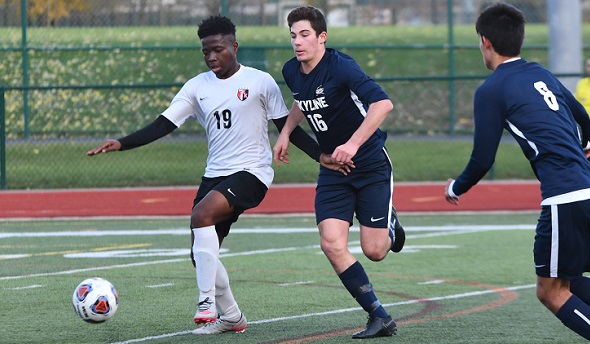
PHOTO: East Kentwood and Ann Arbor Skyline play for last season’s Division 1 boys soccer championship.