

Tales of Teams, Trophies & Trinkets - Vol 2
By
Ron Pesch
MHSAA historian
February 9, 2017
A picture may be worth a thousand words – but often, we can learn as much from a traveling trophy, game ticket, and even an old megaphone.
Michigan’s high school sports history is more than a century old and filled with legends passed on of games, teams and athletes and the roles they played as our communities rolled forward toward present day. Following up last year’s “Tales of Teams, Trophies & Trinkets,” we present a second chapter highlighting artifacts that tell some of those stories.
|
1909 |
Saginaw vs. Saginaw Arthur Hill |
Football Trophy |
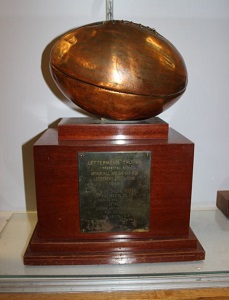 This bronzed football was the original used in the 1909 Thanksgiving Day contest played between Saginaw High and Saginaw Arthur Hill, and won by Saginaw, 5-0 at Burkart Park. In 1948, the ball was stylized into a trophy by the Letterman’s Associations of the rival schools, designed to travel between schools as the reward for winning the annual contest. When the Lumberjacks of Arthur Hill ripped off 24 straight victories beginning in 1971 (the teams played twice in 1974), ownership of the trophy was mostly forgotten. When talk of closing Saginaw High School mounted, the trophy was placed on display at Saginaw’s Castle Museum, then donated to the Saginaw County Sports Hall of Fame.
According to Jeffrey Cottrell, the multi-media specialist at the Historical Society of Saginaw County, when plans to close Saginaw High did not materialize, “it was decided amongst the Saginaw County Sports Hall of Fame and the Arthur Hill Letterwinners Association that it was time to put it back into use. This past fall, the Sports Hall of Fame awarded the trophy to Saginaw High when they beat Arthur Hill 40-0.”
Going forward, the Letterman's Trophy will continue to be presented to the winner of the football game between the Trojans and the Lumberjacks.
|
1921 |
Detroit Cass Tech vs. Flint Central |
Football Program |
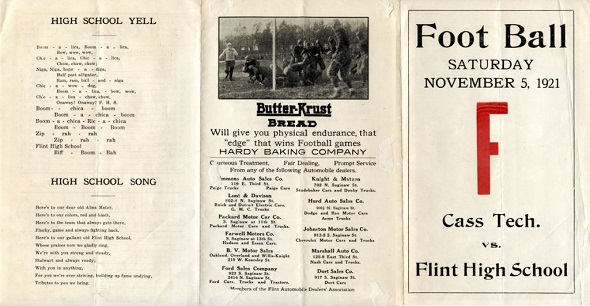
A crowd of 2,500 was on hand for this contest as Detroit Cass Tech downed Flint Central, 34-20, in an aerial battle between the squads. The Detroit Free Press arraigned for a special interurban run, with special railcars earmarked for Cass Tech students interested in attending the Saturday game at Flint. Between 200 to 300 made the trip to cheer their team to victory.
Flint Central completed 14 of 34 passes for 176 yards, but was intercepted on six occasions. Cass Tech arms were accurate on only 7 of 24 attempts for 160 yards, with four interceptions, but two completions went for touchdowns of 18 yards and 50 yards. A third pass of 35 yards helped set up the visitor’s first score. Bruno Murkobred, Cass Tech’s speedy quarterback, was the star of the contest, scoring three of his team’s five touchdowns.
|
1939 |
Kalamazoo Central vs. Battle Creek Central |
Basketball Program |
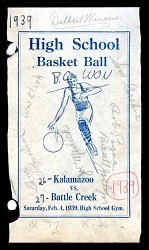 This tattered memento, from a scrapbook kept by historian Dick Kishpaugh, illustrates the modest design of a high school basketball program back in 1939. Likely created by the high school print shop, this single sheet, printed specifically for distribution at the game, features autographs gathered by its owner. Wes Clark, one of the names captured on the cover, led Battle Creek Central with 10 points, including a pair of buckets in the final minute to secure a 27-26 win by the Bearcats.
Newspaper reports from the time indicate that halftime of the contest would feature “a table tennis exhibition between Helen Van Dyke of Flint, four-time state champion, and Floyd Painter, Battle Creek champion.” Miss Van Dyke was a sophomore at Olivet College at the time.
|
1940 |
Lansing Eastern vs. Lansing Central |
Football Program |
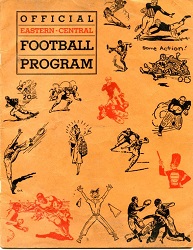 This is the program cover from the 13th annual Football Classic between the Quakers of Eastern and the Big Reds of Central. Fans were requested to “refrain from making unnecessary noise as they drive away from the stadium … due to the nearness of Sparrow Hospital.”
At the time of the 1940 contest, Lansing Central led the series with six wins against five defeats. The series featured a single tie, a 6-6 result in 1935.
Eastern’s 1940 squad, coached by Walter Graff, was able to knot the series at six wins apiece with a thrilling 7- 6 victory over the crosstown rivals, coached by Al Bovard.
The 16-page document was hand set and printed by the Eastern and Central High School Vocational Printing Classes, and included rosters, messages from the two school principals and athletic directors, as well as comments from each member of the coaching staffs, team captains, student council presidents and numerous team members from each school with their views on the game. Of course there is a photograph of each high school football team, but also photos of each band, their directors, and a list of the band members for both Eastern and Central. Finally, there are photos of the Eastern and Central Yell Leaders, nine for the Quakers and six for the Big Reds.
It is a true work of art.
|
1950 |
Central Michigan College Relays |
Track Medal |
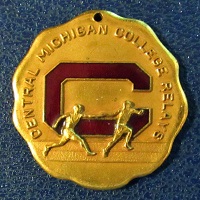 More than 2,300 athletes from 97 high schools descended upon Mt. Pleasant for the Tenth Annual Central Michigan Relays. Ecorse in Class B and Flint School for the Deaf in Class D earned team titles on Friday, May 5th while on Saturday, the 6th, Flint Northern and Milan won Class A and Class C, respectively. Six event records fell during the two-day event, three in the broad jump.
This medal, honoring a member of the winning Class C sprint relay team, was awarded at the event. The winning team, and therefore, the name of the individual awarded the medal, remain a mystery.
|
1962 |
Saginaw Sacred Heart |
Megaphone |
 As at the majority of schools across the state at the time, athletic competition against other schools was not an option for Gloria Groll and her female classmates during her days as a student at Saginaw Holy Rosary High School. So, from the fall of 1959 until her graduation with 27 other students in the spring of 1962, she was a cheerleader for the Greyhounds. This beautiful megaphone, donated by Groll to the Saginaw County Sports Hall of Fame, is a memento from those times.
Holy Rosary was one of nine Catholic high schools operating in the Saginaw area in the 1950s and 1960s. Population shifts from the cities to the suburbs over the coming years would impact enrollment figures at schools nationally. In Saginaw, the opening of the Buena Vista School District in 1956 directly impacted Holy Rosary. In 1970 the school closed. A year later only three schools – SS Peter and Paul, St. Mary and Saginaw St. Stephen – remained. In 1984, those schools were consolidated to form Saginaw Nouvel Catholic Central.
|
1963 & 1930 |
Grosse Pointe St. Paul |
League Trophies |
 On the left, we find the trophy awarded to Grosse Pointe St. Paul's after winning the 1963 city championship. Bob Martin, a 6-foot-6 junior who earned first division all-Catholic honors, scored 14 of his 22 points in the fourth quarter to lead the Lakers to a 55-46 upset-victory over Detroit Pershing. The game was played at University of Detroit Memorial before 6,979 spectators. It was the first time since 1958 that the Catholic League won the annual matchup with the champions of the Public School League.
To the right is the trophy awarded to St. Paul for winning the first golf tournament of the South Michigan Catholic High School League. The school's four golfers shot 710 over 36 holes on the day, 69 fewer strokes than second-place Detroit St. Rose. Played at Clinton Valley, the event saw Bill Beaupre win individual honors with a total of 158, including 76 in the morning. His cousin and teammate, Harold Beaupre, finished second with 169, while Peter Bononis of Detroit Holy Name was third with 171 strokes.
|
1965 |
Fennville vs. Kalamazoo Hackett |
Ticket Stub |
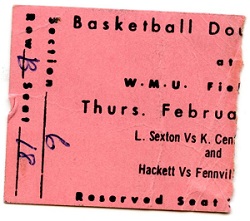 This ticket stub from a doubleheader hosted at Western Michigan University’s Read Fieldhouse on February 18, 1965 was the first chance for many to witness lightning in a bottle. A capacity-plus crowd of 9,100 fans slid through the gate to watch a rumor.
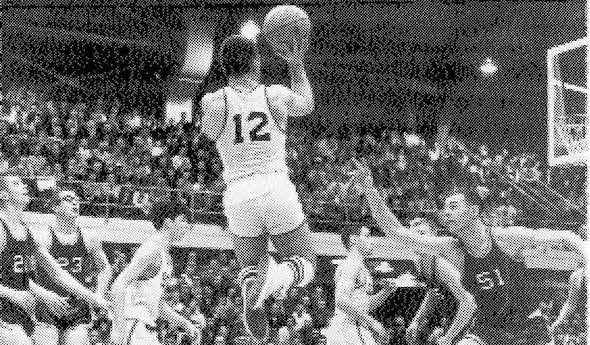
The antics of 5-foot-7½ guard Richie Jordan had been talked about around the Kalamazoo area, but few had actually seen him play. His skills were on full display on this Thursday night, as he netted a fieldhouse scoring record with 49 points in a come-from-behind 76-72 win over a much taller team from Kalamazoo Hackett. Jordan’s output during the evening’s second game eclipsed the 45 points Manny Newsome scored for Western Michigan University against Toledo, just over a year before.
The evening hadn’t started well. According to the Kalamazoo Gazette, “Jordan hit only six of his 13 field shots in the first half and threw the ball away eight times. Trailing Hackett by 17 points, 50-33, with two minutes to play in the third quarter, the Blackhawks were able to cut the deficit to 13, 60-47 as the teams entered the final frame.
Quickly, everyone in the fieldhouse knew who was getting the ball during the comeback attempt. Jordan grabbed control; with his drives for layups and “softly-arched” jump shots against intense pressure, he hit seven of nine field goals, wowing the crowd. With 2:36 to play, Jordan nailed a pair of free throws to tie the game at 72 all. Then, with 57 seconds left, the “Fennville Flash” nailed the go-ahead basket, followed by two insurance free throws to seal the win. For many, his 24 points in the fourth quarter sealed his journey from rumor to legend and, no doubt, inspired the single-sentence first paragraph of the next morning’s coverage in the Gazette.
“Yes, there is a Richie Jordan!”
(P.S. – Kalamazoo Central upset eighth-ranked Lansing Sexton, 67-57, in the evening’s opening contest).
 Ron Pesch has taken an active role in researching the history of MHSAA events since 1985 and began writing for MHSAA Finals programs in 1986, adding additional features and "flashbacks" in 1992. He inherited the title of MHSAA historian from the late Dick Kishpaugh following the 1993-94 school year, and resides in Muskegon. Contact him at [email protected] with ideas for historical articles.
PHOTO: Fennville's Richie Jordan pulls up for a jumper, showing off the form that's become iconic when recalling the high school phenom. (Photos of Letterman's Trophy and Megaphone were provided by Jeffery Cottrell, and photo of Grosse Pointe trophies was provided by Bill Roose.)
Flyers to Terriers, Quakers & Orioles
December 15, 2020
By Ron Pesch
Special for Second Half
Education and all that comes with it, in case you haven’t noticed, is changing. Of course, that’s always been the case. Virtual learning is simply the latest transformation.
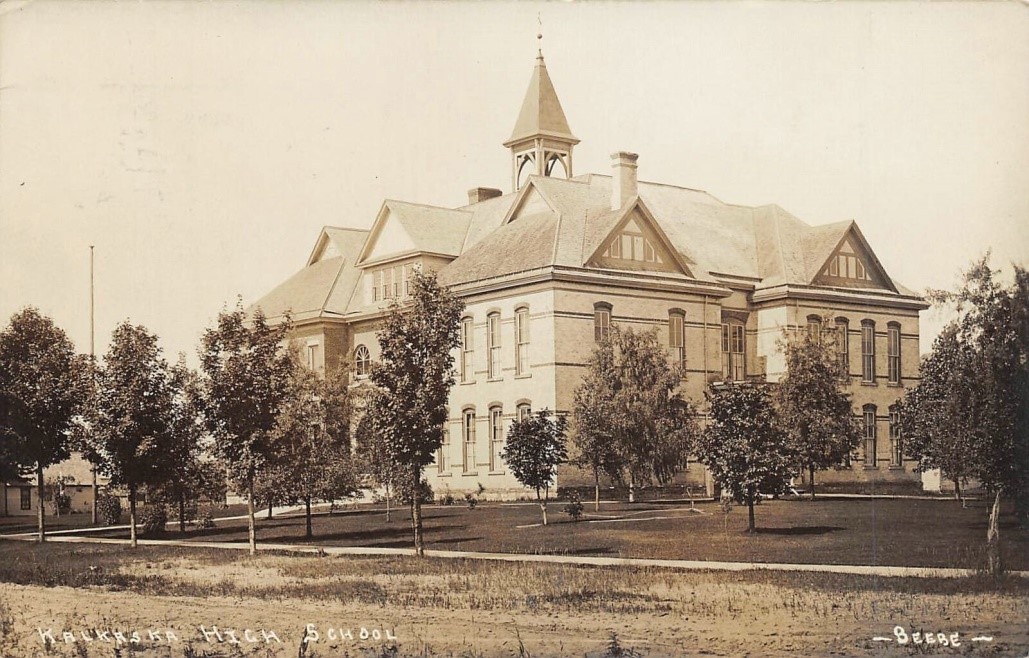
Once we were a nation filled with one-room school houses. By 1910, postcard evidence shows that, at least in Michigan, nearly every town of size had a high school, and that these buildings were showcases for community pride. From wood to brick to limestone, many of the earliest structures had bell towers. By the 1920s, in larger cities, small schools run by neighborhood churches were quite common. Most from those days were multiple-story buildings.
In hindsight, some of those buildings seem incredibly large for the communities they served. Others, too small – especially come the post-war baby boom era, when the suburbs exploded with growth and opportunity and Michigan’s major cities began to shrink in size. The 1950s and 1960s saw numerous Upper Peninsula and rural schools consolidate, while various big-city suburban districts split into two.
 Continued development beyond the first ring of suburbs and decreasing birth rates have combined, with the introduction of school of choice in 1996, to played havoc with enrollments and facilities in more recent times. Today, public and private academies seem to pop up and disappear overnight.
For someone trying to follow along, there are plenty of challenges.
A TOOLBOX
Historians, like many others, require a toolbox to accomplish their work. One of my favorite tools is a spreadsheet that I created several years back. I refer to it as “The List.” It’s my Master List of Michigan High Schools, and I reference it often. But lately, the document has been in a bit of disarray.
It’s been a mess before. Without a focused sabbatical or a grant, it likely will never be polished quite to my satisfaction.
Lost somewhere in time
Scattered to the four winds are details about the naming of schools, their consolidations, relocations and closings. Sadly, stories of how and why schools selected nicknames are often forgotten.
Parochial schools can present challenges of their own. Seemingly countless have opened, closed, consolidated or relocated over the years in Michigan. The city of Detroit alone has played host to a least 32 “Saint” high schools, from St. Agatha to St. Vincent.
 Detroit Catholic Central’s history includes five sites in three separate cities. As noted in my document, Catholic Central is an “All-Boys” school and today located in Novi. Few recall that, beginning in the fall of 1928, there was also a Detroit Girls Catholic Central. It closed in 1969.
Grand Rapids Catholic Central, founded in 1906, states it is the “oldest coeducational Catholic high school in the nation.” They have been known as the Cougars since 1930 or before. Muskegon Catholic Central consolidated three local schools – St. Mary, St. Joseph and St. Jean – and opened in the fall of 1953.
Flint Powers represents another example. My spreadsheet notes that the school’s full name is Flint Powers Catholic Central, and that it was named in honor of Rev. Luke M. Powers. The athletic teams are nicknamed the Chargers. The school was formed by the merger of seven Genesee County schools in 1970 – Flint Catholic schools Holy Redeemer, St. Agnes, St. John Vianney, St. Mary, St. Matthew, St. Michael and Mt. Morris St. Mary. Within the spreadsheet, I also capture their team nicknames: Flyers, Crusaders, Hornets, Wildcats, Panthers, Warriors, and Shamrocks, valuable information in case I find opportunity to write about their athletic accomplishments.
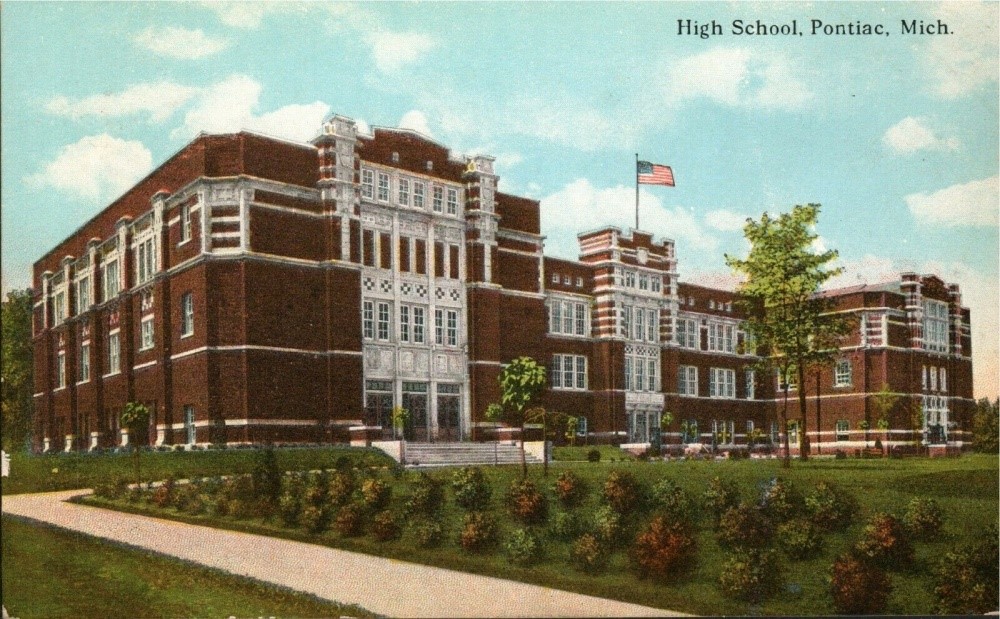
Garden City High School split into Garden City East and West in the mid-1960s, then reunited beginning with the 1982-83 school year. Royal Oak divided into Dondero and Kimball high schools in the late ’50s. They again unified in 2006. Pontiac High School split into Central and Northern in 1958. They merged back into Pontiac High in 2009.
More recently, in 2012, Wyoming Park and Wyoming Rogers merged. Ypsilanti Willow Run and Ypsilanti High School consolidated into Ypsilanti Community Schools in 2013.
Flint’s oldest high school, Central, shuttered in 2009, followed by Flint Northern in 2013. Albion was absorbed into Marshall in 2013. Word is Saginaw and Saginaw Arthur Hill will soon unite.
 Once, Michigan had four high schools that used “Flyers” as their nickname: previously mentioned Flint Holy Redeemer, Detroit St. Andrew, Grosse Pointe St. Paul and Willow Run, which used the nickname as a nod to the area’s ties to Airforce Plant 31, constructed by Ford to manufacture twin-finned B-24 bombers during the early 1940s for the war effort. Today, there are no schools left in Michigan that carry the nickname.
“The List” reminds me that Ferndale changed from the “Railsplitters” to the “Eagles” when they moved from old Ferndale Lincoln High into the newly-opened Ferndale High School in the fall of 1958. They are not to be confused with the “Railsplitters” of Ypsilanti Lincoln or Lincoln Park.
Caledonia once used “Scotties” as the nickname for its athletic teams, but the students chose to change the nickname to the more intimidating “Fighting Scots” in the late 1960s. (I’m still trying to chase down the actual school year of the alteration.)
“The List” explains why the Midland “Chemics” have a lion named Vic for a mascot. (It seems that in 1938, a new high school was built and “the Student Union decided to start some new traditions in order to display pride in their new high school. The school purchased a stuffed lion – a symbol of pride – to be used as a mascot. The name Vic was chosen for the mascot in short for the word ‘Victory’, voted in by the students.”)
Uniqueness
Distinctive nicknames fascinate me, but I always want the story behind the choice. I have written on the subject previously. Digging around the internet, I recently found a reference that was new to me. Alpena St. Anne’s high school athletic teams apparently were nicknamed the “Couturemen.”
The dictionary describes “Couture” as a designer, maker and seller of custom clothing. The word is French in origin. So I shipped off an e-mail the other day to a parish secretary in Alpena, with a question about the very unusual nickname. My question worked its way to Fr. Frank Muszkiewicz.
“St. Anne Church had been the "French" church here in Alpena when there were the more ethnic heritage Catholic communities,” he responded. “My understanding is that St. Anne had a high school until 1951, when Catholic Central High School opened in Alpena …
“Looking at a history book of St. Anne Church in Alpena,” he continued, “I did see a couple of pictures of boys' basketball teams from the 1920's and 1940's, however it seems the team name was the "Big Reds". So, I'm not sure where the "Couturemen" name came from that you found.”
From the late 1920s into the 1940s, it became quite popular to tie nicknames to teams. But before a moniker was assigned, it wasn’t unusual for newspaper writers to refer to a team by the school colors, or blend the last name of a coach with the word “men” when penning a story about a local squad. For example, Bay City Central’s teams often were called “Nevittmen” after coach Garland Nevitt before taking on the nickname “Wolves” around 1927. Muskegon’s teams were “Jacksmen” after their coach, J. Francis Jacks, before they were called the “Big Reds.”
A December 1940 newspaper, covering a game between Ludington St. Simon and St. Anne, gives a hint that this might be the case at St. Anne’s. A player at St. Anne, who happened to foul out of the game, had the last name, Couture. Perhaps there is a similar connection in St. Anne’s history.
Identities
In September 1928, Lansing Eastern athletic teams became known as the Quakers. “The name is derived from the location of the school,” stated the Lansing State Journal, explaining the unusual choice. “Pennsylvania was the original home of the Quakers of the Colonial period of our history, and the new high school, being situated on Pennsylvania Avenue, will be known by the name of the original settlers in the Keystone State.”
 In a November 1929 contest conducted by the State Journal, East Lansing, “long without a nickname,” became the Trojans. “The nickname was the choice of more than 50 per cent of the students.”
In May 1930, The Ludington Daily News noted that “Recently the Northern Michigan Big Six Athletic conference stimulated interest among pupils of the six cities in athletics and team competition … High School pupils of the respective towns proposed nicknames for their school teams and indicated their favorite by vote. Manistee chose the name of ‘Chippewas,’ Traverse City, ‘Trojans,’ Petoskey ‘Northmen,’ Cadillac ‘Vikings’ and Big Rapids ‘Cardinals.’ The time-honored name of ‘Orioles’ was voted to be retained by Ludington high school pupils, completing the list of six schools.”
Impressed, the Daily News quickly went to work to sponsor a county-wide contest with schools in Oceana County to select team nicknames. Later in the month, they announced results of the project.
“Scottville high school teams will henceforth be known as ‘Spartans,’ and Freesoil aggregation as ‘Buccaneers.’
“The team nicknames were decided upon by pupils of their respective institutions under a program of selections sponsored by the News.
“Two schools, Custer and Shelby, will retain their original team titles, (Ludington) St. Simon’s and Hart have not announced a final decision and Pentwater and Walkerville have made no report.”
Scottville’s choice of “Spartans” succeeded the name ‘Canners’ which had been used for a number of years, “a significant, but an unpicturesque appellation.” A rich agricultural part of the state, Scottville was home to a huge W.R. Roach and Co. canning facility. It closed in 2000 after nearly 90 years in business, displacing nearly 300 workers. “Wolverines” had also “won a goodly number of votes as did ‘Hornets.’”
“Cardinals” was retained at Custer.
“Word from Coach T.T. Thatcher at Shelby discloses Shelby’s choice as ‘Pee Wees.’ A selection made last year.
“Shelby voted in 1929 to use that name,’ he says, ‘and since then we have used an emblem on all our suits showing a Pee Wee and S.H.S on it. Our school colors are purple and white so the name is symbolic of the colors.”
For two of the schools, the decisions must have been relatively short-lived. By 1934, Shelby was using the nickname “Tigers.” Freesoil’s nickname had evolved into “Pirates” by the 1940s.
Earlier this year, the Hillsdale Daily News did a series of articles on the history of nicknames for schools in its coverage area. Hillsdale became the ‘Hornets’ in October 1932 following a poll of current football players and faculty. The Daily News at the time announced the nickname had won by a wide margin. Pittsford, it’s believed, first introduced its use of “Wildcats” “around the time the district consolidated in 1938.” At Waldron, “Spartans” was selected over “Lions” and “Bears” in a contest run by the school newspaper, also in 1938. “Students at the time were likely influenced by Waldron’s proximity to Michigan State University, among other factors,” noted the paper.
 The Daily News piece on Litchfield was of special interest to me. The only high school in Michigan nicknamed Terriers, I didn’t know much about its origins – only that from my previous research, the nickname had survived a proposed alteration by the Litchfield Student Council during the 1956-57 school year.
“They aroused quite a discussion within the student body as to the idea of changing the name of our team – Terriers.” stated the school’s yearbook. “But the idea was dropped.”
“According to Litchfield schools employee Judy Bills, the Litchfield Terriers mascot came about through the influence of former teacher and coach Al Terry in the 1930s,” stated the Daily News article. “It was while Terry was teacher and coach in Litchfield schools that the athletic teams became known as the Litchfield Terriers, Bills said.”
For a historian, sometimes answers spur more questions.
Was Litchfield’s team nickname also swayed by Major League Baseball?
Allen Terry coached at Litchfield from 1932 through the fall of 1940 before continuing his career at Plainwell High School.
Interestingly, during that same timespan, a future MLB Hall of Fame inductee, Bill Terry, served as player-manager of the New York Giants. His team’s often grabbed newspaper headlines with a reference to the phrase, “Terry’s Terriers” in the connected article.
 Did the sharing of “Terry” as a last name influence the nickname selection in Litchfield?
Who knows what the future holds for education, school districts and team nicknames across Michigan. Ypsilanti Community School students in grades 7-12 picked Grizzlies over Trailblazers and Flyers in 2013. There are six “Bears,” two “Black Bears” and a single “Polar Bears” on the MHSAA current active lists. Now there is one “Grizzlies.”
Today, “The List” contains 1,438 active and inactive high schools and totals 289 unique nicknames.
Wait.
There’s a St. Helen Charlton Heston Academy? It’s named after the actor, who played Moses in “The Ten Commandments.” It seems he spent part of his childhood in the area.
Make that 1,439.
(Thanks Eric Albright for the ‘Vic the Lion’ Story. I continue to seek out information on old departed high schools in Michigan as well as the stories behind nicknames. Please drop me a line.)
Ron Pesch has taken an active role in researching the history of MHSAA events since 1985 and began writing for MHSAA Finals programs in 1986, adding additional features and "flashbacks" in 1992. He inherited the title of MHSAA historian from the late Dick Kishpaugh following the 1993-94 school year, and resides in Muskegon. Contact him at [email protected] with ideas for historical articles.
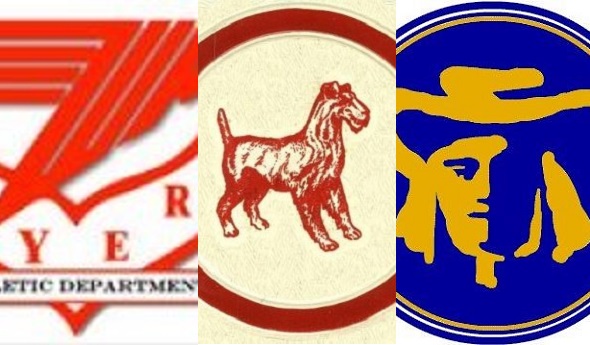
PHOTOS: (Top) Logos which have come, and sometimes gone along with those MHSAA schools through the years. (2) Kalkaska High School – from a postcard postmarked 1908. (3) Old Pontiac High School, built in 1913-14, became known as Pontiac Central once Pontiac Northern opened in 1958. (4) Ypsilanti Willow Run’s Flyers logo. (5) The logo used by Lansing Eastern’s Quakers. (6) Litchfield’s Terrier, as it appeared on the cover of the 1963 yearbook. (7) The logo for St. Helen Charlton Heston Academy’s Patriots. (Images collected by Ron Pesch.)