

Tales of Teams, Trophies & Trinkets - Vol 2
By
Ron Pesch
MHSAA historian
February 9, 2017
A picture may be worth a thousand words – but often, we can learn as much from a traveling trophy, game ticket, and even an old megaphone.
Michigan’s high school sports history is more than a century old and filled with legends passed on of games, teams and athletes and the roles they played as our communities rolled forward toward present day. Following up last year’s “Tales of Teams, Trophies & Trinkets,” we present a second chapter highlighting artifacts that tell some of those stories.
|
1909 |
Saginaw vs. Saginaw Arthur Hill |
Football Trophy |
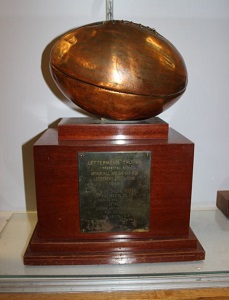 This bronzed football was the original used in the 1909 Thanksgiving Day contest played between Saginaw High and Saginaw Arthur Hill, and won by Saginaw, 5-0 at Burkart Park. In 1948, the ball was stylized into a trophy by the Letterman’s Associations of the rival schools, designed to travel between schools as the reward for winning the annual contest. When the Lumberjacks of Arthur Hill ripped off 24 straight victories beginning in 1971 (the teams played twice in 1974), ownership of the trophy was mostly forgotten. When talk of closing Saginaw High School mounted, the trophy was placed on display at Saginaw’s Castle Museum, then donated to the Saginaw County Sports Hall of Fame.
According to Jeffrey Cottrell, the multi-media specialist at the Historical Society of Saginaw County, when plans to close Saginaw High did not materialize, “it was decided amongst the Saginaw County Sports Hall of Fame and the Arthur Hill Letterwinners Association that it was time to put it back into use. This past fall, the Sports Hall of Fame awarded the trophy to Saginaw High when they beat Arthur Hill 40-0.”
Going forward, the Letterman's Trophy will continue to be presented to the winner of the football game between the Trojans and the Lumberjacks.
|
1921 |
Detroit Cass Tech vs. Flint Central |
Football Program |
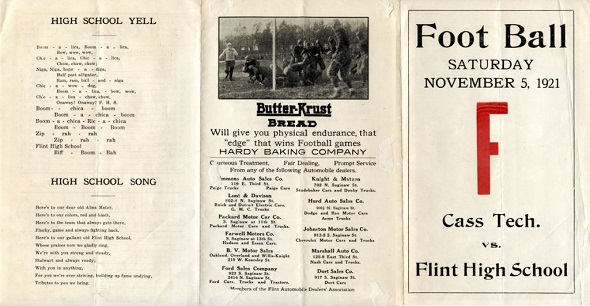
A crowd of 2,500 was on hand for this contest as Detroit Cass Tech downed Flint Central, 34-20, in an aerial battle between the squads. The Detroit Free Press arraigned for a special interurban run, with special railcars earmarked for Cass Tech students interested in attending the Saturday game at Flint. Between 200 to 300 made the trip to cheer their team to victory.
Flint Central completed 14 of 34 passes for 176 yards, but was intercepted on six occasions. Cass Tech arms were accurate on only 7 of 24 attempts for 160 yards, with four interceptions, but two completions went for touchdowns of 18 yards and 50 yards. A third pass of 35 yards helped set up the visitor’s first score. Bruno Murkobred, Cass Tech’s speedy quarterback, was the star of the contest, scoring three of his team’s five touchdowns.
|
1939 |
Kalamazoo Central vs. Battle Creek Central |
Basketball Program |
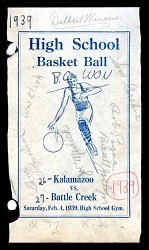 This tattered memento, from a scrapbook kept by historian Dick Kishpaugh, illustrates the modest design of a high school basketball program back in 1939. Likely created by the high school print shop, this single sheet, printed specifically for distribution at the game, features autographs gathered by its owner. Wes Clark, one of the names captured on the cover, led Battle Creek Central with 10 points, including a pair of buckets in the final minute to secure a 27-26 win by the Bearcats.
Newspaper reports from the time indicate that halftime of the contest would feature “a table tennis exhibition between Helen Van Dyke of Flint, four-time state champion, and Floyd Painter, Battle Creek champion.” Miss Van Dyke was a sophomore at Olivet College at the time.
|
1940 |
Lansing Eastern vs. Lansing Central |
Football Program |
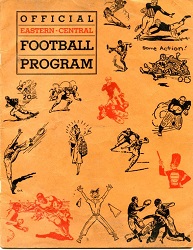 This is the program cover from the 13th annual Football Classic between the Quakers of Eastern and the Big Reds of Central. Fans were requested to “refrain from making unnecessary noise as they drive away from the stadium … due to the nearness of Sparrow Hospital.”
At the time of the 1940 contest, Lansing Central led the series with six wins against five defeats. The series featured a single tie, a 6-6 result in 1935.
Eastern’s 1940 squad, coached by Walter Graff, was able to knot the series at six wins apiece with a thrilling 7- 6 victory over the crosstown rivals, coached by Al Bovard.
The 16-page document was hand set and printed by the Eastern and Central High School Vocational Printing Classes, and included rosters, messages from the two school principals and athletic directors, as well as comments from each member of the coaching staffs, team captains, student council presidents and numerous team members from each school with their views on the game. Of course there is a photograph of each high school football team, but also photos of each band, their directors, and a list of the band members for both Eastern and Central. Finally, there are photos of the Eastern and Central Yell Leaders, nine for the Quakers and six for the Big Reds.
It is a true work of art.
|
1950 |
Central Michigan College Relays |
Track Medal |
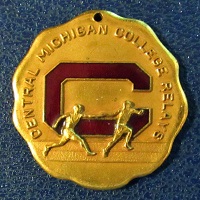 More than 2,300 athletes from 97 high schools descended upon Mt. Pleasant for the Tenth Annual Central Michigan Relays. Ecorse in Class B and Flint School for the Deaf in Class D earned team titles on Friday, May 5th while on Saturday, the 6th, Flint Northern and Milan won Class A and Class C, respectively. Six event records fell during the two-day event, three in the broad jump.
This medal, honoring a member of the winning Class C sprint relay team, was awarded at the event. The winning team, and therefore, the name of the individual awarded the medal, remain a mystery.
|
1962 |
Saginaw Sacred Heart |
Megaphone |
 As at the majority of schools across the state at the time, athletic competition against other schools was not an option for Gloria Groll and her female classmates during her days as a student at Saginaw Holy Rosary High School. So, from the fall of 1959 until her graduation with 27 other students in the spring of 1962, she was a cheerleader for the Greyhounds. This beautiful megaphone, donated by Groll to the Saginaw County Sports Hall of Fame, is a memento from those times.
Holy Rosary was one of nine Catholic high schools operating in the Saginaw area in the 1950s and 1960s. Population shifts from the cities to the suburbs over the coming years would impact enrollment figures at schools nationally. In Saginaw, the opening of the Buena Vista School District in 1956 directly impacted Holy Rosary. In 1970 the school closed. A year later only three schools – SS Peter and Paul, St. Mary and Saginaw St. Stephen – remained. In 1984, those schools were consolidated to form Saginaw Nouvel Catholic Central.
|
1963 & 1930 |
Grosse Pointe St. Paul |
League Trophies |
 On the left, we find the trophy awarded to Grosse Pointe St. Paul's after winning the 1963 city championship. Bob Martin, a 6-foot-6 junior who earned first division all-Catholic honors, scored 14 of his 22 points in the fourth quarter to lead the Lakers to a 55-46 upset-victory over Detroit Pershing. The game was played at University of Detroit Memorial before 6,979 spectators. It was the first time since 1958 that the Catholic League won the annual matchup with the champions of the Public School League.
To the right is the trophy awarded to St. Paul for winning the first golf tournament of the South Michigan Catholic High School League. The school's four golfers shot 710 over 36 holes on the day, 69 fewer strokes than second-place Detroit St. Rose. Played at Clinton Valley, the event saw Bill Beaupre win individual honors with a total of 158, including 76 in the morning. His cousin and teammate, Harold Beaupre, finished second with 169, while Peter Bononis of Detroit Holy Name was third with 171 strokes.
|
1965 |
Fennville vs. Kalamazoo Hackett |
Ticket Stub |
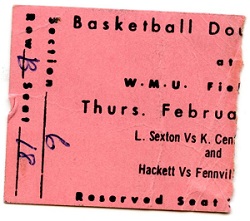 This ticket stub from a doubleheader hosted at Western Michigan University’s Read Fieldhouse on February 18, 1965 was the first chance for many to witness lightning in a bottle. A capacity-plus crowd of 9,100 fans slid through the gate to watch a rumor.
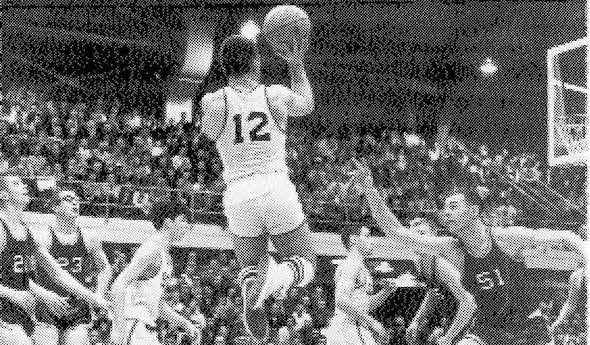
The antics of 5-foot-7½ guard Richie Jordan had been talked about around the Kalamazoo area, but few had actually seen him play. His skills were on full display on this Thursday night, as he netted a fieldhouse scoring record with 49 points in a come-from-behind 76-72 win over a much taller team from Kalamazoo Hackett. Jordan’s output during the evening’s second game eclipsed the 45 points Manny Newsome scored for Western Michigan University against Toledo, just over a year before.
The evening hadn’t started well. According to the Kalamazoo Gazette, “Jordan hit only six of his 13 field shots in the first half and threw the ball away eight times. Trailing Hackett by 17 points, 50-33, with two minutes to play in the third quarter, the Blackhawks were able to cut the deficit to 13, 60-47 as the teams entered the final frame.
Quickly, everyone in the fieldhouse knew who was getting the ball during the comeback attempt. Jordan grabbed control; with his drives for layups and “softly-arched” jump shots against intense pressure, he hit seven of nine field goals, wowing the crowd. With 2:36 to play, Jordan nailed a pair of free throws to tie the game at 72 all. Then, with 57 seconds left, the “Fennville Flash” nailed the go-ahead basket, followed by two insurance free throws to seal the win. For many, his 24 points in the fourth quarter sealed his journey from rumor to legend and, no doubt, inspired the single-sentence first paragraph of the next morning’s coverage in the Gazette.
“Yes, there is a Richie Jordan!”
(P.S. – Kalamazoo Central upset eighth-ranked Lansing Sexton, 67-57, in the evening’s opening contest).
 Ron Pesch has taken an active role in researching the history of MHSAA events since 1985 and began writing for MHSAA Finals programs in 1986, adding additional features and "flashbacks" in 1992. He inherited the title of MHSAA historian from the late Dick Kishpaugh following the 1993-94 school year, and resides in Muskegon. Contact him at [email protected] with ideas for historical articles.
PHOTO: Fennville's Richie Jordan pulls up for a jumper, showing off the form that's become iconic when recalling the high school phenom. (Photos of Letterman's Trophy and Megaphone were provided by Jeffery Cottrell, and photo of Grosse Pointe trophies was provided by Bill Roose.)
Young to Lead BCAM's Next Generation
By
Tom Markowski
Special for Second Half
November 30, 2018
PLYMOUTH – The Basketball Coaches Association of Michigan recently celebrated its 42nd year – and starting Jan. 1, BCAM will welcome just its fourth executive director.
 Tom Hursey, 74, will step down as executive director and hand the gavel over to Dan Young, Hursey’s assistant since 2010.
Young, 50, has been on the BCAM Board of Directors since 1999 and a BCAM member since 1994. He was a boys varsity head coach for 15 years spread over three schools and most recently coached the girls program at Salem (2016-18). He also coaches the boys and girls golf teams at Plymouth.
BCAM got its start in the early 1970s when Hursey, then the boys varsity head coach at Midland High; Ron Vondette, then the boys varsity coach at Carrollton; and other coaches in the Midland-Saginaw area formed the Mid-Michigan Basketball Coaches Association. Hursey and Vondette quickly learned that coaches throughout the state were interested in forming an association, and in 1976 the Michigan High School Basketball Coaches Association was formed. Seven years later, the name changed to what it is known as today – BCAM.
The goal of BCAM and its members is simple – to improve and help the sport grow at all levels.
But the challenges Young faces are quite different from those Hursey confronted when he became executive director in 1997. College recruiting has intensified over the past 20 years, and student-athletes transferring from one high school to another also has become more of a concern for BCAM and the Michigan High School Athletic Association.
In addition, Young said there are other topics his association is currently addressing.
“The buzz right now is seeding,” Young said. “And there’s a committee looking at adding two more games to the season, over the holidays (teams are currently limited to 20 regular season games). Tom and I will meet with (a representative from) the MHSAA to discuss the June camps.”
Though just in its preliminary stages, BCAM, in cooperation with the MHSAA, is seriously considering sponsoring a one-day camp for the top players in the state regardless of class. This is in response to the recommendations made last April by a commission led by Condoleezza Rice, the former U.S. Secretary of State, to aid college coaches in the recruitment of student-athletes. Simply put, the NCAA is attempting to limit how much influence AAU basketball has on the recruitment of high school students, and thereby allow high school coaches to have more influence over their players.
These camps, like the MHSAA/BCAM-sponsored Reaching Higher, allow a large number of players, often more than 100, to receive coaching from high school coaches with college coaches in the gym to evaluate. These also feature speakers who address topics such as entrance tests and what it takes to succeed at the next level, academically and athletically.
Young said the next version could be a two-day event, but he does have some concerns.
“We don’t want to disrupt team camps,” he said. “We’d like to run it with the culture of a team camp. It’s still in its early stages, but I think we’d like to get the top 100 or so players, those that are Division I type of players, and have coaches like (Michigan State coach) Tom Izzo, (Michigan coach) John Beilein, Greg Kampe from Oakland and others be there. Maybe it’ll lasts eight hours. Maybe six. We’d have guest speakers, too.
“It’s possible we’d only invite 60 or 70. We’d take the seniors being recruited by Division I schools, as well as the juniors and sophomores.”
 The camp discussion is an example of why the transition is sure to be a smooth one. Hursey and Young are of one mind on the vast majority of issues BCAM faces. Though a generation apart, they see eye-to-eye on matters of importance. They discuss which battles should be fought and those they should avoid.
In many ways the transition is similar to that which took place within the MHSAA recently with Mark Uyl taking over for Jack Roberts as executive director. Uyl, 25 years Roberts’ junior, has stated that Roberts has left a legacy, and that he hopes to follow up on that legacy.
“Now that Mark Uyl has taken over, like Dan, a new generation has taken over,” Hursey said.
Hursey and Young are hoping seeding will be introduced within the boys and girls tournaments in the next year or two.
On the subject of transfers, Hursey and Young support the new rule instituted by the MHSAA, which states, in part, that a student who transfers will be ineligible for one full school year at the new school in any sports she or he participated in the previous year at the former school (but eligible immediately in all other sports).
Another concern with regard to transfers is the increasing numbers of top-level players leaving the state and enrolling at prep schools, like Findley Prep in Nevada and others. The most recent top player is Mark “Rocket” Watts who left Old Redford Academy in Detroit and is now enrolled at Spire Academy in Ohio. Watts was considered one of the top candidates for the Mr. Basketball Award, sponsored by BCAM.
Beyond educating players and coaches, and possibly parents, Hursey and Young say there’s little they can do from preventing parents from taking their child out of state.
“It’s a sign of the times,” Hursey said. “Dan and I met with Izzo and we talked for two hours about this. Izzo opened our eyes about it. Take the Old Redford (student). They offer him a beautiful dorm to live in, three square meals and the chance to travel around the country. How are we supposed to compete with that? Izzo said they’re playing 30-to-40 games but that only 10 or so are against the best teams. Those are the ones you see on TV.
“There are a lot of positives for staying with your high school. There’s a lot to be said about high school sports being played at a certain level. And there’s nothing like a Friday night basketball game played in front of 2,000 fans and the place rocking. We just have to keep with what we’re doing. We have to educate the coaches. Some of these fly-by-night operations don’t concentrate on the academic part of school. Yeah, we might lose some of our best players, but there are a lot of good players in this state and there still is great basketball being played. This is not just happening in Michigan. We met with the National (High School) Basketball Coaches Association. It’s a problem throughout the country. How can we compete with millionaires?”
Young said BCAM will continue to do what it does best, and that’s to serve coaches throughout the state and promote and help to improve the game through its many clinics and camps. The website, www.bcam.org, has been improved and updated recently, and provides members and nonmembers alike valuable information.
 Tom Markowski is a correspondent for the State Champs! Sports Network and previously directed its web coverage. He also covered primarily high school sports for the The Detroit News from 1984-2014, focusing on the Detroit area and contributing to statewide coverage of football and basketball. Contact him at [email protected] with story ideas for Oakland, Macomb and Wayne counties.
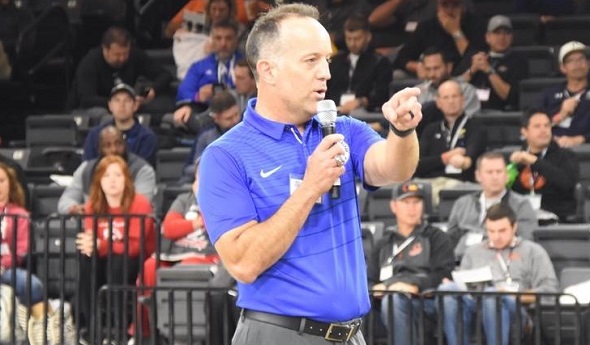
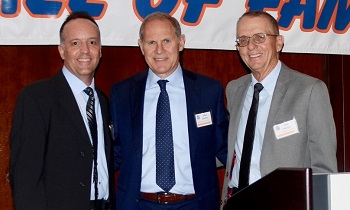
PHOTOS: (Top) Incoming BCAM executive director Dan Young speaks during an event. (Middle) Young and longtime BCAM executive director Tom Hursey, far right, with University of Michigan men’s basketball coach John Beilein. (Photos courtesy of Dan Young.)