

Tales of Teams, Trophies & Trinkets
By
Ron Pesch
MHSAA historian
March 30, 2016
High school athletics leaves behind an amazing array of treasures – although while buried in a keepsake box, or trophy case, the awards stand silent.
For many, their meaning and worth only continues to grow in value. Yet, in other cases, time can be cruel. For some trophies and trinkets, their worth diminishes as the stories contained within are lost behind retirements, neglect, administration decisions and death.
Following are a few tales that live on from more than a century of Michigan high school sports.
|
1909 |
Muskegon High School |
Track Trophy |
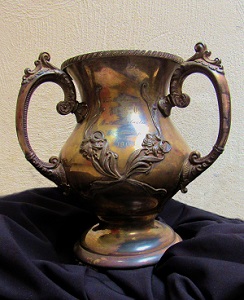 The search continues for the oldest state title trophy presented to a high school in the state of Michigan. This beauty, on display at Muskegon High School within the school’s storied trophy cases, currently leads the pack. In 1909, Muskegon coach Robert Zuppke’s team tallied 43½ points to win the fourth annual Michigan Agricultural College Interscholastic meet in Lansing. The total was the largest sum in the history of the meet, exceeding Detroit University School’s total of 27½ points and Detroit Central’s third-place total of 25 points.
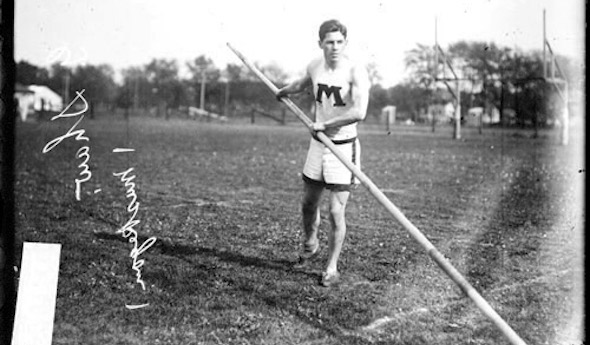
Dominant in the field events, Muskegon was led by George Shaw, who set a new record in the pole vault at 11 feet, 2 inches, and by George Cowley, whose 4:47 time in the mile also set a new mark. Cowley’s time in the mile ranked among the top in the middle west.
Zuppke moved on a year later to coach at Oak Park, Ill., then to the University of Illinois where he became known as one of the great coaching minds in the history of college football. Shaw would school at Northwestern University while Cowley spent some time at the University of Chicago following graduation.
|
1923 |
Dollar Bay |
2nd U.P. Class B Tournament |
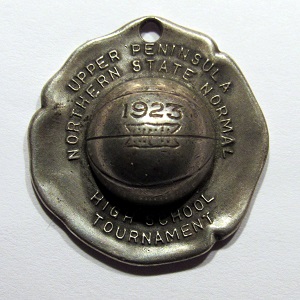 Someone within the Dollar Bay roster was once the proud owner of this silver basketball fob, given to team members by Northern Michigan Normal College for finishing second in the 6th annual Class B High School Basketball Tournament hosted at Northern State Normal College. According to documentation on the event, six sessions were held, and during presentation of the awards, only seven fobs were awarded to each of the top three teams. As was quite common at the time, only last names of players were mentioned in the game program and newspaper coverage. I guess back in the day, everyone who needed to know already knew the player’s first name.
Purchased on Etsy, perhaps this medal was owned by Stevens, who played one of the guard spots and served as team captain. He was responsible for all nine of the team’s points in the Class B championship game. Perhaps it belonged to Penphrase or Mattson, who each scored four points in the semifinal round, where Dollar Bay trounced Stambaugh 21-12. Munising defeated Newberry 15-10 in the semifinal, setting the stage for the title game. Munising won the Saturday evening contest, 17-9, and earned the right to play the Class A winner for the “supremacy of the Upper Peninsula." One week later at the Normal Gym, Munising topped Escanaba, winner of the Class A tournament, for the honor.
|
1927 |
J. Perry Austin |
Three Oaks |
4:57.3 |
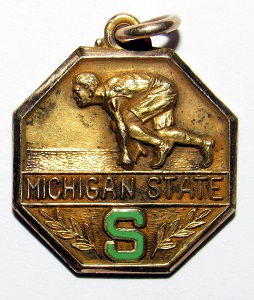 Along with his brother Phil, Joseph Perry Austin was one of 20 graduates in the class of 1927 at Three Oaks High School (Today known as Three Oaks River Valley). The most famous of the group was perhaps Joe Savoldi, who would star at Notre Dame.
The Austin boys moved to Three Oaks from Waukegan, Ill, when they reached high school age. There, Perry, as he was known among family and friends, would excel athletically and academically, winning the Class C MHSAA state championship in the mile and serving as valedictorian of his class. Phil was salutatorian. This medal, presented at Michigan State College of Agriculture and Applied Science (now Michigan State University) was found on Ebay.
Following graduation, Perry attended the University of Michigan, where he was crowned Big Ten Champion in the two mile in 1931. That same year, Austin was honored by the Big Ten with the conference’s prestigious Medal of Honor, awarded one per sport, for athletic and academic achievement in Track & Field. He would remain at Michigan, earning a doctorate in chemistry in 1935.
After graduation, he worked for Abbot Labs in Chicago. In the 1940s, Austin joined the seminary and became an Episcopalian priest, serving parishes in Wisconsin, Texas and Michigan. Ultimately, he returned to education, teaching high school chemistry in Toledo, Ohio. He passed away in 1991.
His brother Phil would ultimately become an internationally renowned watercolorist and a member of the exclusive American Water Color Society.
|
1940 |
Merrill Vandals scoreboard |
Castle Museum, Saginaw |
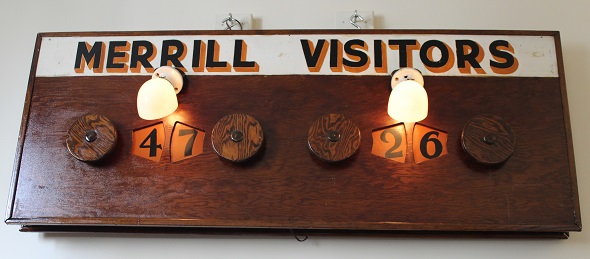 As the story goes, Merrill High School students built this scoreboard in shop class sometime during the late 1930s for use in their high school gymnasium. The board served the district for approximately the next 50 years. “It was always an honor to be selected as one of the kids to operate the scoreboard,” recalled Keith Clark, a former Merrill student who in later years served as a coach, then administrator in the district. “One kid would operate the home side and the other would operate the away side.”
When the new high school opened in 1956, the scoreboard remained in place at the building where it served junior high school teams until the 1980s. It was ultimately presented to Walt Krause, a longtime employee of the Merrill school district. Thanks to the efforts of Clark, and the kindness of the Krause family, the board eventually made its way to the Saginaw Sports Hall of Fame with a single stipulation – that the score displayed should always show Merrill leading.
|
1947 |
Brethren Dickson |
Basketball Team |
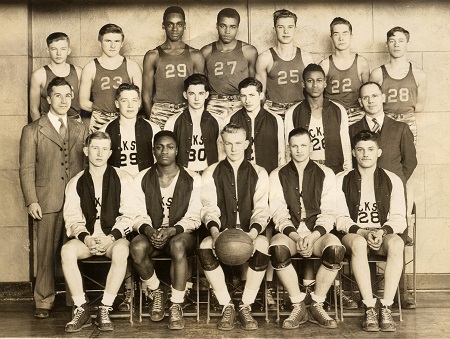 A scan of a photo cherished by the son of one of the team members, this team picture would likely go unnoticed mixed in with a stack of others. Yet, standing in the back row, wearing number 27, is an individual with a likeness, and most certainly a voice, that would be recognized by tens of millions. The Brethren Dickson basketball team of 1947 was eliminated early in the tournament. The 1932 team finished the year as runner-up to Portage for the Lower Peninsula’s Class D title. In 1963, Brethren lost in the state semifinals to eventual Class D state champion Britton.
Using his full given name, one can argue that James Earl Jones ranks with Earvin “Magic” Johnson as the state’s most famous basketball player, though his fame is for something entirely different than his ability to shoot a basketball.
|
1967 |
Ann Arbor University High School |
Track Trophy |
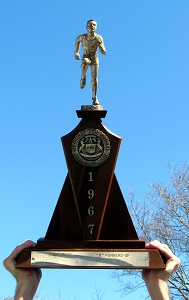 Found at a thrift store in Ann Arbor, it was purchased for $2.12, tax included. Showing its age, the trophy was earned by Ann Arbor University High’s track team that finished second to Detroit St. Charles.
Ann Arbor University High was a demonstration school operated by the University of Michigan’s School of Education. In 1922, the State of Michigan legislature approved $525,000 for the construction and furnishing of the building near the campus of the university. In the fall of 1924, the school was opened with 123 students in grades 7-12. In 1930, an elementary school was added. According to U-M’s Bentley Historical Library, “the school was used as a demonstration center for educators in the newer practices of educating children.”
University High’s athletic teams were nicknamed the Cubs, an obvious nod to the University of Michigan’s Wolverines. University High continued to operate into the 1960s, when a decision was made by U-M’s School of Education to close the school.
The 1967 team, led by Dave Shipman, finished second to Detroit St. Charles in point total, 64 to 47. Shipman, an individual winner in both the 100 and 220-yard events, also ran on University’s victorious 880 relay team. A year later, the final senior class graduated from the school.
|
1984 |
Brimley High School |
Volleyball |
 This medal dates to the days when champions were crowned in volleyball in both upper and lower peninsulas of Michigan. (In the year 2000, the tournament was unified.) This is another Ebay find.
Between 1980 and 1990 the U.P. staged a single open tournament for all schools north of the Mackinac Bridge. Despite competing against schools with much larger enrollment, the Brimley Bays captured seven titles during those 11 years of competition. Located just off I-75, coach Charles Compo’s team traveled extensively into the Lower Peninsula to gain experience. The time and travel paid dividends as the team captured five straight titles between 1981 and 1985. The 1984 title came with 15-3, 15-11 wins over Bessemer. That season, Compo was named U.P. Coach of the Year.
“Compo retired in 1990 with an amazing record of 408 victories and only 74 losses,” notes the Upper Peninsula Sports Hall of Fame, recognizing the achievements of those squads. “Seventeen of Compo's players would earn all-state honors, a total of 32 times.”
|
2009 |
Allison Pall |
East Grand Rapids |
1:50:09 |
 “When the boys on the football team got whiny about practice, their coach would bring them to one of our practices,” remembered Allison Pall, discussing the hours spent training before earning this medal as a member of the East Grand Rapids 200 medley relay team. Those practices were run by legendary swimming coach Milton “Butch” Briggs, Jr. Since taking on the task in fall of 1975, Briggs has led the girls to 19 MHSAA championships and the boys to 10 titles.
Pall, along with schoolmates Ally Bremer, Molly Lundquist, and Karly Surman won the 200 medley relay with an MHSAA Finals time of 1:50.09 at Eastern Michigan. A year later Pall, Bremer, Emily Lundquist and Katie Lachance again won the 200 medley relay, at 1:48.82 at Holland Aquatic Center. The girls clocked a 1:48:75 in the prelims the day prior, establishing a then-school record.
A late beginner in the sport, Pall took up competitive swimming in seventh grade. Following high school graduation, Pall headed to Ann Arbor to enroll at the University of Michigan, where she left behind her swimming career. Her height, an advantage in swimming, meant she was recruited to join the University Rowing team. She stayed for a season, deciding to dedicate herself to studies. Today, Allison is in pursuit of her Master’s degree in Public Health. Her medals will not be found for sale online. They still mean the world to her.
 Ron Pesch has taken an active role in researching the history of MHSAA events since 1985 and began writing for MHSAA Finals programs in 1986, adding additional features and "flashbacks" in 1992. He inherited the title of MHSAA historian from the late Dick Kishpaugh following the 1993-94 school year, and resides in Muskegon. Contact him at [email protected] with ideas for historical articles.
PHOTO: George Shaw prepares for the pole vault for Muskegon High in 1909. (Photos gathered by Ron Pesch.)
Century of School Sports: State's Storytellers Share Fall Memories
By
Geoff Kimmerly
MHSAA.com senior editor
October 15, 2024
The story of school sports always has been, and remains, one of its most valuable commodities – a collection of memories tying together generations who have learned, competed and endured with their classmates, representing their communities over the 100-year history of the Michigan High School Athletic Association.
High School sports in Michigan have had the great benefit of being featured prevalently in the state’s media going back to their start – first in the local newspaper, then over the local radio airwaves, followed by local TV stations and now joined by an online presence allowing anyone from anywhere to keep up with their favorite school team.
Once per season – Fall, Winter and Spring – during this 2024-25 “Century of School Sports” celebration, we’ll feature memories from several of our state’s storytellers who have played major roles in getting out the good word on school sports. Below is our first edition, taken from a survey of more than 20 media members past and present along with our longtime MHSAA historian and staff communications specialist.
Dad Role Provides Perspective for Role as Storyteller
Jack Doles, WOOD TV (Grand Rapids)
I have been covering high school sports in the state of Michigan since 1987. I have seen some of the most incredible games played at the Silverdome and Ford Field in the MHSAA football state championships. Nothing will top watching my son Tommy win a state championship with Grand Rapids Christian in 2012. They beat Orchard Lake St. Mary's in overtime 40-37. Drake Harris, who would go on to play football at the University of Michigan, had a game for the ages.
But the thing I'll never forget was interviewing my son afterward. I could hardly get the questions out. I wasn't the reporter for that game; that wouldn't be right. Still, I came away from that championship run with a different perspective. I saw first-hand how a school community rallies around a team. It gave me a better understanding of how we should try and cover teams and tournaments.
Sexton Takes Lansing on Unforgettable Ride
Brian Calloway, Lansing State Journal
One of the best things about high school sports is seeing teams take communities on special rides and to places they have never been before. I have seen it plenty with football teams I have covered, like Mason and Corunna last season making their historic runs to Ford Field. But the instance that stands out the most is when Lansing Sexton reached the Division 4 state championship game in 2014 under Dan Boggan. The trip ended with a 28-27 loss to Grand Rapids South Christian, but the experience marked a major moment for the Lansing School District, which has produced plenty of football talent over the years but never had any of its schools get to a football state final.
Livonia Schools Set Stage as 1st Class A Boys Soccer Finalists
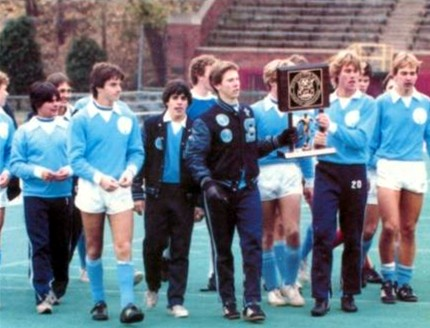 Brad Emons, Detroit Free Press (formerly of Observer & Eccentric newspapers)
The first MHSAA Class A boys soccer championship game, on Nov. 6, 1982, ironically featured two Livonia schools, Stevenson vs. Churchill, at Flint’s Atwood Stadium.
Stevenson, coached by Pete Scerri and led by prolific goal scorer Gary Mexicotte, earned a 4-1 victory over the Chargers.
Reese Refuses to Let Championship Party End
Rob Kaminski, MHSAA communications coordinator since 1999
In a sport that has seen a host of repeat champions and schools with numerous Finals appearances, it’s a school that had only one shot at the Finals and made the most of it against long odds that comes to mind: The 2021 Reese Rockets.
The Rockets, in fact, had only reached the MHSAA Semifinals one other time (2010), and coach Angie Compton’s team was facing a tall task being asked to dethrone two-time defending champion Monroe St. Mary Catholic Central in the Division 3 championship match. SMCC was making its 11th Finals appearance. Before reaching the Final, however, Reese was extended to four sets in a thrilling 25-20, 25-18, 23-25, 28-26 victory over Muskegon Western Michigan Christian.
Facing the perennial power Kestrels the next day, Compton’s team appeared to be running on empty as SMCC took the first two sets, 25-18, 25-19. Unfazed, and actually singing and dancing to music blaring over the public address system during each break in the action, Reese pounded out a 25-25 win in set 3 and put the champs on the ropes with a 25-21 win in set 4 to tie the match, 2-2.
The Rockets would have to battle back from one last deficit, trailing in the see-saw fifth set, 9-7, before capping the Cinderella season on the second championship point of the night as senior Maddi Osantowski and junior Abby Karst combined for a block for a 16-14 victory. Osantowski finished with 34 kills and totaled 110 attack attempts while setter Aydan Dalak had 42 assists.
Muskegon Reminds Us that It’s Never ‘Game Over’
Ron Pesch, MHSAA historian
Part of a rare double bill hosted at MSU's Spartan Stadium, the 2008 Muskegon-Davison Division 2 Semifinal provided countless Big Reds fans with the opportunity to depart early. And many did.
Everything that could go wrong did go wrong for unbeaten, top-ranked, and heavily-favored Muskegon. Turnover after turnover – six in total, including two muffed punts – aligned with a stellar performance by Davison's sophomore quarterback, Jake Thompson, and an opportunistic Cardinals squad. Davison led 21-13 at the half, 35-13 with 4:45 to play in the third quarter, and 35-19 with under five minutes remaining when a blown defensive assignment allowed Muskegon to cut the margin to 35-25 on a 77-yard TD pass. But a failed 2-point conversion meant the Big Reds still needed two scores.
For several in the press box, as well as the great majority in the stands, it was game over. However, in a game filled with life lessons, Muskegon's recovery of a pair of onside kicks – with touchdowns to follow – made the Big Reds’ eventual 38-35 victory the most improbable of improbable comebacks in MHSAA playoff history. It's still stunning to watch.
Good-bye to Legendary Program, Legendary Coach
Brad Emons, Detroit Free Press (formerly of Observer & Eccentric newspapers)
In the final year of Farmington Hills Harrison before it closed its doors, the state’s all-time winningest coach with a career record of 443-112-1 saw his team surrender a 14-7 fourth-quarter lead and fall in a Division 4 Regional Final at home to Chelsea, 21-14, on Nov. 11, 2018.
Afterward, legendary Harrison coach John Herrington addressed the media and said, “The only thing I thought about was Don Meredith and Monday Night Football. He used to say, ‘Turn out the lights, the party is over.’ I guess that’s my quote.” Herrington finished his career at Harrison with 34 playoff appearances, 13 state titles and five runner-up finishes from 1970-2018.
Mercy Completes Miracle at Calihan Hall
Mick McCabe, Detroit Free Press since 1970
(From its start as an MHSAA-sponsored sport in 1973 through 2006, girls basketball was played during the fall.)
On Dec. 11, 1982, the Flint Northern girls basketball team was well on its way to making MHSAA history. After three quarters the Vikings, who were attempting to become the first girls team to win five consecutive state championships, led upstart Farmington Hills Mercy by 19 points.
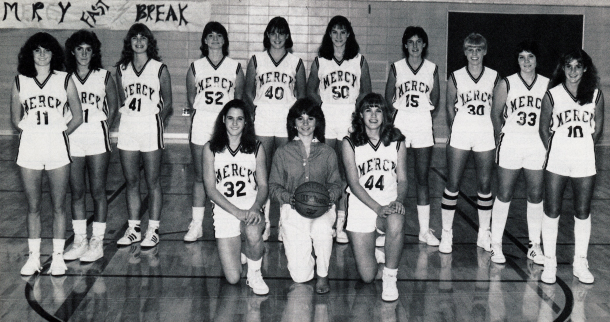
With less than seven minutes remaining the lead was 18 points, and Mercy was in trouble. Left with no alternative, Mercy applied a full-court trapping press and suddenly Northern began turning the ball over like crazy. The Marlins got within five when sophomore Amy DeMattia (13 points, 10 rebounds) scored three straight baskets to give Mercy the lead while Northern, which had 31 turnovers, responded with four consecutive turnovers. Sophomore Annette Ruggiero came up with a key steal and hit a free throw for a two-point lead and then another sophomore, Mary Rosowski, nailed a clutch free throw with 11 seconds left to seal the deal – a 61-58 win over the Vikings.
Junior Sarah Basford led Mercy with 20 points. Mercy started one senior, one junior and three sophomores, and the Marlins may have been too naive to realize they were supposed to be intimidated by Northern. After the final buzzer sounded, Mercy coach Larry Baker looked like he was in a daze as he wandered around the court repeating: “I don’t believe it ... I don’t believe it.” Neither did anyone else.
Grand Ledge Refuses to Lose in 1st Football Finals Trip
Tim Staudt, WILX (Lansing), in 53rd year of broadcasting
(Trailing 14-7 against Utica Eisenhower with less than a minute to play in the 2000 Division 1 football championship game, Grand Ledge scored 12 unanswered points – beginning with a 5-yard touchdown run by Matt Bohnet with 53 seconds to play, followed by an onside kick recovered by the Comets’ Collin O’Keefe, which led to a 45-yard game-winning scoring pass from Bohnet to Tim George with 22 seconds remaining. The 19-14 win gave Grand Ledge its first football Finals championship, notable as well as the team was coached by Pat O’Keefe, who at one time had the record for most baseball coaching wins in state history and remains second on that list.)
One of the most remarkable comebacks in state finals football history was when Grand Ledge came back to defeat Utica Eisenhower at the Silverdome, rallying to win the Division 1 state championship under coach Pat O’Keefe in 2000.
Even for Those Disappointed, 8-Player Final Tremendous
Greg Miller, formerly of 9&10 News (Cadillac)
I had the misfortune of covering a great deal of sad state championship games where our local team would fall to a team from downstate. Few were more heartbreaking than the 2012 8-Player Football Final (the second year a state championship was awarded in 8-player football) at Greenville High School's beautiful football stadium.
The Bellaire Eagles had a 6-0 halftime lead but fell behind when Deckerville scored twice in the third quarter. The Eagles would try to rally in the fourth quarter, and eventually hit a massive touchdown pass with less than a minute to play to pull within a 2-point conversion of tying the game and likely sending it to overtime. Alas, the 2-point try failed, and the subsequent onside kick was unlucky as well.
As a bit of an introduction to a new brand of football that allowed so many small schools across the state to keep playing the game, it was a tremendous game – even if the team I was there to cover came up two points short.
Power of DeYoung’s 42 Resonates for Mourning Champion
Jack Doles, WOOD TV (Grand Rapids)
Back in 2002, the South Christian Sailors had a fantastic team. They were very talented and tight knit. During the playoffs, in the week of the Semifinals, one of their teammates, Derek DeYoung was killed in a car accident. At the urging of his father, a pastor, the Sailors decided to continue to play.
Derek wore number 42, and they scored 42 points in a win over Caro in the Semifinal. After the game, both teams and fans gathered together on the field and took a knee and prayed.
The Sailors then had to go to a funeral for their friend and teammate, and then prepare for a state championship game. Instead of being distracted, they came out focused and on a mission. Derek's brother wore his jersey with the #42 and led the Sailors onto the field. They hammered Riverview and won the state championship. Late in the game, they kicked a field goal that would give them 42 points. There wasn't a dry eye in the house. Another incredible memory from covering high school sports.
Previous "Century of School Sports" Spotlights
Oct. 8: Guided by 4 S's of Educational Athletics - Read
Oct. 1: Michigan Sends 10 to National Hall of Fame - Read
Sept. 25: MHSAA Record Books Filled with 1000s of Achievements - Read
Sept. 18: Why Does the MHSAA Have These Rules? - Read
Sept. 10: Special Medals, Patches to Commemorate Special Year - Read
Sept. 4: Fall to Finish with 50th Football Championships - Read
Aug. 28: Let the Celebration Begin - Read
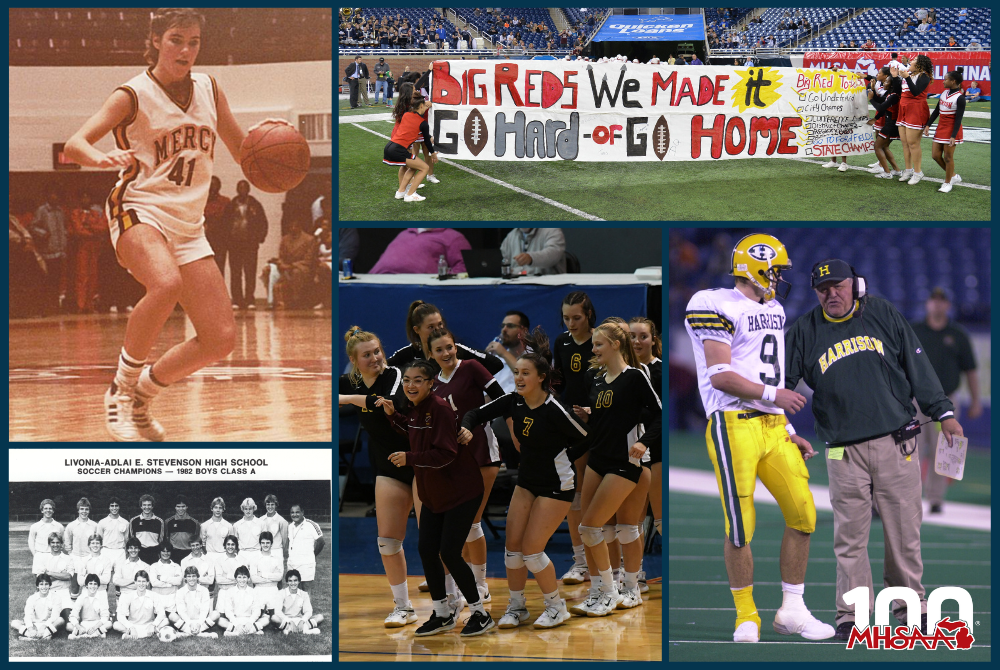
PHOTOS (Top) Clockwise from top left: Farmington Hills Mercy's Sarah Basford directs the offense during a 1982 Class A Semifinal against Lansing Everett. (2) Lansing Sexton's cheerleaders await their football team's entrance at Ford Field. (3) Farmington Hills Harrison football coach John Herrington sends a play in with quarterback Drew Stanton. (4) Reese volleyball players dance together during a break in the 2021 Division 3 Final. (5) The 1982 Livonia Stevenson boys soccer team takes a team photo used in the MHSAA Book of Champions. (Middle) Livonia Stevenson players carry their championship trophy after winning the 1982 Class A soccer title at Atwood Stadium. (Below) Members of the 1982 Farmington Hills Mercy girls basketball team pose for a team photo. (MHSAA file photos.)