

Tales of Teams, Trophies & Trinkets
By
Ron Pesch
MHSAA historian
March 30, 2016
High school athletics leaves behind an amazing array of treasures – although while buried in a keepsake box, or trophy case, the awards stand silent.
For many, their meaning and worth only continues to grow in value. Yet, in other cases, time can be cruel. For some trophies and trinkets, their worth diminishes as the stories contained within are lost behind retirements, neglect, administration decisions and death.
Following are a few tales that live on from more than a century of Michigan high school sports.
|
1909 |
Muskegon High School |
Track Trophy |
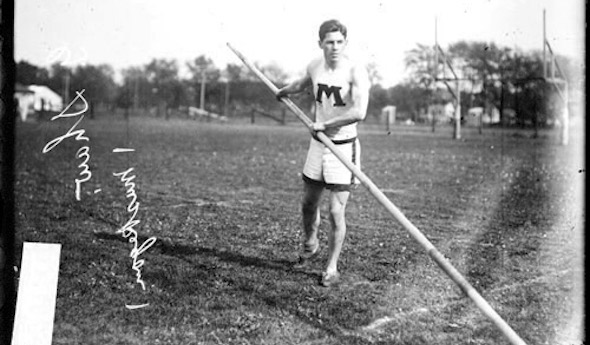
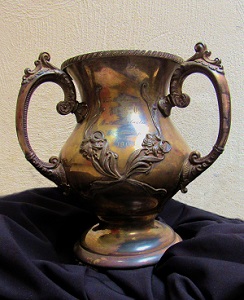 The search continues for the oldest state title trophy presented to a high school in the state of Michigan. This beauty, on display at Muskegon High School within the school’s storied trophy cases, currently leads the pack. In 1909, Muskegon coach Robert Zuppke’s team tallied 43½ points to win the fourth annual Michigan Agricultural College Interscholastic meet in Lansing. The total was the largest sum in the history of the meet, exceeding Detroit University School’s total of 27½ points and Detroit Central’s third-place total of 25 points.
Dominant in the field events, Muskegon was led by George Shaw, who set a new record in the pole vault at 11 feet, 2 inches, and by George Cowley, whose 4:47 time in the mile also set a new mark. Cowley’s time in the mile ranked among the top in the middle west.
Zuppke moved on a year later to coach at Oak Park, Ill., then to the University of Illinois where he became known as one of the great coaching minds in the history of college football. Shaw would school at Northwestern University while Cowley spent some time at the University of Chicago following graduation.
|
1923 |
Dollar Bay |
2nd U.P. Class B Tournament |
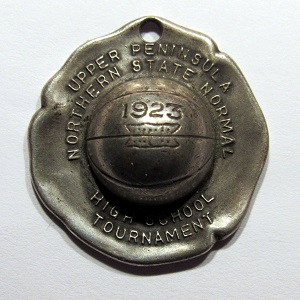 Someone within the Dollar Bay roster was once the proud owner of this silver basketball fob, given to team members by Northern Michigan Normal College for finishing second in the 6th annual Class B High School Basketball Tournament hosted at Northern State Normal College. According to documentation on the event, six sessions were held, and during presentation of the awards, only seven fobs were awarded to each of the top three teams. As was quite common at the time, only last names of players were mentioned in the game program and newspaper coverage. I guess back in the day, everyone who needed to know already knew the player’s first name.
Purchased on Etsy, perhaps this medal was owned by Stevens, who played one of the guard spots and served as team captain. He was responsible for all nine of the team’s points in the Class B championship game. Perhaps it belonged to Penphrase or Mattson, who each scored four points in the semifinal round, where Dollar Bay trounced Stambaugh 21-12. Munising defeated Newberry 15-10 in the semifinal, setting the stage for the title game. Munising won the Saturday evening contest, 17-9, and earned the right to play the Class A winner for the “supremacy of the Upper Peninsula." One week later at the Normal Gym, Munising topped Escanaba, winner of the Class A tournament, for the honor.
|
1927 |
J. Perry Austin |
Three Oaks |
4:57.3 |
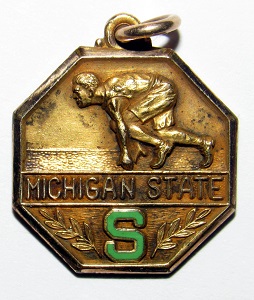 Along with his brother Phil, Joseph Perry Austin was one of 20 graduates in the class of 1927 at Three Oaks High School (Today known as Three Oaks River Valley). The most famous of the group was perhaps Joe Savoldi, who would star at Notre Dame.
The Austin boys moved to Three Oaks from Waukegan, Ill, when they reached high school age. There, Perry, as he was known among family and friends, would excel athletically and academically, winning the Class C MHSAA state championship in the mile and serving as valedictorian of his class. Phil was salutatorian. This medal, presented at Michigan State College of Agriculture and Applied Science (now Michigan State University) was found on Ebay.
Following graduation, Perry attended the University of Michigan, where he was crowned Big Ten Champion in the two mile in 1931. That same year, Austin was honored by the Big Ten with the conference’s prestigious Medal of Honor, awarded one per sport, for athletic and academic achievement in Track & Field. He would remain at Michigan, earning a doctorate in chemistry in 1935.
After graduation, he worked for Abbot Labs in Chicago. In the 1940s, Austin joined the seminary and became an Episcopalian priest, serving parishes in Wisconsin, Texas and Michigan. Ultimately, he returned to education, teaching high school chemistry in Toledo, Ohio. He passed away in 1991.
His brother Phil would ultimately become an internationally renowned watercolorist and a member of the exclusive American Water Color Society.
|
1940 |
Merrill Vandals scoreboard |
Castle Museum, Saginaw |
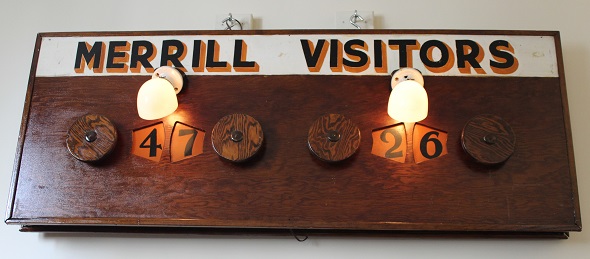 As the story goes, Merrill High School students built this scoreboard in shop class sometime during the late 1930s for use in their high school gymnasium. The board served the district for approximately the next 50 years. “It was always an honor to be selected as one of the kids to operate the scoreboard,” recalled Keith Clark, a former Merrill student who in later years served as a coach, then administrator in the district. “One kid would operate the home side and the other would operate the away side.”
When the new high school opened in 1956, the scoreboard remained in place at the building where it served junior high school teams until the 1980s. It was ultimately presented to Walt Krause, a longtime employee of the Merrill school district. Thanks to the efforts of Clark, and the kindness of the Krause family, the board eventually made its way to the Saginaw Sports Hall of Fame with a single stipulation – that the score displayed should always show Merrill leading.
|
1947 |
Brethren Dickson |
Basketball Team |
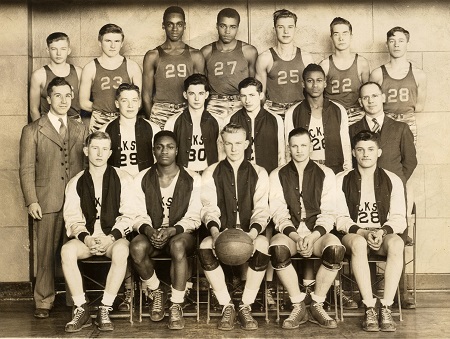 A scan of a photo cherished by the son of one of the team members, this team picture would likely go unnoticed mixed in with a stack of others. Yet, standing in the back row, wearing number 27, is an individual with a likeness, and most certainly a voice, that would be recognized by tens of millions. The Brethren Dickson basketball team of 1947 was eliminated early in the tournament. The 1932 team finished the year as runner-up to Portage for the Lower Peninsula’s Class D title. In 1963, Brethren lost in the state semifinals to eventual Class D state champion Britton.
Using his full given name, one can argue that James Earl Jones ranks with Earvin “Magic” Johnson as the state’s most famous basketball player, though his fame is for something entirely different than his ability to shoot a basketball.
|
1967 |
Ann Arbor University High School |
Track Trophy |
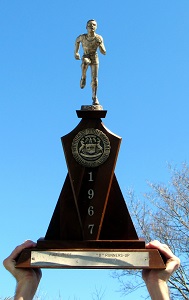 Found at a thrift store in Ann Arbor, it was purchased for $2.12, tax included. Showing its age, the trophy was earned by Ann Arbor University High’s track team that finished second to Detroit St. Charles.
Ann Arbor University High was a demonstration school operated by the University of Michigan’s School of Education. In 1922, the State of Michigan legislature approved $525,000 for the construction and furnishing of the building near the campus of the university. In the fall of 1924, the school was opened with 123 students in grades 7-12. In 1930, an elementary school was added. According to U-M’s Bentley Historical Library, “the school was used as a demonstration center for educators in the newer practices of educating children.”
University High’s athletic teams were nicknamed the Cubs, an obvious nod to the University of Michigan’s Wolverines. University High continued to operate into the 1960s, when a decision was made by U-M’s School of Education to close the school.
The 1967 team, led by Dave Shipman, finished second to Detroit St. Charles in point total, 64 to 47. Shipman, an individual winner in both the 100 and 220-yard events, also ran on University’s victorious 880 relay team. A year later, the final senior class graduated from the school.
|
1984 |
Brimley High School |
Volleyball |
 This medal dates to the days when champions were crowned in volleyball in both upper and lower peninsulas of Michigan. (In the year 2000, the tournament was unified.) This is another Ebay find.
Between 1980 and 1990 the U.P. staged a single open tournament for all schools north of the Mackinac Bridge. Despite competing against schools with much larger enrollment, the Brimley Bays captured seven titles during those 11 years of competition. Located just off I-75, coach Charles Compo’s team traveled extensively into the Lower Peninsula to gain experience. The time and travel paid dividends as the team captured five straight titles between 1981 and 1985. The 1984 title came with 15-3, 15-11 wins over Bessemer. That season, Compo was named U.P. Coach of the Year.
“Compo retired in 1990 with an amazing record of 408 victories and only 74 losses,” notes the Upper Peninsula Sports Hall of Fame, recognizing the achievements of those squads. “Seventeen of Compo's players would earn all-state honors, a total of 32 times.”
|
2009 |
Allison Pall |
East Grand Rapids |
1:50:09 |
 “When the boys on the football team got whiny about practice, their coach would bring them to one of our practices,” remembered Allison Pall, discussing the hours spent training before earning this medal as a member of the East Grand Rapids 200 medley relay team. Those practices were run by legendary swimming coach Milton “Butch” Briggs, Jr. Since taking on the task in fall of 1975, Briggs has led the girls to 19 MHSAA championships and the boys to 10 titles.
Pall, along with schoolmates Ally Bremer, Molly Lundquist, and Karly Surman won the 200 medley relay with an MHSAA Finals time of 1:50.09 at Eastern Michigan. A year later Pall, Bremer, Emily Lundquist and Katie Lachance again won the 200 medley relay, at 1:48.82 at Holland Aquatic Center. The girls clocked a 1:48:75 in the prelims the day prior, establishing a then-school record.
A late beginner in the sport, Pall took up competitive swimming in seventh grade. Following high school graduation, Pall headed to Ann Arbor to enroll at the University of Michigan, where she left behind her swimming career. Her height, an advantage in swimming, meant she was recruited to join the University Rowing team. She stayed for a season, deciding to dedicate herself to studies. Today, Allison is in pursuit of her Master’s degree in Public Health. Her medals will not be found for sale online. They still mean the world to her.
 Ron Pesch has taken an active role in researching the history of MHSAA events since 1985 and began writing for MHSAA Finals programs in 1986, adding additional features and "flashbacks" in 1992. He inherited the title of MHSAA historian from the late Dick Kishpaugh following the 1993-94 school year, and resides in Muskegon. Contact him at [email protected] with ideas for historical articles.
PHOTO: George Shaw prepares for the pole vault for Muskegon High in 1909. (Photos gathered by Ron Pesch.)
1st & Goal: 2025 11-Player Finals Preview
By
Geoff Kimmerly
MHSAA.com senior editor
November 26, 2025
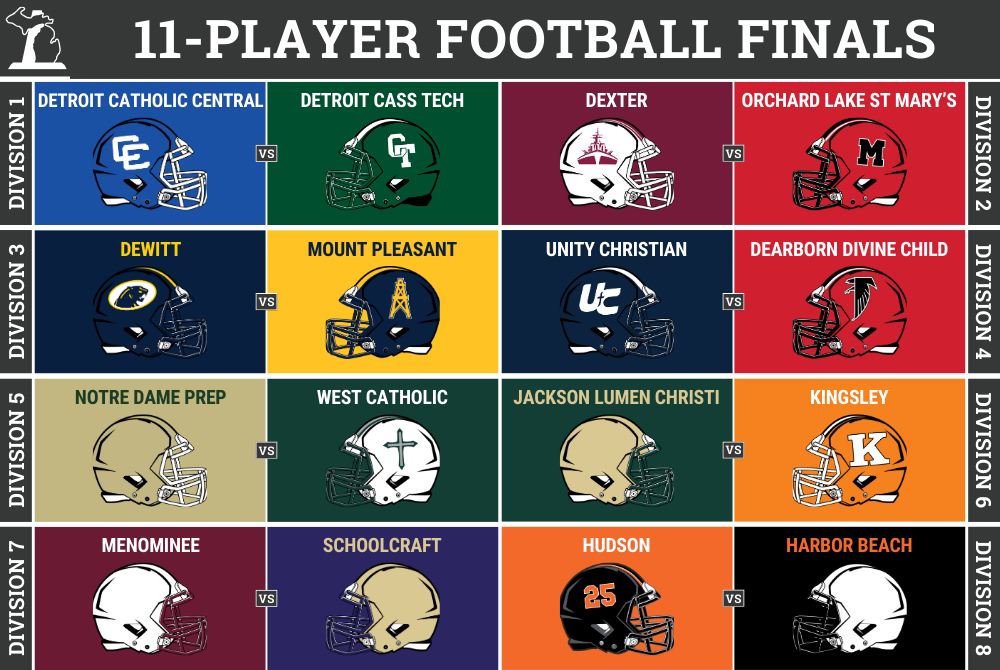
Matchups of undefeated contenders will kick off and conclude this weekend’s 11-Player Football Finals at Ford Field, with one more unbeaten-vs.-unbeaten matchup in the middle of Sunday among headliners this championship weekend.
 With Michigan State playing Maryland on Saturday at Ford Field, the eight MHSAA championship games will be split between Friday and Sunday:
Friday, Nov. 28
Division 8 – Harbor Beach (13-0) vs. Hudson (13-0) – 9:30 a.m.
Division 4 – Dearborn Divine Child (12-1) vs. Hudsonville Unity Christian (12-1) – 12:30 p.m.
Division 6 – Kingsley (11-2) vs. Jackson Lumen Christi (10-3) – 4 p.m.
Division 2 – Orchard Lake St. Mary’s (10-2) vs. Dexter (12-1) – 7 p.m.
Sunday, Nov. 30
Division 7 – Schoolcraft (11-2) vs. Menominee (13-0) – 9:30 a.m.
Division 3 – Mount Pleasant (13-0) vs. DeWitt (13-0) – 12:30 p.m.
Division 5 – Grand Rapids West Catholic (12-1) vs. Pontiac Notre Dame Prep (11-2) – 4 p.m.
Division 1 – Detroit Cass Tech (13-0) vs. Detroit Catholic Central (13-0) – 7 p.m.
All eight championship games will be streamed live on the NFHS Network and available for listening from the MHSAA Network. Links to purchase tickets and more are available on the Football page.
Below is a glance at all eight matchups. Statistics are through Semifinals unless noted.
 Division 1
DETROIT CATHOLIC CENTRAL
Record/Rank: 13-0, No. 1
Coach: Justin Cessante, third season (32-4)
League finish: First in Catholic High School League Central
Championship history: 10 MHSAA Finals titles (most recent 2009), seven runner-up finishes.
Best wins: 46-6 over No. 8 East Kentwood in Semifinal, 42-13 over No. 5 Clarkston in Regional Final, 29-14 over Division 2 No. 1 Orchard Lake St. Mary’s, 26-14 over Division 3 No. 5 Detroit Martin Luther King, 27-14 over Toledo Central Catholic.
Players to watch: WR/DB Samson Gash, 6-1/185, sr. (971 yards/14 TDs receiving); QB Duke Banta, 6-4/210, jr. (2,222 yards/27 TDs passing); TE/DL Jack Janda, 6-6/250, sr. (42 tackles/15 tackles for loss/10 sacks); OL/DL Benny Eziuka, 6-3/300, sr.
Outlook: The Shamrocks will return to the Finals for the first time since 2016 and after reaching the Semifinals last season. They’ve won 25 of their last 26 games – that Semifinal loss to Cass Tech the only defeat during that time – and this season have not allowed an opponent to get closer than 12 points. Gash is committed to Michigan State and made the Division 1-2 all-state first team last season, and senior Cedric Williams (1,146 yards/12 TDs rushing) helps provide balance on offense. Janda and Eziuka are part of a dominating defensive front for a group allowing only nine points per game. Eziuka is committed to Penn State and Janda has several high-major Division I scholarship offers.
DETROIT CASS TECH
Record/Rank: 13-0, No. 2
Coach: Marvin Rushing, fourth season (37-9)
League finish: First in Detroit Public School League Blue
Championship history: Four MHSAA Finals titles (most recent 2024), one runner-up finish.
Best wins: 42-28 over No. 6 Saline in Regional Final, 35-19 and 27-22 over Division 3 No. 5 Detroit Martin Luther King, 28-27 over Toledo Central Catholic.
Players to watch: SE/DB Corey Sadler Jr., 5-11/186 sr. (1,406 yards/19 TDs receiving); LB Marcus Jennings, 6-3/209, sr.; QB Donald Tabron II, 6-4/192, soph. (2,394 yards/30 TDs passing); OL Khalief Canty Jr., 6-5/298, sr. (Statistics through Regional Finals.)
Outlook: Cass Tech is seeking its first repeat Finals championship since winning back-to-back Division 1 titles in 2011 and 2012. The Technicians also have won 23 straight games – including 17-14 over DCC in their Semifinal a year ago. Sadler, committed to North Carolina, and Tabron are the best-known playmakers, but sophomore Julian Taylor showed what he could do in the 48-22 Semifinal win over Rochester Adams, running for 178 yards and five touchdowns to bring his season rushing totals to 845 and 19, respectively. Sadler also has five punt return, two kick return and an interception return for touchdowns this fall. He and Canty both made the Division 1-2 all-state first team last season. Canty has committed to Missouri, and Jennings has committed to Pittsburgh.
 Division 2
DEXTER
Record/Rank: 12-1, No. 5
Coach: Phil Jacobs, ninth season (65-30)
League finish: Second in Southeastern Conference Red
Championship history: Has never played in an MHSAA Final.
Best wins: 56-42 over No. 6 Gibraltar Carlson in Regional Final, 41-27 over No. 4 South Lyon in District Final, 42-28 over Division 4 No. 6 Chelsea, 50-27 over Brighton.
Players to watch: QB Cooper Arnedt, 5-11/170, sr. (4,308 yards/52 TDs passing); WR Cole Novara, 5-8/155, sr. (2,098 yards/28 TDs receiving); LB Nathan Gersh, 6-2/225, sr.; OL/DL Mateo Kipke, 6-6/240, sr.
Outlook: Arnedt to Novara has become the most successful passing duo in MHSAA history, with Arnedt needing 125 yards and four touchdowns to tie single-season records in those categories and Novara setting state records for yardage, receptions (118) and touchdowns catches. That’s come against a schedule that also included Division 1 No. 6 Saline, the only team to defeat the Dreadnaughts. Jacobs took over a program in 2016 that had lost 32 straight games, and after going 0-9 his first season turned it into a state power that made the playoffs for the first time in 2018. Junior running back Brady Arbaugh has run for 949 yards and 13 touchdowns to give the offense another dimension, and Iowa State commit Owen Winder (6-7/290) at left tackle is among those leading the way. Gersh made the all-state first team last season, and Novara made the second.
ORCHARD LAKE ST. MARY’S
Record/Rank: 10-2, No. 1
Coach: Jermaine Gonzales, fourth season (29-17)
League finish: Tied for second in CHSL Central
Championship history: Nine MHSAA Finals titles (most recent 2024), six runner-up finishes.
Best wins: 42-7 over No. 3 Portage Central in Semifinal, 42-7 over No. 10 Midland Dow in Regional Final, 35-14 over Bloomfield Hills Brother Rice in District Final, 49-10 over Division 3 No. 7 Warren De La Salle Collegiate, 36-21 over Toledo Central Catholic.
Players to watch: QB Jabin Gonzales, 6-2/202, jr. (1,881 yards/24 TDs passing, 7 TDs rushing); WR/DB Lorenzo Barber, 5-9/176, jr. (643 yards/11 TDs receiving, 6 TDs rushing); DL Ryan Harrington, 6-5/215, sr.; RB/DB Camari Patterson, 5-10/186, sr.
Outlook: St. Mary’s also is seeking to repeat, after most recently doing so with three straight Division 3 titles from 2014-16. The Eaglets’ first loss this season was to DCC, and in the District Final they avenged their second defeat, to Brother Rice. Harrington made the Division 1-2 all-state first team last season and has committed to Wake Forest, and he and Patterson (Western Michigan) are among standouts on a defense that has allowed just 35 points over four playoff wins. Sophomore running back Jamari Givhan (866 yards/6 TDs rushing) adds additional balance to the offense, and 6-foot-3 junior Chad Willis (649 yards/6 TDs receiving) is another valuable target in the passing game.
 Division 3
DEWITT
Record/Rank: 13-0, No. 1
Coach: Rob Zimmerman, 27th season (275-55)
League finish: First in Capital Area Activities Conference Blue
Championship history: Division 3 champion 2020, six runner-up finishes.
Best wins: 41-20 over No. 7 Warren De La Salle Collegiate in Semifinal, 59-7 over Grand Ledge, 21-3 over Haslett.
Players to watch: QB/DB Traverse Moore, 6-0/195, sr. (2,115 yards/29 TDs rushing, 870 yards/12 TDs passing); WR/DB Jadon Bender, 6-0/182, sr. (307 yards/5 TDs receiving, 24 tackles/7 interceptions); RB Channing Ridley, 6-0/192, soph. (1,098 yards/15 TDs rushing); OL/DL Drew Rumsey, 6-2/285, sr.
Outlook: The Panthers are making their third trip to Ford Field over the last six seasons, having also finished Division 3 runner-up in 2021. With Central Michigan commit Moore leading the way, they’ve piled up points all season at least 50 eight times. DeWitt is defeating its opponents by an average of 40 points per game with only one single-digit margin, and averaging 9.7 yards per play. The defense doesn’t get as much attention but also has held opponents to single digits eight times. Rumsey made the all-state second team last season, and Moore and Bender earned honorable mentions. Sophomore Vincent Rose is another important offensive threat; he’s made 86 of 88 extra-point attempts and five field goals with a long of 40 yards.
MOUNT PLEASANT
Record/Rank: 13-0, No. 2
Coach: Jason McIntyre, 20th season (168-52)
League finish: First in Saginaw Valley League North
Championship history: Division 3 runner-up 2011.
Best wins: 28-14 over No. 8 East Grand Rapids in Regional Final, 42-0 over No. 9 Gaylord in District Final, 63-39 over Division 2 No. 10 Midland Dow, 28-13 over Traverse City Central.
Players to watch: QB/DB Xavier Creguer, 6-0 jr. (1,548 yards/20 TDs passing, 927 yards/8 TDs rushing); FB/LB Grahm Phillips, 5-10 sr. (452 yards/9 TDs rushing); WR/LB Jack Mozurkewich, 6-2 sr. (272 yards/7 TDs receiving); OL/DL Kaed Wheeler, 6-3 jr. (Statistics through Regional Finals.)
Outlook: Mount Pleasant has cleared all of its opponents by at least 10 points this fall and made a nice jump after falling in District Finals the last four seasons. The Oilers handed Dow its only loss of the regular season and Gaylord its lone defeat all fall. Mozurkewich caught two more touchdown passes in the Semifinal win, and senior receivers Riley Olson (445 yards/4 TDs receiving) and Isaiah Rodriguez (395/5) have been two more reliable targets for top playmaker Creguer. Lowell in the Oilers’ 41-21 Semifinal win was the first opponent since Dow in Week 3 to score more than 17 points on the Mount Pleasant defense. Total, the team has 23 seniors, with seven starting on offense and five on defense.
 Division 4
HUDSONVILLE UNITY CHRISTIAN
Record/Rank: 12-1, No. 4
Coach: Craig Tibbe, 23rd season (144-95)
League finish: First in Ottawa-Kent Conference Gold
Championship history: Division 5 champion 2018, Division 4 runner-up 2021.
Best wins: 52-14 over No. 10 Big Rapids in Regional Final, 14-6 over Zeeland West, 40-19 over Division 7 No. 7 Schoolcraft.
Players to watch: QB/DB Justin Febus, 5-9/155, sr. (979 yards/16 TDs rushing, 1,014 yards/18 TDs passing); RB/LB Lucas Elliott, 6-3/190, sr. (698 yards/6 TDs); RB/LB Jared DeVries, 5-11/200, sr. (622 yards/7 TDs); OL/DL Levi Offringa, 6-0/246, sr. (Statistics through Regional Finals.)
Outlook: Unity Christian is a combined 22-2 over the last two seasons, its only loss a year ago in a District Final and the only defeat this fall in Week 9 to Pontiac Notre Dame Prep, which will play this weekend seeking to repeat as the Division 5 champ. The Crusaders have won all of their playoff games by double digits relying again on a crushing T-offense rushing attack that is averaging 331 yards on the ground per game. Unity Christian also has capitalized on nearly two turnovers per game and has more interceptions this season than passing touchdowns allowed (12 to 11).
DEARBORN DIVINE CHILD
Record/Rank: 12-1, No. 7
Coach: Chris Laney, fourth season (34-13)
League finish: Tied for first in CHSL AA
Championship history: Two MHSAA Finals titles (most recent 1985), one runner-up finish.
Best wins: 10-7 over No. 2 Goodrich in Semifinal, 10-6 over No. 1 Harper Woods in Regional Final, 17-13 over Division 6 No. 2 Jackson Lumen Christi.
Players to watch: RB/S Marcello Vitti, 6-0/190 sr.; WR/S Giancarlo Vitti, 5-10/165, jr.; QB Drew Sheridan, 6-1/170, soph.; WR/CB Antonio Solares-Vitti, 6-3/185, sr. (No statistics submitted.)
Outlook: Divine Child will play for a Finals championship for the first time since 1985 after defeating a pair of undefeated contenders (Harper Woods and Goodrich) the last two weeks and losing only to Toledo St. Francis de Sales, by seven points in Week 7. The defense has been tough to beat all season – giving up 6.9 points per game – but really moved to the forefront with those most recent playoff wins. Offensively, Divine Child is dangerous on the ground and through the air, with nearly identical yardage and touchdowns attacking both ways. Marcello Vitti will play next for Iowa, and Solares-Vitti is committed to Eastern Michigan.
 Division 5
PONTIAC NOTRE DAME PREP
Record/Rank: 11-2, No. 4
Coach: Pat Fox, 12th season (89-36)
League finish: Does not play in a conference.
Championship history: Division 5 champion 2024.
Best wins: 51-21 over No. 9 Monroe Jefferson in Semifinal, 42-28 over No. 3 Frankenmuth in Regional Final, 34-25 over Division 4 No. 4 Hudsonville Unity Christian, 21-12 over Division 6 No. 6 Marine City, 63-38 over Division 6 No. 8 Traverse City St. Francis.
Players to watch: RB/CB Ben Liparato, 5-9/160, sr. (924 yards/12 TDs rushing); WR/CB Drake Roa, 6-3/190, sr. (950 yards/17 TDs receiving); QB/LB Sam Stowe, 6-5/205, sr. (2,498 yards/38 TDs passing); WR/LB Brody Sink, 6-4/200, sr. (784 yards/13 TDs receiving). (Statistics through Regional Finals.)
Outlook: After winning its first championship a year ago, Notre Dame Prep will attempt to repeat with a pair of the same standouts leading the way. Stowe at quarterback and Sink at linebacker both made the all-state first team last season and are pacing units that have been outstanding again, with the offense topping 500 points for the second-straight season and the defense posting two shutouts to start the playoffs and slowing Frankenmuth and Jefferson the last two weeks. Among additional two-way standouts, senior running back Anthony Tartaglia had 710 yards and 10 touchdowns rushing through the Regional Final and also starts at linebacker. Sink will play next at Miami (Ohio).
GRAND RAPIDS WEST CATHOLIC
Record/Rank: 12-1, No. 2
Coach: Landon Grove, fourth season (43-7)
League finish: First in O-K White
Championship history: Seven MHSAA titles (most recent 2022), two runner-up finishes.
Best wins: 34-24 over No. 7 Ogemaw Heights in Semifinal, 21-20 (OT) over No. 1 Grand Rapids Catholic Central in District Final, 28-16 over Zeeland West.
Players to watch: QB Grady Augustyn, 6-1/190, sr. (2,154 yards/20 TDs passing); RB/DB Connor Olszewski, 5-11/195, sr. (1,129 yards/12 TDs rushing); TE/LB Jael Djouguem, 5-10/170, jr.; OL/DL Jacob Timmer, 6-7/275, sr.
Outlook: West Catholic is back in a Division 5 Final for the first time since claiming five straight from 2013-17 and after winning in Division 6 in 2022. A key was getting past rival Grand Rapids Catholic Central, which had ended West Catholic’s last two seasons with playoff losses. Timmer, who will play next at Central Michigan, made the Division 5-6 all-state first team last season and leads a blocking unit that’s also cleared the way for junior Collin Abram (1,182 yards/16 TDs rushing). Senior kicker Landon Smith also is a returning all-state first-teamer and has connected on 49 of 53 extra-point attempts and eight field goals.
 Division 6
JACKSON LUMEN CHRISTI
Record/Rank: 10-3, No. 2
Coach: Herb Brogan, 46th season (431-96)
League finish: Tied for first in CHSL AA
Championship history: 14 MHSAA Finals titles (most recent 2024), three runner-up finishes.
Best wins: 25-19 (3OT) over No. 1 Almont in Semifinal, 27-12 over No. 8 Traverse City St. Francis, 41-6 over Division 4 No. 7 Dearborn Divine Child, 54-34 over Division 5 No. 4 Pontiac Notre Dame Prep.
Players to watch: QB Benny Gaston, 6-0/185, jr. (1,594 yards/12 TDs passing); RB/LB Paul Sattler, 6-1/190, sr. (1,250 yards/14 TDs rushing); FB/LB Sean Walicki, 6-0/205, sr. (629 yards/9 TDs rushing); TE/DE Isaac Maki, 6-3/185, sr.
Outlook: Lumen Christi is playing for a fourth-straight Finals championship and second-straight in Division 6 after winning in 2021 and 2022 in Division 7. Brogan is the second-winningest coach in MHSAA football history, tying and then moving past Brother Rice legend Al Fracassa (430 wins) over the last two weeks. Two of Lumen’s losses this season came to teams playing for championships this weekend – Notre Dame Prep and Lombard Montini Catholic from Illinois – and the third defeat came to Grand Rapids Catholic Central during a 2-3 start to the season. Lumen hasn’t given up more than 19 points in a game since that Week 3 loss to the Cougars.
KINGSLEY
Record/Rank: 11-2, No. 5
Co-Coaches: Tim Wooer, 17th season (145-44); Jason Morrow, second season (18-5)
League finish: Second in Northern Michigan Football Conference Legends
Championship history: Two MHSAA Finals titles (most recent 2023)
Best wins: 14-0 over No. 4 Kent City in Semifinal, 18-14 (Regional Final) and 24-6 over No. 9 Reed City, 57-6 over No. 8 Traverse City St. Francis in District Final, 44-18 over Division 7 No. 4 Charlevoix.
Players to watch: TE/LB Colton Goethals, 6-1/195, sr. (420 yards/8 TDs receiving); QB/LB Tucker Dreves, 6-1/175, sr. (1,046 yards/13 TDs passing); FB/OL/DL Isaiah Cosgrove, 5-9/190, sr. (739 yards/6 TDs rushing); FB/DB Gavin Lewis, 5-9/160, sr. (1,023 yards/14 TDs). (Statistics through Regional Final.)
Outlook: Kingsley has navigated one of the toughest playoff roads in any division, and the Charlevoix win closed the regular season. The St. Francis victory in the District Final avenged a one-point loss to the Gladiators in Week 5, and the Stags’ only other loss came to Division 3 Gaylord, which finished 10-1 this fall. Goethals made the Division 5-6 all-state second team last season and keys a defense that hasn’t given up more than 21 points in a game and has allowed 34 total over four playoff wins. Cosgrove has been the team’s second-leading rusher, but is starting at right guard along with his spot at defensive end.
 Division 7
MENOMINEE
Record/Rank: 13-0, No. 1
Coach: Chad Brandt, fourth season (40-10)
League finish: First in Western Peninsula Athletic Conference Copper
Championship history: Three MHSAA Finals titles (most recent 2007), three runner-up finishes.
Best wins: 32-28 over No. 3 Pewamo-Westphalia in Semifinal, 49-6 over No. 9 McBain in District Final, 49-14 over Kingsford.
Players to watch: QB/DB Tanner Theuerkauf, 6-3/185, sr. (1,379 yards/22 TDs passing); RB/DB Dawson Bardowski, 5-9/165, sr. (516 yards/6 TDs receiving); RB/DL Clayton Miller, 5-11/190, sr. (1,132 yards/22 TDs rushing); OL/DL Ryan Marzian, 6-0/240, sr. (Statistics through Regional Final.)
Outlook: Menominee is making its second trip to Ford Field over three seasons, most recently finishing Division 7 runner-up in 2023, and after an impressive comeback win over P-W in the Semifinal. The Pirates were the only team this season to score more than 17 points on the Maroons, and Menominee’s 32 points were the most P-W gave up this fall. Once known for its run-heavy single-wing offense, Menominee attacks with plenty of balance and spreads it around on the passing side with three receivers catching at least four touchdowns this fall. Senior nose guard Blake Paasch and Theuerkauf were among the team’s leading tacklers in its 34-30 loss to Lumen Christi in the 2023 Final.
SCHOOLCRAFT
Record/Rank: 11-2, No. 7
Coach: Dan DeVries, first season (11-2)
League finish: First in Southwestern Athletic Conference Valley
Championship history: Three MHSAA Finals titles (most recent 2001), three runner-up finishes.
Best wins: 43-14 over No. 5 Clinton in Semifinal, 22-14 over Hanover-Horton in Regional Final, 26-0 (District Final) and 18-14 over Lawton.
Players to watch: RB/DB T.J. Luteyn, 5-11/180, sr. (681 yards/8 TDs rushing); WR/DB Drew Enright, 6-1/185, sr. (858 yards/13 TDs receiving); QB/P Jack DeVries, 6-2/180, jr. (2,290 yards/30 TDs passing); OL/DL Brody Epple, 6-3/200, sr.
Outlook: Schoolcraft is making its first Finals trip since that most recent championship season, and doing so under first-year coach Dan DeVries, who was promoted after four seasons coaching the junior varsity and played on the 1994 team that finished Class C runner-up. The Eagles’ only losses were early to Hudsonville Unity Christian – playing in the Division 4 Final – and in the regular-season finale to Division 5 Kalamazoo United. Schoolcraft has nearly identical yardage and touchdown totals rushing and passing, with several contributors to both parts of the attack.
 Division 8
HUDSON
Record/Rank: 13-0, No. 1
Coach: Dan Rogers, sixth season (58-11)
League finish: First in Lenawee County Athletic Association
Championship history: Two MHSAA Finals titles (most recent 2021), three runner-up finishes.
Best wins: 67-14 over No. 5 Allen Park Cabrini in Semifinal, 68-22 over No. 6 Springport in Regional Final, 44-8 over No. 8 Fowler, 38-0 over Berrien Springs, 32-16 over Division 7 No. 5 Clinton.
Players to watch: RB/DB Beckett Campbell, 5-7/160, soph. (2,345 yards/37 TDs rushing); RB/DB Grayson Bills, 5-9/165, sr. (1,790 yards/25 TDs rushing, 4 TDs receiving); QB/DB Colt Perry, 5-7/155, sr. (637 yards/9 TDs passing, 4 TDs rushing); OT/DE Koen Hinzman, 6-7/285, jr.
Outlook: Save for an 8-3 win over Division 6 Ida in Week 2, Hudson has dominated this season from start to near-finish, defeating its opponents by an average of 41 points. Bills made the all-state first team as a running back last season and is joined by Campbell; they combined for most of the team’s 450-plus rushing yards in the Semifinal win. As a team, the Tigers have run for nearly 5,300 yards this fall, which would rank third all-time heading into this weekend. Seniors Malachi Marshall (6-4/245) and Colton Natale (6-0/255) also start on both the offensive and defensive lines, and senior flanker Devon Brigman has nearly 500 yards and eight touchdowns rushing to augment Campbell and Bills’ efforts.
HARBOR BEACH
Record/Rank: 13-0, No. 3
Coach: Troy Schelke, 29th season (220-90)
League finish: First in Big Thumb Conference Black
Championship history: Division 8 champion 2012, Class C runner-up 1991.
Best wins: 40-0 over Bark River-Harris in Semifinal, 26-15 over No. 2 Beal City in Regional Final, 41-7 over Division 7 No. 10 Millington, 43-14 over Division 7 No. 8 Ottawa Lake Whiteford.
Players to watch: QB/LB Caden Bucholtz, 6-1/225, sr. (960 yards/21 TDs rushing, 753 yards/10 TDs passing); RB/S Benson Harper, 6-0/180, sr. (308 yards/3 TDs rushing, 178 yards/3 TDs receiving); C/DE Peyton Roggenbuck, 6-3/220, sr.; OT/DT Noah Mellendorf, 6-3/245, sr.
Outlook: Harbor Beach has seemed on the verge of this moment with two straight perfect regular seasons and with its only 2023 losses during the regular season and playoffs to eventual Division 8 champion Ubly. The closest an opponent has gotten to the Pirates this season was 11 points, and they’ve won their playoff games by an average of nearly 38. Harper made the Division 7-8 all-state first team last season, and Bucholtz earned an honorable mention. While Bucholtz directs the offense, Harbor Beach has several contributors including as well senior fullback Rogan Messing (697 yads/10 TDs rushing), senior running back Keagun Potestivo (495 yards/11 TDs rushing) and 6-5 senior tight end Skiler Kruse (293 yards/5 TDs receiving).
MHSAA.com's weekly “1st & Goal” previews and reviews are powered by MI Student Aid, a division within the Department of Lifelong Education, Advancement, and Potential (MiLEAP). MI Student Aid encourages students to pursue postsecondary education by providing access to student financial resources and information. MI Student Aid administers the state’s scholarship and grant programs that help make college Accessible, Affordable and Attainable for you. Click to connect with MI Student Aid and find more information on Facebook and Twitter @mistudentaid.