

Tales of Teams, Trophies & Trinkets
By
Ron Pesch
MHSAA historian
March 30, 2016
High school athletics leaves behind an amazing array of treasures – although while buried in a keepsake box, or trophy case, the awards stand silent.
For many, their meaning and worth only continues to grow in value. Yet, in other cases, time can be cruel. For some trophies and trinkets, their worth diminishes as the stories contained within are lost behind retirements, neglect, administration decisions and death.
Following are a few tales that live on from more than a century of Michigan high school sports.
|
1909 |
Muskegon High School |
Track Trophy |
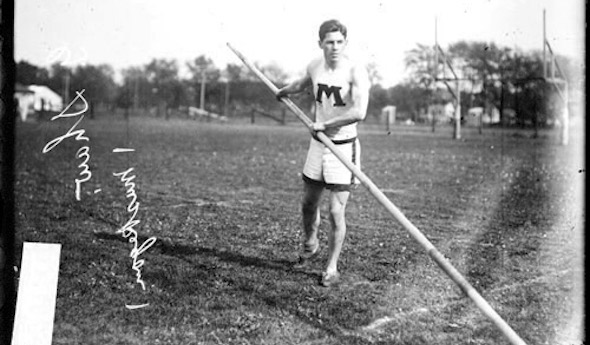
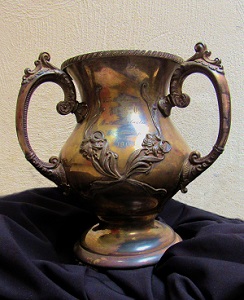 The search continues for the oldest state title trophy presented to a high school in the state of Michigan. This beauty, on display at Muskegon High School within the school’s storied trophy cases, currently leads the pack. In 1909, Muskegon coach Robert Zuppke’s team tallied 43½ points to win the fourth annual Michigan Agricultural College Interscholastic meet in Lansing. The total was the largest sum in the history of the meet, exceeding Detroit University School’s total of 27½ points and Detroit Central’s third-place total of 25 points.
Dominant in the field events, Muskegon was led by George Shaw, who set a new record in the pole vault at 11 feet, 2 inches, and by George Cowley, whose 4:47 time in the mile also set a new mark. Cowley’s time in the mile ranked among the top in the middle west.
Zuppke moved on a year later to coach at Oak Park, Ill., then to the University of Illinois where he became known as one of the great coaching minds in the history of college football. Shaw would school at Northwestern University while Cowley spent some time at the University of Chicago following graduation.
|
1923 |
Dollar Bay |
2nd U.P. Class B Tournament |
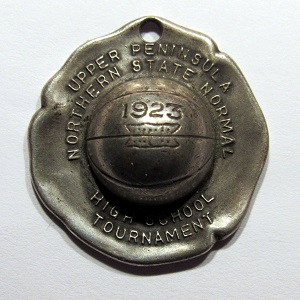 Someone within the Dollar Bay roster was once the proud owner of this silver basketball fob, given to team members by Northern Michigan Normal College for finishing second in the 6th annual Class B High School Basketball Tournament hosted at Northern State Normal College. According to documentation on the event, six sessions were held, and during presentation of the awards, only seven fobs were awarded to each of the top three teams. As was quite common at the time, only last names of players were mentioned in the game program and newspaper coverage. I guess back in the day, everyone who needed to know already knew the player’s first name.
Purchased on Etsy, perhaps this medal was owned by Stevens, who played one of the guard spots and served as team captain. He was responsible for all nine of the team’s points in the Class B championship game. Perhaps it belonged to Penphrase or Mattson, who each scored four points in the semifinal round, where Dollar Bay trounced Stambaugh 21-12. Munising defeated Newberry 15-10 in the semifinal, setting the stage for the title game. Munising won the Saturday evening contest, 17-9, and earned the right to play the Class A winner for the “supremacy of the Upper Peninsula." One week later at the Normal Gym, Munising topped Escanaba, winner of the Class A tournament, for the honor.
|
1927 |
J. Perry Austin |
Three Oaks |
4:57.3 |
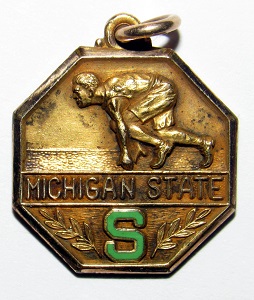 Along with his brother Phil, Joseph Perry Austin was one of 20 graduates in the class of 1927 at Three Oaks High School (Today known as Three Oaks River Valley). The most famous of the group was perhaps Joe Savoldi, who would star at Notre Dame.
The Austin boys moved to Three Oaks from Waukegan, Ill, when they reached high school age. There, Perry, as he was known among family and friends, would excel athletically and academically, winning the Class C MHSAA state championship in the mile and serving as valedictorian of his class. Phil was salutatorian. This medal, presented at Michigan State College of Agriculture and Applied Science (now Michigan State University) was found on Ebay.
Following graduation, Perry attended the University of Michigan, where he was crowned Big Ten Champion in the two mile in 1931. That same year, Austin was honored by the Big Ten with the conference’s prestigious Medal of Honor, awarded one per sport, for athletic and academic achievement in Track & Field. He would remain at Michigan, earning a doctorate in chemistry in 1935.
After graduation, he worked for Abbot Labs in Chicago. In the 1940s, Austin joined the seminary and became an Episcopalian priest, serving parishes in Wisconsin, Texas and Michigan. Ultimately, he returned to education, teaching high school chemistry in Toledo, Ohio. He passed away in 1991.
His brother Phil would ultimately become an internationally renowned watercolorist and a member of the exclusive American Water Color Society.
|
1940 |
Merrill Vandals scoreboard |
Castle Museum, Saginaw |
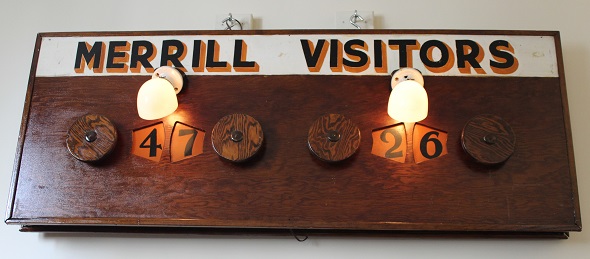 As the story goes, Merrill High School students built this scoreboard in shop class sometime during the late 1930s for use in their high school gymnasium. The board served the district for approximately the next 50 years. “It was always an honor to be selected as one of the kids to operate the scoreboard,” recalled Keith Clark, a former Merrill student who in later years served as a coach, then administrator in the district. “One kid would operate the home side and the other would operate the away side.”
When the new high school opened in 1956, the scoreboard remained in place at the building where it served junior high school teams until the 1980s. It was ultimately presented to Walt Krause, a longtime employee of the Merrill school district. Thanks to the efforts of Clark, and the kindness of the Krause family, the board eventually made its way to the Saginaw Sports Hall of Fame with a single stipulation – that the score displayed should always show Merrill leading.
|
1947 |
Brethren Dickson |
Basketball Team |
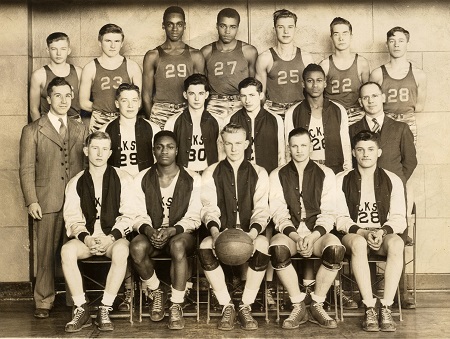 A scan of a photo cherished by the son of one of the team members, this team picture would likely go unnoticed mixed in with a stack of others. Yet, standing in the back row, wearing number 27, is an individual with a likeness, and most certainly a voice, that would be recognized by tens of millions. The Brethren Dickson basketball team of 1947 was eliminated early in the tournament. The 1932 team finished the year as runner-up to Portage for the Lower Peninsula’s Class D title. In 1963, Brethren lost in the state semifinals to eventual Class D state champion Britton.
Using his full given name, one can argue that James Earl Jones ranks with Earvin “Magic” Johnson as the state’s most famous basketball player, though his fame is for something entirely different than his ability to shoot a basketball.
|
1967 |
Ann Arbor University High School |
Track Trophy |
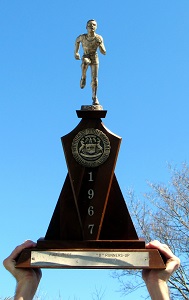 Found at a thrift store in Ann Arbor, it was purchased for $2.12, tax included. Showing its age, the trophy was earned by Ann Arbor University High’s track team that finished second to Detroit St. Charles.
Ann Arbor University High was a demonstration school operated by the University of Michigan’s School of Education. In 1922, the State of Michigan legislature approved $525,000 for the construction and furnishing of the building near the campus of the university. In the fall of 1924, the school was opened with 123 students in grades 7-12. In 1930, an elementary school was added. According to U-M’s Bentley Historical Library, “the school was used as a demonstration center for educators in the newer practices of educating children.”
University High’s athletic teams were nicknamed the Cubs, an obvious nod to the University of Michigan’s Wolverines. University High continued to operate into the 1960s, when a decision was made by U-M’s School of Education to close the school.
The 1967 team, led by Dave Shipman, finished second to Detroit St. Charles in point total, 64 to 47. Shipman, an individual winner in both the 100 and 220-yard events, also ran on University’s victorious 880 relay team. A year later, the final senior class graduated from the school.
|
1984 |
Brimley High School |
Volleyball |
 This medal dates to the days when champions were crowned in volleyball in both upper and lower peninsulas of Michigan. (In the year 2000, the tournament was unified.) This is another Ebay find.
Between 1980 and 1990 the U.P. staged a single open tournament for all schools north of the Mackinac Bridge. Despite competing against schools with much larger enrollment, the Brimley Bays captured seven titles during those 11 years of competition. Located just off I-75, coach Charles Compo’s team traveled extensively into the Lower Peninsula to gain experience. The time and travel paid dividends as the team captured five straight titles between 1981 and 1985. The 1984 title came with 15-3, 15-11 wins over Bessemer. That season, Compo was named U.P. Coach of the Year.
“Compo retired in 1990 with an amazing record of 408 victories and only 74 losses,” notes the Upper Peninsula Sports Hall of Fame, recognizing the achievements of those squads. “Seventeen of Compo's players would earn all-state honors, a total of 32 times.”
|
2009 |
Allison Pall |
East Grand Rapids |
1:50:09 |
 “When the boys on the football team got whiny about practice, their coach would bring them to one of our practices,” remembered Allison Pall, discussing the hours spent training before earning this medal as a member of the East Grand Rapids 200 medley relay team. Those practices were run by legendary swimming coach Milton “Butch” Briggs, Jr. Since taking on the task in fall of 1975, Briggs has led the girls to 19 MHSAA championships and the boys to 10 titles.
Pall, along with schoolmates Ally Bremer, Molly Lundquist, and Karly Surman won the 200 medley relay with an MHSAA Finals time of 1:50.09 at Eastern Michigan. A year later Pall, Bremer, Emily Lundquist and Katie Lachance again won the 200 medley relay, at 1:48.82 at Holland Aquatic Center. The girls clocked a 1:48:75 in the prelims the day prior, establishing a then-school record.
A late beginner in the sport, Pall took up competitive swimming in seventh grade. Following high school graduation, Pall headed to Ann Arbor to enroll at the University of Michigan, where she left behind her swimming career. Her height, an advantage in swimming, meant she was recruited to join the University Rowing team. She stayed for a season, deciding to dedicate herself to studies. Today, Allison is in pursuit of her Master’s degree in Public Health. Her medals will not be found for sale online. They still mean the world to her.
 Ron Pesch has taken an active role in researching the history of MHSAA events since 1985 and began writing for MHSAA Finals programs in 1986, adding additional features and "flashbacks" in 1992. He inherited the title of MHSAA historian from the late Dick Kishpaugh following the 1993-94 school year, and resides in Muskegon. Contact him at [email protected] with ideas for historical articles.
PHOTO: George Shaw prepares for the pole vault for Muskegon High in 1909. (Photos gathered by Ron Pesch.)
Block Party: 2025 Girls Volleyball District Preview
By
Geoff Kimmerly
MHSAA.com senior editor
November 3, 2025
Nearly 700 high school varsity volleyball teams will begin their marches toward MHSAA championships over the next three days, beginning a final three-week run that will conclude Nov. 22 at Battle Creek’s Kellogg Arena.
District tournaments start tonight with 178 matches. Links to interactive brackets for all four divisions plus information on purchasing tickets is available on the Girls Volleyball page, and a list version of tonight’s slate is posted on the Scores page – with green TV icons linked to broadcasts on the NFHS Network.
Below is a look at a few last regular-season results of note and glances at three Districts in each division that especially pop off the page. Records, results and schedules below are those posted for teams on MHSAA.com, and rankings reflect polls posted by the Michigan Interscholastic Volleyball Coaches Association.
Week in Review
The countdown of last week’s five most intriguing results:
1. Kingsley d. Traverse City St. Francis (25-20, 25-21) This was the most notable result from the annual ABCD quad, as Kingsley (50-4-1) is ranked No. 3 in Division 3 and St. Francis is No. 8 (28-16-0).
2. Coldwater d. Mendon (2-25, 25-22, 22-25, 25-22, 15-3) The Cardinals (22-17-5) head into Division 1 District play off avenging a loss from 11 days prior to the Division 4 top-ranked Hornets (32-6-1).
3. Marshall d. Edwardsburg (25-23, 25-21, 15-25, 25-15) Honorable mention Marshall (31-11-5) got a nice boost heading into Division 2 District play, adding a second win this season over the No. 9 Eddies (28-8-0).
4. Adrian Madison d. Concord (23-25, 26-24, 25-15) The Trojans (34-14-2) came back after losing the first set to add a second win this season (plus a draw) against the Division 4 No. 6 Yellow Jackets (26-10-3).
5. Lowell d. Battle Creek Harper Creek (25-14, 25-15) The Division 1 No. 8 Red Arrows (35-8-3) also swept Mattawan and Caledonia at their regular-season ending quad, but with this matchup with the Division 2 honorable mention Beavers (27-21-1) perhaps most notable from the final tune-up.
Districts at a Glance
These could be among our most competitive brackets. Host sites are in bold, and top two seeds at each are noted.
DIVISION 1
Cadillac
#1 Cadillac (34-7-1), #2 Mount Pleasant (26-9-1), Midland (25-8-4), Midland Dow (21-13-5), Bay City Western (20-16-4).
All five of these teams have winning records, with Big North Conference co-champion Cadillac holding down the top seed and potentially looking for a chance to avenge after seeing last season end against Mount Pleasant in a District Semifinal. Those two met only once this regular season, a 2-1 Mount Pleasant win at the Flint Powers Catholic Tournament. The Oilers also won their division of the Saginaw Valley League and went a combined 6-0 against the other three SVL teams in this week’s field.
Northville
#1 South Lyon East (37-7-1), #2 South Lyon (33-9-0), Northville (19-13-0), Salem (12-11-0), Canton (7-17-0), Plymouth (8-26-0).
South Lyon East has won its last 11 matches, is the only team in the state to defeat top-ranked Rockford, has a pair of wins over rival South Lyon and defeated Northville in their lone meeting as well. But South Lyon will certainly be prepared to challenge its rival one more time and has won nine of its last 10 matches with a victory over Clarkston during that run. And don’t count out Northville – last season’s Division 1 champion – which has seen several of the state’s best and did defeat East in last year’s District Final.
Troy Athens
#1 Bloomfield Hills Marian (43-5-0), #2 Bloomfield Hills (37-6-1), Troy Athens (21-6-1), Bloomfield Hills Cranbrook Kingswood (10-11-3), Birmingham Seaholm (12-22-2), Troy (1-29-0).
Marian and Bloomfield Hills High have hovered among the top-ranked teams in the state all season, with the Black Hawks holding a 2-1 match advantage as Marian won their first meeting Sept. 4 but Bloomfield Hills claimed the next two including in a three-set comeback Oct. 25. Marian made the Division 1 Semifinals last season and has won District championships nine straight seasons. Host Athens has enjoyed a notable six-win jump from a year ago and won 11 of its last 12 matches.
DIVISION 2
Adrian
#1 Tecumseh (51-2-0), #2 Adrian Madison (34-14-2), Chelsea (32-11-2), Brooklyn Columbia Central (23-16-0), Adrian (15-21-1), Michigan Center (14-23-2).
Last season’s Division 2 runner-up Tecumseh has certainly earned its way to the top seed this week with its only losses this season to Division 3 top-ranked Roscommon and Division 1 No. 6 Grand Rapids Forest Hills Northern. Tecumseh also has two wins apiece over Chelsea, Columbia Central, Adrian and Madison, and Chelsea and Madison could meet Wednesday to set up one last rematch. Madison defeated Chelsea in three sets during the Sept. 20 Onsted Tournament.
Caro
#1 North Branch (32-8-0), #2 Imlay City (33-9-0), Yale (23-24-1), Croswell-Lexington (25-24-0), Caro (1-20-0).
A District Final matchup between North Branch and Imlay City would be the third meeting in three weeks between the Blue Water Area Conference rivals, with North Branch winning during the league schedule Oct. 21 and again in the league tournament four days later, both in three-set sweeps. The Broncos are ranked No. 2 and Imlay City No. 7 statewide in Division 2, and if they meet once more it will be with North Branch’s 20-year District title streak on the line.
Saginaw Swan Valley
#1 Essexville Garber (39-13-3), #2 Saginaw Swan Valley (22-13-1), Freeland (24-15-2), Carrollton (31-2-2), Bay City John Glenn (10-18-1), Bridgeport (1-13-0).
Garber is the top seed after reaching the Division 2 Semifinals a year ago and taking Tecumseh to a fifth set in Battle Creek. But no matter which opponent the Dukes might face if they reach the District Final this week, they’ll surely be cautious. Garber defeated Swan Valley in four sets two weeks ago, but fell to Freeland in five in their league meeting Sept. 24. And Carrollton definitely is intriguing with its only losses to Division 3 No. 9 Saginaw Valley Lutheran and a strong Breckenridge team.4
DIVISION 3
Elkton-Pigeon-Bay Port Laker
#1 Cass City (22-8-2), #2 Elkton-Pigeon-Bay Port Laker (19-14-3), Bad Axe (26-14-0), Unionville-Sebewaing (16-15-4), Harbor Beach (15-17-3).
Although Cass City is a combined 7-0 this season against Laker, Bad Axe and USA, there is potential for some shaking up in this bracket as those opponents all are familiar with each other. Cass City won two matches against Laker, both in four sets, and Laker has two wins in three matches against Bad Axe, both victories coming in five sets. Laker and Bad Axe could meet Wednesday with another opportunity to see Cass City on the line – but Harbor Beach and USA have made enough noise during the season to make this unpredictable.
Monroe St. Mary Catholic Central
#1 Monroe St. Mary Catholic Central (20-4-1), #2 Clinton (31-5-1), Ottawa Lake Whiteford (20-12-0), Erie Mason (13-13-3), Blissfield (8-28-1), Ypsilanti Arbor Prep (7-9-1).
Monroe St. Mary Catholic Central is the reigning Division 3 champion and again has seen its share of top competition from multiple divisions. The Kestrels are coming off a loss to league rival Flat Rock, and Clinton – which made the Regional Finals a year ago – will try to jump into the mix with 11 wins over its last 13 matches and losses as well to some of the best in Divisions 2 and 4 including Tecumseh and Mendon. Whiteford also recently tested itself against several larger opponents, going 3-3 at the Belleville Invitational on Oct. 18.
Morley Stanwood
#1 Morley Stanwood (26-12-0), #2 Kent City (31-7-2), White Cloud (16-16-0), Lakeview (14-13-3), Blanchard Montabella (3-26-1).
Host Morley Stanwood and Kent City met three times during the regular season, splitting league matchups with Kent City winning the first, Morley Stanwood the second, but then Kent City coming back to win the third at the Central State Activities Association Tournament – and after losing the first set. That turnaround may provide Kent City with nice momentum if they meet again, although the Eagles did go 2-2 in matches last week. White Cloud lost twice to both this fall, but did take a set off Kent City in their second meeting Oct. 14.
DIVISION 4
Non-Traditional (top line of bracket hosts)
#1 Hancock (24-4-2), #2 Lake Linden-Hubbell (24-5-0), Baraga (21-10-0), Dollar Bay (19-11-0), Chassell (13-11-0), L’Anse (8-19-0).
Hancock burst back on the scene by making last season’s Division 4 Semifinals, and while it would be easy to look ahead to a potential Regional matchup next week with Crystal Falls Forest Park, the Bulldogs have to be cautious this week to make that happen. They’ve seen Lake Linden-Hubbell twice, winning both times in four sets, and Baraga and Dollar Bay have impressed as well – Baraga nearly flipping its record from a year ago. Lake Linden-Hubbell closed the regular season with a sweep of Dollar Bay, but Dollar Bay won their previous meeting in five and should present quite a challenge if it advances to Wednesday.
Bear Lake
#1 Onekama (32-9-3), #2 Suttons Bay (23-2-0), Leland (12-27-1), Frankfort (15-17-2), Bear Lake (16-23-0), Lake Leelanau St. Mary (4-26-3).
Onekama is a combined 11-2-1 over its last 14 matches and 5-0 this season against teams in this bracket as the Portagers seek a sixth-straight District title. They played Suttons Bay to a five-set win on Sept. 25, taking the first two and losing the next pair before winning the decider. Suttons Bay’s only other loss this season came to Division 3 contender Traverse city St. Francis, and the Norsemen defeated both possible Wednesday opponents Leland and St. Mary in a quad Oct. 23.
Hillsdale Will Carleton Academy
#1 Hillsdale Academy (21-11-1), #2 Concord (26-10-3), Hillsdale Will Carleton Academy (18-7-3), Pittsford (13-12-0).
The bracket also is filled with teams with winning records, with Hillsdale Academy an honorable mention and Concord ranked No. 6 in the most recent coaches poll. Hillsdale Academy has lost four of its last six matches, but those defeats came to Division 2 or 3 teams, or top-ranked Mendon, and Colts have wins in lone matches against Concord and Pittsford. Concord went 2-2 to close the regular season, but also with losses to Division 2 and 3 teams. Will Carleton and Pittsford have split a pair of meetings over the last three weeks.
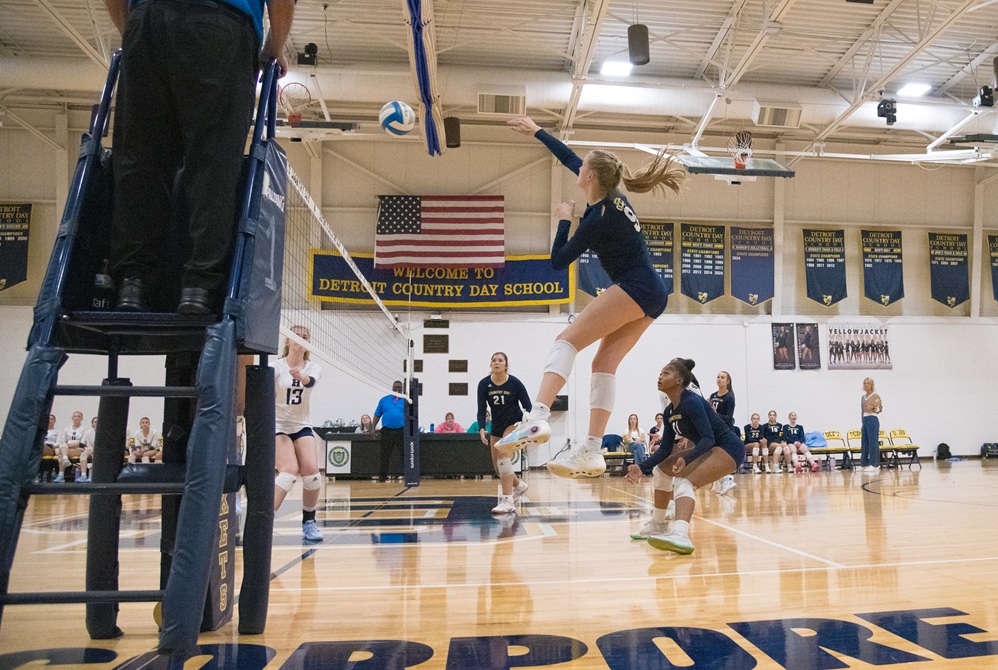
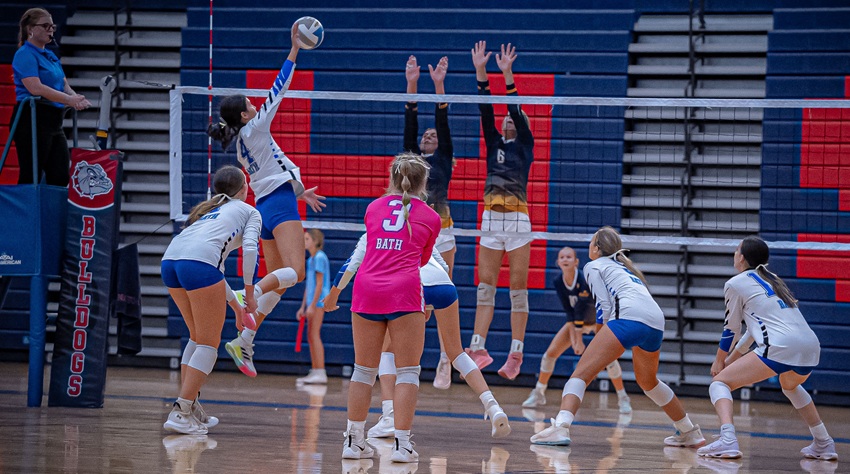
PHOTOS (Top) Detroit Country Day hosts Hartland on Oct. 9. (Middle) Bath faces Brooklyn Columbia Central during the Mason Invitational on Sept. 13. (Country Day/Hartland photo by TCP-Photography. Bath/Ovid-Elsie photo by Click by Christine McCallister.)