

Unified Sports: Unified Goal, Unified Effort
By
Mark Uyl
MHSAA Executive Director
April 11, 2019
The following publisher's note and cover story were featured in this winter's edition of the MHSAA benchmarks magazine.
At its best, sport breaks down barriers and differences through promoting teamwork, inclusiveness and humility. At its worst, we’ve seen sport do the opposite.
Obviously those involved in school sports aim to create a culture within every school which fosters the best of what all of us can be. Those places that do this best have created a culture in every hallway, classroom, playing field and gymnasium filled with diverse students pulling for one another and working together regardless of the different backgrounds, races, religions, abilities, physical stature or academic acumen of each person. A culture of understanding and acceptance is what we strive for in each of our school communities.
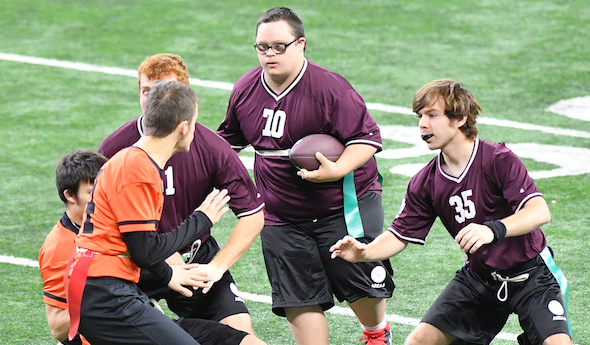
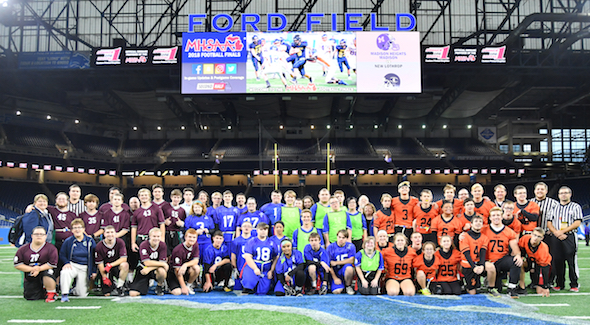
On Nov. 24, such a scene played out on the grand stage of the playing surface at Ford Field in Detroit. In what we hope will be the launching pad for many more such events, Unified Sports competitors from four MHSAA member schools competed simultaneously in two games prior to the MHSAA Division 7 Football Final.
Unified Sports is an inclusive sports program within Special Olympics which pairs students with and without intellectual disabilities as teammates for training and competition.
From the time competitors walked through the tunnel to perform in front of family, friends, and the appreciative crowds from New Lothrop and Madison Heights Madison awaiting kickoff for the 10 a.m. game, the enthusiasm was unmatched.
Following competition these Unified teams were given tours of the facility, including a visit to the Detroit Lions locker room. We intended to deliver a day filled with an experience and memory for a lifetime for our guests, and feedback suggests that was accomplished. But, make no mistake, the session left lasting impressions on the staff here at the MHSAA, as well.
Brighton, Holt, Mason and Sparta – schools represented at the 2018 Football Finals – are among the 300-plus schools statewide which are Special Olympics Unified Champion Schools®, and it is our hope that the number continues to grow around Michigan and throughout the country.
The MHSAA and Michigan Special Olympics have a wonderful relationship, and we will continue to plan with our valued partner for future events as opportunities present themselves.
There is no limit to the benefits of these games and such a partnership. And, no limit to the enthusiasm of its participants who are helping to redefine school cultures by helping us break down barriers and build inclusive school communities around this great state.
***
By Rob Kaminski
MHSAA benchmarks editor
The pass was lofted high, and floating toward the end zone nearest the tunnel where teams enter the playing surface at Ford Field.
As players from both teams converged, the intended receiver came away with the ball, clutching his prize and raising his arms in jubilant triumph.
It was arguably the best catch of the Thanksgiving weekend football feast in Detroit, and undoubtedly a memory this player will never forget. Moments later, the ear-to-ear grin remained as he high-fived spectators and family members on the way to the tunnel and up to the locker room.
And all of this happened before the second day of MHSAA 11-Player Football Finals kicked off Saturday, Nov. 24.
The play was one of many memorable moments to take place during the first-ever Unified Champion School event held in conjunction with the MHSAA Football Finals. If this year’s exhibition was any indication, it will be the first of many to come.
“The event far exceeded our expectations, and in discussions with the students, coaches and parents involved, I think it exceeded their expectations as well,” said MHSAA Executive Director Mark Uyl. “The feedback was positive, and the thanks and appreciation we received was overwhelming.”
Special Olympics Unified Champion Schools® (UCS) is an education-based project that uses sports and education programs to activate young people to develop school communities where all youth are agents of change – fostering respect, dignity and advocacy for people with intellectual disabilities.
Last summer, as Uyl was settling into his role as executive director at the MHSAA, Tim Hileman was acclimating himself to a similar role with Michigan Special Olympics. Both were replacing long-time leaders – Jack Roberts at the MHSAA and Lois Arnold at Special Olympics, who both had served their organizations for more than three decades.
The similarities brought Uyl and Hileman together, and they began to nurture seeds that had been planted by their predecessors.
“Mark reached out when the announcement was made that I was to become CEO of Michigan Special Olympics,” said Hileman. “We strongly believed in the benefits of a partnership between the two organizations. We talked about long-term plans and the goal of growing a culture of inclusion within our schools. A more immediate component was exploring existing opportunities to highlight a partnership, and what greater way to do that than at Ford Field during one of the most prominent weekends of the MHSAA sports season?”
The inaugural event included students from Brighton, Holt, Mason and Sparta school districts, each of which sponsor Unified teams.
Brighton, which has been in the game since 2016-17 and involves a combined 75 general education students and students with intellectual disabilities (I.D. students), recently earned national recognition for its Unified program.
“Andy Doupe, a faculty member who teaches special education here, brought the initiative to our district and it was a no-brainer that we needed to implement the program,” said John Thompson, athletic director at Brighton High School and a member of the MHSAA Representative Council. “It was a great opportunity to be supportive of all students in our community.”
Brighton Unified coach and faculty member Jody Renicker has helped take the lead.
“The foundation of Unified Sports is pretty simple,” Renicker said. “It's the idea that training and competing together is one of the fastest ways to friendship and understanding. The students discover that they are much more alike than they are different. This helps to dissolve the preconceptions and stereotypes often associated with people with disabilities.”
Just up the road in Holt, that community was gaining its own recognition, bringing home the Gold Medal from the USA Flag Football Championships in Seattle last summer. The lessons and experiences proved even more valuable.
“Athletes roomed with UCS partners,” said Val Suszko, a coach for the Holt/Mason program, which involves roughly 80 students with and without disabilities and is in its sixth year of existence. “The friendship that they developed over those 10 days was priceless. They are friends for life. They care for and protect each other. Without this experience, they wouldn’t have ever met.”
That’s the overriding goal of Unified athletics: to break down barriers within schools and communities while introducing young people to those with various challenges, offering opportunities to lead and assist.
 “The inclusion of special needs kids and how it makes them feel is a wonderful part of the school community and program,” Thompson said. “We have a young lady with a prosthetic leg who never wore shorts because she was embarrassed. Now, being part of our basketball team, she wears shorts all the time.
“Naturally there’s a huge upside for the special needs students, but the general ed kids are being provided an opportunity to grow and develop leadership skills. The experiences open some eyes and break down some divisions that exist to make for an improved culture throughout the school. The melding of kids with different backgrounds of any kind is always good for perspective.”
Unified programs offer increased participation opportunity for the general education population as well as the I.D. students. For students who may not make the cut for school teams, or prefer to focus on academics or part-time jobs, the Unified option provides just what they are seeking. Others are varsity athletes looking for competition outside their preferred sport seasons.
“We receive a lot of interest from those partners who might have wanted to play on freshman, JV, or varsity teams but couldn’t meet the eligibility requirements or physically do not make the cuts at those levels of team tryouts,” said Renne Wyman, Unified coach at Sparta High School. “So they wander into the gym and join us. What happens is, the level of play ratchets up a notch or two. These kids initially come here to play, not necessarily help the intellectually disabled kids.
“But, then they start giving shooting advice, or directing them where to move offensively or whom to cover defensively. Suddenly they are talking to each other, and no adult staged the mentoring. It carries on between quarters, at halftime, before games and practices. They start texting and offering a seat in the cafeteria at lunch. I’m talking about major culture change in our building.”
This type of interaction serves to reduce the number of negative incidents in the hallways.
“Statistics show that these programs have proven to reduce bullying of the intellectually disabled population,” said Suszko of Holt/Mason. “To have an organized sports team and school support team is invaluable. The students with intellectual disabilities gain so much. They train together, play together and develop friendships through sports with the general school population.”
With such important life lessons in the balance, and 300-plus schools around Michigan sponsoring school programs, the time was right to further shine a spotlight on the product. In the past, Unified basketball events have been showcased during MHSAA Hoopfest events in conjunction with the Boys Basketball Finals, and it was time to take the next step.
“A partnership between the MHSAA and Special Olympics is a natural fit, and our goal is to assist in promoting inclusiveness and leadership components of Unified Champion Schools as opportunities at our tournaments allow,” Uyl said. “These are such worthwhile endeavors, and the student-athletes involved truly symbolize the best in school sports.”
The Ford Field event provided a chance for some serious competition on the field, along with countless smiles – and some tears – from onlookers and support groups following the action.
“My favorite story from that day came as Mark (Uyl) was addressing the group in the Lions locker room and thanking them for being there,” Hileman said. “I looked into the corner of the room and there’s a man – pretty good sized, tough-looking – standing there with his wife, and they’ve got tears in their eyes. The dad came up and told me, ‘I never thought I’d see my son play any kind of sport, and here he is at Ford Field. I’ll never forget this, and never watch a Lions game without thinking of this.’
“So many of our athletes are told what they can't do. Special Olympics is about showing what they can do.”
 For Suszko, the highlights began earlier in the morning.
“The most memorable moment for me was watching the expressions on all of the athletes’ faces as they walked through the tunnel onto the field,” she said. “What a great opportunity. The hospitality that Mark Uyl, Nate Hampton, and the rest of the staff gave us was appreciated so much. The parents were excited. They loved seeing their athlete participating alongside the other high school football teams. Watching barriers being broken and teamwork being established is what inclusion is all about.”
There were plenty of emotions to go around, from the guests and the hosts.
“The kids and parents were over the moon when the invitation came. Ford Field, the MHSAA Finals, it really resonated with the kids, the school and families,” Thompson said. “Nate and Mark and all staff involved went out of their way to make it a wonderful and meaningful experience. They did more for the families and kids than anyone expected. We are very appreciative of the MHSAA continuing to work toward inclusion, and events like these help to spread the word.”
Spreading the word will help bolster an already strong movement both in Michigan and nationally. Hileman is excited for the future in partnering with the MHSAA for events like the one in November, which generate a high level of enthusiasm. In the near future, he has some more immediate goals.
“We are concentrating on expanding league play. That’s what sports are; athletes competing, and our athletes want to compete,” Hileman said. “We have league play in the O-K Conference, and in the Lansing area. Our goal and vision is to continue to build on the Unified conference experience; more competitions during the season.”
The Sparta program has been in place for four years, and numbers have increased from a handful to a total of 60 partners and Special Olympics athletes combined. Volunteers are a vital part of the initiative, and Wyman says hundreds of people donate their time at affiliated service projects held twice yearly. The school offers Unified flag football at the league/conference level each fall, Unified ski/snowboard on a smaller scale, Unified basketball at the league/conference level in the winter, and is looking to add Unified track & field at the league/conference level this spring.
Make no mistake; athletes of all kinds like to compete.
“My kids are learning the game like they never did before. The partners don’t dumb down the vocabulary or slow down what they teach. This occurs in real-time scrimmaging with a need to adjust quickly,” said Wyman. “So our Unified athletes are being coached and challenged to increase their skill and conditioning at a level I just can’t replicate in my Special Olympics Physical Education class where no partners are present.”
One also cannot replicate the related successes outside the gyms and away from the fields, where Wyman reports that I.D. students are now being offered rides to school for dances and athletic events, improving their grades to be eligible to participate in the program and becoming healthier through the activities, all while gaining confidence in themselves.
Renicker believes that seeing is believing, and encourages people to attend events in neighboring communities. The impression will likely spur action.
“My No. 1 suggestion would be to come and witness how special a Unified Game is,” Renicker said. “It will give you hope for our future and highlight some pretty amazing things that are going on in schools every day that don't make the front page of the newspaper. I feel so lucky to be part of a school community that values this program and the culture it has created.”
Hileman recently attended a national Special Olympics event and heard International Chairman of Special Olympics Dr. Timothy Shriver proclaim his dream: that just as every high school sponsors boys and girls athletic programs, he hopes that one day every high school in the country will become a Unified Champion School.
It is a big dream, but the slightest nudge can put things in motion, as Wyman has seen.
“It can start small. You only need one or two partners to commit and you can get something going,” Wyman said. “A lot of kids would love to help in supporting roles, whether it’s running sporting events, officiating, keeping stats, designing, or organizing. In the beginning, it is one person reaching out to one school seeing if they can get together and play the game.”
With that, the guidance of Special Olympics, and assistance from partners like the MHSAA, maybe the ball can keep rolling all the way around the state.
***
Inclusion is Primary Mission of Special Olympics UCS
Team sports bring people together. Special Olympics Unified Sports® teams do that, too, and much more.
About 1.4 million people worldwide take part in Unified Sports, breaking down stereotypes about people with intellectual disabilities in a really fun way. ESPN has served as the Global Presenting Sponsor of Special Olympics Unified Sports since 2013, supporting the growth and expansion of this program that empowers individuals with and without intellectual disabilities to engage through the power of sports.
Promoting Social Inclusion Through Sport
Special Olympics is dedicated to promoting social inclusion through shared sports training and competition experiences. Unified Sports joins people with and without intellectual disabilities on the same team. It was inspired by a simple principle: training together and playing together is a quick path to friendship and understanding. In Unified Sports, teams are made up of people of similar age and ability. That makes practices more fun and games more challenging and exciting for all. Having sport in common is just one more way that preconceptions and false ideas are swept away.
States Embracing Unified Sports
Young people with disabilities do not often get a chance to play on their school sports teams. More and more states are adopting the Unified Sports approach that Special Olympics pioneered.
Unified Sports is also an integral part of Special Olympics Unified Champion Schools, which was founded in 2008 and funded through the U.S. Office of Special Education Programs at the U.S. Department of Education to use Special Olympics as a way to build inclusion and tolerance in schools. Unified Sports are now in more than 4,500 elementary, middle and high schools in the United States. Seventy percent of Unified Champion Schools (Pre-K through Grade 12) are engaging in Unified Sports! Also 215 U.S. colleges and universities have Special Olympics College Clubs on campus, providing ongoing Unified and inclusionary activities for students and Special Olympics athletes. Seventy-three of the 215 U.S. colleges and universities activating Special Olympics College conduct ongoing Unified Sports on their campuses. Learn how to get involved at www.playunified.org.
Mission: Inclusion
As part of the Special Olympics-Lions Clubs International “Mission: Inclusion” partnership, the LCI youth network-Leos have become a strong global partner in expanding and implementing Unified Sports together with Special Olympics. The Leos have helped start and sustain Unified Sports in a number of nations worldwide, and serve as one of the movement’s strongest youth leadership networks in bringing inclusive programming to communities across the world. From Zimbabwe to Brazil and from California to India, the Leos continue to amplify the voice of athletes and embody the creed: Play Unified. Live Unified.
Major sports organization, league and event support to Play Unified
Many high-profile, professional sports organizations and events have also showcased Unified Sports as a vehicle to show the power of inclusive sports! This support includes:
• National Basketball Association (NBA)
• Major League Soccer (MLS)
• Union of European Football Associations (UEFA)
• National Collegiate Athletic Association, D-III
• ESPN's X Games Aspen
• National Federation of State High School Associations (NFHS)
• National Intramural-Recreational Sports Association (NIRSA)
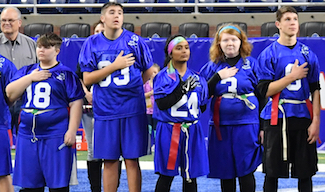
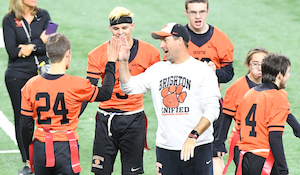
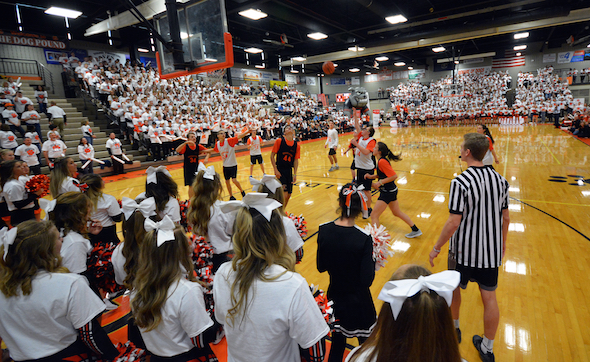
PHOTOS: (Top) Unified teams from Brighton and Mason/Holt play during the second day of the MHSAA 11-Player Football Finals at Ford Field. (Top middle) Participants from those three schools and Sparta took part in the morning's games. (Middle) Sparta athletes stand together for the national anthem. (Below middle) A Brighton coach and players exchange high fives. (Below) Brighton's Unified basketball team plays during a celebration for receiving national recognition last fall. (Photos by John Johnson.)
Cross Country Builds Century-Long Run of Starts & Finishes
By
Ron Pesch
MHSAA historian
December 30, 2021
Conditions weren’t ideal in Ypsilanti on this November morning in 1950.
The track at Washtenaw Country Club was snow-covered. Strong, cold wind and sub-freezing temperatures greeted runners. As in years past, Michigan State Normal College (MSNC), today known as Eastern Michigan University, was playing host to the Michigan High School Athletic Association’s cross country championships.
According to preliminary Associated Press coverage of the meet, “Kalamazoo Central won the Class A state high school cross-country championship. Ann Arbor placed second. The races were held at (MSNC) over a two-mile course. Individual winners from the 23 schools competing in the Class A event were James Arnold of Battle Creek, first and James Bishop, of Kalamazoo, second.”
Alma emerged from a field of 24 schools as the victor of the Class B race. Lansing Everett finished first among 14 schools in Class C-D that afternoon.
But, unmentioned in initial coverage, there was a hitch in the Class A race that day. A total of 25 teams had entered the race – the first of the day. Due to a scheduling mishap, two teams - Grand Rapids Catholic Central and Battle Creek Central, both strong candidates to win the competition – had been “literally left standing at the starting gate.”
“Originally scheduled to get underway at 11:30,” stated the Grand Rapids Press in its evening coverage of the morning’s race, “the run actually started at 11:20. Catholic and Battle Creek squads were both on hand, but were not notified of the change in time.”
“It all happened when the Bearcats had taken their warmup trots and had 50 minutes to go before the Class A event was slated to get underway,” reported the Battle Creek Enquirer in coverage the following day. Told the event would start as scheduled at 11:30, the Bearcats sought warmth, before they “returned to the course at about 11:17 – just in time to see the Class A field go past.”
Like Battle Creek, Catholic had headed to the clubhouse before the race, returning to the course to discover the pack had left.
James Arnold of Battle Creek, one of the event’s top runners, quickly recognized what was happening, and “sauntered into the pack of 161 runners after the start …” noted the Enquirer, reporting the chaos.
“(The) runner was 50 or so more yards down the stretch when he noticed the swarm of thinclads romp by him,” stated the Press, adding color to the moment. “He quickly doffed his sweat suit and took pursuit. He was Jim Arnold, who incidentally, came in the winner.”
“So befuddled were the officials,” said the Enquirer, “that they let Arnold be crowned individual champion and gave him a time of 10 minutes and 45 seconds even though he didn’t get under way at the starting line. But the other Bearcat entries weren’t so fortunate and finished far back to place the Bearcats far down the list.”
“He should be given a lot of credit for his performance,” stated the Press, “but on the other hand, is he legally entitled to the honor? He didn’t run the regulation distance that the other boys covered?”
Immediately following, and in the days after the race, formal protests were lodged by various coaches with the MHSAA.
“It certainly was an injustice as far as Catholic’s Joe Host was concerned,” Grand Rapids Union coach Lowell Palmer told the Press. Host was the Class A individual winner in 1949 and was returning to defend his title. “It probably would have been his last prep meet, and he deserved a better fate.”
Harriers in the Great Lakes State
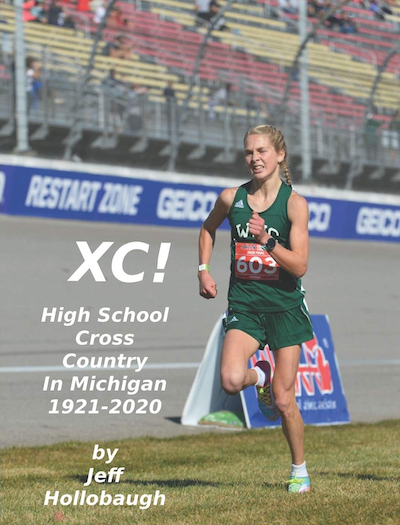
Readers interested in the sport’s entire history should make a dash for a copy of Jeff Hollobaugh’s book, XC! High School Cross Country In Michigan. At 270 pages in length, it “brings to life the traditions and memories of the most challenging of high school sports.” The author – or at least his voice – is well-known to many as the announcer at MHSAA cross country and track meets. For those with more than just a passing interest, he also maintains Michtrack.org, the place to go for everything running.
 What was considered the first true State High School Track and Field Championships in Michigan was held in the spring of 1908 at Michigan Agricultural College (MAC), today known as Michigan State University (MSU). So, it should come as no surprise Michigan’s first planned prep cross country state title meet would be planned for the same place.
The desire to host a meet was, in all likelihood, self-centered. What better way to recruit future distance runners than to invite all the state’s best high school runners to an event hosted at your campus?
Chester L. Brewer, athletic director at the college, announced plans to host a state interscholastic cross country meet in East Lansing in the fall of 1921. According to author Mark E. Havitz, the first school ran its first cross country race in 1907. The University of Michigan, which had organized a cross country club in 1901 to train distance runners in track, began official varsity cross country competition with the 1919-20 school year.
An announcement in the Benton Harbor News Palladium in its Nov. 4 edition detailed the basics. “This meet, the first of its kind in the history of state athletics, is expected to bring together the best long distance runners in Michigan schools. The race will be over a three mile course, instead of the five miles to be run by college athletes … . Floyd Rowe, state director of physical education, will be in charge.”
The Bay City Times on Nov. 8 added detail.
The “chief aim is to develop cross country in the secondary schools of Michigan … . While several schools, such as Battle Creek, Kalamazoo, Highland Park, Ypsilanti, and others are already strong in distance running, those in many other sections never go beyond the mile or possibly the two-mile in their track activities.”
Interestingly, Rowe also held another title, omitted from the announcements.
“Floyd Rowe, State Physical Training Director, will coach the (cross country) team this fall,” stated the Sept. 30, 1921, edition of the MAC. Record, a weekly published by the school’s alumni association. “Rowe, who is an old Michigan distance star, has had a lot of experience and should get the best out of his men. He is living at East Lansing at present.”
“The visiting lads will have an opportunity to witness Armistice Day ceremonies” scheduled at MAC for the November 11th meet. In addition, a trophy for the top five-man team was up for grabs along with 10 medals, one gold, one silver, and eight bronze for individuals.”
However, Mother Nature intervened, smothering those plans.
“Nineteen inches of snow which fell at East Lansing on Tuesday and Wednesday of last week blocked the college cross country course to such an extent that the First Annual M.A.C. High School Cross Country Run, scheduled for Friday, November 11 was indefinitely postponed,” stated a report in the Record, published on the 18th of that month. “While it is not likely that an attempt will be made to hold the run later this season, Director C. L. Brewer announces that the event will be held next fall and established as an annual event.”
Only, that didn’t happen.
Rather, the “first official state high school championship cross country run” – sanctioned by the Michigan Interscholastic Athletic Association, the immediate predecessor to the modern-day MHSAA – was held at Michigan State Normal College in Ypsilanti in November 1922 on Armistice Day.
The meet, held under the direction of MSNC’s new coach and athletic director, Lloyd W. Olds, included 12 schools, including Battle Creek, Ann Arbor, Kalamazoo, Central and Union from Grand Rapids, and numerous Detroit high schools.
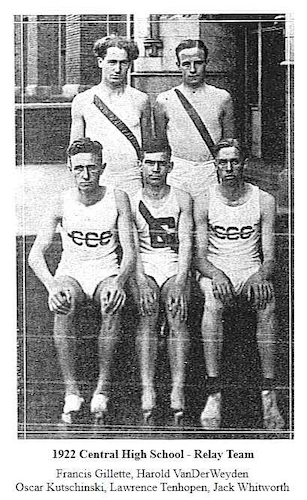
Ann Arbor topped the field, finishing with 27 points to Detroit Northwestern’s 96, followed by Battle Creek at 101. Junior Oscar Kutschinski of Grand Rapids Central topped the field, covering the two and a half mile course at 13:28, trailed by Theodore Hornberger of Ann Arbor, “a distance of about 20 feet separating the pair,” according to Ann Arbor News coverage of the meet. (While the two never met, Kutschinski’s great-nephew, Ron, won the MHSAA’s 1963 Class B 880 running for East Grand Rapids, then claimed the Lower Peninsula individual cross country title in 1964. The winner of the Big Ten half-mile while at the University of Michigan, Ron also represented the U.S. at the 1968 Olympics.)
 Competition for runners at the collegiate level in Michigan had been growing across the state. Michigan Normal had started its program in 1911 and, under the guidance of Coach Olds, the school’s track and cross country programs developed into national powers. Men's cross country became a championship sport in the fall of 1922 for the Michigan Intercollegiate Athletic Association (MIAA) – America’s oldest collegiate conference, formed in 1888. Kalamazoo College was that league’s first XC champion, topping MSNC (a member of the MIAA from 1892 until 1926), Albion, and Olivet.
The 1923 state meet at MSNC, run under muddy conditions, saw individual honors go to LeRoy Potter of Coldwater while the Ann Arbor team won its second consecutive title.
Ann Arbor picked up its third-straight team championship in 1924, earning “permanent possession of the M.S.N.C. trophy,” according to the Detroit Free Press. Ann Arbor High records show the school also claimed state titles for 1919, 1920, and 1921 as well, based on finishes in an annual Detroit Thanksgiving Day run. The school’s next team title wouldn’t arrive until 1987.
Potter “repeated and hung up another record, beating (his) old mark by 17 and 1/5 seconds,” to become the meet’s first two-time winner. “He led the group from the start, and finished with a strong sprint, being a full 500 yards ahead of the second man, Van Mere, of Kalamazoo. Donner of Ann Arbor was third.”
After graduation, Potter attended Michigan State Normal and became the school’s “first track performer to earn All-America status when he captured the mile run title at the 1928 NCAA Championships.”
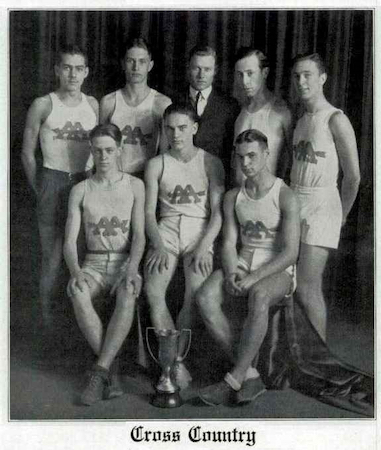 The Ypsilanti meet continued without change when the MHSAA took charge of prep athletics in Michigan midway through the 1924-25 school year. To conclude the Fall 1925 season, Kalamazoo Central won the “hill and dale” gathering with five finishers in among the first 15, with Ann Arbor ending in second, 36 to 52. Detroit Northwestern finished in third with 61. Lloyd Cody from Ann Arbor “finished the two and a half mile grind in 11 minutes 52 5/10 seconds.” Van Mere of Kalamazoo again finished second.
Over 300 invitations were sent out to different schools for the 5th annual interscholastic run in 1926. A total of 18 teams competed with a field of 105 competitors. Kalamazoo repeated as champs, this time also supplying the individual winner, Raymond Swartz, who clocked in at 14:24.2 over the two and a half mile course. A total of 93 runners finished the race. A trophy that cost the Association $12 was presented to the winning team.
XC Above the Straits of Mackinac
The first cross country meet in Michigan’s Upper Peninsula, according to the Escanaba Daily Press, was held in October of 1927 – “just before the Menominee-Escanaba football game” – with three schools, Iron Mountain, Manistique, and Escanaba, scheduled to participate.
“The state athletic association is very much in favor of cross-country running as a high school sport, and A. W. Thompson, state director of athletics has designated the race here as an official upper peninsula event,” added the Daily Press – the sponsor of the meet and donor of a trophy for the winning school. “He was pleased to learn that three schools would participate the first year and predicted that many more would enter runners in the years to follow.
“Cross-country has never been attempted in the peninsula, but high schools below the straits have been developing the sport rapidly.”
“Because Escanaba was the only school entering a full team, it was decided in fairness to the others, to award the trophy” to the school whose runner won the race. James Crummey, a junior and the only entry from Iron Mountain, won the event, “completing the 1 7/8 mile course in 11:35, far ahead of his nearest competitor,” Emmett Lough of Escanaba finished second, followed by two teammates, Tom Froberg, and Irv Cass.
The 1927 state competition at Ypsilanti, now with 27 teams, was split into Class A and Class B for the first time. According to the MHSAA’s January 1928 Bulletin, “a team trophy and 20 medals were awarded for each class.” Swartz of Kalamazoo again won the individual honor, now in Class A, leading his team to its third-straight team championship. All of Kalamazoo’s runners finished in the top 10, allowing the team to repeat as champion.
“After figuring for two hours,” noted the Grand Rapids Press, “the mathematicians decided Detroit Eastern had second and Pontiac third.”
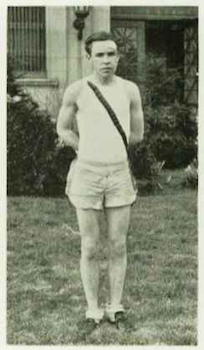 For the first time, the U.P. had entries in a state title race, as Crummey of Iron Mountain and Oliver Cejka of Kingsford made the long trip downstate to compete in Class B.
Dearborn grabbed the ‘B’ team title. Earl Sonnenberg of Wyandotte Roosevelt earned the classification’s individual crown “after a two mile battle with Crummey,” noted the Press. Brown of Ferndale was third, while Cejka finished sixth.
With the solid showings, the U.P. beamed with pride.
The Sport Grows
The meet was expanded to three classifications with the addition of Class C in 1928. Kalamazoo, again, won the top honor in Class A, defeating Detroit Northwestern, 51-66. Jack Rutherford of Flint Central came away with the individual honor, with a time of 10:23, a “rather good time considering the snow-clad pathway,” noted the Bay City Times. Marcellus Barlage of Detroit Holy Redeemer took Class B in 10:46 while Tompledus (first name not available), Parma’s only runner, finished at 11:52 for the Class C honor. Roosevelt was the only team in the class “that returned five men to the starting or finish line.”
In 1929, the MHSAA reported 68 schools sponsoring XC teams. Because of the continued growth, for the first time, regional meets were hosted by the MHSAA that year, with seven taking place initially. Sonnenberg, who also won the Class B 880 track event in the spring, picked up his second harrier title come fall, this time in Class A for Wyandotte Roosevelt. He had finished second in ‘B’ in 1928 and would later compete for Western State Teachers’ College – today’s Western Michigan University.
The meet saw its first shared title in 1930, when Grand Rapids South, coached by Percy L. ‘Pop’ Churm, deadlocked with Alonzo Stoddard’s Kalamazoo Central squad, with 91 points each, to split honors in Class A. Missing from the South team was future President of the United States, Gerald Ford, who was not a distance runner, but rather one of the “weight men” on Churm’s South track team. The season also marked the first year in which the Detroit Public Schools didn’t compete due to their choice to withdraw from state competition.
In 1931, “Kalamazoo became state champs because they had a well-balanced team,” detailed the school’s yearbook, “in contrast to some teams who have one man who finishes first most of the time while there may be three or four others who finish far down in the standings. Gerald Roberts led the local thinclads to the tape in the State run, finishing sixth, but it was the mass formation of (Arnold) Baker, (Robert) Massey and (Randall) Swartz that brought home the trophy. This group finished 12th, 13th, and 14th respectively while (George) Vande Lester assured Central of the title by crossing the line 25th which is not at all bad considering that there were over 100 men entered.”
With the onset of the Depression, the annual state cross country finals were canceled due to finances, and teams ended their seasons with regional competitions in both 1932 and 1933. The championships disappeared again in 1942 due to World War II. They resumed in 1943. In 1944, the MHSAA sponsored its first split peninsula harrier championships, with Baraga winning their first of back-to-back Class C-D-E titles under Coach Evins Edward Erickson. Iron Mountain topped Escanaba, 15 to 44, in Class B. The 2-mile runs were hosted “between the halves” of the Escanaba-Iron Mountain football game in late October, according to the Escanaba Daily Press.
The Re-Running of the 1950 Class A Meet
“I am not positive we would have won it,” said Battle Creek coach Bob Mowerson, “but I feel sure we would at least have placed second, I’m going to call and tell the story to (Charles) Forsythe, (director of the MHSAA) but I feel little can be done now.”
Before the state final, Battle Creek Central had beaten Kalamazoo Central in three of four previous meets that year. The single defeat, a 28-27 win by the Maroon Giants, had come at home in a dual meet early in the season, hosted at Riverside Country Club. It marked the first dual dropped by the Bearcats in two years.
“Coach Ted Sowle of Catholic thought Battle Creek had too much depth for his team to beat,” stated the Press, “but was of the opinion that the two teams would finish one-two had they been allowed to participate.”
Dave Arnold, assistant state director of athletics, suggested that the meet be rerun the following weekend. Forsythe agreed but decided that since 21 of the 23 teams entered had completed the race, the results of the original run would stand.
 “A new title, new set of trophies, and more expense mileage will be available for this second event. The race – a second Class A championship - was scheduled for the coming weekend, and scheduled for 10:30 again at Ypsilanti.
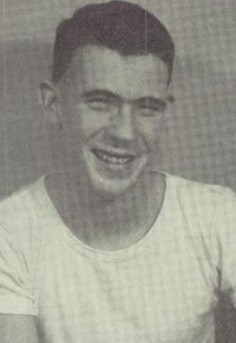
“Fleet-footed Bearcat ace Jim Arnold scampered across the finish line in the No. 1 position for the second week running, which gives him the distinction of having won top individual honors in the annual high school cross country championship event twice in one year,” noted the Enquirer with glee.
“Jim jumped into the race last week in 80th place, out ran the entire field, and finally sprinted into the winner’s spot in first place. His pace-making time of 10 minutes and 39.5 seconds in yesterday’s race bettered that of his first title run by 5.5 seconds on the same course.” The race-time temperature was 27 degrees.
Just 10 teams and 75 harriers entered the second running, as the results of the original race would still stand. With little to gain, Kalamazoo Central stayed away. Ann Arbor, second in the original race, returned.
“Arnold and Joe Host, Grand Rapids Catholic’s defending individual champion in the event, led the pack for the first half of the race,” added the Enquirer, “running side by side over frigid snow-covered track at Washtenaw golf course. The Bearcat ace pulled away at the three-quarter mark, however, and won going away. Host crossed the finish line in third place as an Ann Arbor harrier sped past him down the home stretch.”
Battle Creek Central won the event with 45 points. Ann Arbor, repeating its second-place performance, topped Catholic Central, which finished third, 69 points to 118.
The annual Lower Peninsula championships remained in Ypsilanti for another 20 years.
Changes
The U.P. championships continued to be hosted in October during football games, alternating between Escanaba and Iron Mountain and run during the annual Saturday contest between those two schools into the mid-1950s before moving to Marquette under management of Northern Michigan University.
In 1961, Detroit schools returned to statewide competition, and, suitably, the Lower Peninsula Class A team championship was won by Detroit Redford at Washtenaw Country Club. Redford’s Dick Sharkey, unbeaten in his 20 races as a junior and senior, finished first, outdistancing Detroit Cody’s Tony Mifsud by 50 yards. That year, the MHSAA added an All-Class individual race for runners “whose teams failed to qualify for the team event”, noted the Detroit Free Press. Tom Florida of Flint Southwestern was the race’s first winner. Individual runs were added to Class B In 1964, and to Class C-D in 1971.
According to Hollobaugh, heavy snow in 1966 caused a one-week delay in the running of the championships. It’s been the only weather-related postponement in the event’s history.
Five Decades of XC
The 1971 championship marked 50 years since the first run in Ypsilanti in 1922. Based on a survey by the National Federation of State High School Associations (NFHS), 472 of Michigan’s high schools now sponsored boys cross country teams.
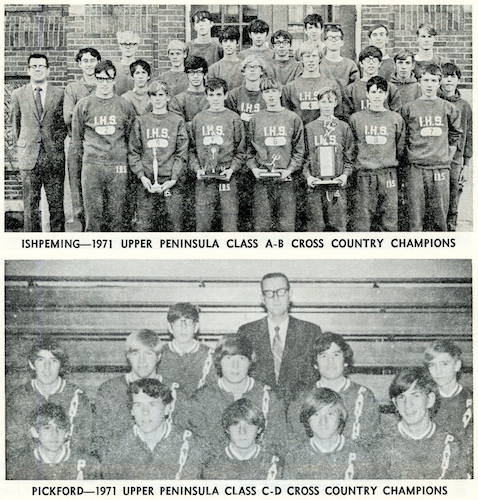
Tim Tobin of St. Joseph grabbed the Class A individual championship and led the Bears – the smallest of the ‘A’ schools based on enrollment – to its first-ever title, 97 to 120 over second-place Flint Kearsley. St. Joseph had previously finished second to Kearsley in both 1968 and 1970. Muskegon Catholic Central grabbed Class B, with Wyoming Lee earning Class C-D. In the U.P., Ishpeming won A-B and Pickford grabbed C-D, staged at Northern Michigan University in Marquette.
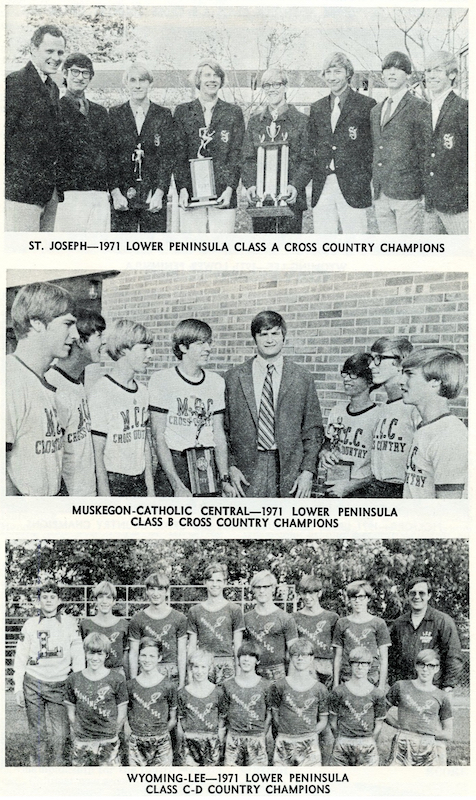 Dismal weather had dampened the L.P. meet, run on a newly laid-out 2½-mile course at Washtenaw Country Club, but the races still saw a crowd of “3,000 to 4,000 people” spread around the course according to MHSAA Executive Director Allen W. Bush.
Nevertheless, the gathering was the last of the long run of consecutive meets hosted by the university.
“In 1971, which is the last year that (they) ran at Washtenaw Country Club, I was at that meet,” recalled Jerry Myszkowski, who ran for coach Bob Parks at Eastern Michigan during its NCAA Division II and NAIA national championship season of 1970. “It was a deluge. It was raining cats and dogs and did not let up. Basically, the course was just a mess. There was standing water … every turn was all torn up.”
“A couple of years before the change, Parks was complaining that he was getting more pushback from members of Washtenaw Country Club about using the course. They were upset that we were going to take a whole day off and not play golf, et cetera, et cetera.”
More and more club members were coming in from beyond the county.
 “Park’s statement was, he felt in the old days, most of these members were members of Washtenaw County, Ann Arbor, and Ypsilanti and they took civic pride in this thing,“ continued Myszkowski. “I’m sure that with all those spectators as well as runners, there was already some damage probably done on the course. With the rain, I think that was the last straw.”
Minutes from the May 1972 MHSAA Representative Council meeting indicate that the Association planned to make a change in direction for the coming fall.
“The following requests from the Cross Country Committee were reviewed at this meeting. It was decided that a single class final for cross country would be conducted at three different sites as recommended by the Coaches Association and the committee. Class A will be conducted by Detroit-Redford Union, Class B by Vicksburg High School, and Class C-D by Jackson-Vandercook Lake High School. The Upper Peninsula meet will be conducted at Northern Michigan University.”
“With a wet fall, you can really tear up a golf course with that many people on it,” said Rudy Godefroidt, who guided Breckenridge to a Class C title in 1976, then served as an official for three decades. “(The Association) knew that if they separated the meet, they would separate the number of individuals (watching the event).”
The 1972 season included one more additional change, as the distance run by prep XC athletes in Michigan was increased from 2½ to 3 miles.
An NFHS survey showed 42 Michigan schools sponsored cross country for girls during the 1975-76 school year. With the arrival of Title IX, MHSAA-sponsored Lower and Upper Peninsula Open Class girls state championship meets were added to the postseason mix in 1978. A year later, with 221 schools now sponsoring the sport for girls, the Association separated the girls finals into classifications. In 1980, the standard distance of a race moved to five kilometers (3.10686 miles).
Return to a Single Site
Dave Bork, a former cross country runner and later coach at Monroe High School, and past vice president of the Michigan Interscholastic Track Coaches Association, and Mike Woolsey, cross country and track coach at Jackson Lumen Christi and previous president of MITCA, “had been tossing around the possibility of having all schools compete again at a single location,” recalled the Monroe News in 2020. They investigated the possibility of using Michigan International Speedway as the site. “That was in 1994.”
“Fortunately, Woolsey lived in the same neighborhood as (former Jackson Citizen Patriot sports editor and) the public relations director for MIS, Tommy Cameron,” stated the Monroe paper. “Cameron liked the idea and asked then-MIS owner Roger Penske about it. Penske said yes, and then Bork and Woolsey went to work. The two formed an 11-member committee to lay the foundation for MIS to host the state meet.”
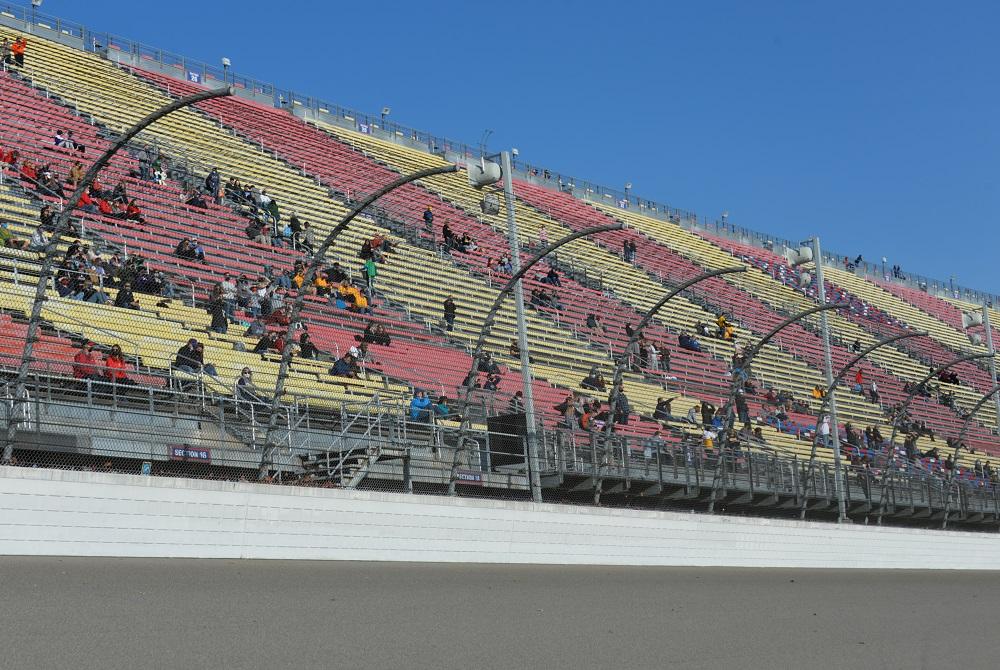 Of course, much had changed since 1972. Once the logistics were worked out, the MHSAA event made the move to Brooklyn for the Lower Peninsula meets starting in 1996. Instantly, the cross country championships became the single largest gathering of athletes in the history of the Association, with nearly 1,900 athletes from around 500 schools competing across eight runs – four for boys and four for girls. It was the first state meet in the country to use electric timing, even before any NCAA meet.
“MIS was not only developed as a high-banked, high-speed track for Indy Car and NASCAR events; located to the East of the racing oval was a car testing/road rally course of dips and turns and rolling landscape that two thirds of the race would actually take place on,” stated John Johnson, recently-retired communications director for the MHSAA. “The race would start on the infield before heading to the back course, and finish with the runners reentering the oval at Turn 3 and finishing on the grass skirt of the oval in front of the main grandstand.“
A 300-foot wide starting line also meant that separate team and individual races were no longer needed as the site could accommodate all the runners in a single race.
Still, logistical issues arose with timing the mass of runners, creating unforeseen problems at the first running at MIS
“As I like to say to this day – ‘We’re still waiting on the results of the 1996 Cross Country Finals,’” added Johnson.
MIS officials were concerned with allowing spectators on the course, and hence, all were forced to watch from the main grandstands.
“It wasn’t what they wanted,” stated Johnson.
But, with the efforts from MITCA, the MHSAA, and expanded flexibility from MIS owners and staff, the initial issues marring the event were soon worked out.
More Than 2 Decades Later ...
The Cross Country Finals have been hosted at the Speedway for 26 years. Like Ford Field in football or Breslin Center in basketball, it’s become a destination point that teams can target as their goal for the season.
“The kids themselves (have become) enthusiastic about having a place to call their own,” added Johnson. “The rolling Irish Hills (have produced) incredibly fast and competitive races, and the MIS facility (has) turned into a beehive of activity on race day with a rainbow of team tents and fans in an incredible atmosphere. Administratively, things (have) continued to get better every year.”
“I think we had close to 12,000 there this year at MIS” added Godefroidt. “If you try to put 10 or 12,000 on Washtenaw Country Club, there’s absolutely no way you could park everybody, there’s no way they all could see what they need to see.”
“The great side is everyone’s on the same course on the same day,” stated Kim Spalsbury, who coached boys and girls at Fowler and Grand Ledge over a 30-year span and has witnessed the event at MIS every year in some capacity. “From a coaching standpoint, you know the course, your kids have this institutional memory of the course because, if you have a good program or even if you just have had successful individuals, somebody on your team likely has been there before and experienced the race and can assure others of what it’s like. …That’s valuable to everybody to have that.
“And just from a historical perspective, the course might be a little different in terms of the conditions any given year; rain, cold … . It’s always tweaked a little bit here and there, but it’s essentially the same course and there’s all kinds of historical value in being able to compare times across generations now, you know, because we’re into a new generation since we started this in ‘96 down there.”
“What MIS does for us is just phenomenal, so it’s pretty hard to beat that site,” added Bork. “They are so professional there – the amenities that we have there that you wouldn’t have at any other place, it’s remarkable.”
AUTHOR’S NOTE: Special thanks to Chuck and Janet Janke, as well as those quoted in the article, for their assistance in telling the story.
 Ron Pesch has taken an active role in researching the history of MHSAA events since 1985 and began writing for MHSAA Finals programs in 1986, adding additional features and "flashbacks" in 1992. He inherited the title of MHSAA historian from the late Dick Kishpaugh following the 1993-94 school year, and resides in Muskegon. Contact him at [email protected] with ideas for historical articles.
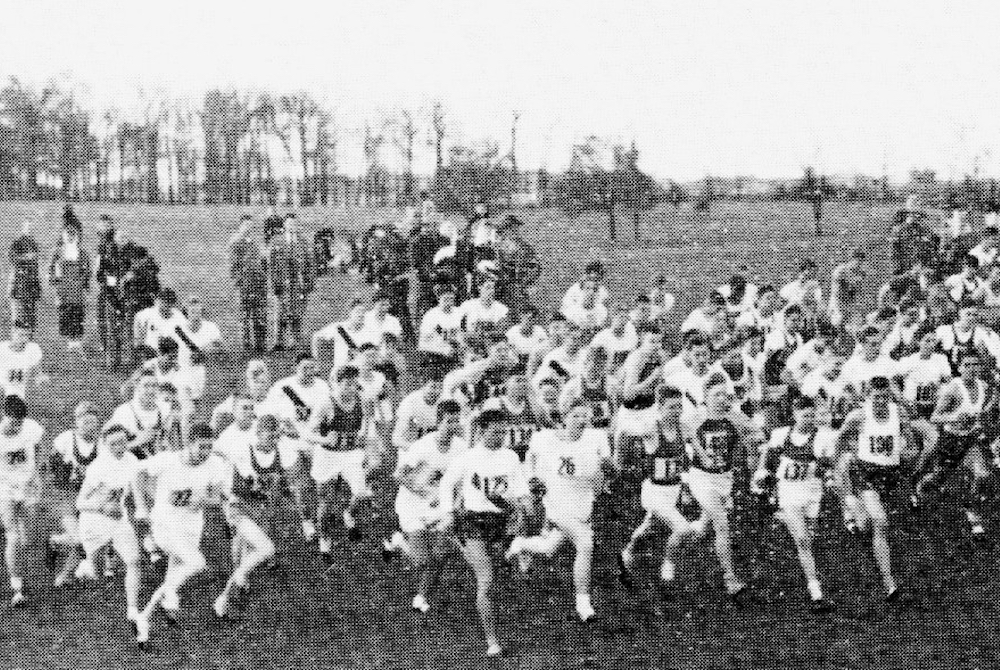
PHOTOS (Top) Contenders race during 1949 Finals at Washtenaw Country Club. (2) Jeff Hollobaugh’s book, XC! High School Cross Country In Michigan, is a detailed collection of the state’s cross country history. (3) Grand Rapids Central’s 1922 team featured Oscar Kutschinski, the first-place finisher in the state’s inaugural XC championships. (4) Ann Arbor’s 1924 championship team. (5) James Crummey of Iron Mountain. He would later run for the University of Wisconsin. (6) Fleet-footed Battle Creek Central ace Jim Arnold, two-time winner of the 1950 Class A XC meet. (7) Team photos of the 1971 XC champions. (8) Michigan International Speedway is the longtime home of the MHSAA Lower Peninsula Cross Country Finals. (Photos collected by Ron Pesch.)