

10 to Remember: 2012-13 Finals
June 27, 2013
By Geoff Kimmerly
Second Half editor
Championships are culminations of season-long journeys, concluding with the most exciting competitions of the year but steeped in back stories that make those crowning achievements mean so much more.
The Michigan High School Athletic Association awards 127 team championships each school year. Anyone picking 10 favorites could come up with at least 13 different lists.
So the list that follows likely won’t agree with many others. But here’s one person’s take on the 10 most incredible MHSAA Finals performances – focusing mostly on the final competition but with some back story built in – from the 2012-13 school year. (Click on headings for full stories.)
10. Special teams lead to special accomplishment for Brother Rice
Birmingham Brother Rice and Muskegon had combined for 12 MHSAA football championships entering the Finals. But in winning their eighth, the Warriors also accomplished a first in 44 seasons under coach Al Fracassa – their first back-to-back titles. They went ahead in the eventual 35-28 win on a cross-field lateral that turned into a 91-yard kickoff return with 2:13 to play.
9. Lakewood volleyball ends championship wait ...
Lake Odessa Lakewood coach Kellie Rowland has won 787 matches during her 15 seasons over two tenures leading the program, and frequently had brought the Vikings to the cusp of their first MHSAA title. They finally got it by defeating perennial power North Branch in three games in the Class B championship match.
8. ... and so does Bay City Western baseball
The Warriors earned coach Tim McDonald his first MHSAA championship game victory to go with 562 more wins over 21 seasons. Bay City Western won 1-0 in both the Semifinal and then Final over Brother Rice to secure its first baseball title and a 42-2 finish.
7. “Core 4” leave Mona Shores with four more
Seniors Hailey Hrynewich, Morgan Smith, Britni Gielow and Kelsey McKinley finished their high school careers as starters on four MHSAA championship teams, including the one that won the Lower Peninsula Division 2 Final this school year by 41 strokes. Hrynewich and Smith both posted top-five individual finishes as Mona Shores shot a two-day 666 at their final championship tournament.
6. Grand Ledge gymnastics sets the bar
Number six on this list makes sense for the Comets, who won their sixth straight MHSAA team championship to set the all-time longest title streak in the sport. They did so with the fifth-highest score in MHSAA Finals history – 149.350 – and despite graduating the Division 1 all-around champion the spring before.
5. Seniors say good-bye at LP Division 1 Final
Grosse Pointe South’s Hannah Meier and West Bloomfield’s Erin Finn brought national acclaim to the Detroit suburbs over the last two years with dominating performances in track and cross country. They finished their careers at the LP Division 1 Track & Field Final, where Meier set all-MHSAA Finals records in the 800 and 1,600 and Finn set an all-Finals record in the 3,200. In the fall, Finn and Meier finished first and second, respectively, at the LP Division 1 Cross Country Final.
4. Fowlerville standout reaches the stars
Gladiators senior Adam Coon, once an aspiring astronaut now turned aspiring aerospace engineer, became the 17th wrestler in MHSAA history to win four individual Finals championships. And he became the first to do so at the two heaviest weights, earning his titles at 215 and 285 pounds. He graduated with a career record of 211-3 and a 194-match winning streak.
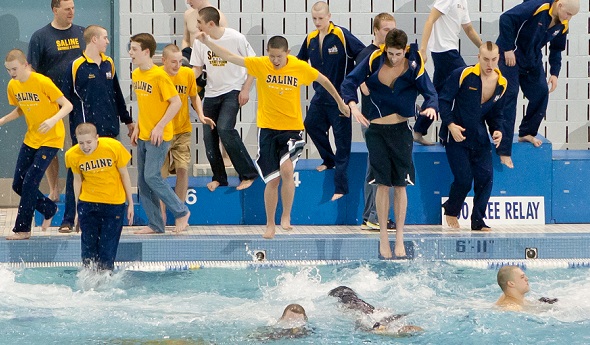
3. Swimming with speed in Saline
Saline also won its fourth straight MHSAA title, in Lower Peninsula Division 1, anchored by seniors David Boland, Josh Ehrman, Michael Bundas and Adam Whitener. Combined, they hold four Finals individual and two relay records, and Ehrman graduated with all-Finals records in the 200-yard individual medley and 100 breaststroke. Those four also leave with the 200 medley relay all-Finals record – with their time of 1:30.01 good for third-best in the national record book.
2. Michell sits atop MHSAA medal count
Reed City’s Sami Michell is one of two girls in MHSAA history to win four events at a Track & Field Final – a feat she accomplished both this season and last. And she finished her career this month with 12 individual titles overall, two more than the previous Lower Peninsula record. She graduated with LP Division 3 Finals records in both hurdles races and the long jump, and her 300 hurdles time of 42.23 is an all-Finals record.
1. Football Finals end in overtime classic
The most exciting MHSAA Football Final likely was the last of Thanksgiving weekend – a 40-37 overtime win by Grand Rapids Christian over Orchard Lake St. Mary’s that gave the Eagles the Division 3 title. And at least on this list, it counts as the most exciting of all the buzzer-beating, one-point, by one millimeter endings to the MHSAA’s 127 Finals this school year.
The Saturday night crowd at Ford Field was treated to an incredible performance by Eagles receiver Drake Harris, who had eight catches for a record 243 yards and touchdown and was nearly unstoppable as Grand Rapids Christian drove down the stretch. Quarterback Alex VanDeVusse threw for 307 yards, fourth-most in MHSAA Finals history, as the frazzled nerves of fans, players and coaches alike hung on every play. St. Mary’s ran for 459 of the single-team Finals record 579 yards of total offense; the teams combined for another record of 1,033 total yards between them. And at the end, the game was decided on a 27-yard field goal by Joel Schipper, who had connected on a 28-yarder with four seconds left in regulation to send the game to overtime.
PHOTO:Saline swimmers take a celebratory dip after claiming their fourth straight Lower Peninsula Division 1 championship.
Preview: Trio of Contenders Aim for Highest Achievement on State's Biggest Stage
By
Geoff Kimmerly
MHSAA.com senior editor
February 27, 2025
The largest MHSAA championship event – competed in the largest arena to host one – begins again today, with 1,120 wrestlers taking the mats at Ford Field for the Individual Wrestling Finals.
There are at least that many storylines swirling as first-round matches get underway. But three in particular are likely to gain statewide attention as they begin final drives to join an elite group.
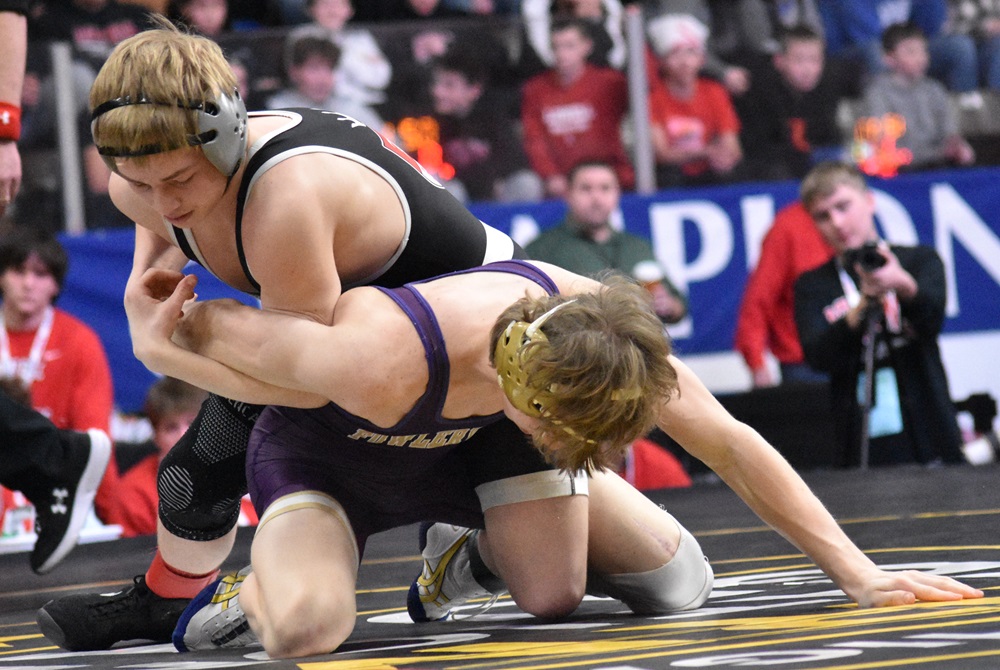
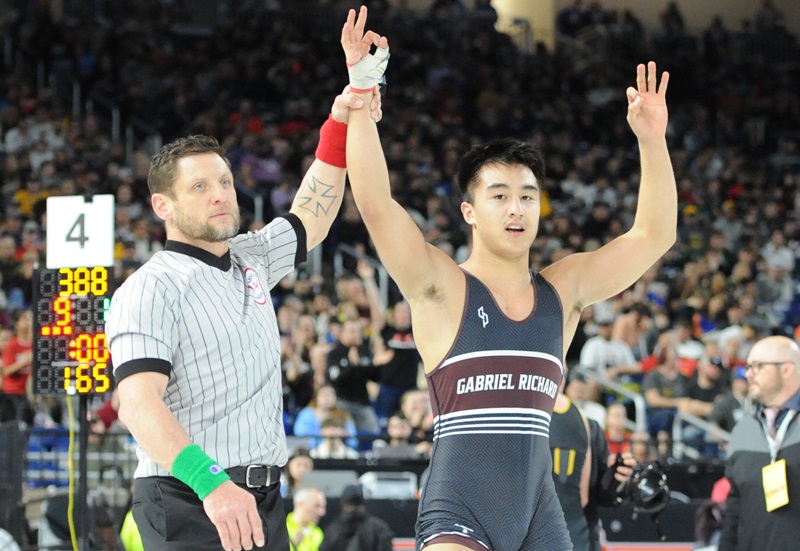
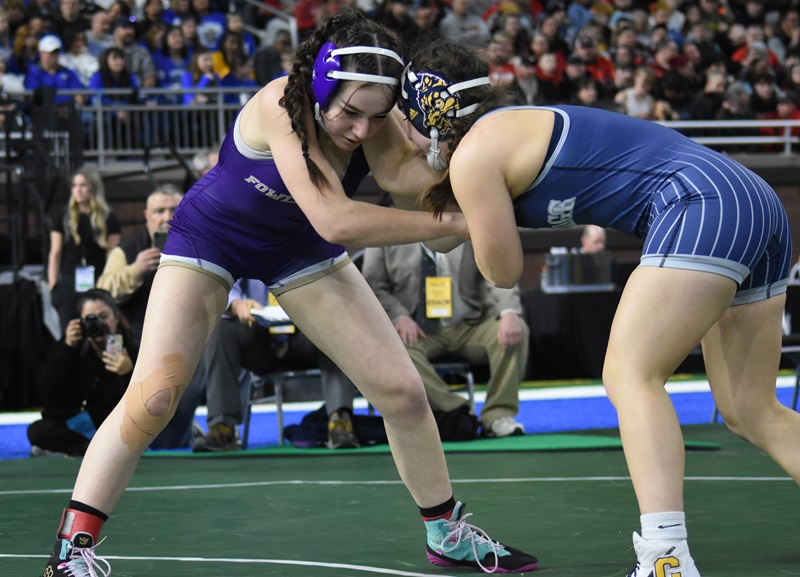
Lowell's Jackson Blum, Riverview Gabriel Richard's Sebasatian Martinez and Fowlerville's Margaret Buurma could bring the total of four-time champions in Individual Finals history to 40 by Saturday night – and Buurma could become the first four-time girls champion since the MHSAA added that division in 2022.
The Grand March begins at 10 a.m. today, with wrestling through semifinals this evening. Wrestling begins again at 9 a.m. Saturday, with championship matches at 3:30 p.m.
Tickets may be purchased from Ford Field. All matches will be broadcast live on MHSAA.tv, and we’ll talk to all 14 champions in each division for our coverage published later that evening and overnight. See the MHSAA.com Wrestling page for more information and to follow results this weekend.
Following are glances at just some of the many contenders who will compete this weekend.
Division 1
120 Wyatt Lees, Detroit Catholic Central junior (34-5) – The top seed at this weight has won championships at 106 and 113 pounds over his first two seasons, respectively.
120 Steve Vaughn, Davison sophomore (28-10) – He started his high school career with a championship at 106 last season.
126 Archer Anderson, Clarkston senior (42-2) – Last season’s champ at 120 – defeating teammate Preston Lefevre in overtime – and the 113 runner-up in 2023 is the top seed in his bracket.
132 Bohdan Abbey, Hartland junior (45-1) – The top seed at this weight is a combined 102-2 over the last two seasons, coming off a runner-up finish at 126 after winning 113 as a freshman.
144 Grayson Fuchs, Detroit Catholic Central sophomore (38-2) – Last season’s champion at 126 is the top seed in his bracket as he pursues a second title.
150 Wyatt Hepner, Grosse Pointe South senior (43-1) – The reigning champion at 138 is seeded second at this weight and also was the runner-up at 126 as a sophomore.
150 Dallas Korponic, Hartland junior (46-4) – He claimed the title at 132 last season with a third-period comeback and is seeded first in his bracket this weekend.
165 Jay’Den Williams, Roseville junior (49-0) – He’s seeded first at this weight after finishing runner-up last season at 157, when he faced DCC’s eventual four-time champ Darius Marines for the title, and at 144 as a freshman.
215 Connor Bercume, Detroit Catholic Central senior (44-0) – He’s seeking his third championship at this weight and has entered as the top seed all three seasons.
285 Logan Tollison, Grand Ledge junior (41-0) – Last season’s runner-up at 215 hasn’t lost since that championship match and is the top seed in his bracket.
Other 2024 runners-up: 120 Matthew Quigley, Traverse City West sophomore (44-1, 113 last year); 138 Preston Lefevre, Clarkston senior (45-1, 120 last year); 138 Josh Vasquez, Grandville senior (37-3, 132 last year); 144 Tanner Mcdunnah, Davison senior (31-8, 144 last year); 285 Anton Barynas, Jenison senior (32-4, 285 last year).
Additional No. 1 seeds: 106 Cyrus Woodberry, Detroit Cass Tech freshman (47-2); 113 Layne Martin, Rockford sophomore (39-3); 138 Jace Morgan, Rochester Adams senior (43-0); 157 Braylenn Aulbach, Rockford senior (45-2); 175 Luke Johnson, Oxford senior (42-4); 190 Lee Krueger, Detroit Catholic Central senior (37-8).
Also undefeated: 144 Ian Cook, Muskegon Reeths-Puffer senior (48-0).
Division 2
113 Jarrett Smith, Lowell junior (38-3) – He defeated teammate Cole Cichocki at 106 to win his first championship last season and is the top seed in his bracket for the second straight.
120 Devan Garcia, Battle Creek Harper Creek junior (32-1) – The top seed at this weight won at 113 last season and is a combined 79-2 over the last two.
126 Carter Cichocki, Lowell senior (33-10) – He won 120 last season and finished runner-up at 113 as a sophomore.
132 Jackson Blum, Lowell senior (43-0) – He’s won titles at 112, 120 and 132 and is a combined 78-1 over the last two seasons.
144 Jaron Bensinger, Gaylord junior (43-0) – The top seed at this weight is seeking to take the next step after finishing runner-up at 126 last season.
150 Lane Button, Wayland senior (48-0) – The reigning champion at this weight, he’s seeded first again and has built a combined 96-0 record over the last two seasons.
165 Owen Segorski, Lowell senior (41-4) – He’s seeking to graduate with three championships after winning 125 as a freshman and 144 last year, and placing second at 138 as a sophomore.
165 Zane Willobee, Gaylord junior (29-1) – A bit of an unexpected champion as the sixth seed last season at 157, he’s the second seed in this weekend’s bracket.
175 Zachary Taylor, Gibraltar Carlson senior (50-1) – The top seed in this bracket in Division 2 suffered his only loss last season in the 165-pound final in Division 1.
215 James Mahon, Goodrich senior (30-3) – The champion at 285 the last two seasons, last year with a 9-8 decision after trailing 5-0, has dropped down a weight this winter.
Other 2024 runners-up: 120 Cole Cichocki, Lowell sophomore (24-15, 106 last year); 120 Cristian Haslem, St. Clair junior (37-0, 113 last year); 138 Dominic Gumtow, Warren Woods Tower senior (20-1, 120 last year); 138 Trendon Bashore, DeWitt senior (55-1, 132 last year); 144 Buddy Leonard, Freeland senior (43-2, 138 last year competing for Alma); 165 D’Marion Erlenbeck, Clio junior (41-2, 157 last year); 175 Fabian Facundo, Freeland senior (39-1, 150 last year); 215 Case Johnson, Greenville senior (54-1, 215 last year).
Additional No. 1 seeds: 106 Tyler Sage, Linden freshman (56-1); 126 Jeremiah Brown, Flint Kearsley senior (21-0); 138 Trenden Bashore, DeWitt senior (55-1); 157 Tyler Bashore, DeWitt sophomore (51-0); 190 Casey Engle, Lowell senior (38-8); Charles White, Orchard Lake St. Mary’s senior (20-2); 285 Adin Young, Plainwell senior (42-0).
Also undefeated: 120 Joshua Ledford, Zeeland East sophomore (46-0); 157 Jacob Chase, Hamilton senior (50-0); 157 Ayden Tatum, Orchard Lake St. Mary’s junior (32-0).
Division 3
113 Mason Katschor, Dundee sophomore (30-5) – Last season’s champion at 106 is the top seed in his bracket for the second-straight year.
120 Haydn Nutt, Dundee junior (28-6) – He’s a top seed for the third-straight season after winning 106 as a freshman and finishing runner-up last year at 113.
126 Dale Gant, Grand Rapids Catholic Central junior (36-1) – He’s seeking a third title to go with championships at 113 as a freshman and 120 last year, and also is a top seed.
132 Braden Broderick, Dundee junior (31-10) – Last season’s runner-up at 120 enters this weekend as the top seed in this bracket.
144 Mikey Wilson, Grand Rapids Catholic Central senior (42-1) – The reigning champion at 138 is the top seed at this weight and a combined 60-1 over the last two seasons.
150 Blake Cosby, Dundee junior (33-0) – He went from runner-up at 144 as a freshman to champ at that weight last year, and he’s the top seed at this weight and a combined 77-1 over the last two winters.
165 Donny Beaufait, Dundee junior (43-1) – He finished runner-up at 150 last year, losing an ultimate tie-breaker to teammate Trey Parker, and enters this weekend as another Dundee top seed.
175 Kole Katschor, Dundee senior (41-4) – He’s won at 150 and 157 the last two seasons and is the top seed in this bracket.
190 Gavin Craner, Whitehall senior (54-0) – He’s a combined 108-0 over the last two seasons, having won 175 a year ago and also finishing runner-up at 175 in 2023.
285 Wyatt Spalo, Reed City senior (47-4) – Last year’s runner-up at 285, by a 3-0 decision, is the third seed in his return.
Another 2024 runner-up: 113 Kaleb Reese, Frankenmuth senior (43-5, 106 last year).
Additional No. 1 seeds: 106 Brody Ashley, Coloma freshman (55-2), 138 Wyatt Burns, Dundee sophomore (34-9); 157 Jeremy Amrhein, Dundee junior (41-6); 215 Wyatt Jenkins, Whitehall senior (49-3); 285 Reid Hiltunen, Algonac senior (51-1).
Also undefeated: 190 Trevor Thorbahn, Gladstone junior (21-0).
Division 4
120 Logan Gilbert, Climax-Scotts/Martin senior (40-5) – The second seed at this weight is looking to finish with a third title to go with wins at 106 last year and 103 as a freshman, and also a runner-up finish at 106 as a sophomore.
120 Alex Rodriguez, St. Lous junior (49-4) – He’s the third seed in this bracket after winning 113 last season and finishing runner-up at that weight as a freshman.
120 Sammy Stewart, Manchester junior (47-1) – He finished runner-up at 126 a year ago but is the top seed in this strong bracket looking to add to his title at 113 from 2023.
126 Nicholas Sorrow, Hudson junior (49-1) – He’s looking to add a third title to championships won at 120 last year and 106 as a freshman, and is a top seed for the third-straight year as well.
138 Julien Kimling, Hudson senior (23-2) – The reigning champion at 126 edged Stewart in that final last year and will look to emerge from the middle of this bracket.
144 Haylen Buell, Climax-Scotts/Martin junior (50-4) – He’s a top seed and seeking a second-straight title after winning 132 last year and finishing runner-up at that weight as a freshman.
150 Blake Sloan, Manchester junior (47-3) – He finished runner-up at 144 last year and 138 as a freshman, and is hoping to emerge from the middle of this bracket.
157 Montana Connell, Union City senior (21-7) – He’s also seeking a second-straight title, after winning 150 last year, and positioned in the middle of his bracket this weekend.
165 Layne Knisely, Bronson junior (44-2) – He missed out on the championship last season at 157 with a 1-0 loss, and he’ll pursue again entering as the second seed in this bracket.
175 Sebastian Martinez, Riverview Gabriel Richard senior (41-2) – He’s won championships at 145, 157 and 165 and is the top seed in his final high school bracket.
Other 2024 runners-up: 106 Jordan Zambon, Riverview Gabriel Richard sophomore (35-2, 106 last year); 126 Austin Garcia, Lawton senior (49-4, 113 last year); 132 Colt Perry, Hudson junior (38-10, 120 last year); 138 Logan Mears, Union City senior (37-3, 132 last year); 157 Gabriel Erwin, Bronson junior (36-4, 150 last year); 175 CJ Copeland, Lakeview senior (45-8, 190 last year); 190 Bryce Randolph, Clinton senior (38-5, 175 in Division 3 last year); 285 Chaz Underwood, White Pigeon senior (49-3, 285 last year).
Additional No. 1 seeds: 106 Jordan Zambon, Riverview Gabriel Richard sophomore (35-2); 113 Owen Fogel, St. Louis junior (44-2); 132 Braylon Long, Clinton senior (34-3); 138 Luke Harrington, Riverview Gabriel Richard junior (40-4); 150 Dalton Birchmeier, New Lothrop senior (47-2); 157 Jericho Holmes, LeRoy Pine River junior (42-2); 165 Fred Hammond, Otisville LakeVille Memorial junior (50-1); 190 Bryce Randolph, Clinton senior (38-5); 215 Landen Johnson, Lakeview senior (51-1); 285 Mitchell Swift, Delton Kellogg junior (37-6).
Also undefeated: 113 Kolton Burns, Decatur sophomore (30-0); 190 Rowan Bradford, Decatur junior (49-0).
Girls Division
100 Madison Nieuwenhuis, Plainwell junior (22-0) – She’s the top seed again as she wrestles for her third-straight championship in this bracket and to finish a second-straight undefeated season.
105 Natalie Gibson, Remus Chippewa Hills senior (16-2) – The reigning champion at this weight will need to emerge from the middle of the bracket to repeat.
110 Nakayla Dawson, Westland John Glenn junior (8-0) – She’s a top seed again as well pursuing her second-straight title at this weight and third overall after winning 105 as a freshman.
125 Lola Barkby, Sturgis senior (19-1) – She’s seeded second in this bracket after winning at 120 a year ago.
145 Margaret Buurma, Fowlerville senior (34-3) – She could become the first four-time champion since the MHSAA Finals added a girls division, as she won 135 last year, 125 as a sophomore and 115 as a freshman.
145 Belicia Manuel, Romeo junior (27-2) – Last season’s champion at 140 is the top seed in this bracket and a combined 50-2 over the last two seasons.
155 Kaili Manuel, Romeo sophomore (38-0) – The reigning champion at 145 also is top-seeded in this bracket and a combined 64-1 over the last two seasons.
155 Maddison Ward, Niles senior (27-0) – The reigning champion at 170 is a combined 64-1 over the last two seasons and seeded second in this bracket.
170 Maddie Hayden, Caledonia junior (18-1) – Last season’s champion at 155 is the top seed at this weight and is wrestling for her third title after also winning 155 as a freshman.
190 Madasyn Frisbie, Belding senior (20-1) – She won titles at 235 the last two seasons after finishing runner-up as a freshman, and she’s seeded third in this bracket as she goes for a third championship.
Other 2024 runners-up: 115 Gracey Barry, Grand Haven senior (30-1, 115 last year); 120 Cheyenne Frank, Oxford junior (22-0, 110 last year); 125 Jamie Cook, DeWitt senior (39-3, 125 last year); 130 Faith Burgess, Grand Blanc senior (31-1, 120 last year); 135 Isabella Cepak, South Lyon East senior (14-0, 130 last year); 145 Rihanna Venegas, Riverview Gabriel Richard senior (19-1, 145 last year); 190 Heaven Cole, Kalamazoo Loy Norrix (18-0, 170 last year); 235 Braelyn Flemming, Spring Lake senior (6-2, 235 last year).
Additional top seeds: 105 Tatianna Castillo, Lowell freshman (24-0); 115 Kennedy Perez, Livonia Franklin senior (13-0); 125 Cecilia Williams, Mason junior (6-0); 130 Faith Burgess, Grand Blanc senior (31-1); 135 Isabella Cepak, South Lyon East senior (14-0); 140 Mackenna Webster, Bronson junior (30-0); 190 Heaven Cole, Kalamazoo Loy Norrix (18-0); 235 Annmarie Green, Clare junior (23-8).
Also undefeated: 115 Zionah Gardner, Homer senior (9-0), 115 Harmony Gonzales, Oxford freshman (13-0); 130 Elyse Morales, Mattawan junior (30-0); 235 Isabel Anaya, Holland West Ottawa senior (29-0); 235 Mya Brandenburg, Allen Park junior (22-0).
PHOTOS (Top) Lowell's Jackson Blum, left, wrestles Fowlerville's Caleb Cyman during last Saturday's Division 2 Team Final. (Middle) Riverview Gabriel Richard's Sebastian Martinez, right, holds up three fingers on both hands after winning his third Finals championship last season. (Below) Fowlerville's Margaret Buurma, left, wrestles Clarkston's Paisley Denault last season on the way to winning her third championship. (Click for more from High School Sports Scene.)