

10 to Remember: 2012-13 Finals
June 27, 2013
By Geoff Kimmerly
Second Half editor
Championships are culminations of season-long journeys, concluding with the most exciting competitions of the year but steeped in back stories that make those crowning achievements mean so much more.
The Michigan High School Athletic Association awards 127 team championships each school year. Anyone picking 10 favorites could come up with at least 13 different lists.
So the list that follows likely won’t agree with many others. But here’s one person’s take on the 10 most incredible MHSAA Finals performances – focusing mostly on the final competition but with some back story built in – from the 2012-13 school year. (Click on headings for full stories.)
10. Special teams lead to special accomplishment for Brother Rice
Birmingham Brother Rice and Muskegon had combined for 12 MHSAA football championships entering the Finals. But in winning their eighth, the Warriors also accomplished a first in 44 seasons under coach Al Fracassa – their first back-to-back titles. They went ahead in the eventual 35-28 win on a cross-field lateral that turned into a 91-yard kickoff return with 2:13 to play.
9. Lakewood volleyball ends championship wait ...
Lake Odessa Lakewood coach Kellie Rowland has won 787 matches during her 15 seasons over two tenures leading the program, and frequently had brought the Vikings to the cusp of their first MHSAA title. They finally got it by defeating perennial power North Branch in three games in the Class B championship match.
8. ... and so does Bay City Western baseball
The Warriors earned coach Tim McDonald his first MHSAA championship game victory to go with 562 more wins over 21 seasons. Bay City Western won 1-0 in both the Semifinal and then Final over Brother Rice to secure its first baseball title and a 42-2 finish.
7. “Core 4” leave Mona Shores with four more
Seniors Hailey Hrynewich, Morgan Smith, Britni Gielow and Kelsey McKinley finished their high school careers as starters on four MHSAA championship teams, including the one that won the Lower Peninsula Division 2 Final this school year by 41 strokes. Hrynewich and Smith both posted top-five individual finishes as Mona Shores shot a two-day 666 at their final championship tournament.
6. Grand Ledge gymnastics sets the bar
Number six on this list makes sense for the Comets, who won their sixth straight MHSAA team championship to set the all-time longest title streak in the sport. They did so with the fifth-highest score in MHSAA Finals history – 149.350 – and despite graduating the Division 1 all-around champion the spring before.
5. Seniors say good-bye at LP Division 1 Final
Grosse Pointe South’s Hannah Meier and West Bloomfield’s Erin Finn brought national acclaim to the Detroit suburbs over the last two years with dominating performances in track and cross country. They finished their careers at the LP Division 1 Track & Field Final, where Meier set all-MHSAA Finals records in the 800 and 1,600 and Finn set an all-Finals record in the 3,200. In the fall, Finn and Meier finished first and second, respectively, at the LP Division 1 Cross Country Final.
4. Fowlerville standout reaches the stars
Gladiators senior Adam Coon, once an aspiring astronaut now turned aspiring aerospace engineer, became the 17th wrestler in MHSAA history to win four individual Finals championships. And he became the first to do so at the two heaviest weights, earning his titles at 215 and 285 pounds. He graduated with a career record of 211-3 and a 194-match winning streak.
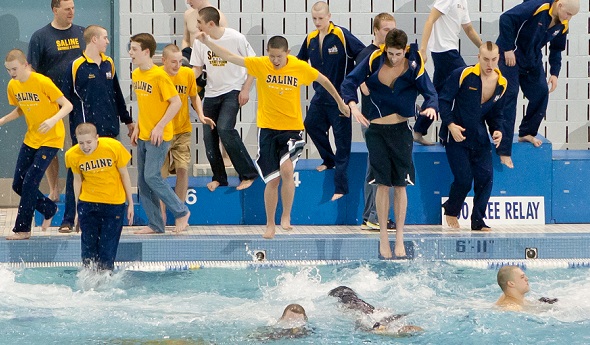
3. Swimming with speed in Saline
Saline also won its fourth straight MHSAA title, in Lower Peninsula Division 1, anchored by seniors David Boland, Josh Ehrman, Michael Bundas and Adam Whitener. Combined, they hold four Finals individual and two relay records, and Ehrman graduated with all-Finals records in the 200-yard individual medley and 100 breaststroke. Those four also leave with the 200 medley relay all-Finals record – with their time of 1:30.01 good for third-best in the national record book.
2. Michell sits atop MHSAA medal count
Reed City’s Sami Michell is one of two girls in MHSAA history to win four events at a Track & Field Final – a feat she accomplished both this season and last. And she finished her career this month with 12 individual titles overall, two more than the previous Lower Peninsula record. She graduated with LP Division 3 Finals records in both hurdles races and the long jump, and her 300 hurdles time of 42.23 is an all-Finals record.
1. Football Finals end in overtime classic
The most exciting MHSAA Football Final likely was the last of Thanksgiving weekend – a 40-37 overtime win by Grand Rapids Christian over Orchard Lake St. Mary’s that gave the Eagles the Division 3 title. And at least on this list, it counts as the most exciting of all the buzzer-beating, one-point, by one millimeter endings to the MHSAA’s 127 Finals this school year.
The Saturday night crowd at Ford Field was treated to an incredible performance by Eagles receiver Drake Harris, who had eight catches for a record 243 yards and touchdown and was nearly unstoppable as Grand Rapids Christian drove down the stretch. Quarterback Alex VanDeVusse threw for 307 yards, fourth-most in MHSAA Finals history, as the frazzled nerves of fans, players and coaches alike hung on every play. St. Mary’s ran for 459 of the single-team Finals record 579 yards of total offense; the teams combined for another record of 1,033 total yards between them. And at the end, the game was decided on a 27-yard field goal by Joel Schipper, who had connected on a 28-yarder with four seconds left in regulation to send the game to overtime.
PHOTO:Saline swimmers take a celebratory dip after claiming their fourth straight Lower Peninsula Division 1 championship.
Performance of the Week: Huron Valley United's Stella Musialowski
January 30, 2026
 Stella Musialowski ♦ Milford
Senior ♦ Gymnastics
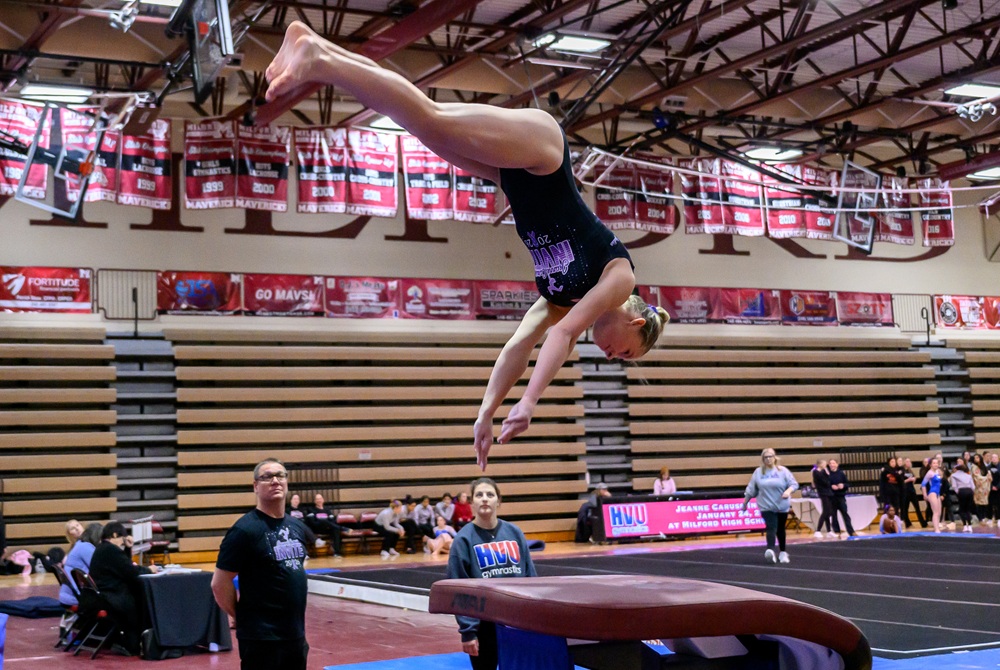
Musialowski – who competes for Huron Valley United, a cooperative team of Milford and White Lake Lakeland students – finished first in the Division 1 all-around competition at her program’s Jeanne Caruss Memorial Invitational, which featured 20 teams from across the state. She scored a 38.0075, with first places on balance beam (9.7) and uneven parallel bars (9.4), a second place on floor exercise (9.675) and third on vault (9.3).
Her all-around success led Huron Valley United to a third-place team finish behind only annual Finals championship contenders Rockford and Farmington United. Musialowski – who played hockey and softball as well growing up before focusing on competitive gymnastics – is accelerating toward a big finish to her high school career. She finished 15th in Division 1 all-around at the MHSAA Finals as a sophomore and improved to sixth last season with a score of 36.800.
@mhsaasports 🤸POW: Stella Musialowski #milford #gymnastics #highschoolsports #performanceoftheweek #MHSAA ♬ Bright and fun upbeat pops, Kids, Animals, Pets, Fun, Cute, Happy, Playful, Upbeat(1465232) - SAKUMAMATATA
@mhsaasports 🤸POW: Stella Musialowski #funfacts #tiktalk #performanceoftheweek #highschoolsports #MHSAA ♬ Girly and cute synth pop - SAKUMAMATATA
Follow the MHSAA on TikTok.
MHSAA.com's "Performance of the Week" features are powered by MI Student Aid, a division within the Department of Lifelong Education, Advancement, and Potential (MiLEAP). MI Student Aid encourages students to pursue postsecondary education by providing access to student financial resources and information. MI Student Aid administers the state’s 529 college savings programs (MET/MESP), as well as scholarship and grant programs that help make college Accessible, Affordable and Attainable for you. Connect with MI Student Aid at www.michigan.gov/mistudentaid and find more information on Facebook and X @mistudentaid.
Previous 2025-26 honorees
Jan. 22: Baylor Perkins, Grand Blanc swimming - Report
Jan. 15: Delaney Vanier, Flint Kearsley bowling - Report
Jan. 8: Stevie Hall, Detroit Cass Tech basketball - Report
Dec. 18: Ethan Martha, Ishpeming Westwood basketball - Report
Dec. 11: Louis Smith, Three Rivers wrestling - Report
Dec. 4: Traverse Moore, DeWitt football - Report
Nov. 28: Elizabeth Eichbrecht, West Bloomfield swimming - Report
Nov. 20: Brady Kieff, Blanchard Montabella football - Report
Nov. 13: Ella Laupp, Battle Creek Harper Creek swimming - Report
Nov. 7: Hunter Eaton, Charlevoix cross country - Report
Oct. 31: Stephen Gollapalli, Lansing Christian tennis - Report
Oct. 23: Talya Schreiber, Pickford cross country - Report
Oct. 16: Avery Manning, Dexter golf - Report
Oct. 9: Brady Van Laecke, Hudsonville football - Report
Oct. 2: Sarah Giroux, Flat Rock volleyball - Report
Sept. 25: Sam Schumacher, Portage Central tennis - Report
Sept. 18: Kaylee Mitzel, Saline field hockey - Report
Sept. 11: Natasza Dudek, Ann Arbor Pioneer cross country - Report
Sept. 4: Kate Posey, Big Rapids golf - Report
(Photos courtesy of the Huron Valley United gymnastics program.)