

10 to Remember: Fall 2014
December 12, 2014
By Geoff Kimmerly
Second Half editor
This fall saw the start of numerous championship legacies all over the Michigan, the continuation of a few more and the end of one that likely will be recalled for decades to come.
All championship runs are memorable for those fortunate enough to achieve them. But because of historical reference, dramatic impact or in rare cases national significance, some stay in our discussions a little bit longer.
Below is one person’s thoughts on the most memorable finishes from this fall’s MHSAA Finals.
10. Novi, East Kentwood Rise to the Top
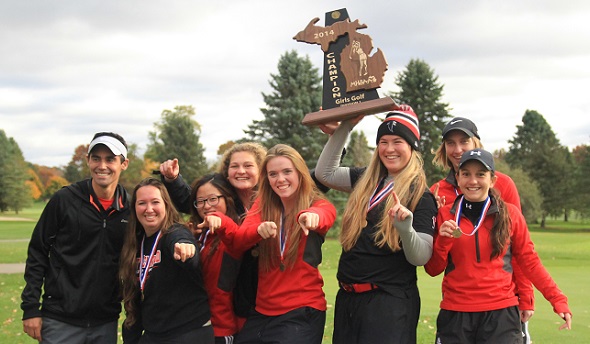
Among a number of first-time champions this fall, the Novi boys tennis team and East Kentwood girls golf team celebrated taking final steps after some recent close misses. Novi had finished second at the 2013 Lower Peninsula Division 1 Final, by a point, as Ann Arbor Huron won its third straight title. The Wildcats clinched their first ever this season, by eight points, while the East Kentwood golfers finished 22 strokes better than their LP Division 1 field after finishing 10th and sixth the last two seasons, respectively. Senior Emily White capped her high school career with a 51-foot putt to win the individual title.
9. Saline Clinches on Final Swim
The Saline girls swimming and diving team trailed reigning champion Farmington Hills Mercy by a half-point entering the final event of the LP Division 1 Final. But the Hornets outpaced Mercy by three seconds in the 400-yard freestyle relay to move ahead and claim the team championship by 5.5 points. Saline had finished runner-up to Mercy by 20 points in 2013.
8. St. Mary’s Football Keeps Promise
From an incredible story point of view, Orchard Lake St. Mary’s 7-0 win over Muskegon in the Division 3 Football Final was easily the most memorable of the fall. Showing immense courage, Eaglets running back Brandon Adams took the field only two days after his mother died after fighting cancer. He scored the game’s lone points midway through the first quarter.
7. Kestrels Give Coach Best Retirement Gift
Monroe St. Mary Catholic Central’s Diane Tuller coached teams to 595 wins over 17 seasons – and in her final match took the Kestrels to their fifth MHSAA championship. St. Mary downed Schoolcraft in four sets despite dropping the first to claim its third Class C title in five seasons. The Kestrels became the eighth team to win at least five MHSAA titles, claiming all five under Tuller’s guidance.
6. Concord’s Hersha Joins Elite Company
Only 14 runners in MHSAA boys cross country history have won at least three individual championships. Concord’s Jason Hersha became the latest, claiming the LP Division 4 title in 15:23.0, the second-fastest time in LP Division 4 Finals history. He became only the third to win three boys titles since team and individual qualifiers began running the same race in 1996; he also finished first as a sophomore and junior.
5. Canton Never Loses on Division 1 March
Just one on-target kick can change a soccer game. That makes Canton’s undefeated run to this season’s Division 1 boys championship even more impressive. Finishing without a loss in any sport is something – but the Chiefs defeated Rochester Adams 1-0 in the Final to end 24-0-3 and as the 13th undefeated champion in MHSAA boys soccer history. Canton posted 16 shutouts this fall.
4. Spring Lake Surges to First Championship
Despite trailing annual power Bloomfield Hills Cranbrook-Kingswood by six strokes after the first round, Spring Lake rolled through the second at the LP Division 3 Girls Golf Final to best the field by a final margin of 18 strokes and claim the school’s first MHSAA golf championship. The achievement was a crowning one for the program started by George Bitner, who has coached at the school since 1968 and fielded his first girls team in 1980.
3. Fisher Finishes Among Fastest in MHSAA History
Grand Blanc senior Grant Fisher finished his high school career with a second straight Lower Peninsula Division 1 championship – and the third-fastest time since the Finals moved to Michigan International Speedway 19 seasons ago. Fisher finished in 14:52.5, 1.5 seconds off the second-fastest time in MHSAA Finals history since 5K (3.1 miles) became the distance in 1980. The only runners who have come in faster than Fisher went on to the Olympics (Dathan Ritzenhein) and top American finishes (twice) at the Boston Marathon (Jason Hartmann).
2. St. Philip Stands Alone with 9 Straight Titles
Battle Creek St. Philip continued its near-decade dominance of Class D, but this time with another historical twist. The Tigers downed Leland in four sets in this season’s Final to win their ninth straight MHSAA championship – setting a record for consecutive titles after formerly being tied with the Marysville teams from 1997-2004. St. Philip entered the postseason ranked No. 3 in D but defeated both No. 2 Mendon and the top-ranked Comets during the final week.
1. Monroe St. Mary Ends Ithaca’s Record Run
Much of the credit for this topping the list goes to Ithaca, which brought a 69-game winning streak into the Division 6 Football Final. The streak was the longest active streak nationally among 11-player football teams, and a win would've allowed the Yellowjackets next fall an opportunity to break the MHSAA winning streak record of 72. But St. Mary controlled the clock with a workmanlike running game and held an Ithaca offense averaging 43 points to nearly a quarter of that in winning 22-12.
PHOTO: The East Kentwood girls golf team raised its first MHSAA Finals championship trophy this October. (Click for more from HighSchoolSportsScene.com.)
Refusing to Settle for Less Than Best, Stoney Creek Shines to Complete 3-Peat
By
Tom Kendra
Special for MHSAA.com
March 6, 2026
MOUNT PLEASANT – It really hadn’t been Rochester Hills Stoney Creek’s year going into the MHSAA Finals.
The Cougars were the two-time reigning Division 1 champions, but they didn’t win their conference or their District or their Regional.
But on the biggest stage of all at Central Michigan University’s McGuirk Arena, the Cougars delivered once again.
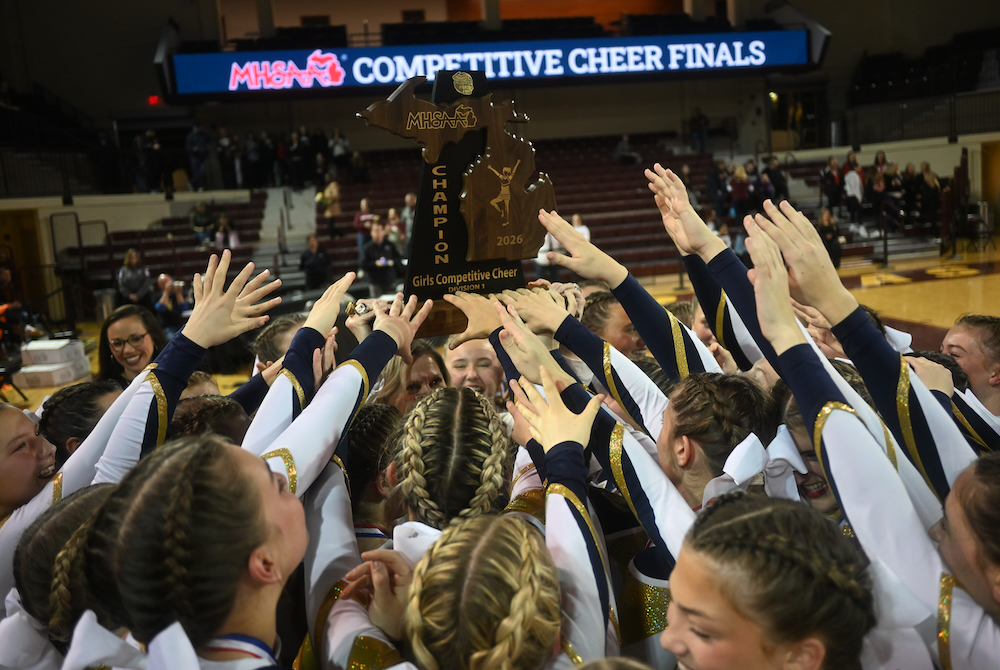
Stoney Creek, which entered the postseason ranked No. 5, used another clutch performance in Round 3 to “three-peat” as Division 1 champion with 789.94 points – once again barely edging neighboring rivals Rochester (789.52) and Rochester Adams (789.16).
“Things haven’t been going our way this year, but these girls never stopped believing in themselves,” said 23rd-year Stoney Creek coach Tricia Williams, who won her fifth Finals championship.
“They peaked at the state finals, and I couldn’t be more proud of them.”
It looked for a while that the Division 1 title might go to a West Michigan school for the first time since 2015, as Grandville held the lead after Round 1 and Round 2 before struggling in the final round and finishing fifth (785.56).
Brighton was also right in the mix in third place heading into the final round, but backed up a spot to fourth (788.58).
It was in the “money round” of Round 3, as has so often been the case in past years, where the three Rochester schools pulled away with their complex and more difficult routines – much to the delight of the rabid fan bases from each school.
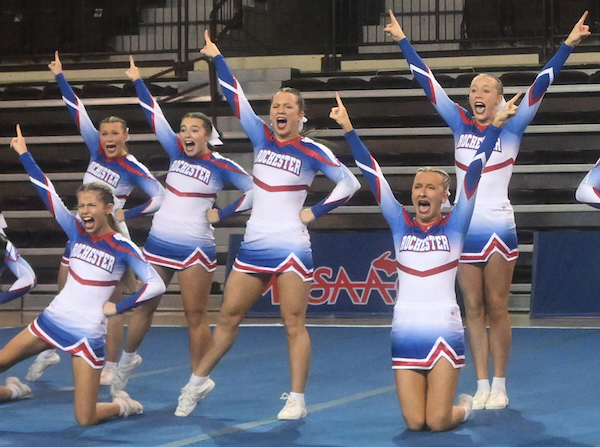 Rochester posted the best Round 3 score of 321.80 to jump from fifth place up to second. Adams turned in a 321.00 to move from fourth to third place.
That just left Stoney Creek, going last in the final round for the second consecutive year, to see if it could do enough to hold off its rivals. The Cougars posted the same score as Adams, 321.00, to win by 0.42 over Rochester.
“I think the reason that we won today is because we didn’t win at Districts and Regionals,” said Stoney Creek’s Audrey Harvath, one of 13 seniors on the 26-athlete roster.
“We knew we had to keep climbing. We looked at each of our rounds in slow motion and tried to find every little thing that we could possibly improve, and that made the difference.”
Harvath was one of three returning first-team all-staters for the Cougars, along with fellow seniors Mia Badalucco and Natalie Marco.
Seniors Taylor Brandimarte and Kendall Keller and sophomore Kate Kacy were second team all-state last season, while senior Cassidy Niester and Isabel Williams were honorable mention.
It was not only the third-straight championship for Stoney Creek, but the eighth straight for a Rochester school and the 10th in 11 years – with Stoney Creek winning four and Adams and Rochester three each. The only non-Rochester school to win the title in Division 1 during that stretch was Sterling Heights Stevenson in 2018.
“At the end of the day, we are grateful to be in each other’s backyards because it forces us to keep getting better,” said fourth-year Rochester coach Samantha Dean. “What can I say, it came down to tenths of a point again. We can say we had the best Round 3 in the state, which is certainly something to be proud of.”
The three schools have battled each other for the last three Saturdays, with each of them winning a title – Adams at Districts, Rochester at Regionals and Stoney Creek at the Finals.
It was truly a bittersweet moment as those 13 Stoney Creek seniors lingered on the McGuirk Arena floor long after most of the fans had filed out.
The Cougars became the 13th competitive cheer program in MHSAA history to win at least three Finals championships in a row.
“Going for back-to-back was hard enough, and we knew trying to get three in a row would be even harder against some powerhouse competition,” said Harvath. “It obviously took every last ounce of energy that we had.”