

10 to Remember: Winter 2014-15
April 2, 2015
By Geoff Kimmerly
Second Half editor
As one might imagine, six straight weekends of MHSAA Finals produce enough highlights to distract us from our seemingly endless Michigan winters.
As explained to preface “10 to Remember” many times before, all championships are lifetime memories for those who achieved them. Those listed below are just one person’s thoughts on which moments from this season will continue to be discussed most in the seasons to come.
10. Brother Rice Rides Team Effort to Repeat
Birmingham Brother Rice repeated as Lower Peninsula Division 1 swimming and diving champion, and did so by winning by more than 100 points for the second consecutive season. But what made this Warriors finish so impressive was that it didn’t include a single individual championship – they won the opening and closing relays of the meet and took seven second-place individual finishes along the way.
9. Kearsley Sweeps Bowling Championships … Again
Flint Kearsley varsity bowlers are guaranteed one other title this season – MHSAA champions. Both the girls and boys teams won team titles in Division 2, just as they had in 2014. The Kearsley girls again defeated Bay City Western in the championship match, this time by a mere 30 pins, 1,242-1,212. The Kearsley boys also earned their title by defeating Bay City Western, and by only seven pins – 1,351-1,344.
8. Rockford/Sparta Owns the Weekend
Rockford hosted the MHSAA Gymnastics Finals, making the cliché “bringing home the title” a short trip – twice. The Rams, a co-op with Sparta, won the team competition by 1.750 points over reigning champion Canton; Rockford’s only other MHSAA gymnastics championship also was the first in any sport in school history, in the Lower Peninsula in 1989. Juniors Madi Myers and Morgan Korf led the effort with the third and fourth-highest all-around scores of the Team Final – and Korf came back the next day with a stunning move to take the Division 1 individual championship. She had finished 18th in Division 1 as a sophomore.
7. Breckenridge Returns to Cheer Elite
In its second season back as a competitive program, Breckenridge added to its stature as one of the most powerful competitive cheer programs in MHSAA history by claiming the Division 4 championship by nearly 24 points over runner-up Pewamo-Westphalia. Breckenridge has won eight MHSAA titles in cheer, but didn’t have a team for six seasons because of low participation until bringing back the program for 2013-14.
6. Cowboys Lasso First Basketball Title
First Detroit Western International won its first Detroit Public School League championship since 1922. Then it made its first MHSAA Semifinals since 1974. The Cowboys capped this season with its first MHSAA Final victory, a nail-biter 62-59 over Saginaw Arthur Hill in Class A. Western also defeated Detroit Catholic League A-B champion Detroit U-D Jesuit in the Semifinal, and finished the season 26-0.
No team traveled farther to the MHSAA Basketball Finals than the Calumet girls – and it can be argued that no team came from farther away in expectation to become an MHSAA champion. The unranked Copper Kings traveled more than 500 miles to arrive at the Breslin Center, then defeated top-ranked Laingsburg in a Class C Semifinal and perennial power Flint Hamady in the championship game to claim its first MHSAA title in the sport.
4. Skatzka, Olson Become Latest of the Greatest
Richmond’s Devin Skatzka and Davison’s Lincoln Olson pushed the list of MHSAA four-time individual champions to 21 by finishing their careers with big victories. Olson actually was the 20th, winning his match at 135 pounds by technical fall in Division 1. Skatzka then became No. 21 with four MHSAA titles, with a technical fall in the 160-pound match in Division 3.
3. Brighton Claims First Title in Final Match
Few Finals in any sport this winter carried the drama of Brighton’s 31-25 win over Hartland in Division 1 wrestling. Bulldogs 112-pounder Lee Grabowski entered the final match carrying his team’s three-point lead but facing the scenario that if he lost even by decision, and the team score went to 28-28, Brighton would lose the tie-breaker. Oh, and Grabowski was facing an opponent he’d lost to twice in league competition earlier in the winter. Grabowski won a 4-2 decision this time, and Brighton won its first team title.
2. Godwin Heights, Powers North Central Cap 3-Season Surges
Wyoming Godwin Heights and Powers North Central made the MHSAA record book by adding to a pair of the most successful three-season runs in boys basketball history – and capping them with championships. Godwin Heights won its first MHSAA title, downing Detroit Henry Ford 85-68 in the Class B Final, to finish the last three seasons a combined 74-5. North Central, meanwhile, downed Morenci 67-47 in Class D to win its first title since 1984 and cap a three-season 75-5 run.
1. Record Comeback Sends Saints Home as Champs
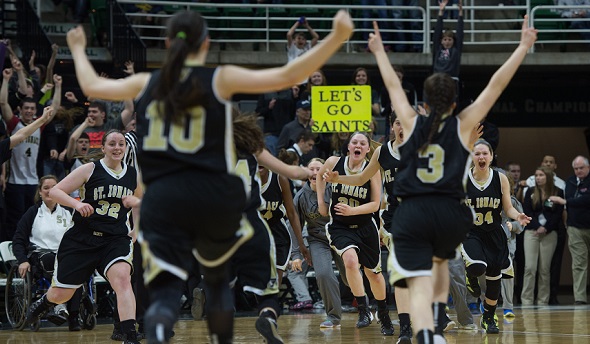
St. Ignace trailed undefeated Pittsford by 20 points two minutes into the Class D Final when it launched a comeback equaled by only one other team in MHSAA girls basketball history. The Saints tied the score with 35 seconds to play in regulation and continued the rally in the extra period to claim a 64-60 title-clinching victory. Detroit Cass Tech, in the 1987 Class A Final, also had come back from 20 down in the third quarter to win. The championship was St. Ignace’s fifth in girls basketball.
PHOTO: St. Ignace basketball players celebrate after the Saints tied the largest comeback in MHSAA Finals history on the way to claiming the Class D title. (Click to see more at HighSchoolSportsScene.com.)
Country Day Repeats as Cook Serves Up Another Title-Clinching Goal
By
Drew Ellis
Special for MHSAA.com
June 6, 2026
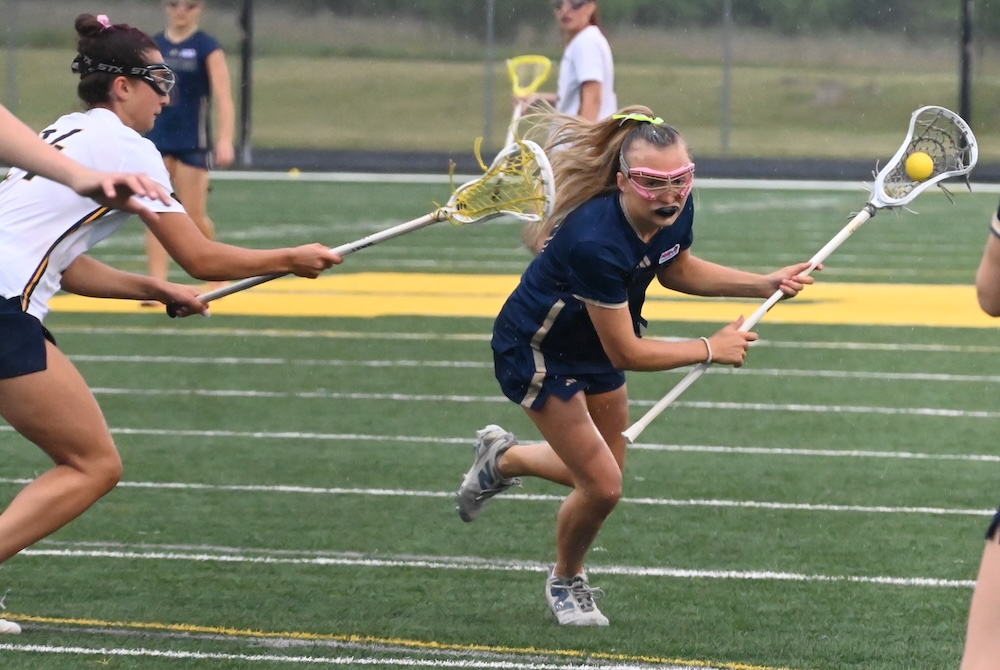
HOWELL – Charlotte Cook is building quite a reputation for herself at Detroit Country Day.
In 2025, as a freshman, Cook scored the game-winning goal in overtime to lift the Yellowjackets to the Division 2 championship over Grand Rapids Catholic Central.
On Friday night, in pouring rain, Cook found herself with the ball in the final minute of the 2026 D2 Final with East Grand Rapids, with the score tied 12-12.
Cook once again came through, putting the ball in the back of the net with 29 seconds to play for what would be the game-winning score in DCD’s 13-12 victory.
“Taking the ball at the end, I wanted to prove to everyone that as a sophomore, even when I was being face-guarded, I could get in there and I could make something happen,” Cook said of her game-winning goal. “I wasn’t just doing it to win, I wasn’t doing it for myself, I was doing it for my team around me because they wanted me to take that (shot) and I’m glad they could trust me.”
Cook tied the game with 2:52 to play as part of a six-goal effort to lead Country Day to its first repeat MHSAA girls lacrosse championship, and third Finals title overall.
 “She’s someone that we can consistently depend on and rely on to be the one to set the tempo,” Detroit Country Day coach Liz Nussbaum said. “I think that takes so much character and so much preparation on her part. She puts in the work in advance so she’s ready for these big moments, and she carries the team on her back in that way.”
The win for Country Day (15-5) avenged a pair of losses during the season to the Pioneers (19-3). East Grand Rapids led for the majority of Friday’s game, including the 12-11 advantage in the closing minutes, but came up just shy of claiming its first championship since 2022.
“I think the reason they fought so hard is because of their love for each other and their love for the game,” EGR coach Kira Schoonveld said of her team’s effort. “It’s been a while since we’ve been back on this stage, so they were hungry for it.”
The Pioneers took control of the game in the second quarter with a four-goal surge that put them up 6-3. Senior Rylee Renker had two of the goals during the run to help EGR lead 6-4 at the break.
“I think the girls actually came out pretty settled. Of course, they have nerves, but I think they managed those pretty well,” Schoonveld said of her team’s first half.
Country Day came out in the second half and scored the first four goals. Two came from Cook and the other two came from senior Adri Zuk.
“That was absolutely huge,” Nussbaum said of the scoring surge. “We are very young, so a lot of this game is really mental for us. Having that kind of momentum shift was super important.”
East Grand Rapids answered the Country Day run with one of its own. The Pioneers scored the next three goals to regain the lead at 9-8.
The lead would change hands three more times over the remainder of the game, including with Cook’s game-winner.
 The drama was heightened by the consistent rain, which never let up throughout the match.
“Rain is never fun and we’ve been fortunate that we’ve never had to play in the rain this season, so that of course poses more challenges,” Schoonveld said. “But, between every quarter and time out, our girls were still fired up and pumped and just ready to take on the challenge ahead of them. It’s just unfortunate that it didn’t go our way tonight.”
Jane Weaver finished with three goals and an assist to lead East Grand Rapids, while Nora Williams, Livia Burgess and Renker each had two goals and an assist. Avery Albers made 10 saves in net.
Cook finished with six goals to lead Country Day, while sophomore Bella Papsin had six assists.
“She’s always been a really good feeder, but she’s improved with her patience and waiting for more open opportunities,” Nussbaum said of Papsin. “She really found the open player today, and that was important because we knew that we weren’t going to be able to drive very well against this EGR defense.”
Junior Jackie Calso had four goals in the win, while Zuk tallied the other three.
After graduating a large senior class in 2025, Nussbaum wasn’t sure if her team would be able to get back to the Finals in 2026. Despite the rain pouring down, Nussbaum was all smiles after the match given her team’s difficult achievement of repeating as champion.
“We lost 11 seniors last year and had almost a completely new squad this season, but the consistency and dependability of the team, and the culture they have built, led them to this championship,” Nussbaum said. “It really is such a reward and a joy to be able to coach these girls and see all their work pay off.”
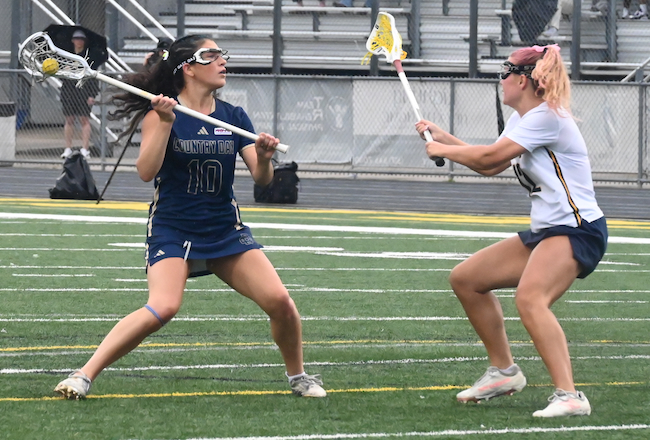
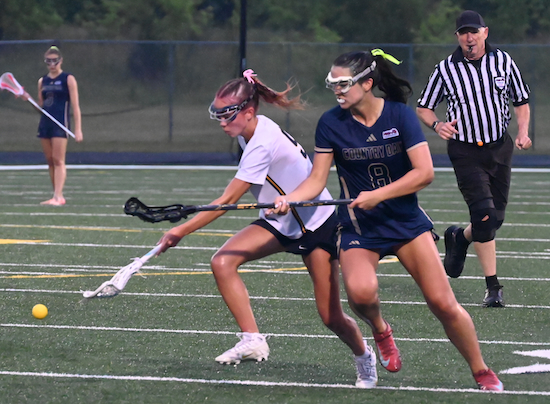
PHOTOS (Top) Detroit Country Day’s Charlotte Cook makes a move while directing the offense during Friday’s Division 2 Final. (Middle) The Yellowjackets’ Adriana Zuk (10) winds up to take a shot. (Below) DCD's Jackie Calso (8) and EGR's Ella Alguire (9) contend for the ball.