

10 to Remember: Winter 2014-15
April 2, 2015
By Geoff Kimmerly
Second Half editor
As one might imagine, six straight weekends of MHSAA Finals produce enough highlights to distract us from our seemingly endless Michigan winters.
As explained to preface “10 to Remember” many times before, all championships are lifetime memories for those who achieved them. Those listed below are just one person’s thoughts on which moments from this season will continue to be discussed most in the seasons to come.
10. Brother Rice Rides Team Effort to Repeat
Birmingham Brother Rice repeated as Lower Peninsula Division 1 swimming and diving champion, and did so by winning by more than 100 points for the second consecutive season. But what made this Warriors finish so impressive was that it didn’t include a single individual championship – they won the opening and closing relays of the meet and took seven second-place individual finishes along the way.
9. Kearsley Sweeps Bowling Championships … Again
Flint Kearsley varsity bowlers are guaranteed one other title this season – MHSAA champions. Both the girls and boys teams won team titles in Division 2, just as they had in 2014. The Kearsley girls again defeated Bay City Western in the championship match, this time by a mere 30 pins, 1,242-1,212. The Kearsley boys also earned their title by defeating Bay City Western, and by only seven pins – 1,351-1,344.
8. Rockford/Sparta Owns the Weekend
Rockford hosted the MHSAA Gymnastics Finals, making the cliché “bringing home the title” a short trip – twice. The Rams, a co-op with Sparta, won the team competition by 1.750 points over reigning champion Canton; Rockford’s only other MHSAA gymnastics championship also was the first in any sport in school history, in the Lower Peninsula in 1989. Juniors Madi Myers and Morgan Korf led the effort with the third and fourth-highest all-around scores of the Team Final – and Korf came back the next day with a stunning move to take the Division 1 individual championship. She had finished 18th in Division 1 as a sophomore.
7. Breckenridge Returns to Cheer Elite
In its second season back as a competitive program, Breckenridge added to its stature as one of the most powerful competitive cheer programs in MHSAA history by claiming the Division 4 championship by nearly 24 points over runner-up Pewamo-Westphalia. Breckenridge has won eight MHSAA titles in cheer, but didn’t have a team for six seasons because of low participation until bringing back the program for 2013-14.
6. Cowboys Lasso First Basketball Title
First Detroit Western International won its first Detroit Public School League championship since 1922. Then it made its first MHSAA Semifinals since 1974. The Cowboys capped this season with its first MHSAA Final victory, a nail-biter 62-59 over Saginaw Arthur Hill in Class A. Western also defeated Detroit Catholic League A-B champion Detroit U-D Jesuit in the Semifinal, and finished the season 26-0.
No team traveled farther to the MHSAA Basketball Finals than the Calumet girls – and it can be argued that no team came from farther away in expectation to become an MHSAA champion. The unranked Copper Kings traveled more than 500 miles to arrive at the Breslin Center, then defeated top-ranked Laingsburg in a Class C Semifinal and perennial power Flint Hamady in the championship game to claim its first MHSAA title in the sport.
4. Skatzka, Olson Become Latest of the Greatest
Richmond’s Devin Skatzka and Davison’s Lincoln Olson pushed the list of MHSAA four-time individual champions to 21 by finishing their careers with big victories. Olson actually was the 20th, winning his match at 135 pounds by technical fall in Division 1. Skatzka then became No. 21 with four MHSAA titles, with a technical fall in the 160-pound match in Division 3.
3. Brighton Claims First Title in Final Match
Few Finals in any sport this winter carried the drama of Brighton’s 31-25 win over Hartland in Division 1 wrestling. Bulldogs 112-pounder Lee Grabowski entered the final match carrying his team’s three-point lead but facing the scenario that if he lost even by decision, and the team score went to 28-28, Brighton would lose the tie-breaker. Oh, and Grabowski was facing an opponent he’d lost to twice in league competition earlier in the winter. Grabowski won a 4-2 decision this time, and Brighton won its first team title.
2. Godwin Heights, Powers North Central Cap 3-Season Surges
Wyoming Godwin Heights and Powers North Central made the MHSAA record book by adding to a pair of the most successful three-season runs in boys basketball history – and capping them with championships. Godwin Heights won its first MHSAA title, downing Detroit Henry Ford 85-68 in the Class B Final, to finish the last three seasons a combined 74-5. North Central, meanwhile, downed Morenci 67-47 in Class D to win its first title since 1984 and cap a three-season 75-5 run.
1. Record Comeback Sends Saints Home as Champs
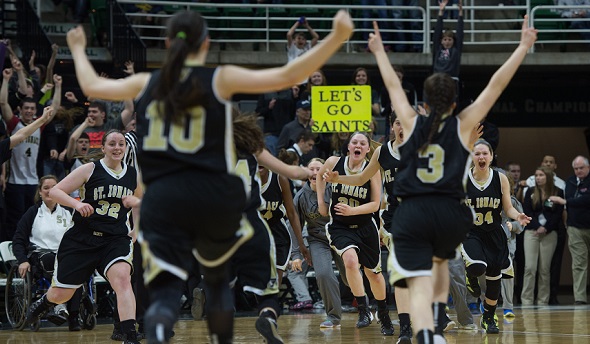
St. Ignace trailed undefeated Pittsford by 20 points two minutes into the Class D Final when it launched a comeback equaled by only one other team in MHSAA girls basketball history. The Saints tied the score with 35 seconds to play in regulation and continued the rally in the extra period to claim a 64-60 title-clinching victory. Detroit Cass Tech, in the 1987 Class A Final, also had come back from 20 down in the third quarter to win. The championship was St. Ignace’s fifth in girls basketball.
PHOTO: St. Ignace basketball players celebrate after the Saints tied the largest comeback in MHSAA Finals history on the way to claiming the Class D title. (Click to see more at HighSchoolSportsScene.com.)
Preview: Girls Lacrosse Finals to Match Reigning Champs Vs. Record Holders
By
Geoff Kimmerly
MHSAA.com senior editor
June 4, 2026
Rockford and East Grand Rapids will add to their shared record of 10 MHSAA Girls Lacrosse Finals appearances Friday at Howell Parker, and could also add to their Division-leading championship counts as well.
But a pair of teams moving up the historical charts are eager to continue making their own names among the all-time elite.
Reigning Division 1 champion South Lyon United hasn’t lost in two years and will try to extend that streak against the Rams. Reigning Division 2 champion Detroit Country Day will play in its fifth-straight Final to move into a tie for most championship game appearances in MHSAA girls lacrosse history.
Below is a glance at all four teams playing for titles. Rankings as part of “best wins” are based on the Michigan Power Rating formula. Tickets cost $11 and are good for both games, and may be purchased online only at GoFan.
Both games will be broadcast and available with subscription from MHSAA.tv.
Division 1
ROCKFORD
Record/MPR: 11-8, No. 10
League finish: Third in Ottawa-Kent Conference Tier 1
Coach: Mark Neumen, fifth season (65-35-1)
Championship history: Nine Division 1 titles (most recent 2021), runner-up in 2024.
Best wins: 9-4 over No. 7 Hartland in Semifinal, 16-6 over No. 9 Hudsonville in Regional Final, 18-11 over Division 2 No. 8 Grand Rapids Forest Hills Central, 9-7 over Division 2 No. 2 East Grand Rapids, 7-6 over Division 2 No. 6 Spring Lake.
Players to watch: Ella Larva, sr. M (33 goals, 9 assists); Kiah Kruisenga, jr. M (26 goals, 8 assists); Brooke Gordon, sr. M (39 goals, 22 assists); Ava Wekenman, soph. A (41 goals, 29 assists).
Outlook: After a year away from the Finals, Rockford is back in a familiar spot and riding a five-game winning streak that began by avenging a mid-April loss to Spring Lake. The Rams also avenged their March defeat to East Grand Rapids a month later. Larva made the all-state first team last season, Kruisenga the third team and junior defender Lyla Vogt earned an honorable mention. Seven players total had scored at least 15 goals entering this week, including as well sophomores Avery Maag (25) and Jordyn Coretti (15, 18 assists) and senior Ella Wagenmaker (18/12).
SOUTH LYON UNITED
Record/MPR: 27-0, No. 2
League finish: First in Lakes Valley Conference
Coach: Deanna Radcliffe, 10th season (168-26)
Championship history: Division 1 champion 2025, runner-up 2008.
Best wins: 9-8 and 14-11 (Regional Final) over No. 1 Brighton, 23-8 over No. 8 Bloomfield Hills in Semifinal, 17-10 over No. 3 Lake Orion, 15-2 and 14-5 over No. 6 White Lake Lakeland, 17-3 over No. 5 Grosse Pointe South, 19-5 over No. 4 Birmingham United, 20-5 over Division 2 No. 5 Haslett/Williamston.
Players to watch: Shaelyn Perry, sr. M (78 goals, 23 assists); Cate Cumberland, jr. M/D (33 goals, 20 assists); Gabriela Lucchesi, sr. A (36 goals, 41 assists); Reagan Shields, jr. A (87 goals, 61 assists).
Outlook: South Lyon United has won 48 straight games as it seeks to finish a second-straight perfect season. United also has defeated the other seven top-eight teams in Division 1 by MPR at the end of the regular season, and done so giving up double-digit goals only twice and with an offense that has reached 20 goals eight times. Shields, Perry and Cumberland are returning all-state first teamers, and Lucchesi earned an honorable mention last year. Seniors Alyssa Jakubiec (52 goals/15 assists) and Gianna Lucchesi (51/26) and junior Madison Lukas (49/9) also are among leading offensive contributors.
Division 2
DETROIT COUNTRY DAY
Record/MPR: 14-5, No. 4
League finish: Does not compete in a conference.
Coach: Liz Nussbaum, third season (48-12-1)
Championship history: Division 2 champion 2023 and 2025, runner-up 2005, 2022 and 2024.
Best wins: 23-3 over No. 3 Ann Arbor Father Gabriel Richard in Semifinal, 13-9 over No. 7 Pontiac Notre Dame Prep in Regional Final, 16-2 over No. 11 Rochester Hills Stoney Creek in Regional Semifinal, 11-10 over No. 9 Grand Rapids Catholic Central, 9-3 and 18-8 over Division 1 No. 7 Hartland.
Players to watch: Campbell Lindner, sr. G (126 saves, .490 save %); Charlotte Cook, soph. M (74 goals, 22 assists); Adriana Zuk, sr. M (46 goals, 17 assists); Jackie Calso, jr. M (47 goals, 14 assists).
Outlook: This will be Country Day’s fifth-straight Finals appearance, and the Yellowjackets return with a pair of 2025 all-state second-teamers in Lindner and Cook and honorable mentions in Zuk and Calso. The only in-state losses this season were twice to East Grand Rapids and once to Brighton, and Country Day won its first four postseason games by a combined 70-14. They also have notable victories over Carmel (Ind.) and Chicago St. Ignatius College Prep. Junior Bridget Kenney had added another 21 goals entering the week, and sophomore Maggie Stoller had 15.
EAST GRAND RAPIDS
Record/MPR: 19-2, No. 2
League finish: First in O-K Tier 1
Coach: Kira Schoonveld, first year (19-2)
Championship history: Eight Division 2 titles (most recent 2022), runner-up in 2017 and 2023.
Best wins: 20-6 over No. 5 Haslett/Williamston in Semifinal, 11-2 (Regional Final), 12-7 and 13-8 over No. 6 Spring Lake; 17-5 (Regional Semifinal) and 12-5 over No. 9 Grand Rapids Catholic Central, 9-7 (Regional Quarterfinal), 7-4 and 11-4 over No. 8 Grand Rapids Forest Hills Central; 11-9 and 12-5 over No. 4 Detroit Country Day, 12-5 over Division 1 No. 4 Birmingham United, 11-10 (OT) over Division 1 No. 7 Hartland, 12-10 (OT) over Division 1 No. 10 Rockford.
Players to watch: Avery Albers, jr. G (7.2 goals-against average, 112 saves); Jane Weaver, jr. A (49 goals, 18 assists); Livia Burgess, jr. M (32 goals, 23 assists); Rylee Renker, sr. A (37 goals, 3 assists).
Outlook: Aside from a couple of late losses to Grand Rapids Catholic Central and Rockford by a combined five goals, EGR has been pretty much unstoppable on the way to its first championship game appearance in three years. The Pioneers did end up avenging that CC loss in the Regional Semifinal to finish that season series with a 2-1 edge, and they haven’t given up more than 10 goals in a game – and allowed 10 only twice, both in overtime wins. Albers made the all-state first team last season, Weaver made the second and Burgess and senior Ellen Cross earned honorable mentions. Junior Nora Williams (25 goals/8 assists) and sophomores Ciarra Burns (21/8) and Sarah Cross (15/17) also are among leading scorers this spring.
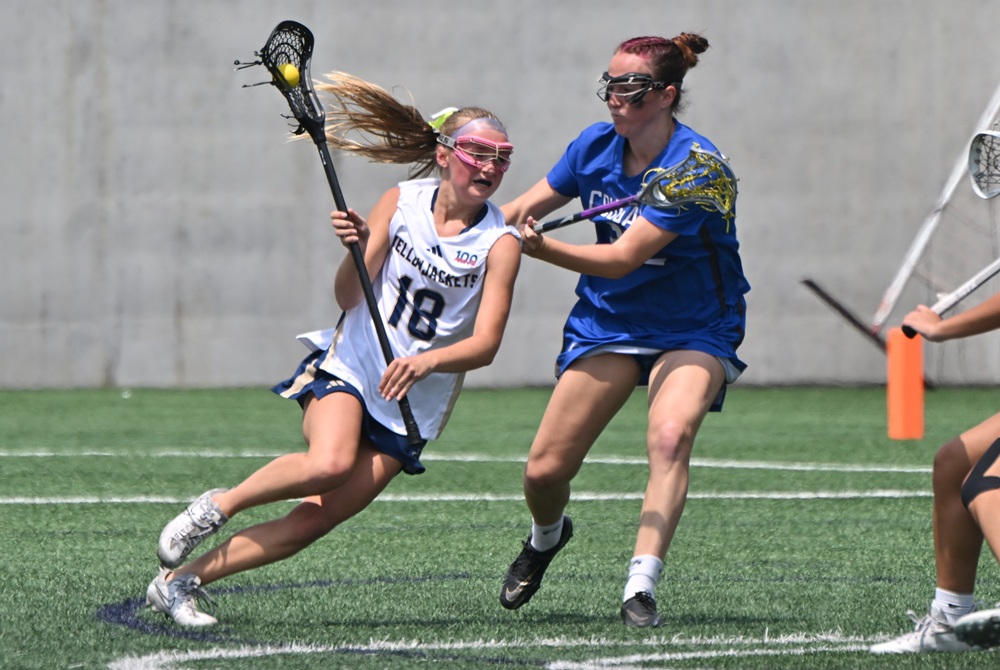
PHOTO Detroit Country Day’s Charlotte Cook (18) attempts to get past a Grand Rapids Catholic Central defender during last season’s Division 2 Final.