


AD Inducted to National Hall of Fame
May 7, 2014
By Geoff Kimmerly
Second Half editor
Winter gets hectic so quickly that we’re forced to save some intriguing items that come our way for a sunnier day – and that day is today.
Following are news, notes and a few key links collected over the last few months, including the national Hall of Fame induction of a longtime Michigan athletic director, local recognition for another and statewide acclaim for a group of students putting their video production equipment to good use benefiting all.
Ann Arbor AD Honored Nationally
Former Ann Arbor Huron athletic director Jane Bennett was among five inducted into the National Interscholastic Athletic Administrators Association Hall of Fame in December.
Bennett served 26 years as a teacher, coach, athletic director and assistant principal in Michigan before spending the last decade as a principal at two schools in Montana. She served as athletic director at Huron for 15 years through 2002-03. The NIAAA reported that during her final decade in that position, participation in athletics doubled.
Bennett, who received her bachelor’s and master’s degrees from the University of Michigan, began her career at Huron in 1977 as varsity softball coach and became a math teacher and the co-director of athletics a year later. She coached the softball team 14 seasons before moving into the full-time athletic director position. Bennett was co-founder of the Michigan High School Softball Coaches Association and served as MHSSCA president from 1982-87.
Among other achievements at Huron, Bennett was a leader in a successful campaign to gain voter approval of a $60 million bond package, which included $20 million to improve and expand athletic facilities. She also developed curriculum for an annual varsity captains/head coaches leadership training program and composed handbooks/guidebooks for coaches, athletes and parents.
Bennett also was a valuable contributor to the Michigan Interscholastic Athletic Administrators Association and the NIAAA. She was president of the MIAAA in 1993-94 and a state conference speaker on several occasions. Bennett also served in various NIAAA leadership positions including on the committee that developed the Leadership Training Institute in 1996.
Bennett was named MIAAA Athletic Director of the Year in 1998 and received its State Award of Merit in 1997. She received the MHSAA’s Women in Sports Leadership Award in 1995 and was inducted into the MHSSCA Hall of Fame in 1995. Prior to her selection to the NIAAA Hall of Fame, Bennett was honored with the NIAAA Distinguished Service Award in 1998 and the NIAAA Thomas E. Frederick Award of Excellence in 2000. In 2005, she was inducted into the National Council of Secondary School Athletic Directors Hall of Fame, having served as its president in 2003 and been selected as its Athletic Director of the Year in 1998.
PSL's Ward: 'Pillar' of Detroit Athletics
Alvin Ward, the executive director of athletics for the Detroit Public School League and a member of the MHSAA Representative Council, received a 2014 Pillar in the Community Award in April from the Coast II Coast All-Stars, a Detroit-based pro basketball team that plays in the American Basketball Association.
Ward has served as a teacher, assistant principal and principal as well for Detroit Public Schools, and directs programs with a combined 500 coaches and 4,500 athletes.
Linked up
- This winter, the MHSAA Representative Council adopted a number of football practice rules changes aimed at improving player acclimatization at the start of fall and reducing head trauma and injuries. The Adrian Daily Telegram’s Doug Donnelly got responses from a number of coaches from that area of the state; click to find out why they feel these changes are important.
- Port Huron Times Herald writer Paul Costanzo let people know about our Student Advisory Council through the experience of Marlette’s Connor Thomas, one of our juniors and a great contributor this school year.
Power of Awareness
The Kimberly Anne Gillary Foundation works to educate Michigan schools on sudden cardiac arrest and train personnel in CPR and the use of an AED (automated external defibrillator). The video below teaches us again about the importance of awareness.
Saginaw Heritage was awarded $5,000 in April as the winner of the Gillary Foundation’s High School AED Contest. Students were asked to create a 3-minute video emphasizing the importance of Michigan high schools being adequately prepared to respond to a sudden cardiac arrest or related event on school property.
Randy and Sue Gillary created the foundation after their 15-year-old daughter Kimberly – an athlete at Troy Athens – died after suffering sudden cardiac arrest in 2000. The contest judges were Kimberly’s sisters Emily Kucinich, Jennifer Gregroy and Katie Gillary.
As of April 1, the Gillary Foundation had raised $1.2 million and donated 650 AEDs to schools – with three lives having been saved with donated AEDs. For more, click www.kimberlysgift.org.
1st-Time Semifinalists Walled Lake Northern, Grand Haven Earn Championship Chance
By
Keith Dunlap
Special for MHSAA.com
June 11, 2026
EAST LANSING — When Walled Lake Northern senior ace pitcher Lyla Turmell faced Northville in a tournament at New Baltimore Anchor Bay on April 25, things didn’t go as planned in a 6-3 loss.
Getting another chance at Northville in a Division 1 Semifinal at Michigan State’s Secchia Stadium on Thursday, Turmell said there were plenty of mental notes to recall from that first meeting.
“We played them earlier in the season, so I kind of knew some of them,” Turmell said. “I knew the hitters, (that) I had to move the ball out more or in more. It 100 percent helped.”
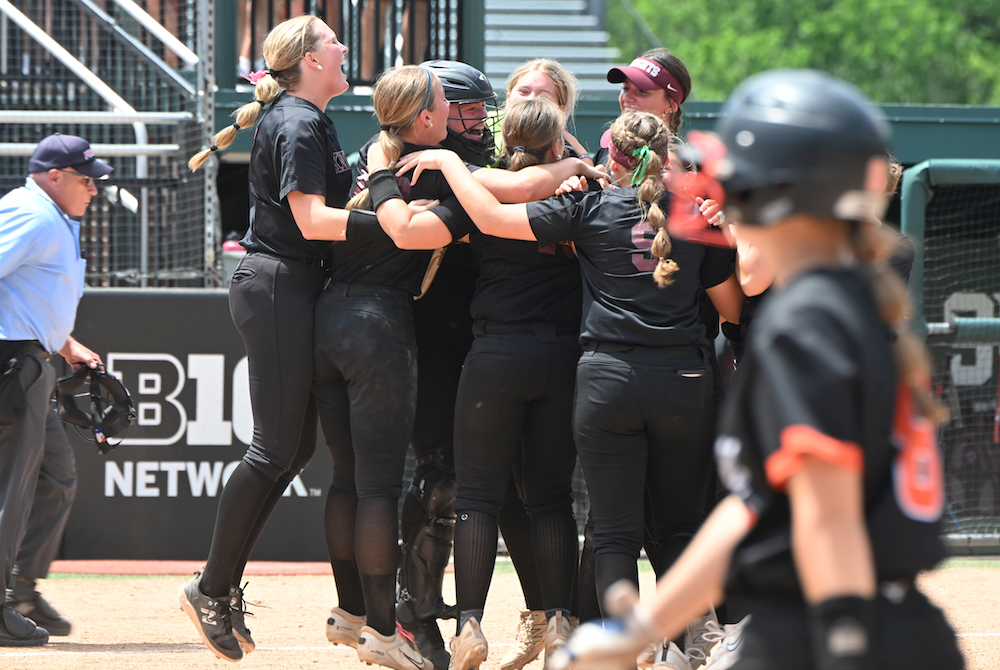
It certainly did, as Turmell limited a powerful Northville offense to just five hits in a 2-1 Northern victory.
In doing so Turmell, who has signed with Toledo, also helped guide the Knights to their first state championship game, where they will meet Grand Haven at 10 a.m. Saturday.
Northern head coach Kristen Woodard said she didn’t offer any special advice to Turmell before the game – other than to just be herself.
“To hit her spots, and I know she’s tough and can do that,” Woodard said.
While Turmell led the Knights in the run-prevention category, sisters Aubrey Kresbaugh and Makenna Kresbaugh provided the offense.
A sophomore, Aubrey Kresbaugh opened the scoring, leading off the game with a home run to right field to give Northern a 1-0 lead.
Northville countered with a run in the bottom of the first inning, tying the game at 1-1 on an RBI single by sophomore Jocelyn Burns after senior Kendall Heron had tripled.
It was the predictable pitcher’s duel from that point between Turmell and Northville senior ace Mary Gugala, until Northern broke through in the sixth.
With Aubrey Kresbaugh on third base and two outs, Makenna Kresbaugh hit a liner to right that ended up dropping for an RBI single that gave the Knights a 2-1 lead.
Northville got its leadoff hitter on base in the seventh inning on an error, but a double play on a popped up bunt, plus a strikeout, ended the game.
Gugala was just as brilliant in defeat for Northville, tossing a four-hitter and striking out 10.
The Mustangs (35-5-1) were making their first Semifinal appearance as well.
“That’s been Mary Gugala for three-plus years,” Northville head coach Scott DeBoer said. “She’s been somebody that just digs deep, and things don’t bother her. She’s only 5-foot-3, but she’s got a heart that’s bigger.”
Grand Haven 8, Macomb Dakota 3
It’s not a formula that Grand Haven head softball John Hall coach wants to consistently follow, but it has sure worked for his team thus far in the MHSAA Tournament.
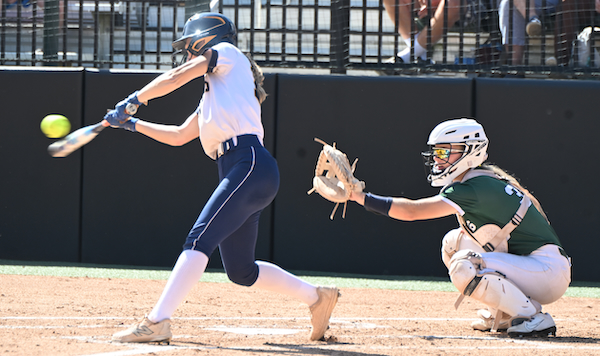 The Buccaneers have consistently fallen behind in games, but rallied for victories, which happened again against Dakota in the first Division 1 Semifinal.
Grand Haven spotted Dakota a run in the bottom of first inning, but once again roared back in advancing to its first championship game.
“To me, we’re the hunters,” Hall said. “We were down 1-0 to Reeths-Puffer. We were down 4-0 to Rockford. We were down 1-0 to Hudsonville, we were down 1-0 to Traverse City Central and came back to win every game. It wakes them up. I’m not saying we want to go down 1-0 in every game. But it fires them up and wakes them up.”
After Dakota took a 1-0 lead in the bottom of the first inning on an RBI single by senior Kiley Phelan, Grand Haven responded with a run in the top of the second on an RBI groundout by senior outfielder Claire Sova to tie the game at 1-1.
The Buccaneers then plated two runs in the third inning on an RBI sacrifice fly by senior Lorelei Chiciuk and an RBI single by junior Makenna VandenBrink. Grand Haven then broke the game open in the fifth, scoring four times to take a 7-1 lead. VandenBrink had an RBI single and Sova another RBI groundout during the rally that was aided by a Dakota error.
The run support was more than enough for Chiciuk, the team’s ace who settled down after a rocky first inning.
Chiciuk didn’t allow a hit in the second, third and fourth innings and pitched out of some trouble, most notably in the sixth when she got out of a bases-loaded, one-out jam with two strikeouts. Sova also made a diving catch to end the fifth inning and save a run.
Chiciuk finished with 15 strikeouts as she moved toward 400 on the season.
“I’ve noticed through every game, the first inning is always the ice-breaker where I go through rocky stuff,” Chiciuk said. “There’s going to be something that happens. But it’s the comeback that happens.
Grand Haven (34-7-1) collected 10 hits.
“We hit all our metrics today,” Hall said. “We love 8 to 10 hits, we love to score four or five runs, and you need about one or two ESPN plays (defensively).”
Dakota made somewhat of an unexpected run in the tournament, with the signature win a 7-5 triumph over No. 2 New Baltimore Anchor Bay in a District Final.
The Cougars advanced to the Semifinals for the first time since finishing Division 1 runner-up in 2022.
“We applied pressure, we got runners in scoring position,” Dakota head coach Shelby Weeks said. “We just couldn’t come up with those key hits today. That’s just how it was for us. The girls fought the whole seven innings.”
PHOTOS (Top) Walled Lake Northern players celebrate after their Semifinal win over Northville on Thursday at Secchia Stadium. (Middle) A Grand Haven hitter drives a pitch during her team’s Semifinal victory.