


AD Inducted to National Hall of Fame
May 7, 2014
By Geoff Kimmerly
Second Half editor
Winter gets hectic so quickly that we’re forced to save some intriguing items that come our way for a sunnier day – and that day is today.
Following are news, notes and a few key links collected over the last few months, including the national Hall of Fame induction of a longtime Michigan athletic director, local recognition for another and statewide acclaim for a group of students putting their video production equipment to good use benefiting all.
Ann Arbor AD Honored Nationally
Former Ann Arbor Huron athletic director Jane Bennett was among five inducted into the National Interscholastic Athletic Administrators Association Hall of Fame in December.
Bennett served 26 years as a teacher, coach, athletic director and assistant principal in Michigan before spending the last decade as a principal at two schools in Montana. She served as athletic director at Huron for 15 years through 2002-03. The NIAAA reported that during her final decade in that position, participation in athletics doubled.
Bennett, who received her bachelor’s and master’s degrees from the University of Michigan, began her career at Huron in 1977 as varsity softball coach and became a math teacher and the co-director of athletics a year later. She coached the softball team 14 seasons before moving into the full-time athletic director position. Bennett was co-founder of the Michigan High School Softball Coaches Association and served as MHSSCA president from 1982-87.
Among other achievements at Huron, Bennett was a leader in a successful campaign to gain voter approval of a $60 million bond package, which included $20 million to improve and expand athletic facilities. She also developed curriculum for an annual varsity captains/head coaches leadership training program and composed handbooks/guidebooks for coaches, athletes and parents.
Bennett also was a valuable contributor to the Michigan Interscholastic Athletic Administrators Association and the NIAAA. She was president of the MIAAA in 1993-94 and a state conference speaker on several occasions. Bennett also served in various NIAAA leadership positions including on the committee that developed the Leadership Training Institute in 1996.
Bennett was named MIAAA Athletic Director of the Year in 1998 and received its State Award of Merit in 1997. She received the MHSAA’s Women in Sports Leadership Award in 1995 and was inducted into the MHSSCA Hall of Fame in 1995. Prior to her selection to the NIAAA Hall of Fame, Bennett was honored with the NIAAA Distinguished Service Award in 1998 and the NIAAA Thomas E. Frederick Award of Excellence in 2000. In 2005, she was inducted into the National Council of Secondary School Athletic Directors Hall of Fame, having served as its president in 2003 and been selected as its Athletic Director of the Year in 1998.
PSL's Ward: 'Pillar' of Detroit Athletics
Alvin Ward, the executive director of athletics for the Detroit Public School League and a member of the MHSAA Representative Council, received a 2014 Pillar in the Community Award in April from the Coast II Coast All-Stars, a Detroit-based pro basketball team that plays in the American Basketball Association.
Ward has served as a teacher, assistant principal and principal as well for Detroit Public Schools, and directs programs with a combined 500 coaches and 4,500 athletes.
Linked up
- This winter, the MHSAA Representative Council adopted a number of football practice rules changes aimed at improving player acclimatization at the start of fall and reducing head trauma and injuries. The Adrian Daily Telegram’s Doug Donnelly got responses from a number of coaches from that area of the state; click to find out why they feel these changes are important.
- Port Huron Times Herald writer Paul Costanzo let people know about our Student Advisory Council through the experience of Marlette’s Connor Thomas, one of our juniors and a great contributor this school year.
Power of Awareness
The Kimberly Anne Gillary Foundation works to educate Michigan schools on sudden cardiac arrest and train personnel in CPR and the use of an AED (automated external defibrillator). The video below teaches us again about the importance of awareness.
Saginaw Heritage was awarded $5,000 in April as the winner of the Gillary Foundation’s High School AED Contest. Students were asked to create a 3-minute video emphasizing the importance of Michigan high schools being adequately prepared to respond to a sudden cardiac arrest or related event on school property.
Randy and Sue Gillary created the foundation after their 15-year-old daughter Kimberly – an athlete at Troy Athens – died after suffering sudden cardiac arrest in 2000. The contest judges were Kimberly’s sisters Emily Kucinich, Jennifer Gregroy and Katie Gillary.
As of April 1, the Gillary Foundation had raised $1.2 million and donated 650 AEDs to schools – with three lives having been saved with donated AEDs. For more, click www.kimberlysgift.org.
Grand Rapids NorthPointe Christian, Napoleon's McCubbins clinch 1st Finals Titles
By
Scott DeCamp
Special for MHSAA.com
October 18, 2025
BIG RAPIDS – The first time was a charm for Grand Rapids NorthPointe Christian girls golf coach Myrna Duflo and her freshman daughter, Izzy, at the Lower Peninsula Division 4 Final this weekend at Katke Golf Course.
For Napoleon senior Anna McCubbins, persistence paid off in a major way.
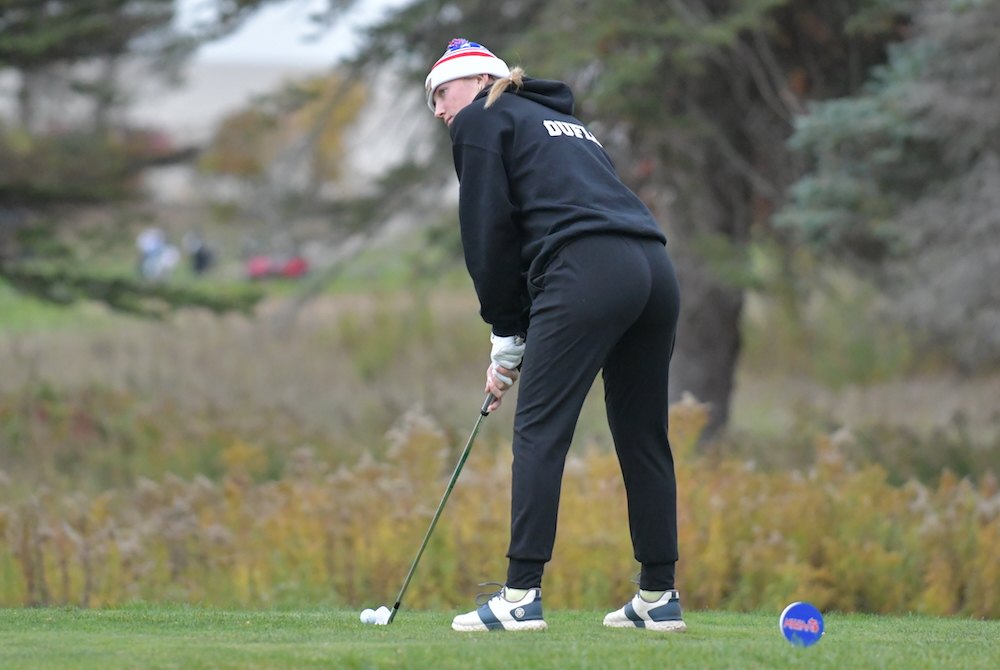
In her first season as NorthPointe Christian’s head coach, Myrna Duflo guided the Mustangs to their first-ever Finals title. Izzy Duflo has been their No. 1 golfer all season and she was again this weekend, placing fourth individually with a two-day total of 166 (78-88).
Meanwhile, McCubbins cruised to her first championship in her fourth Finals appearance by firing a 155 (79-76) in clearing the rest of the field by five strokes.
“It’s awesome. It’s very surreal. I’m still in a little bit of shock about it,” Myrna Duflo said. “It’s my first year coaching it and I have a great group of girls, and they’re the ones that got the job done, not me. They did the hard work – I just encouraged them throughout the day.”
NorthPointe Christian shot 374 on Friday and 371 in soggy, challenging conditions Saturday. The second round was originally scheduled to begin at 10 a.m. Saturday, but it was bumped to 9 a.m. in hopes of dodging some of the inclement weather before heavy rains forced a postponement to an 11 a.m. start after all.
NorthPointe Christian edged Lansing Catholic by one shot, as the Cougars came oh, so close to their second Finals crown in three years. NorthPointe Christian was runner-up last season, and Lansing Catholic also finished second in 2020 and 2021.
When the dust settled Saturday – or, more appropriately, as the wet course began to dry out a bit – Elk Rapids placed third (753), followed by Montague in fourth (755) and Napoleon fifth (778).
“It feels really good,” Izzy Duflo said as she cradled the championship trophy. “Being a freshman, knowing my team did well throughout the season, I’m happy.”
The word “happy” is not strong enough to describe the emotions McCubbins felt after she sealed the medalist honor. She birdied two of her first four holes Saturday and had three of them in her 4-over-par round.
McCubbins tied for 11th at the Final as a freshman, then placed seventh in both her sophomore and junior seasons.
“Seriously, I’ve dreamed about this moment at least four times,” said McCubbins, who will play next for Saginaw Valley State University. “It’s just such a crazy, surreal experience. Just happy tears, honestly.”
Rounding out the top 10 individual finishers were Bath’s Addilyn Duflo in second (160), Byron’s Adalen Brown third (165), Elk Rapids’ Piper Smith and NorthPointe Christian’s Izzy Duflo tied for fourth (166), Lansing Catholic’s Addi Rule sixth (173), Fowler’s Noelle Krepps seventh (177), NorthPointe Christian’s Natalie Kent eighth (179), Montague’s Cadence Fox ninth (180), and Monroe St. Mary Catholic Central’s Nora Kinsey 10th (182).
A Montague golfer’s bag of clubs went missing Saturday morning. On the driving range during warmups, McCubbins loaned her driver to the Montague golfer.
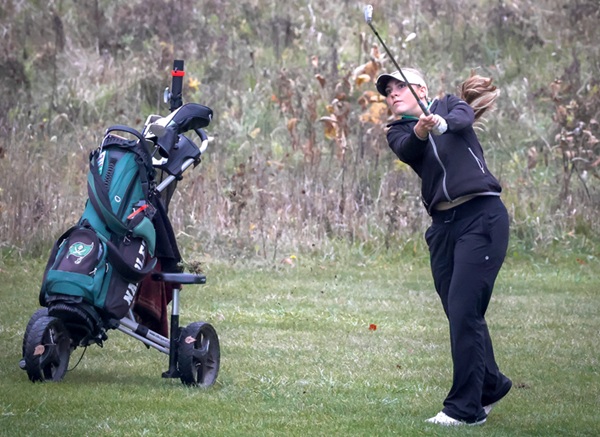 On top of the goodwill gesture, McCubbins said she felt a sense of fulfillment in capturing the individual title. Her life the past four years has been committed to golf and getting better, she said.
“Golf, it’s such a mental game. Just have a good, mental state the entire day. Stay calm, you know, don’t get super upset. Play with emotion without being emotional, and I feel like I really pulled that off today,” she said. “Especially with the weather being as bad as it was, I’ve had experience playing in bad weather, I know what that’s like, and I think that’s what gave me an advantage.”
NorthPointe’s Aila Ellis (196) and Clara Velting (204) rounded out their team’s top four scorers, while Kezia Beeke shot 221 for the Mustangs.
Beeke, who was one of two seniors on the NorthPointe squad, said that sticking with it and staying together were among the keys for her team.
“We were really encouraged. Coach did a lot of encouragement over the season and over today and yesterday, and I just think that encouragement and just knowing our team is so bonded and we’re so impacted by each other that we really just pushed through and we were able to win,” Beeke said.
“It’s proven that if you know your team well and you were loved and were cared for by your team and you know that, you significantly would do better. That’s what I think makes our team such a good team is because we can love each other well and support each other no matter what happens on the course.”
Izzy Duflo added team bonding and motivating each other also carried the Mustangs, who finished runner-up to Montague in the Regional by one shot.
Myrna Duflo quipped, maybe NorthPointe will win the Regional next year. For now, the Finals championship will suit the Mustangs just fine.
“Next year’s a new year and hopefully we’ll be standing here again,” coach Duflo said. “At the end of the day, this is what we trained for all season, and we’ve worked really hard.”
PHOTOS (Top) NorthPointe Christian's Izzy Duflo tees off during the opening round of the Division 4 Final on Friday. (Middle) Napoleon's Anna McCubbins follows an approach shot Saturday. (Click for more from High School Sports Scene. McCubbins photo submitted by the Michigan Interscholastic Golf Coaches Association.)