

Add, Subtract, Divide, Multiply: MHSAA Not Alone
July 25, 2017
By Rob Kaminski
MHSAA benchmarks editor
This is the third part in a series on MHSAA tournament classification, past and present, that will be published over the next two weeks. This series originally ran in this spring's edition of MHSAA benchmarks.
As the MHSAA faces its most recent classification task with 8-Player Football, and opinions continue to swirl about as to the method, timeframe, location and other procedures, a look around the country provides plenty of company among state association brethren factoring variables into their own equations.
In the Pacific Northwest, the Oregon School Activities Association Football Playoffs are under public scrutiny as leadership ponders a five or six classification format beginning with the 2018-19 school year.
The OSAA has crowned six champions on the gridiron since 2006-07. Many of the state’s smaller schools would like to keep it that way, while larger schools lean toward a five-classification system, citing larger leagues, ease of travel and credibility to state championships as the advantages.
Still others would prefer more than six classes, pointing to safety issues and the opportunity to increase participation numbers as positives.
Moving southeast of Oregon, the Nevada Interscholastic Activities Association recently voted to hold serve on a classification proposal that was volleyed to the membership.
However, changes still could be forthcoming by as early as the 2018-19 season which would add a fifth classification in more populated southern Nevada while allowing northern schools to participate in four classifications. Such divisions could mean no state championship for the fifth class in southern Nevada.
Because of that, the NIAA wants equal numbers of schools in each classification on both ends of the state. Complicating the issue is the fact that the 24 largest schools in the state, by enrollment, are all in Clark County in Southern Nevada.
Across Nevada’s border into Arizona, charter schools are asking the Arizona Interscholastic Association to reconsider classification that was voted upon and approved in September 2015. That agreement called for the largest 33 percent of charter schools by enrollment to be placed in the state’s largest school classification, 3A, the middle 33 percent into 2A, and the smallest 33 percent into 1A.
Less than two years later the charter schools have had a change of heart and have asked to be considered the same as other Arizona public schools and be placed appropriately by enrollment beginning with the 2018-19 school year.
The situation in Arizona further illustrates how the public/private debate that all state associations have faced throughout existence now has the added dynamic of rapidly growing charter schools in today’s educational system, along with virtual school enrollment.
In the nation’s heartland, Nebraska has retooled its football classifications by using enrollment of boys students only in its schools rather than total enrollment. The Nebraska School Activities Association football-playing schools will kick off the 2018 season using this alignment.
Nebraska has three classes of 11-player football, with the smallest class divided in two, Class C-1 and C-2. The state also will have 8-player football for boys enrollments under 47, and the NSAA will sponsor a new 6-player tournament in 2018 for schools with 27 or fewer boys.
“This is a good proposal because some schools have a sizable imbalance between the number of boys and girls, and there’s a large gap (in enrollment) between the largest and smallest schools in Classes A and B,” NSAA executive director Jim Tenopir said. “I think this addresses both of those concerns.”
Swimmers in Georgia, meanwhile, will feel like they are moving with the current, rather than upstream in 2017-18, as the Georgia High School Association recently doubled the number of team championship events from two to four.
Swim enthusiasts can also count on longer days at the finals, as the top 30 finishers from the prelims will advance to the finals instead of 20, and all championship events will have three heats versus two.
Dehlin's Title Sweep Leads Marquette Boys' Return to Top Spot in Division 1
By
Nick Cooper
Special for MHSAA.com
February 25, 2025
HARBOR SPRINGS – Sam Dehlin’s final high school ski runs can undoubtedly be declared a success.
The reigning Division 1 Finals champion in the slalom once again took home the crown in that event and added another accolade to his resume with a first place in the giant slalom on a warm Monday at Nub’s Nob.
Dehlin also propelled the Marquette boys to the team championship as the Sentinels scored a combined 50.4 points, 13.5 fewer than second-place Traverse City West.
“Overall, I think it was a really good. I think all the people on our team skied to the best of their ability,” said Dehlin.
 His first-place finish in the slalom clocked in at a combined time of 70.16 seconds, with Marquette teammates Conner Henry taking second place with a time of 72.99, Brady Audette finishing fourth (75.63) and Ben Kuhl sixth (76.52) solidifying an outstanding showing by the Sentinels as each earned first-team all-state honors.
Marquette’s team championship was its first since completing a run of eight straight in 2020. The Sentinels had finished third the last two seasons.
Not to be outdone, the Traverse City West and Central boys both finished among the top three. West finished in second place with a score of 64 points, and Central was third with a score of 103 points including the meet’s best giant slalom score of 25 points. Finishing fourth through ninth respectively were Clarkston (155), Lake Orion (203), Detroit Catholic Central (210), Rochester Hills Stoney Creek (256.5), Milford (261) and Northville (262).
Also earning first-team all-state in the slalom were Central third-place finisher Jace Rowell (74.27), West’s fifth-place finisher Cam Lewandowski (76.48), West’s Dane Lewandowski (76.56) in seventh, Central’s Trevor Suttle (77.02) in eighth, West’s Grady Ellis (77.28) in ninth and Brighton’s John Popov (78.37) in 10th.
“Overall, (we were) pretty consistent and stayed in the top 10 in both events, so that was good. The snow conditions weren’t ideal, but they worked, and we managed to get second overall,” said TC West’s Dane Lewandowski.
In the giant slalom, Dehlin secured the victory with a combined time of 52.88. Taking second was Broden Janczarek of Lake Orion with a time of 53.55. In third place, Traverse City Central’s Emerson Elkins clocked in at 53.91.
 Giant slalom first-team all-state honors also went to Rowell in fourth, Kuhl in fifth, Cam Lewandowski in sixth, Ellis in seventh, Central’s Cooper Gerber in eighth, Dane Lewandowski in ninth, and Suttle in 10th.
As Dehlin’s career came to a close, the decorated slope star said he hopes to continue a passion that started long before high school.
“I've been skiing since I was 5 and then obviously racing high school all four years. (I’ve had) a lot of fun with high school racing. I’m kind of sad to see it come to a close. But I’m going to go to the University of Michigan (and) they have a club team that I’m going to try and join,” said Dehlin.
Click for full results. Click to watch NFHS Network broadcasts: Slalom | Giant Slalom
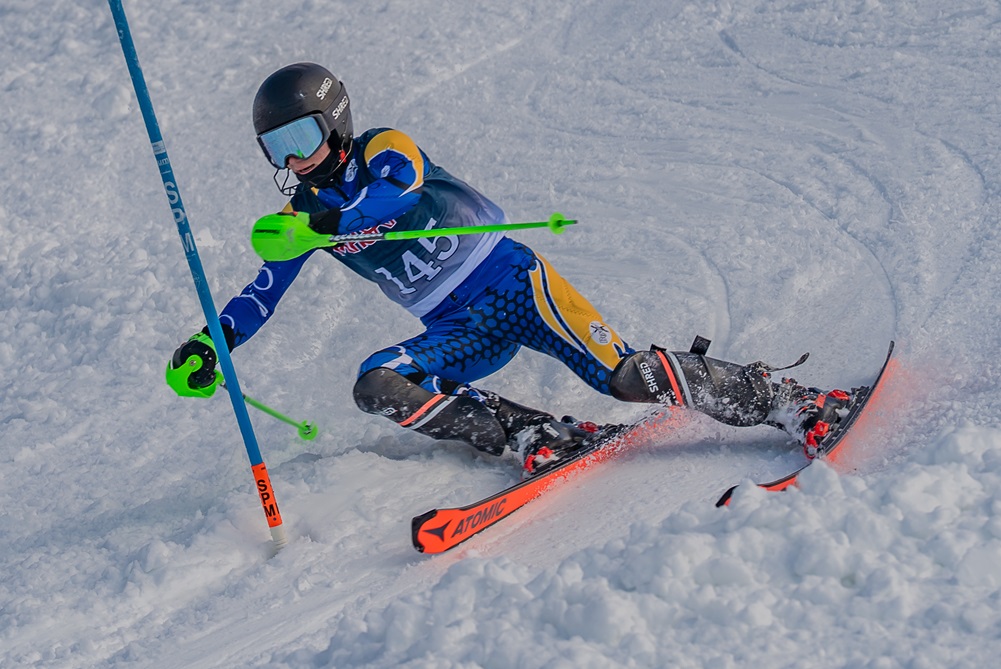
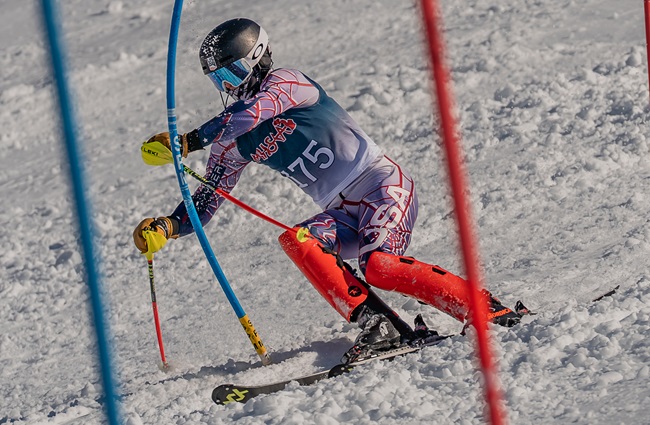
PHOTOS (Top) Grand Haven’s Maverick Hardebeck carves through a turn during the slalom Monday at Nub’s Nob. (Middle) Brighton’s Erik DeKeyser breaks past a gate during a slalom run. (Below) Lake Orion’s Raffael Anders finishes a giant slalom run. (Click for more from Tori Burley – photos to be added throughout this week.)