


Add, Subtract, Divide, Multiply: MHSAA Not Alone
July 25, 2017
By Rob Kaminski
MHSAA benchmarks editor
This is the third part in a series on MHSAA tournament classification, past and present, that will be published over the next two weeks. This series originally ran in this spring's edition of MHSAA benchmarks.
As the MHSAA faces its most recent classification task with 8-Player Football, and opinions continue to swirl about as to the method, timeframe, location and other procedures, a look around the country provides plenty of company among state association brethren factoring variables into their own equations.
In the Pacific Northwest, the Oregon School Activities Association Football Playoffs are under public scrutiny as leadership ponders a five or six classification format beginning with the 2018-19 school year.
The OSAA has crowned six champions on the gridiron since 2006-07. Many of the state’s smaller schools would like to keep it that way, while larger schools lean toward a five-classification system, citing larger leagues, ease of travel and credibility to state championships as the advantages.
Still others would prefer more than six classes, pointing to safety issues and the opportunity to increase participation numbers as positives.
Moving southeast of Oregon, the Nevada Interscholastic Activities Association recently voted to hold serve on a classification proposal that was volleyed to the membership.
However, changes still could be forthcoming by as early as the 2018-19 season which would add a fifth classification in more populated southern Nevada while allowing northern schools to participate in four classifications. Such divisions could mean no state championship for the fifth class in southern Nevada.
Because of that, the NIAA wants equal numbers of schools in each classification on both ends of the state. Complicating the issue is the fact that the 24 largest schools in the state, by enrollment, are all in Clark County in Southern Nevada.
Across Nevada’s border into Arizona, charter schools are asking the Arizona Interscholastic Association to reconsider classification that was voted upon and approved in September 2015. That agreement called for the largest 33 percent of charter schools by enrollment to be placed in the state’s largest school classification, 3A, the middle 33 percent into 2A, and the smallest 33 percent into 1A.
Less than two years later the charter schools have had a change of heart and have asked to be considered the same as other Arizona public schools and be placed appropriately by enrollment beginning with the 2018-19 school year.
The situation in Arizona further illustrates how the public/private debate that all state associations have faced throughout existence now has the added dynamic of rapidly growing charter schools in today’s educational system, along with virtual school enrollment.
In the nation’s heartland, Nebraska has retooled its football classifications by using enrollment of boys students only in its schools rather than total enrollment. The Nebraska School Activities Association football-playing schools will kick off the 2018 season using this alignment.
Nebraska has three classes of 11-player football, with the smallest class divided in two, Class C-1 and C-2. The state also will have 8-player football for boys enrollments under 47, and the NSAA will sponsor a new 6-player tournament in 2018 for schools with 27 or fewer boys.
“This is a good proposal because some schools have a sizable imbalance between the number of boys and girls, and there’s a large gap (in enrollment) between the largest and smallest schools in Classes A and B,” NSAA executive director Jim Tenopir said. “I think this addresses both of those concerns.”
Swimmers in Georgia, meanwhile, will feel like they are moving with the current, rather than upstream in 2017-18, as the Georgia High School Association recently doubled the number of team championship events from two to four.
Swim enthusiasts can also count on longer days at the finals, as the top 30 finishers from the prelims will advance to the finals instead of 20, and all championship events will have three heats versus two.
Byron Center All-Stater Johnson Set to Represent US at Pan American Cup
By
Dean Holzwarth
Special for MHSAA.com
August 26, 2026
BYRON CENTER – Byron Center volleyball coach Missy Ritz-Johnson had known for a while that her daughter, Mallory Johnson, possessed all of the attributes and intangibles to become a top-notch libero.
 It became obvious at a young age.
“I would say when she was young that she often knew where the hitters were going to hit the ball better than, sometimes, they did,” Ritz-Johnson said. “She has had an ability to read hitters and anticipate what they are going to do, which makes her a really good defender. A lot of natural ability to read and understand the game, and she’s been thriving at that position.
“She’s really athletic and really competitive, and that's a good combination to have at that position.
Johnson, a 5-foot-6 senior, has blossomed into one of the top liberos in the country and was recently named to the U23 USA Volleyball Pan American Cup roster.
She traveled to Colorado Springs, Colo., earlier this week to train with the team at the United States Olympic Training Center before leaving for Managua, Nicaragua, to compete September 1-6.
“It’s a great opportunity, and every time I step in this gym at this training center (in Colorado) it’s crazy to think that I'm even here,” Johnson said. “But the girls are amazing. They are great people, great athletes and great competitors. It's really fun, and I learn every time I come here and grow as an athlete and as a person.”
Johnson made the team after spending a week at the training center in mid-July.
“Obviously I was so grateful to be selected to try out, and when I made the team I was speechless and overwhelmed with joy,” Johnson said. “I called my mom right away and tried to gauge what was even going on. I really didn’t know what to expect going into it, but it was super competitive.”
After leading the state-ranked Bulldogs to an 8-0 start with four wins at both the Cornerstone Showcase and Traverse City West Invitational, Johnson will take a brief hiatus from her high school team and return on Sept. 7.
 “I have talked a lot with my teammates about my absence, and they are all cool with it and doing great,” Johnson said. “I talk to them almost every day and ask them how practice went. They are all set and more than capable of handling business without me. For me, I think competing in these games will only make me grow and get out of my comfort zone. Hopefully I’ll bring my talents back to high school and see what we can do this year.”
Johnson, who first started playing club volleyball when she was 8, is one of nine returners for a talented Bulldogs’ squad that lost a thrilling match (3-2) during last season’s Division 1 Semifinals to eventual champion Farmington Hills Mercy.
That heartbreaking defeat has provided motivation for this year’s group.
“That loss hurt,” said Johnson, who made the Division 1 all-state team last fall as an outside hitter. “I know, personally, I have changed so much from that loss, and I’ve learned so much. I know that it sucked for the other eight returners, too. There’s been a mood switch with this team, and I know we all want it really bad this year.”
Johnson's personality and leadership fit well for her libero position, and she has embraced it fully.
“I’ve known nothing else, and I find myself just loving my position as a libero,” she said. “I love being in charge of the backcourt, getting to celebrate with my teammates and putting them in good positions to make plays.”
Ritz-Johnson said her daughter has been involved with the Olympic Developmental Program since she was in seventh grade and has worked hard to achieve her goals.
“She’s worked really hard to earn these opportunities,” Ritz-Johnson said. “She has a love for the game and has never complained about going to practice. She loves to practice and compete, and her favorite sport is one she is best at, which is not always the case.”
Last June, Johnson committed to a collegiate powerhouse, the University of Nebraska, after receiving interest from about 30 programs.
“It was pretty surreal, and I just remember watching them on TV when I was in sixth grade, and obviously Nebraska is a very big deal,” Johnson said. “I watched them and was thinking, ’Holy cow, I want to go here. I want to play at this level, and I want to be involved in this atmosphere.’”
“I’ve been to camps there since seventh grade and been out to campus every year since then. Every time I went there I loved it, and it felt like home. I knew I wanted to be there, and it wasn't a super-hard decision for me.”
Ritz-Johnson is excited for her daughter to play at such a high-profile program.
“There’s no place like Nebraska, as they say,” she said. “They’ve had attendance records and sell out when they travel and just the way the team is treated. The coaching staff is really special.”
 Dean Holzwarth has covered primarily high school sports for Grand Rapids-based WOOD-TV for five years after serving at the Grand Rapids Press and MLive for 16 years along with shorter stints at the Ionia Sentinel and WZZM. Contact him at [email protected] with story ideas for Allegan, Kent and Ottawa counties.
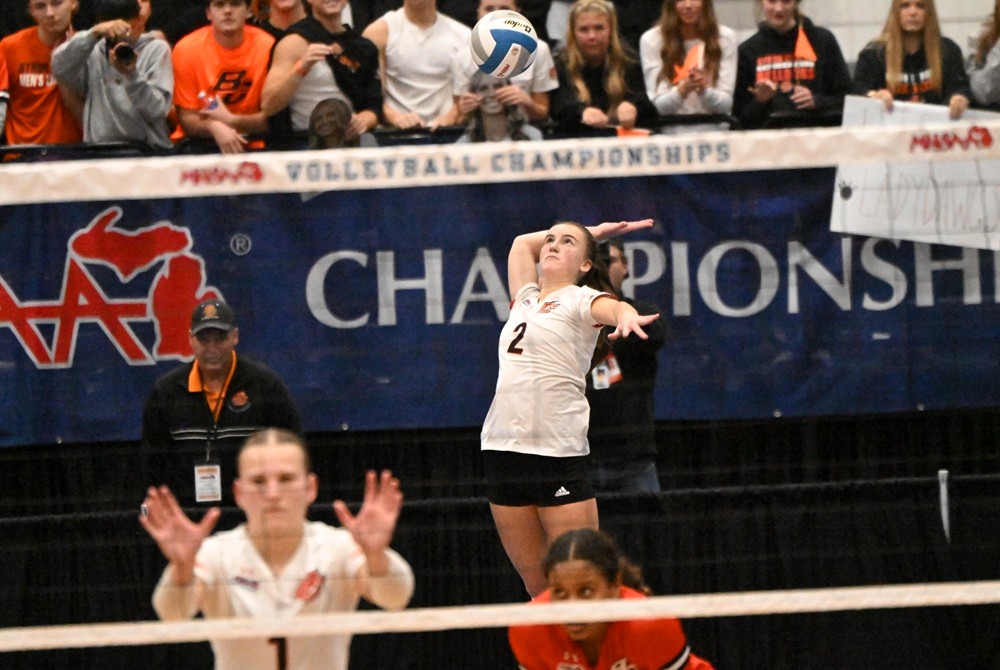
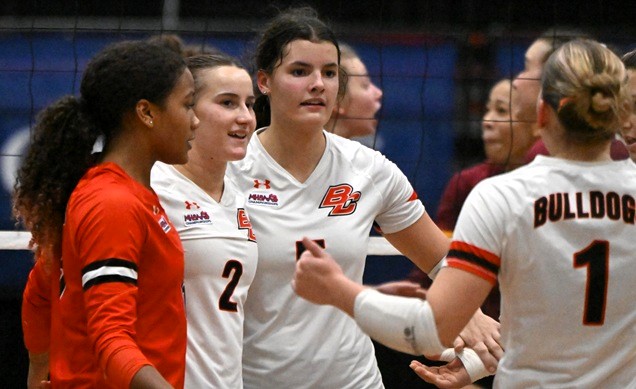
PHOTOS (Top) Mallory Johnson (2) serves during last season’s Division 1 Semifinal against Farmington Hills Mercy. (Middle) Johnson huddles for a moment during that match with her teammates including, from left, Kinsley Whitfield, Lainey VanTol and Caitlin Hartson.