

Add, Subtract, Divide, Multiply: MHSAA Not Alone
July 25, 2017
By Rob Kaminski
MHSAA benchmarks editor
This is the third part in a series on MHSAA tournament classification, past and present, that will be published over the next two weeks. This series originally ran in this spring's edition of MHSAA benchmarks.
As the MHSAA faces its most recent classification task with 8-Player Football, and opinions continue to swirl about as to the method, timeframe, location and other procedures, a look around the country provides plenty of company among state association brethren factoring variables into their own equations.
In the Pacific Northwest, the Oregon School Activities Association Football Playoffs are under public scrutiny as leadership ponders a five or six classification format beginning with the 2018-19 school year.
The OSAA has crowned six champions on the gridiron since 2006-07. Many of the state’s smaller schools would like to keep it that way, while larger schools lean toward a five-classification system, citing larger leagues, ease of travel and credibility to state championships as the advantages.
Still others would prefer more than six classes, pointing to safety issues and the opportunity to increase participation numbers as positives.
Moving southeast of Oregon, the Nevada Interscholastic Activities Association recently voted to hold serve on a classification proposal that was volleyed to the membership.
However, changes still could be forthcoming by as early as the 2018-19 season which would add a fifth classification in more populated southern Nevada while allowing northern schools to participate in four classifications. Such divisions could mean no state championship for the fifth class in southern Nevada.
Because of that, the NIAA wants equal numbers of schools in each classification on both ends of the state. Complicating the issue is the fact that the 24 largest schools in the state, by enrollment, are all in Clark County in Southern Nevada.
Across Nevada’s border into Arizona, charter schools are asking the Arizona Interscholastic Association to reconsider classification that was voted upon and approved in September 2015. That agreement called for the largest 33 percent of charter schools by enrollment to be placed in the state’s largest school classification, 3A, the middle 33 percent into 2A, and the smallest 33 percent into 1A.
Less than two years later the charter schools have had a change of heart and have asked to be considered the same as other Arizona public schools and be placed appropriately by enrollment beginning with the 2018-19 school year.
The situation in Arizona further illustrates how the public/private debate that all state associations have faced throughout existence now has the added dynamic of rapidly growing charter schools in today’s educational system, along with virtual school enrollment.
In the nation’s heartland, Nebraska has retooled its football classifications by using enrollment of boys students only in its schools rather than total enrollment. The Nebraska School Activities Association football-playing schools will kick off the 2018 season using this alignment.
Nebraska has three classes of 11-player football, with the smallest class divided in two, Class C-1 and C-2. The state also will have 8-player football for boys enrollments under 47, and the NSAA will sponsor a new 6-player tournament in 2018 for schools with 27 or fewer boys.
“This is a good proposal because some schools have a sizable imbalance between the number of boys and girls, and there’s a large gap (in enrollment) between the largest and smallest schools in Classes A and B,” NSAA executive director Jim Tenopir said. “I think this addresses both of those concerns.”
Swimmers in Georgia, meanwhile, will feel like they are moving with the current, rather than upstream in 2017-18, as the Georgia High School Association recently doubled the number of team championship events from two to four.
Swim enthusiasts can also count on longer days at the finals, as the top 30 finishers from the prelims will advance to the finals instead of 20, and all championship events will have three heats versus two.
Fresh Off Newfound Spring Swing, Tabron Remains Driver of Cass Tech Title Hopes
By
Keith Dunlap
Special for MHSAA.com
August 20, 2026
DETROIT — One of the country’s top football recruits in the Class of 2028, Detroit Cass Tech junior quarterback Donald Tabron pursued a newfound passion this spring even while zigzagging across the country on recruiting visits to prominent college football programs.
 When he wasn’t busy with school studies, recruiting trips or football training, Tabron happily was a member of Cass Tech’s boys golf team, building on a love for that sport he developed the previous spring as he was winding down his freshman year of high school.
Tabron said one of his football teammates who was also on the golf team introduced him to a golf simulator at the school, and the seed was planted.
“We got down and hit golf balls in the simulator,” Tabron said. “We did that the last few weeks of the school year. He was like, ‘You have a pretty decent swing. I’ll get you with our golf coach,’ So I got with Coach Mike (Schuchard). I love Coach Mike. He helped me out during that summer, giving me lessons once a week. I went to Five Iron Golf and those indoor simulators on Sundays and just suddenly was getting better. I got my first set of clubs.”
Tabron liked golf so much that he decided to not participate on the track & field team at Cass Tech, where he shined in the high jump as a freshman.
In fairness, his busy schedule of football recruiting trips also played a factor in not going out for track. But he made time for golf, finishing up by competing in his team’s Regional tournament in May.
There are physical characteristics of playing golf that Tabron said should help him in football, such as similar torso turning and strength needed to both swing a golf club and throw a football. But it’s the mental side of golf that he feels will make him a better quarterback.
“A lot of times in football you may take a bad hit or make a bad play, and in golf you may hit a bad shot,” Tabron said. “It’s how you rebound from that. As a quarterback, you have to be able to stay cool, calm and collected. You can’t get too over your head or too low. That’s the same for golf.”
 There haven’t been too many lows for Tabron during what already has been an accomplished high school football career – and he still has two years left.
As a freshman two years ago, Tabron was the starter for Cass Tech’s team that won the Division 1 championship, and he helped lead the Technicians to an unbeaten record last year before a loss to Detroit Catholic Central in the title game.
This year as a junior, particularly with Mr. Football Award winner C.J. Sadler graduated, it is fully Tabron’s offense and his team.
“I’m going to be like the offensive coordinator on the field, but you can only work as good as the surrounding cast,” Tabron said. “That’s how it’s going to be for us. I’ll be like the coach and leader on the field, but I can’t do it without them.”
Tabron got his start in football much earlier in life than golf, as a toddler, mainly because his father, Donald Tabron Jr., played collegiately at Northwood.
A right-handed thrower, Tabron made an immediate impact once he got to high school, earning the starting quarterback job, and after initial lumps, guided Cass Tech to that Division 1 championship. Tabron finished 15 of 20 passing with three touchdowns that day at Ford Field, and from there college scouts started drooling.
The 6-foot-3 Tabron committed to Texas A&M on Saturday, and this spring was quite a whirlwind with recruiting trips across the country including to Oregon, USC, Texas A&M, LSU, Ohio State and many others.
Tabron didn’t measure how many miles he traveled, but he did become quite an expert on the quality of airports in various cities.
“My mom was like, ‘Not many kids can say how good or bad airports are at 17 years old,” Tabron said. “I’m definitely blessed and grateful for the opportunity to go to all these places.”
He likely won’t go on more recruiting visits now that he is committed. But if he does, one big request from Tabron will be to check out the university’s golf course.
“I actually talked about it with a few coaches because a lot of college coaches play golf,” he said. “(They say) ‘Next time you come down, get on the range here or get on the course where the golf team practices at.’ It’s definitely been a conversation.”
 Keith Dunlap has served in Detroit-area sports media for more than two decades, including as a sportswriter at the Oakland Press from 2001-16 primarily covering high school sports but also college and professional teams. His bylines also have appeared in USA Today, the Washington Post, the Detroit Free Press, the Houston Chronicle and the Boston Globe. He served as the administrator for the Oakland Activities Association’s website from 2017-2020. Contact him at [email protected] with story ideas for Oakland, Macomb and Wayne counties.
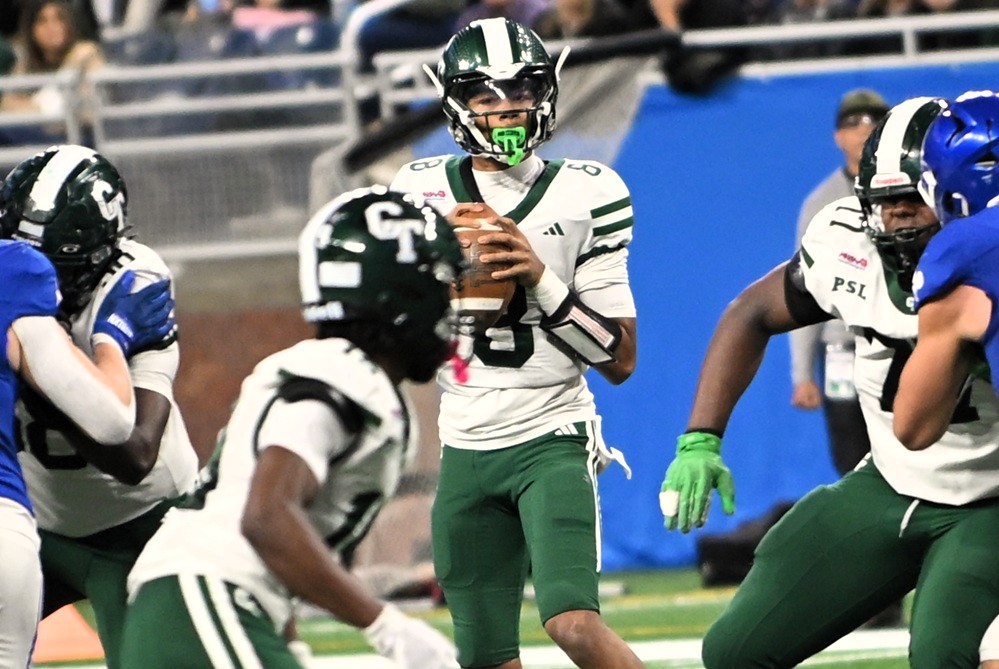
PHOTO (Top) Cass Tech quarterback Donald Tabron (8) drops back to pass during last season’s Division 1 Final, moments before throwing for a big gain that set up the team’s first touchdown.