

Add, Subtract, Divide, Multiply: MHSAA Not Alone
July 25, 2017
By Rob Kaminski
MHSAA benchmarks editor
This is the third part in a series on MHSAA tournament classification, past and present, that will be published over the next two weeks. This series originally ran in this spring's edition of MHSAA benchmarks.
As the MHSAA faces its most recent classification task with 8-Player Football, and opinions continue to swirl about as to the method, timeframe, location and other procedures, a look around the country provides plenty of company among state association brethren factoring variables into their own equations.
In the Pacific Northwest, the Oregon School Activities Association Football Playoffs are under public scrutiny as leadership ponders a five or six classification format beginning with the 2018-19 school year.
The OSAA has crowned six champions on the gridiron since 2006-07. Many of the state’s smaller schools would like to keep it that way, while larger schools lean toward a five-classification system, citing larger leagues, ease of travel and credibility to state championships as the advantages.
Still others would prefer more than six classes, pointing to safety issues and the opportunity to increase participation numbers as positives.
Moving southeast of Oregon, the Nevada Interscholastic Activities Association recently voted to hold serve on a classification proposal that was volleyed to the membership.
However, changes still could be forthcoming by as early as the 2018-19 season which would add a fifth classification in more populated southern Nevada while allowing northern schools to participate in four classifications. Such divisions could mean no state championship for the fifth class in southern Nevada.
Because of that, the NIAA wants equal numbers of schools in each classification on both ends of the state. Complicating the issue is the fact that the 24 largest schools in the state, by enrollment, are all in Clark County in Southern Nevada.
Across Nevada’s border into Arizona, charter schools are asking the Arizona Interscholastic Association to reconsider classification that was voted upon and approved in September 2015. That agreement called for the largest 33 percent of charter schools by enrollment to be placed in the state’s largest school classification, 3A, the middle 33 percent into 2A, and the smallest 33 percent into 1A.
Less than two years later the charter schools have had a change of heart and have asked to be considered the same as other Arizona public schools and be placed appropriately by enrollment beginning with the 2018-19 school year.
The situation in Arizona further illustrates how the public/private debate that all state associations have faced throughout existence now has the added dynamic of rapidly growing charter schools in today’s educational system, along with virtual school enrollment.
In the nation’s heartland, Nebraska has retooled its football classifications by using enrollment of boys students only in its schools rather than total enrollment. The Nebraska School Activities Association football-playing schools will kick off the 2018 season using this alignment.
Nebraska has three classes of 11-player football, with the smallest class divided in two, Class C-1 and C-2. The state also will have 8-player football for boys enrollments under 47, and the NSAA will sponsor a new 6-player tournament in 2018 for schools with 27 or fewer boys.
“This is a good proposal because some schools have a sizable imbalance between the number of boys and girls, and there’s a large gap (in enrollment) between the largest and smallest schools in Classes A and B,” NSAA executive director Jim Tenopir said. “I think this addresses both of those concerns.”
Swimmers in Georgia, meanwhile, will feel like they are moving with the current, rather than upstream in 2017-18, as the Georgia High School Association recently doubled the number of team championship events from two to four.
Swim enthusiasts can also count on longer days at the finals, as the top 30 finishers from the prelims will advance to the finals instead of 20, and all championship events will have three heats versus two.
East Grand Rapids Dominates From Start to Finish in Earning Title 27
By
Brad Emons
Special for MHSAA.com
November 23, 2024
YPSILANTI – Winning MHSAA Finals championships has become standard operating procedure for the East Grand Rapids girls swimming & diving program.
The top-ranked Pioneers did it again Saturday, earning their fourth consecutive crown while giving coach Milton Briggs his 27th title in 50 years by scoring a whopping 407 points to outdistance Bloomfield Hills Marian (173) and St. Joseph (166) at Eastern Michigan University’s Jones Natatorium.
East Grand Rapids has now captured a total of 10 Division 3, 15 Class B and pair of D2 titles under Briggs, who has been at the helm for the Pioneers for a half-century.
“This group came in as a group; they stay together” Briggs said. “They allowed the freshmen to mature, and they accepted each other’s values. We just always made sure they were on track. There’s usually a lot of drama that goes on with a girls team. This one didn’t have any. They were absolutely wonderful to work with.”
The Pioneers swept all three relays, while senior Kate Simon and junior Ellery Chandler each figured in four firsts with two individual titles apiece.
Simon now has a combined four individual and eight relay titles over four years after sweeping the 100- and 200-yard freestyles in 50.6 seconds (meet record) and 1:48.19, respectively.
 She was also the lead-off leg on the victorious 200 freestyle relay (1:36.24) followed by junior Nora Camfferman, senior Gracie Putnam and Chandler.
The quartet of Camfferman, sophomore Ivey Chu, senior Sarah Lincolnhol and Simon capped off the meet by holding off St. Joseph to win in the 400 freestyle relay (3:37.01).
“It was my goal going into the weekend. I’m happy with it,” Simon said. “It’s been so fun, I’ve had a lot of fun with my teammates and spent the weekend with my best friends, made lots of memories. I think our coach Coach Briggs really makes this team special. I’m honored to be coached by him. He’s really the best, and I look up to him so much.”
Meanwhile, Chandler took the 100 butterfly (56.07) and 100 breaststroke (1:02.86), while also teaming up with sophomore Meredith Sperling, sophomore Addie Hein and Putnam (1:46.40) in the 200 medley relay.
Chandler also had won the breaststroke last season.
“It was definitely so fun, especially being with the team,” Chandler said. “Everyone just has such a good time with everyone, and that’s what it makes it so much fun. There were a little bit of nerves, especially being close to different records and stuff. That’s probably challenging, going into those (to) try and see if we can get them.”
Hein also made her mark by winning the 200 individual medley in 2:06.71.
Another individual double winner was Holland Christian sophomore Camryn Siegers, who captured the 50 freestyle (23.19) while also repeating in the 100 backstroke (55.69).
She helped Holland Christian to a fifth-place team finish.
“Last year I got a gold and a silver, so I came back this year hoping to get two golds and I did that, so I’m very happy with it,” she said. “I still have some work to do, I have big meet in a couple of weeks, so I have another chance to get those.
 “I think we did really well. We lost a lot of good seniors last year, but we really stepped up this year.”
Another swimmer who made her mark once again was Dearborn Divine Child junior Ella Dziobak, who defended her title in the 500 freestyle (5:12.74) after going a fast 5:03.24 in the prelims. She was also part of two relays that scored for the Falcons.
“I was happy to be able to score some points for DC even though it wasn’t as fast as I went yesterday,” Dziobak said. “I had some goals; I didn’t necessarily reach them, but I’m happy I scored some points and our relays did really well, so ... it’s exciting. I think people at school are going to be pretty excited.”
The meet’s other individual winner was Chelsea sophomore Anna McAllister, who improved upon last year’s fourth-place finish with a victory in the 1-meter diving as she scored 407.40 points. McAllister, who began competitive diving with she was age 7, was the favorite going in.
But the day belonged to the Pioneers, who entered as the prohibitive favorite after winning three straight team titles – in Division 3 last year and 2021, along with D2 in 2022. Coming out of Friday’s prelims, they were seeded first in all three relays and four individual races.
Briggs credits the team’s success to his two assistant coaches – Gwen Barnes, a former EGR swimmer in her fourth year, along with Josh Dolecki, who is in his second season.
With them, EGR has put together a successful year-round program.
“They swim all year; that’s the biggest thing,” Briggs said. “Josh (Dolecki) does our age-group program that keeps going the rest of the year. This win can be dedicated to our age-group swim team because most of the kids who scored came out of there. And those two girls (Simon and Chandler) will do anything to make the team better.”
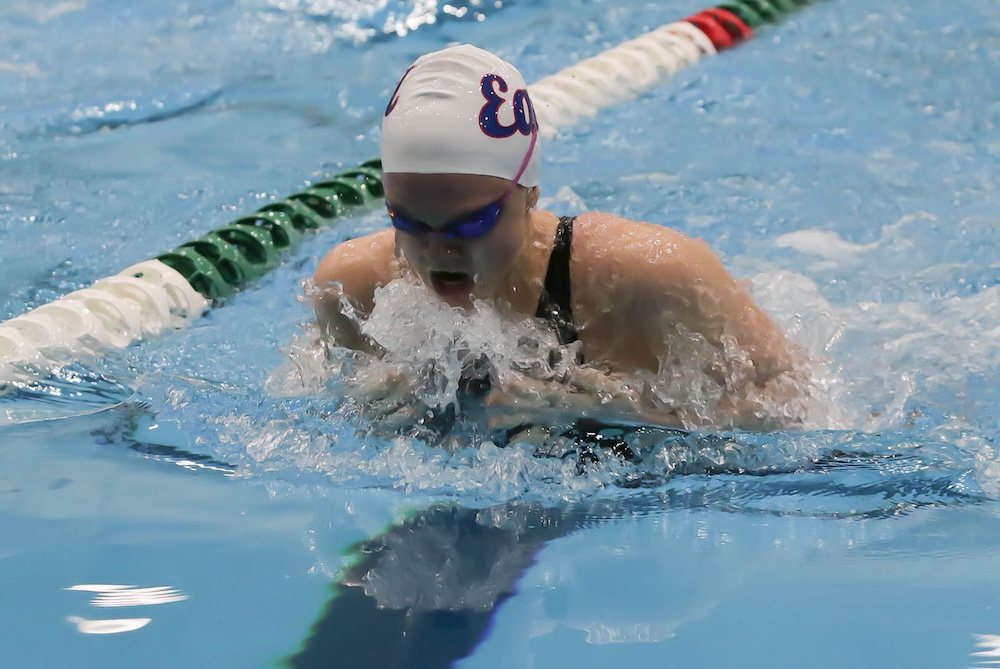
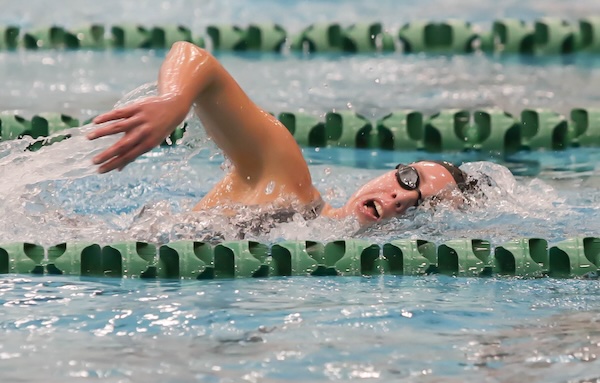
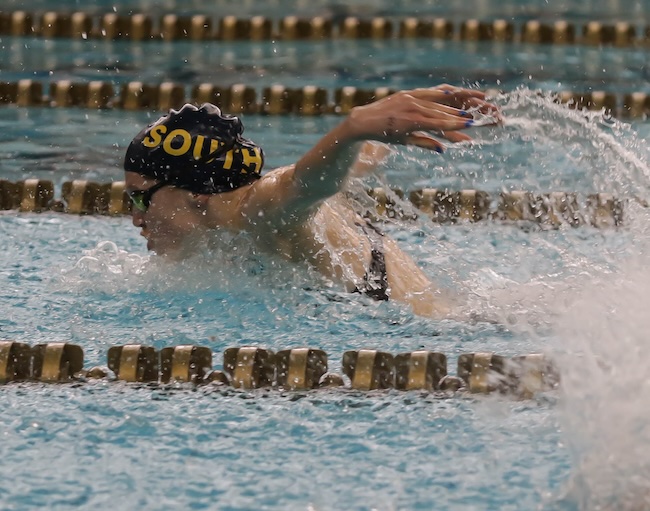
PHOTOS (Top) East Grand Rapids’ Ellery Chandler swims the breaststroke during Friday’s preliminaries at Oakland University. (Middle) Dearborn Divine Child’s Ella Dziobak swims the 500 prelim. (Below) Chelsea’s Anna McAllister dives during Friday evening’s first rounds. (Click for more from High School Sports Scene.)