


Add, Subtract, Divide, Multiply: MHSAA Not Alone
July 25, 2017
By Rob Kaminski
MHSAA benchmarks editor
This is the third part in a series on MHSAA tournament classification, past and present, that will be published over the next two weeks. This series originally ran in this spring's edition of MHSAA benchmarks.
As the MHSAA faces its most recent classification task with 8-Player Football, and opinions continue to swirl about as to the method, timeframe, location and other procedures, a look around the country provides plenty of company among state association brethren factoring variables into their own equations.
In the Pacific Northwest, the Oregon School Activities Association Football Playoffs are under public scrutiny as leadership ponders a five or six classification format beginning with the 2018-19 school year.
The OSAA has crowned six champions on the gridiron since 2006-07. Many of the state’s smaller schools would like to keep it that way, while larger schools lean toward a five-classification system, citing larger leagues, ease of travel and credibility to state championships as the advantages.
Still others would prefer more than six classes, pointing to safety issues and the opportunity to increase participation numbers as positives.
Moving southeast of Oregon, the Nevada Interscholastic Activities Association recently voted to hold serve on a classification proposal that was volleyed to the membership.
However, changes still could be forthcoming by as early as the 2018-19 season which would add a fifth classification in more populated southern Nevada while allowing northern schools to participate in four classifications. Such divisions could mean no state championship for the fifth class in southern Nevada.
Because of that, the NIAA wants equal numbers of schools in each classification on both ends of the state. Complicating the issue is the fact that the 24 largest schools in the state, by enrollment, are all in Clark County in Southern Nevada.
Across Nevada’s border into Arizona, charter schools are asking the Arizona Interscholastic Association to reconsider classification that was voted upon and approved in September 2015. That agreement called for the largest 33 percent of charter schools by enrollment to be placed in the state’s largest school classification, 3A, the middle 33 percent into 2A, and the smallest 33 percent into 1A.
Less than two years later the charter schools have had a change of heart and have asked to be considered the same as other Arizona public schools and be placed appropriately by enrollment beginning with the 2018-19 school year.
The situation in Arizona further illustrates how the public/private debate that all state associations have faced throughout existence now has the added dynamic of rapidly growing charter schools in today’s educational system, along with virtual school enrollment.
In the nation’s heartland, Nebraska has retooled its football classifications by using enrollment of boys students only in its schools rather than total enrollment. The Nebraska School Activities Association football-playing schools will kick off the 2018 season using this alignment.
Nebraska has three classes of 11-player football, with the smallest class divided in two, Class C-1 and C-2. The state also will have 8-player football for boys enrollments under 47, and the NSAA will sponsor a new 6-player tournament in 2018 for schools with 27 or fewer boys.
“This is a good proposal because some schools have a sizable imbalance between the number of boys and girls, and there’s a large gap (in enrollment) between the largest and smallest schools in Classes A and B,” NSAA executive director Jim Tenopir said. “I think this addresses both of those concerns.”
Swimmers in Georgia, meanwhile, will feel like they are moving with the current, rather than upstream in 2017-18, as the Georgia High School Association recently doubled the number of team championship events from two to four.
Swim enthusiasts can also count on longer days at the finals, as the top 30 finishers from the prelims will advance to the finals instead of 20, and all championship events will have three heats versus two.
FHN Earns 3rd Finals Championship in 4 Seasons, Dow's King Crowned Again
By
Scott Hassinger
Special for MHSAA.com
October 19, 2024
KALAMAZOO – Another Lower Peninsula Division 2 boys tennis championship trophy will be added to the showcase at Grand Rapids Forest Hills Northern.
After finishing as Finals runners-up two of the last three seasons, Steve Olson's Huskies totaled 26 points to win Saturday at Kalamazoo College’s Stowe Stadium.
Forest Hills Northern narrowly edged co-runners-up Midland Dow and Birmingham Seaholm, which tied at 24 points followed by Byron Center and Grand Rapids Forest Hills Central in fourth place with 21 and Mattawan sixth with 12 points.
Olson, who took over last year as head coach replacing the legendary Dave Sukup, guided Forest Hills Northern to its first Finals title since 2020. The Huskies had finished runners-up in 2021 and 2022.
"Tennis is a big sport at our school. We put a lot of time into this sport ,and we take it very seriously,” Olson said. “Our goal every season is to win a state championship, but there are a lot of great teams out there that make that a tough thing to do. We knew the tournament was going to be a close one.”
Olson pointed to the success of the Huskies' doubles flights as critical. All four of made the semifinal round.
 "Our success in doubles was huge. Our No. 4 doubles team of Markus Bernard and Will Hernly were unseeded and played above that. I'm very proud of how they stepped up for us," Olson said.
Junior Sebastian Madlangbayan was the only Forest Hills Northern player to win his respective flight. Madlangbayan captured the crown at No. 2 singles with a 7-6 (7-1), 6-4 win over Dylan Hodgman from Mattawan.
"There were a lot of ups and downs. I was just focused on opening up the angles on the court against him (Hodgman),” Madlangbayan said. “I can control court position with my forehand and give myself the chance to volley at the net."
Olson praised Madlangbayan's performance.
"Sebastian came in as the top seed, and he had some tight moments but he really dominated this tournament. But the reality is that our whole team contributed. To have six flights reach the semifinals, get those first-round byes and win a lot of early-round matches were also big for us," Olsen said. "We are senior and freshman heavy, but we have a good nucleus returning to build upon in the future."
Midland Dow senior Austin King completed his season unbeaten at 38-0 after earning the No. 1 singles crown with his 6-4, 7-5 win over Portage Central sophomore Sam Schumacher. King breezed through his morning semifinal with a 6-1, 6-0 victory over Nolan Ackerman of Mattawan.
"I had already played (Schumacher) a couple times this year, so I knew he'd be one of my tougher opponents. I made sure I got a good warmup in before I got out there, but it turned out to be quite a battle. My ability to not give up was key. I was down twice today, once in each set, so I knew I could do this, especially after winning the title last year," said King, who despite receiving Division I full-ride scholarship offers from several schools, including Villanova, has decided to forgo playing at the next level to concentrate on his pre-medical studies at Michigan or Michigan State.
Schumacher complimented King on his performance.
"It just means a great deal to me to be able to share the court with a player like Austin. I have to give him a ton of credit. I really hung in there and played my best match of the season," Schumacher said.
North Farmington senior Jack Weingarden came into the tournament unseeded, but won the No. 3 singles flight on a 5-3 injury default by Mattawan's Connor Schultz in the first set. Weingarden had defeated Forest Hills northern freshman Vikram Krishnan in the semifinals 6-4, 6-3.
 "My consistency helped me get through the semifinals and finals. I was definitely playing my best tennis of the season this weekend," Weingarden said.
Seaholm fourth seed Alex Ting topped Dow's Siddarth Venkatesan 6-2, 6-3 to win at No. 4 singles.
"My semifinals match went almost three hours. I started cramping up in both my legs, but I persevered through it. My team and family supported me through the whole day, and that really helps my mindset," Ting said.
Forest Hills Central's Willem Knoester and his partner Austin Rowland knocked off Forest Hills Northern's tandem of Tanav Shenov and Matthew Chan in the No. 1 doubles finale 7-5, 3-6, 6-3. At No. 2 doubles, FHC's Hayden Tanner and Joseph Song defeated Byron Center's duo of Rylan Vandenberger and Casey Schans 6-1, 7-6 (9-7).
Seaholm's No. 3 tandem of Britton Leo and Aaryan Senthilvanan disposed of FHC’s No. 3 tandem of James Notarnicola and Sawyer Jordan in the finals 3-6, 7-5, 6-2. The No. 4 doubles crown was also claimed by Seaholm's tandem of Connor Champion and Andrew Wachowicz with a 7-5, 6-2 win over Forest Hills Northern's Benard and Hernly.
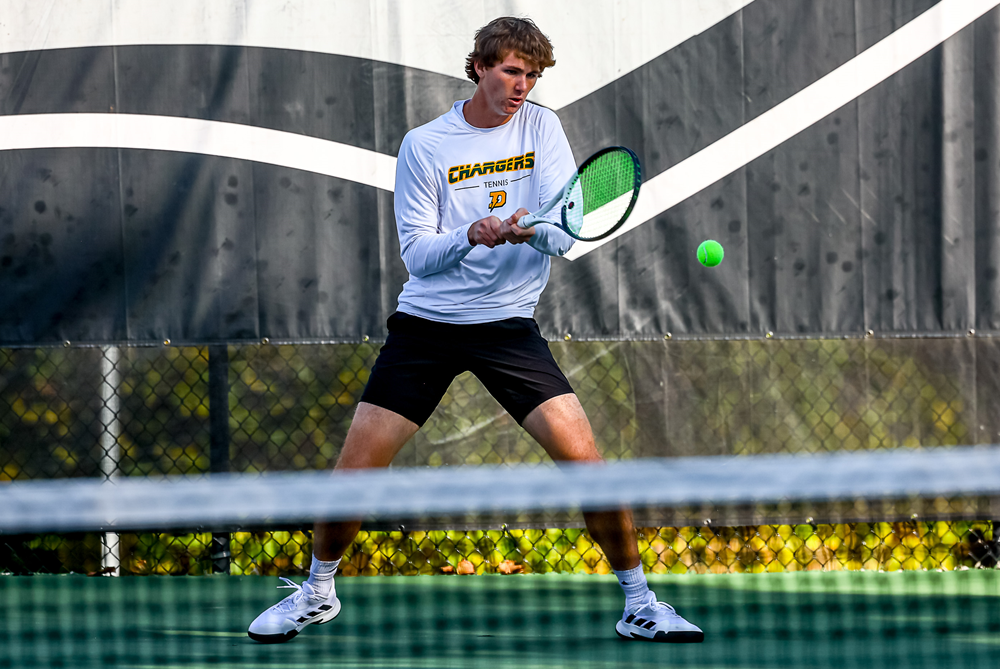
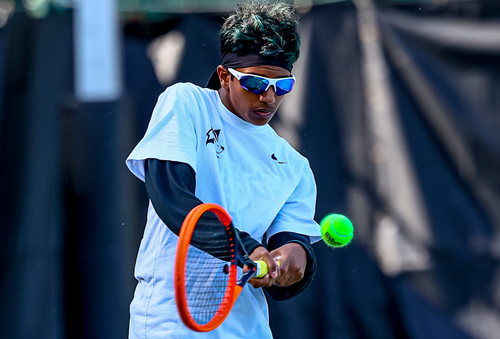
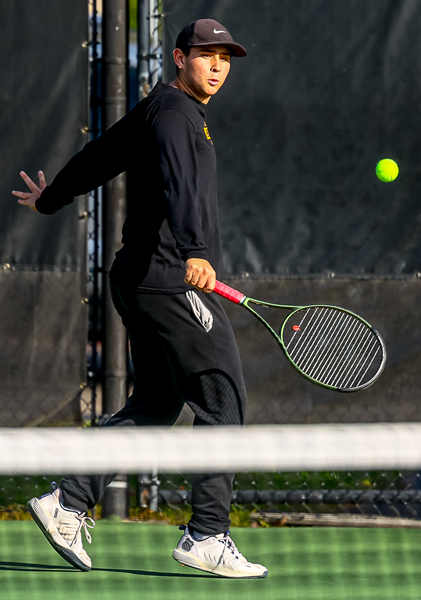
PHOTOS (Top) Midland Dow's Austin King hits a backhand during an early No. 1 singles match Friday at Kalamazoo College. (Middle) Forest Hills Northern's Vikram Krishnan sends a forehand at No. 3 singles. (Below) North Farmington's Jack Weingarden volleys during his first match at No. 3 singles. (Click for more from High School Sports Scene.)