

Add, Subtract, Divide, Multiply: MHSAA Not Alone
July 25, 2017
By Rob Kaminski
MHSAA benchmarks editor
This is the third part in a series on MHSAA tournament classification, past and present, that will be published over the next two weeks. This series originally ran in this spring's edition of MHSAA benchmarks.
As the MHSAA faces its most recent classification task with 8-Player Football, and opinions continue to swirl about as to the method, timeframe, location and other procedures, a look around the country provides plenty of company among state association brethren factoring variables into their own equations.
In the Pacific Northwest, the Oregon School Activities Association Football Playoffs are under public scrutiny as leadership ponders a five or six classification format beginning with the 2018-19 school year.
The OSAA has crowned six champions on the gridiron since 2006-07. Many of the state’s smaller schools would like to keep it that way, while larger schools lean toward a five-classification system, citing larger leagues, ease of travel and credibility to state championships as the advantages.
Still others would prefer more than six classes, pointing to safety issues and the opportunity to increase participation numbers as positives.
Moving southeast of Oregon, the Nevada Interscholastic Activities Association recently voted to hold serve on a classification proposal that was volleyed to the membership.
However, changes still could be forthcoming by as early as the 2018-19 season which would add a fifth classification in more populated southern Nevada while allowing northern schools to participate in four classifications. Such divisions could mean no state championship for the fifth class in southern Nevada.
Because of that, the NIAA wants equal numbers of schools in each classification on both ends of the state. Complicating the issue is the fact that the 24 largest schools in the state, by enrollment, are all in Clark County in Southern Nevada.
Across Nevada’s border into Arizona, charter schools are asking the Arizona Interscholastic Association to reconsider classification that was voted upon and approved in September 2015. That agreement called for the largest 33 percent of charter schools by enrollment to be placed in the state’s largest school classification, 3A, the middle 33 percent into 2A, and the smallest 33 percent into 1A.
Less than two years later the charter schools have had a change of heart and have asked to be considered the same as other Arizona public schools and be placed appropriately by enrollment beginning with the 2018-19 school year.
The situation in Arizona further illustrates how the public/private debate that all state associations have faced throughout existence now has the added dynamic of rapidly growing charter schools in today’s educational system, along with virtual school enrollment.
In the nation’s heartland, Nebraska has retooled its football classifications by using enrollment of boys students only in its schools rather than total enrollment. The Nebraska School Activities Association football-playing schools will kick off the 2018 season using this alignment.
Nebraska has three classes of 11-player football, with the smallest class divided in two, Class C-1 and C-2. The state also will have 8-player football for boys enrollments under 47, and the NSAA will sponsor a new 6-player tournament in 2018 for schools with 27 or fewer boys.
“This is a good proposal because some schools have a sizable imbalance between the number of boys and girls, and there’s a large gap (in enrollment) between the largest and smallest schools in Classes A and B,” NSAA executive director Jim Tenopir said. “I think this addresses both of those concerns.”
Swimmers in Georgia, meanwhile, will feel like they are moving with the current, rather than upstream in 2017-18, as the Georgia High School Association recently doubled the number of team championship events from two to four.
Swim enthusiasts can also count on longer days at the finals, as the top 30 finishers from the prelims will advance to the finals instead of 20, and all championship events will have three heats versus two.
Learning as They Play, Algonac Boys Soccer Back on Pitch for 1st Time since 2016
By
Paul Costanzo
Special for MHSAA.com
September 18, 2024
Zeke Stiltner knew what he was signing up for when he agreed to join the Algonac boys soccer team.
 As a senior, joining a program that hadn’t taken the field since 2016, he wasn’t expecting many – if any – wins. He wasn’t looking for a grand send-off. He was simply happy to be there at the beginning of something new.
“It’s such a unique experience,” said Stiltner, who played travel soccer in California prior to moving to Algonac as a freshman. “You don’t get the opportunity to build a brand-new team and build a bit of a legacy.”
Stiltner and his Algonac teammates are part of a restarted program that has been dormant for eight years. While the team has begun 0-7, just being on the field at all is a success. And growing the team to 17 active players, with just four seniors and no juniors, is more than they could have imagined.
“I don’t think there was any expectation of measuring success with wins and losses and the record,” Algonac coach Lance Whitney said. “We all knew the wins and losses was probably not going to be great. Really, we went into the beginning of the year teaching the kids how to play soccer and have fun.”
It was Algonac wrestling coach Brian Ranger who had originally brought the idea of reviving the soccer program to Whitney when the latter began teaching in the district in 2022. The two had gone to high school and wrestled together at Richmond, and Ranger – who serves as the team’s assistant coach – was looking for something for his wrestlers to do in the offseason, as Algonac was also reviving its football program at the time.
“Half the team is wrestling kids,” Whitney said. “He kind of used it as a way for his wrestlers to do something other than nothing if they weren’t playing football or running cross country. Some of them came out because they just wanted to do something, and a lot of them were recruited by Ranger.”
Whitney had coached at Richmond for a decade, his last season with the boys in 2022. He’s also a coach at Thundercats travel club, where his daughter and Ranger’s daughter had played.
That time included plenty of success and a good number of teams filled with experienced players.
Algonac started this season with three players who had played organized soccer.
“I think for me, you change your whole approach,” Whitney said. “You have to kind of balance that I’m only going to teach them so much technical stuff in two and a half months, but I have to, at some point, teach them, ‘Here’s the formation. Here are positions. Here are responsibilities.’ What I did in August is brought them all together for a week and said, ‘This is how you strike a ball. How you pass. How you play defense.’ All the technical stuff you can do.
“I’m not pretending this is the type of team where we’re going to be able to drop a ball at the goalie’s feet and play out of the back. But we do at least one technical skill (in practice), then I treat them like I do any other team I coach, even my highest-level girls team. We do Rondos, possession – try and let the game teach them how to play.”
But even for the few experienced players, that first week was more than enough. Simply being on the field playing was a breath of fresh air.
“I enjoyed it,” senior Griffin Degowske said. “That first practice, it was just fun to be out there. I was just glad we had a team.”
Goal-setting and expectations were also on a different level for the Muskrats. After losing their first two matches by goal-differential rule in the first half, the goal was to get to a second half. When that was accomplished, the goal was to complete a game without a mercy rule ending it.
They’ve accomplished that in both of their past two games, even scoring their first goal since 2016 in a 7-1 loss to Armada on Sept. 12.
The goal was scored by freshman Oliver Geck off a corner kick. While it made the score 5-1 midway through the second half, you couldn’t tell from the celebration.
“They celebrated like they won the game,” Whitney said. “It was really awesome, especially for the kid that scored. Oliver is a freshman, and he’s never really played before. He’s a pretty athletic kid, and the ball was bouncing around and he struck it. We were close (to scoring again) a couple times (Monday) night.”
While the team is still growing skill wise, Whitney is continually impressed with what they’re giving him from an effort standpoint. The team’s toughness and athleticism – no doubt buoyed by the influx of wrestlers – also has stood out.
“Teaching them is a lot different than teaching a (kids) team since they were 6(-years-old), and they’re 13 now,” Whitney said. “But they’re starting to put things together. A lot of the things they do, they can get to the right place, they can move, they can get to where they need to be positionally. It’s just the lack of technical skills right now that will mess up plays.”
Most important, at least for the future of the program, are the numbers. With 17 on the roster and 13 eligible to come back for not just 2025, but 2026, there’s a clear path forward for Muskrats soccer.
“It is amazing,” Whitney said. “It’s a step in the right direction for the school and the program, and all of those kids individually, too.”
 Paul Costanzo served as a sportswriter at The Port Huron Times Herald from 2006-15, including three years as lead sportswriter, and prior to that as sports editor at the Hillsdale Daily News from 2005-06. He can be reached at [email protected] with story ideas for Genesee, Lapeer, St. Clair, Sanilac, Huron, Tuscola, Saginaw, Bay, Arenac, Midland and Gladwin counties.
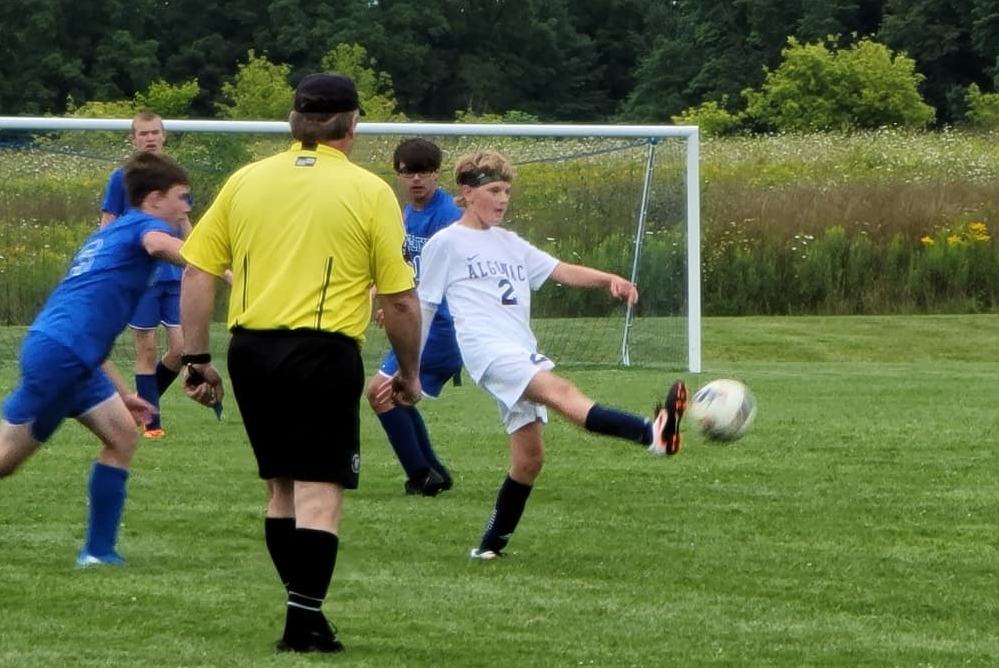
PHOTO Algonac’s Louis LaParl (2) clears the ball during a game against Croswell-Lexington. (Photo courtesy of the Algonac boys soccer program.)