


Add, Subtract, Divide, Multiply: MHSAA Not Alone
July 25, 2017
By Rob Kaminski
MHSAA benchmarks editor
This is the third part in a series on MHSAA tournament classification, past and present, that will be published over the next two weeks. This series originally ran in this spring's edition of MHSAA benchmarks.
As the MHSAA faces its most recent classification task with 8-Player Football, and opinions continue to swirl about as to the method, timeframe, location and other procedures, a look around the country provides plenty of company among state association brethren factoring variables into their own equations.
In the Pacific Northwest, the Oregon School Activities Association Football Playoffs are under public scrutiny as leadership ponders a five or six classification format beginning with the 2018-19 school year.
The OSAA has crowned six champions on the gridiron since 2006-07. Many of the state’s smaller schools would like to keep it that way, while larger schools lean toward a five-classification system, citing larger leagues, ease of travel and credibility to state championships as the advantages.
Still others would prefer more than six classes, pointing to safety issues and the opportunity to increase participation numbers as positives.
Moving southeast of Oregon, the Nevada Interscholastic Activities Association recently voted to hold serve on a classification proposal that was volleyed to the membership.
However, changes still could be forthcoming by as early as the 2018-19 season which would add a fifth classification in more populated southern Nevada while allowing northern schools to participate in four classifications. Such divisions could mean no state championship for the fifth class in southern Nevada.
Because of that, the NIAA wants equal numbers of schools in each classification on both ends of the state. Complicating the issue is the fact that the 24 largest schools in the state, by enrollment, are all in Clark County in Southern Nevada.
Across Nevada’s border into Arizona, charter schools are asking the Arizona Interscholastic Association to reconsider classification that was voted upon and approved in September 2015. That agreement called for the largest 33 percent of charter schools by enrollment to be placed in the state’s largest school classification, 3A, the middle 33 percent into 2A, and the smallest 33 percent into 1A.
Less than two years later the charter schools have had a change of heart and have asked to be considered the same as other Arizona public schools and be placed appropriately by enrollment beginning with the 2018-19 school year.
The situation in Arizona further illustrates how the public/private debate that all state associations have faced throughout existence now has the added dynamic of rapidly growing charter schools in today’s educational system, along with virtual school enrollment.
In the nation’s heartland, Nebraska has retooled its football classifications by using enrollment of boys students only in its schools rather than total enrollment. The Nebraska School Activities Association football-playing schools will kick off the 2018 season using this alignment.
Nebraska has three classes of 11-player football, with the smallest class divided in two, Class C-1 and C-2. The state also will have 8-player football for boys enrollments under 47, and the NSAA will sponsor a new 6-player tournament in 2018 for schools with 27 or fewer boys.
“This is a good proposal because some schools have a sizable imbalance between the number of boys and girls, and there’s a large gap (in enrollment) between the largest and smallest schools in Classes A and B,” NSAA executive director Jim Tenopir said. “I think this addresses both of those concerns.”
Swimmers in Georgia, meanwhile, will feel like they are moving with the current, rather than upstream in 2017-18, as the Georgia High School Association recently doubled the number of team championship events from two to four.
Swim enthusiasts can also count on longer days at the finals, as the top 30 finishers from the prelims will advance to the finals instead of 20, and all championship events will have three heats versus two.
Goodrich Enjoying Every Moment of Pursuing 1st Finals Title since 2005
By
Paul Costanzo
Special for MHSAA.com
August 23, 2024
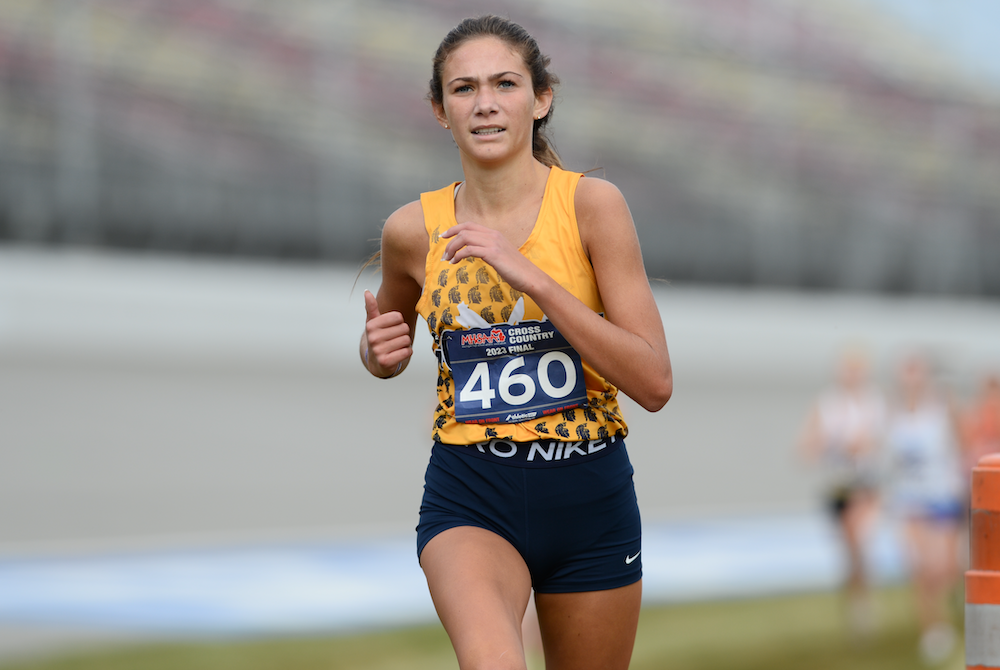
Kamryn Lauinger and her Goodrich girls cross country teammates have a very big but attainable goal heading into the season: Stand atop the podium as Division 2 Finals champions at Michigan International Speedway on Nov. 2.
 The Martians were third a year ago, return their entire top seven, and added a top-flight freshman to that already stacked lineup.
But you won’t catch Lauinger and the Martians looking ahead; they’re too busy enjoying every moment together along the way.
“I don’t want the season to go by fast,” said Lauinger, who placed 10th at the 2023 Finals. “It’s my last year, and we’re all kind of taking it all in, working hard together and preparing for what we can accomplish.”
Goodrich entered the season as the top-ranked team in Lower Peninsula Division 2, and with one meet under its belt has lived up to that ranking. The Martians won the Unionville-Sebewaing Invitational on Aug. 19 with a perfect score (15) – 1. Lauinger; 2. Jordan; 3. Sophomore Alivia Ottinger; 4. Sophomore Claire Brown; 5. Senior Avery Byrne.
Their sixth (freshman Kayla Shellenbarger) and seventh (sophomore Baylor Lauinger) runners finished sixth and seventh.
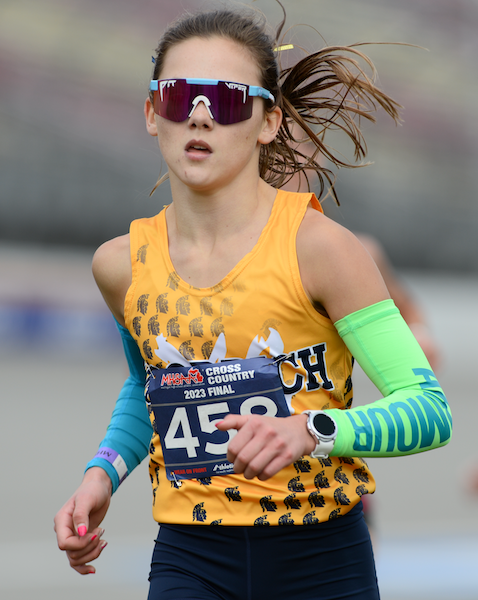 “It’s definitely exciting – I think we’re going to have a really great season,” said senior Layla Jordan, the reigning LP Division 2 Track & Field 800-meter champion. “Also, at the same time, we’re taking the same approach. We’re not changing anything we do. We’re excited, but we’re trying not to get too excited to the point where we look ahead. It’s really great to know that we have such great depth. Everybody is working for the same goal, and we all can just rely on one another.”
They’re also relying on their self-described “computer geek” of a coach, Al Warden, who has built a season-long plan he said is backed by science and computer programs – along with his own knowledge.
“I tell the kids all the time, this is not about going out there and being faster than everybody else,” Warden said. “You have to be smarter than everybody else. It’s science-based. Every single practice is science-based.”
Warden creates his training calendar by starting at Nov. 2 and building backward. That includes more than just workouts, as one of the items on next week’s agenda is buying new shoes.
“The more determined runners, they’re at that 400-mile mark,” he said. “They need new shoes, because they wore them out. That’s right in my schedule so I don’t have to remember to remember it.”
Warden’s plans are clearly getting results, and his runners have bought in completely.
“It definitely helps, because we know he cares,” Lauinger said. “I do like knowing all of his science – he does a lot of research. I like it. I like how he does it.”
While Warden is focused on the science of training, he hasn’t forgotten that it also needs to be fun if he’s going to get the most out of his runners.
So, mixed in with the temple runs and 10-mile days around Top Hill Farm are donut runs, slushie runs, pizza parties and swimming parties. There’s also a “no runner left behind” policy that ensures the top runners turn back and finish with the next group, reinforcing a culture of togetherness.
 “I think it’s just that we all enjoy it,” Jordan said. “You have to love what you do, and we all love running. It’s really cool to be great at something, but it’s not as fun to be great alone. We all want to be great.”
If the Martians were to finish off the season with a Finals title, it would be the first since they won three straight from 2003-05.
As Warden said, “it’s time for Goodrich to win it again.”
His runners agreed.
“It would mean to me that I got to do something that’s going to be long-lasting,” Kamryn Lauinger said. “To have the little runners at Goodrich looking up to us. Just to have something long-lasting and people knowing that I came in here and did what I needed to do and left a mark.”
A Finals title would also allow the Martians to partake in one of their favorite traditions – treating a championship trophy like the Stanley Cup, and allowing a team member to take it home with them.
Who gets each trophy is normally a pretty easy decision, Jordan said, as they’re often on the same page about who deserves it on a given day.
There would be absolutely no debate if they win the big one: Warden.
“He’s the reason that we’re up there anyway,” Jordan said. “We couldn’t have done it without him.”
 Paul Costanzo served as a sportswriter at The Port Huron Times Herald from 2006-15, including three years as lead sportswriter, and prior to that as sports editor at the Hillsdale Daily News from 2005-06. He can be reached at [email protected] with story ideas for Genesee, Lapeer, St. Clair, Sanilac, Huron, Tuscola, Saginaw, Bay, Arenac, Midland and Gladwin counties.
PHOTOS (Top) Goodrich’s Kamryn Lauinger pushes through the final stretch to finish 10th at last year’s LPD2 championship race at MIS. (Middle) Layla Jordan races for the finish line in placing 27th last season. (Below) The Martians’ Baylor Lauinger and Zeeland East’s Meredith Cook charge toward the finish. (Click for more from RunMichigan.com.)