

Add, Subtract, Divide, Multiply: MHSAA Not Alone
July 25, 2017
By Rob Kaminski
MHSAA benchmarks editor
This is the third part in a series on MHSAA tournament classification, past and present, that will be published over the next two weeks. This series originally ran in this spring's edition of MHSAA benchmarks.
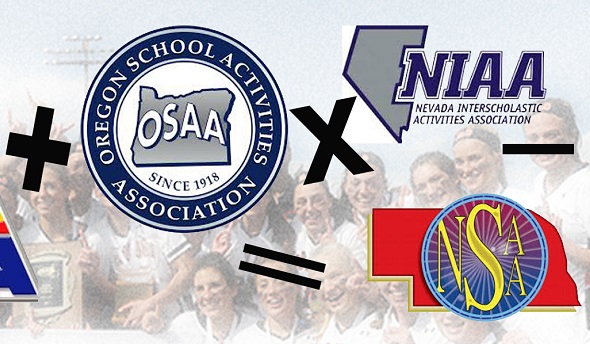
As the MHSAA faces its most recent classification task with 8-Player Football, and opinions continue to swirl about as to the method, timeframe, location and other procedures, a look around the country provides plenty of company among state association brethren factoring variables into their own equations.
In the Pacific Northwest, the Oregon School Activities Association Football Playoffs are under public scrutiny as leadership ponders a five or six classification format beginning with the 2018-19 school year.
The OSAA has crowned six champions on the gridiron since 2006-07. Many of the state’s smaller schools would like to keep it that way, while larger schools lean toward a five-classification system, citing larger leagues, ease of travel and credibility to state championships as the advantages.
Still others would prefer more than six classes, pointing to safety issues and the opportunity to increase participation numbers as positives.
Moving southeast of Oregon, the Nevada Interscholastic Activities Association recently voted to hold serve on a classification proposal that was volleyed to the membership.
However, changes still could be forthcoming by as early as the 2018-19 season which would add a fifth classification in more populated southern Nevada while allowing northern schools to participate in four classifications. Such divisions could mean no state championship for the fifth class in southern Nevada.
Because of that, the NIAA wants equal numbers of schools in each classification on both ends of the state. Complicating the issue is the fact that the 24 largest schools in the state, by enrollment, are all in Clark County in Southern Nevada.
Across Nevada’s border into Arizona, charter schools are asking the Arizona Interscholastic Association to reconsider classification that was voted upon and approved in September 2015. That agreement called for the largest 33 percent of charter schools by enrollment to be placed in the state’s largest school classification, 3A, the middle 33 percent into 2A, and the smallest 33 percent into 1A.
Less than two years later the charter schools have had a change of heart and have asked to be considered the same as other Arizona public schools and be placed appropriately by enrollment beginning with the 2018-19 school year.
The situation in Arizona further illustrates how the public/private debate that all state associations have faced throughout existence now has the added dynamic of rapidly growing charter schools in today’s educational system, along with virtual school enrollment.
In the nation’s heartland, Nebraska has retooled its football classifications by using enrollment of boys students only in its schools rather than total enrollment. The Nebraska School Activities Association football-playing schools will kick off the 2018 season using this alignment.
Nebraska has three classes of 11-player football, with the smallest class divided in two, Class C-1 and C-2. The state also will have 8-player football for boys enrollments under 47, and the NSAA will sponsor a new 6-player tournament in 2018 for schools with 27 or fewer boys.
“This is a good proposal because some schools have a sizable imbalance between the number of boys and girls, and there’s a large gap (in enrollment) between the largest and smallest schools in Classes A and B,” NSAA executive director Jim Tenopir said. “I think this addresses both of those concerns.”
Swimmers in Georgia, meanwhile, will feel like they are moving with the current, rather than upstream in 2017-18, as the Georgia High School Association recently doubled the number of team championship events from two to four.
Swim enthusiasts can also count on longer days at the finals, as the top 30 finishers from the prelims will advance to the finals instead of 20, and all championship events will have three heats versus two.
Can A Sports Physical Replace A Wellness Exam?
August 6, 2024
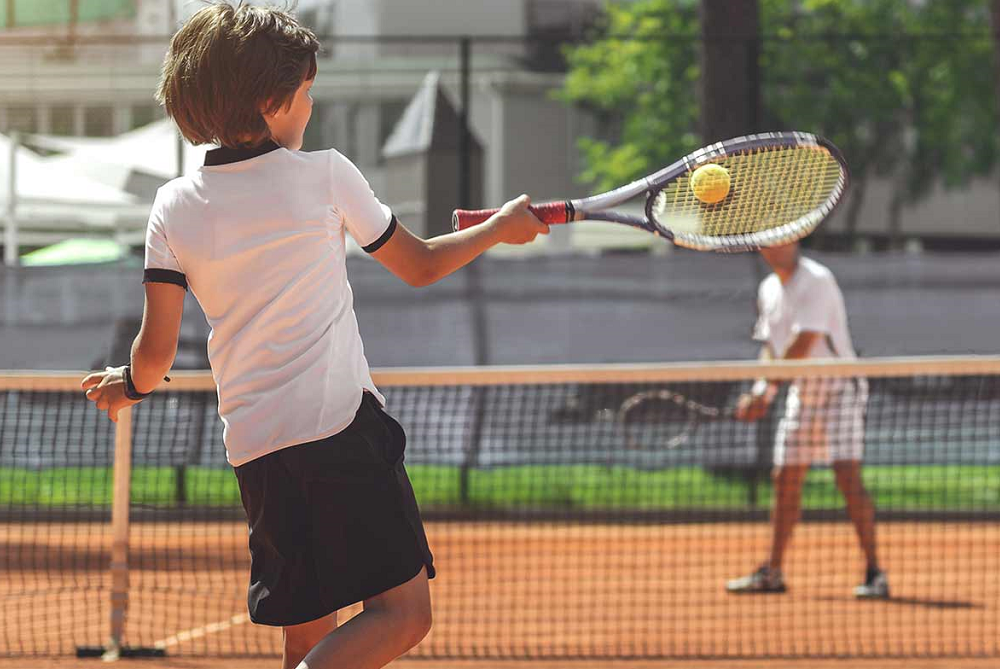
Before your child can take the field or hit the courts, their doctor must give the all-clear for them to play.
 Since the sports physical is a pre-requisite to organized activity, you may be tempted to skip your child’s annual well-visit. After all, do you really need to go to the doctor’s office twice if they’re healthy enough to play sports?
Of course, the answer is yes! Each type of visit to your pediatrician serves a different purpose, and one cannot replace the other.
Shoshana Gordon, D.O., a pediatrician for Henry Ford Health, explains the differences between the sports physical and regular wellness examination.
What Happens at a Wellness Exam
An annual wellness exam is a comprehensive visit that allows your child’s pediatrician to monitor all aspects of your child’s development. These appointments can vary quite a bit, depending on your child’s age.
“Your child grows so much early in life that we need to see them several times before their first birthday,” says Dr. Gordon. “As they get older, the conversations at these appointments evolve and expand to include topics like mental health and what to expect from puberty.”
Generally, many aspects of your child’s wellness exam will stay the same over time. Regardless of age, this appointment will include:
- Checking vitals (heart rate, blood pressure)
- A physical exam (to monitor physical growth)
- Discussing developmental milestones
- Developmental and emotional/behavioral screenings
- Conversations about nutrition and any physical activities your child is involved in
- Conversations about how your child is getting on at school
- An opportunity to discuss questions or concerns you or your child may have
One crucial part of the wellness exam is immunization. This appointment is the best time for you to talk with your child’s pediatrician to make sure that your child is up to date on necessary vaccines.
Additionally, wellness exams are the best way for you and your child to develop a relationship with their pediatrician. When you only take your child to the doctor when they are sick, it is harder for your pediatrician to set a baseline for their health.
“Regular wellness visits allow you and your child to get comfortable with asking your doctor questions,” says Dr. Gordon. “Once we develop a good patient-provider relationship, your child’s pediatrician will have an easier time recognizing when your child isn’t feeling like themselves and can better offer alternate approaches to care that best suit your child’s unique needs."
What Happens at a Sports Physical
Sports physicals are used to determine if your child is healthy enough to participate in organized sports. During this appointment, your child’s doctor will screen them for different sports-specific health concerns. They will be evaluating several things including:
- Heart function
- Lung function
- Mobility
- Reflexes
- Endurance
“During a sports physical, we’ll look at both your child’s and your family’s health history to make sure there aren’t any indicators that could impact your child’s ability to play,” says Dr. Gordon. “For example, if your child had COVID or if you have a family history of cardiovascular complications, additional tests may be necessary to make sure this isn’t affecting your child’s health.”
The biggest difference from a wellness exam? Sports physicals don’t include developmental screeners that are essential to your child’s growth.
“At the end of the day, a sports physical cannot take the place of your child’s annual wellness exam,” says Dr. Gordon. “However, when you go for your child’s wellness exam, talk to your child’s pediatrician about including a sports physical as part of the appointment.”
In addition to the developmental, social and emotional evaluations that take place at your child’s annual wellness exam, this is the best time for you and your child to get to know your pediatrician. Establishing yourself with your child’s doctor will make it easier to treat and care for your child as they continue to grow.
To find a sports medicine provider at Henry Ford Health, visit henryford.com/athletes or call 313-651-1969.
Dr. Shoshana Gordon is a pediatrician who sees patients at Henry Ford Medical Center-Royal Oak and Henry Ford Medical Center-Sterling Heights.