

Add, Subtract, Divide, Multiply: MHSAA Not Alone
July 25, 2017
By Rob Kaminski
MHSAA benchmarks editor
This is the third part in a series on MHSAA tournament classification, past and present, that will be published over the next two weeks. This series originally ran in this spring's edition of MHSAA benchmarks.
As the MHSAA faces its most recent classification task with 8-Player Football, and opinions continue to swirl about as to the method, timeframe, location and other procedures, a look around the country provides plenty of company among state association brethren factoring variables into their own equations.
In the Pacific Northwest, the Oregon School Activities Association Football Playoffs are under public scrutiny as leadership ponders a five or six classification format beginning with the 2018-19 school year.
The OSAA has crowned six champions on the gridiron since 2006-07. Many of the state’s smaller schools would like to keep it that way, while larger schools lean toward a five-classification system, citing larger leagues, ease of travel and credibility to state championships as the advantages.
Still others would prefer more than six classes, pointing to safety issues and the opportunity to increase participation numbers as positives.
Moving southeast of Oregon, the Nevada Interscholastic Activities Association recently voted to hold serve on a classification proposal that was volleyed to the membership.
However, changes still could be forthcoming by as early as the 2018-19 season which would add a fifth classification in more populated southern Nevada while allowing northern schools to participate in four classifications. Such divisions could mean no state championship for the fifth class in southern Nevada.
Because of that, the NIAA wants equal numbers of schools in each classification on both ends of the state. Complicating the issue is the fact that the 24 largest schools in the state, by enrollment, are all in Clark County in Southern Nevada.
Across Nevada’s border into Arizona, charter schools are asking the Arizona Interscholastic Association to reconsider classification that was voted upon and approved in September 2015. That agreement called for the largest 33 percent of charter schools by enrollment to be placed in the state’s largest school classification, 3A, the middle 33 percent into 2A, and the smallest 33 percent into 1A.
Less than two years later the charter schools have had a change of heart and have asked to be considered the same as other Arizona public schools and be placed appropriately by enrollment beginning with the 2018-19 school year.
The situation in Arizona further illustrates how the public/private debate that all state associations have faced throughout existence now has the added dynamic of rapidly growing charter schools in today’s educational system, along with virtual school enrollment.
In the nation’s heartland, Nebraska has retooled its football classifications by using enrollment of boys students only in its schools rather than total enrollment. The Nebraska School Activities Association football-playing schools will kick off the 2018 season using this alignment.
Nebraska has three classes of 11-player football, with the smallest class divided in two, Class C-1 and C-2. The state also will have 8-player football for boys enrollments under 47, and the NSAA will sponsor a new 6-player tournament in 2018 for schools with 27 or fewer boys.
“This is a good proposal because some schools have a sizable imbalance between the number of boys and girls, and there’s a large gap (in enrollment) between the largest and smallest schools in Classes A and B,” NSAA executive director Jim Tenopir said. “I think this addresses both of those concerns.”
Swimmers in Georgia, meanwhile, will feel like they are moving with the current, rather than upstream in 2017-18, as the Georgia High School Association recently doubled the number of team championship events from two to four.
Swim enthusiasts can also count on longer days at the finals, as the top 30 finishers from the prelims will advance to the finals instead of 20, and all championship events will have three heats versus two.
Lessons from Multi-Sport Experience Guide Person in Leading New Team
By
Pam Shebest
Special for MHSAA.com
August 1, 2024
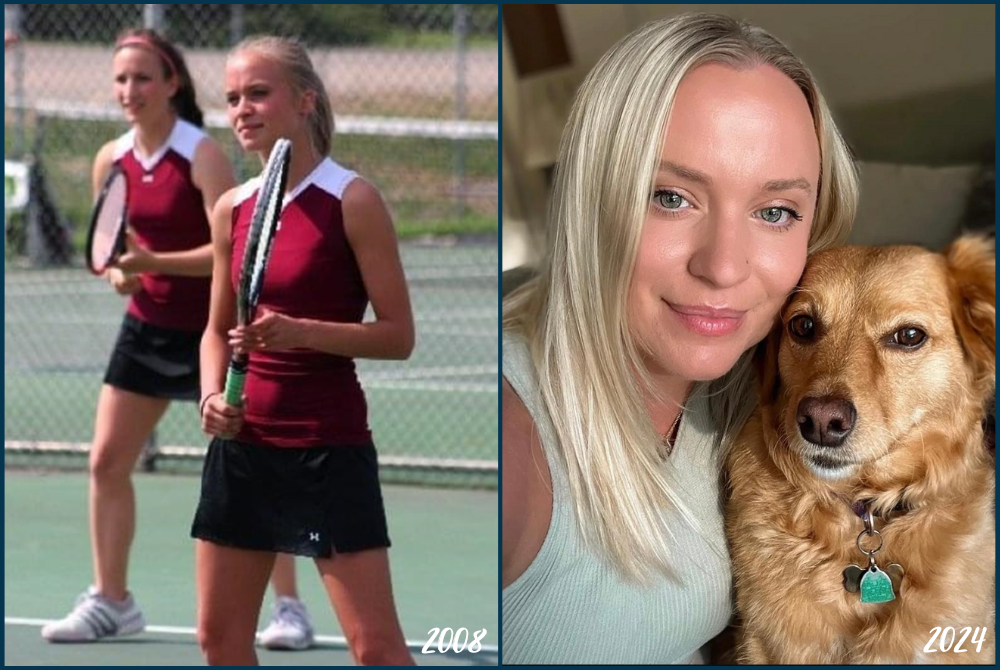
PARCHMENT — When Amanda Person was in sixth grade, her family hosted an international student from Japan.
 Until then, soccer was the main sport for her family – but that soon changed.
“Naoki wanted to play tennis,” Person said. “He started playing and then my sister (Marissa) started playing, and then I started playing.”
That passion for both sports only increased during her four years at Parchment High School.
“Soccer was really fun, but when I look back on my high school career, tennis was the most prominent thing I remember,” the 2008 grad said. “I think it’s because I played year-round: our regular tennis season and then our summer tennis program and winter tennis program.”
Although it has been 16 years since her glory days at Parchment ended, Person has no trouble recalling the best parts of her Panthers sports career.
In fact, coming up with memories from those days is no problem — she has a folder full of photos called “I Miss Team Sports” on her Facebook page.
Playing intramural soccer at Michigan State University, she graduated with a degree in social work, then stayed in the Big Ten. She is the campus tours and ambassador coordinator at Purdue University in West Lafayette, Ind., where she supervises 80 to 100 student tour guides who provide information for families considering the school.
Her ties to the Spartans sometime makes for interesting conversations with her colleagues.
“They give me a hard time,” she said with a quick laugh. “I say Michigan State will always be my No. 1. That’s my alma mater I spent four years of time, tears and money at Michigan State. But I really love Purdue, so I’ll root for the Boilermakers second.”
She is also working on her master’s degree in higher education at Purdue.
Her office in the welcome center shares space with the alumni association, leading to an unforgettable experience.
During a lunch break, she went home to let out her dog, Tessa. When she returned, a trophy and a bucket were sitting on her desk.
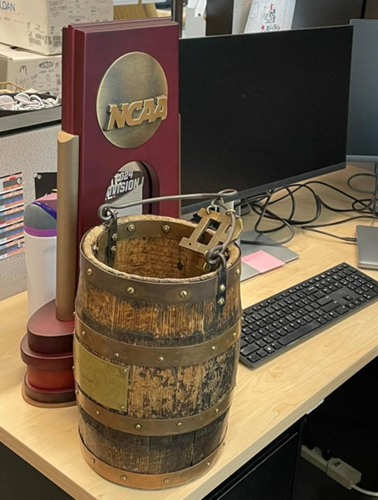 Confused, she asked what they were doing there.
“The tour guides I was working with said (during an event) they had to put them somewhere before putting them out (to the public), so they just put them on my desk,” she said.
Turns out, one trophy was the NCAA Final Four runner-up men’s basketball trophy the Boilermakers took home last year after losing to Connecticut in the championship game.
The other was the Old Oaken Bucket, the trophy that goes to the winner between Purdue and Indiana University’s annual football grudge match.
“I didn’t know anything about the Old Oaken Bucket,” she said. “They were like, what do you mean ‘what is this?’ Then they told me the story behind it.”
Creating core memories
Recalling her years at Parchment, Person becomes animated, smiling and laughing at all the memories.
“The first thing I remember is that my sister was really, really good at soccer,” she said. "I was always trying to keep up with her a bit.”
Her dad, Dave Person, noted that “all of our kids (Adam, Marissa, Amanda) had some success in sports during high school while realizing that it was secondary to their education.
“My only input was that I insisted they treat officials, coaches and opponents with respect, which they did. I always thought that while Marissa did very well in tennis, she was a natural at soccer. Amanda, on the other hand, was very good at soccer, but was a natural at tennis.”
Amanda said her soccer memories come down to “we might not have won a lot, but it was still a lot of fun.”
She said while several on the team, including herself, had years of soccer experience, players also welcomed those who wanted to try the sport for the first time.
“Our team had a home for those people, too,” she said. “The games were always fun, but I feel like a lot of being on a team like that is the outside things you do together: the team dinners, the traveling on the bus, even practices.”
Her freshman year, the team advanced to the MHSAA Lower Peninsula Division 4 Girls Tennis Finals, finishing 19th.
Her senior year was a transition when several sports seasons were switched, putting girls soccer and tennis at the same time during the spring.
 Person and the other three two-sport seniors juggled both.
“All of a sudden we were playing soccer and tennis in the spring,” she said. “Thankfully they let us do both, and our coaches were very good in terms (of) making sure nothing important overlapped.”
Person played doubles all four years and was at No. 1 with Kelly Drummond her final two seasons.
“If my memory serves me correctly, I believe we only lost two matches the whole (senior) year, so it was a good year for us,” she said.
It was a very good year.
She and Drummond won their Regional Final, but that ended her prep career since the team did not qualify for championship weekend.
Preparing for life
The best thing about high school tennis, she said, was that it was a combination team and individual sport.
“You can do really well individually and maybe the team doesn’t do well, or maybe the team does well and you don’t do well personally,” she said. “It has the aspect of wanting the entire team to do good.”
Competing in both sports prepared her for the “real” world, she said.
“Playing soccer and tennis and being part of a team helped me cheer other people on,” she said. “The world is a competitive place, so having that foundation of team sports is really good to teach a plethora of things you can use in the real world.
“Even at work, you have your individual job but you’re also part of a team. If one person isn’t doing well, then your whole team isn’t doing well. If someone else is having a hard time, helping them out is helping the team.”
She added that losing also teaches important lessons.
“You’re going to lose at things your entire life,” she said. “Being able to handle losing, handle rejection, is a good skill to have for anything in life. I’ve learned it’s not what happens to you but how you respond to it. That’s a huge lesson. There are a lot of life lessons you can get from playing team sports in high school.”
Her advice to high school athletes today: “Enjoy it, first of all. Don’t take it too seriously in wins and losses.
“When I look back, most of my core memories are being part of a team, having fun with the team, having fun playing the sport. Enjoy your time,” she said.
“Now I miss it.”
2024 Made In Michigan
July 30: After Successful 'Sequel,' Suttons Bay's Hursey Embarking on Next Chapter - Read
July 24: East Kentwood Run Part of Memorable Start on Knuble's Way to NHL, Olympics - Read
July 22: Monroe High Memories Remain Rich for Michigan's 1987 Mr. Baseball - Read
July 17: Record-Setting Viney Gained Lifelong Confidence at Marine City - Read
July 11: High School 'Hoop Squad' Close to Heart as Hughes Continues Coaching Climb - Read
July 10: Nightingale Embarking on 1st Season as College Football Head Coach - Read
June 28: E-TC's Witt Bulldozing Path from Small Town to Football's Biggest Stage - Read
PHOTOS (Top) At left, Parchment’s Amanda Person plays a 2008 tennis match with doubles partner Kelly Drummond; at right, Person and her dog Tessa. (Middle) A pair of beloved trophies sit temporarily on Person’s desk at Purdue. (Below) Person also was a soccer standout at Parchment. (Photos courtesy of Amanda Person.)