

Add, Subtract, Divide, Multiply: MHSAA Not Alone
July 25, 2017
By Rob Kaminski
MHSAA benchmarks editor
This is the third part in a series on MHSAA tournament classification, past and present, that will be published over the next two weeks. This series originally ran in this spring's edition of MHSAA benchmarks.
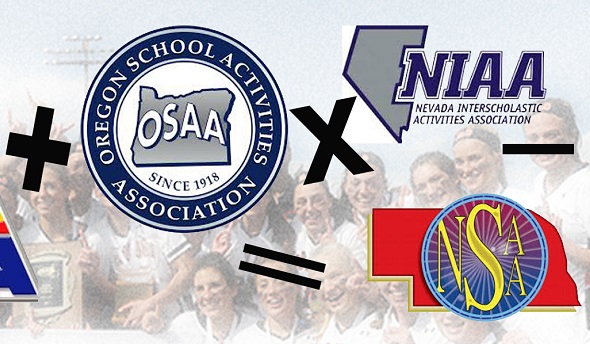
As the MHSAA faces its most recent classification task with 8-Player Football, and opinions continue to swirl about as to the method, timeframe, location and other procedures, a look around the country provides plenty of company among state association brethren factoring variables into their own equations.
In the Pacific Northwest, the Oregon School Activities Association Football Playoffs are under public scrutiny as leadership ponders a five or six classification format beginning with the 2018-19 school year.
The OSAA has crowned six champions on the gridiron since 2006-07. Many of the state’s smaller schools would like to keep it that way, while larger schools lean toward a five-classification system, citing larger leagues, ease of travel and credibility to state championships as the advantages.
Still others would prefer more than six classes, pointing to safety issues and the opportunity to increase participation numbers as positives.
Moving southeast of Oregon, the Nevada Interscholastic Activities Association recently voted to hold serve on a classification proposal that was volleyed to the membership.
However, changes still could be forthcoming by as early as the 2018-19 season which would add a fifth classification in more populated southern Nevada while allowing northern schools to participate in four classifications. Such divisions could mean no state championship for the fifth class in southern Nevada.
Because of that, the NIAA wants equal numbers of schools in each classification on both ends of the state. Complicating the issue is the fact that the 24 largest schools in the state, by enrollment, are all in Clark County in Southern Nevada.
Across Nevada’s border into Arizona, charter schools are asking the Arizona Interscholastic Association to reconsider classification that was voted upon and approved in September 2015. That agreement called for the largest 33 percent of charter schools by enrollment to be placed in the state’s largest school classification, 3A, the middle 33 percent into 2A, and the smallest 33 percent into 1A.
Less than two years later the charter schools have had a change of heart and have asked to be considered the same as other Arizona public schools and be placed appropriately by enrollment beginning with the 2018-19 school year.
The situation in Arizona further illustrates how the public/private debate that all state associations have faced throughout existence now has the added dynamic of rapidly growing charter schools in today’s educational system, along with virtual school enrollment.
In the nation’s heartland, Nebraska has retooled its football classifications by using enrollment of boys students only in its schools rather than total enrollment. The Nebraska School Activities Association football-playing schools will kick off the 2018 season using this alignment.
Nebraska has three classes of 11-player football, with the smallest class divided in two, Class C-1 and C-2. The state also will have 8-player football for boys enrollments under 47, and the NSAA will sponsor a new 6-player tournament in 2018 for schools with 27 or fewer boys.
“This is a good proposal because some schools have a sizable imbalance between the number of boys and girls, and there’s a large gap (in enrollment) between the largest and smallest schools in Classes A and B,” NSAA executive director Jim Tenopir said. “I think this addresses both of those concerns.”
Swimmers in Georgia, meanwhile, will feel like they are moving with the current, rather than upstream in 2017-18, as the Georgia High School Association recently doubled the number of team championship events from two to four.
Swim enthusiasts can also count on longer days at the finals, as the top 30 finishers from the prelims will advance to the finals instead of 20, and all championship events will have three heats versus two.
Country Day Two-Time Champ Moore Building Perennial Winner at Harvard
By
Keith Dunlap
Special for MHSAA.com
July 16, 2026
Carrie Moore says her high school sports experience in Michigan has “left a lifetime impression on me.”
 Back in the early 2000s, Moore certainly had a fulfilling one while starring as a two-sport standout at Detroit Country Day.
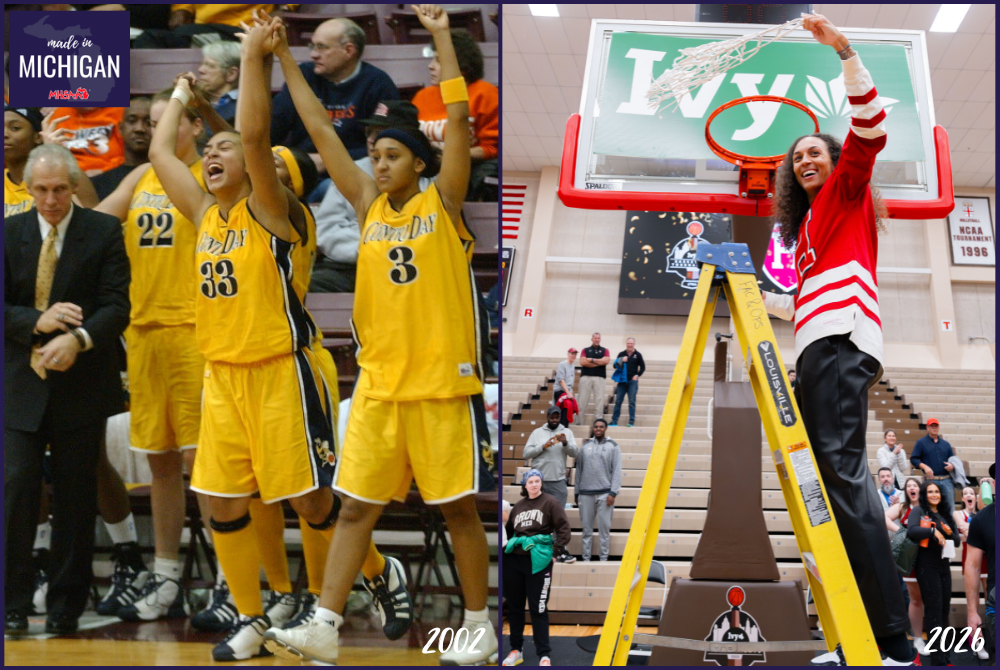
In basketball, she was a four-year varsity performer for legendary head coach Frank Orlando, helping guide Country Day to Class B titles in 1999 as a freshman and 2002 as a senior. During the latter, she was a first-team all-state performer and scored a team-high 18 points in a Semifinal win over Flint Powers Catholic.
Moore also was a standout soccer player on that Country Day varsity powerhouse for three years.
“Who I am as a leader, as a competitor, and a team player is because of what I learned about the process in high school as a student-athlete,” Moore said. “The pursuit of excellence isn’t always easy, but I learned at such a young age that I can do hard things. I was challenged because I was surrounded by the best on the court and in the classroom, but ultimately it brought out the best version of myself and I was so prepared for what came next after graduation.”
Make no mistake about it, Moore has continued to do great things since graduating from Country Day in 2003.
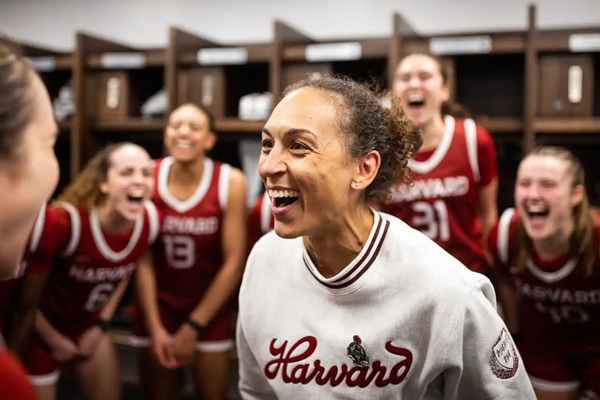
She is currently the head women’s basketball coach at Harvard, where she just completed her fourth season and has amassed an 80-41 record with the Crimson. This past season, she helped guide her team to a 20-12 record and the Women’s Basketball Invitational Tournament.
Moore was a terrific college player at Western Michigan, finishing as the school’s all-time scoring leader with 2,216 points and earning Mid-American Conference Player of the Year in 2007 after averaging 25.4 points per game. But she initially wasn’t planning on being a coach once her time at Western was over.
After playing one season professionally in Poland and then being cut twice by WNBA teams during training camp, Moore had an opportunity to join the coaching staff at Princeton in 2010.
From there, the coaching bug bit her, so to speak.
“Being a part of that program allowed me to see the lasting impact I could have on young women in growing them as people and players, and ultimately, give back to the game that gave me so much,” Moore said.
Moore was on the staff for two seasons at Princeton, and then moved on to Creighton, where she spent five years as an assistant coach.
Following a second stint as an assistant coach at Princeton that lasted four years, Moore moved on to North Carolina, where she spent two years as an assistant coach and recruiting coordinator for the program.
 A native of Lathrup Village, Moore then briefly returned to her home state for the 2021-22 season, serving as an assistant coach and recruiting coordinator for University of Michigan’s team that went 25-7.
After that season, the opportunity at Harvard came about, and Moore has proved she can be successful running a program as well.
In her first season, Moore set a program record for most wins by a first-year head coach (20). Two years later, she guided the Crimson to its first Ivy League Tournament title and back to the NCAA Tournament for the first time in 18 years.
Even to this day, Moore is influenced by her time at Country Day and in Michigan. She speaks regularly to Orlando, picking his brain for advice or an answer to any other question that might come up.
“I keep in touch with Coach O as often as I can,” Moore said. “He reaches out after big wins or tough losses and always reassures his belief in me as a leader of young women. His mantra ‘Believe It’ is living on within our program at Harvard, and I hope he feels deeply connected to it because of it. I will always honor him in any way that I can, as he has shaped me greatly as a human and coach.”
Moore hasn’t had a player from her home state on her Harvard roster. But she said Michigan is an important recruiting area, and she’s keeping an eye out for prospects.
“I’m very hopeful that it will happen one day,” Moore said.
2026 Made In Michigan
July 9: Multi-Sport Career at TC West Helps Gillis Thrive as Pro in Game She Once Left Behind - Report
July 2: Inspired by Home, Eager to Give Back, Spencer Hosts Hoop City Alumni Games - Report
PHOTOS (Top) At left, Detroit Country Day’s Carrie Moore (33) celebrates with her teammates at the end of a Class B Semifinal win over Flint Powers Catholic in 2002. At right, Moore holds up the net after making the last cut this past season to celebrate Harvard’s Ivy League Tournament championship. (Middle) Moore enjoys a moment with her Crimson players. (Harvard photos courtesy of the Harvard athletic department.)