

Add, Subtract, Divide, Multiply: MHSAA Not Alone
July 25, 2017
By Rob Kaminski
MHSAA benchmarks editor
This is the third part in a series on MHSAA tournament classification, past and present, that will be published over the next two weeks. This series originally ran in this spring's edition of MHSAA benchmarks.
As the MHSAA faces its most recent classification task with 8-Player Football, and opinions continue to swirl about as to the method, timeframe, location and other procedures, a look around the country provides plenty of company among state association brethren factoring variables into their own equations.
In the Pacific Northwest, the Oregon School Activities Association Football Playoffs are under public scrutiny as leadership ponders a five or six classification format beginning with the 2018-19 school year.
The OSAA has crowned six champions on the gridiron since 2006-07. Many of the state’s smaller schools would like to keep it that way, while larger schools lean toward a five-classification system, citing larger leagues, ease of travel and credibility to state championships as the advantages.
Still others would prefer more than six classes, pointing to safety issues and the opportunity to increase participation numbers as positives.
Moving southeast of Oregon, the Nevada Interscholastic Activities Association recently voted to hold serve on a classification proposal that was volleyed to the membership.
However, changes still could be forthcoming by as early as the 2018-19 season which would add a fifth classification in more populated southern Nevada while allowing northern schools to participate in four classifications. Such divisions could mean no state championship for the fifth class in southern Nevada.
Because of that, the NIAA wants equal numbers of schools in each classification on both ends of the state. Complicating the issue is the fact that the 24 largest schools in the state, by enrollment, are all in Clark County in Southern Nevada.
Across Nevada’s border into Arizona, charter schools are asking the Arizona Interscholastic Association to reconsider classification that was voted upon and approved in September 2015. That agreement called for the largest 33 percent of charter schools by enrollment to be placed in the state’s largest school classification, 3A, the middle 33 percent into 2A, and the smallest 33 percent into 1A.
Less than two years later the charter schools have had a change of heart and have asked to be considered the same as other Arizona public schools and be placed appropriately by enrollment beginning with the 2018-19 school year.
The situation in Arizona further illustrates how the public/private debate that all state associations have faced throughout existence now has the added dynamic of rapidly growing charter schools in today’s educational system, along with virtual school enrollment.
In the nation’s heartland, Nebraska has retooled its football classifications by using enrollment of boys students only in its schools rather than total enrollment. The Nebraska School Activities Association football-playing schools will kick off the 2018 season using this alignment.
Nebraska has three classes of 11-player football, with the smallest class divided in two, Class C-1 and C-2. The state also will have 8-player football for boys enrollments under 47, and the NSAA will sponsor a new 6-player tournament in 2018 for schools with 27 or fewer boys.
“This is a good proposal because some schools have a sizable imbalance between the number of boys and girls, and there’s a large gap (in enrollment) between the largest and smallest schools in Classes A and B,” NSAA executive director Jim Tenopir said. “I think this addresses both of those concerns.”
Swimmers in Georgia, meanwhile, will feel like they are moving with the current, rather than upstream in 2017-18, as the Georgia High School Association recently doubled the number of team championship events from two to four.
Swim enthusiasts can also count on longer days at the finals, as the top 30 finishers from the prelims will advance to the finals instead of 20, and all championship events will have three heats versus two.
Game May Change, But Success Continues as Wilson Nears 800 Coaching Wins
By
Pam Shebest
Special for MHSAA.com
April 16, 2024
SOUTH HAVEN — No dugouts, no outfield fences, $25 bats.
 Things have come a long way since Wilma Wilson took over the coaching reins at her alma mater 35 years ago.
“When I played, we didn’t have fences, we didn’t have dugouts; we had benches,” the South Haven softball coach said. “If you hit a home run, it had to be an in-the-park home run because there were hardly any parks that had any fences.
“It’s come a long way. Now you go to fields that are turfed. I love it. I’m glad to see the change for the girls and to see more emphasis on them playing and being involved.”
With a 791-406 record over her 35 years coaching the Rams softball team, Wilson is closing in on 800 career wins. Her current record puts her 19th among MHSAA coaches and just 16 victories behind former Monroe coach Vince Rossi’s 807 victories.
The Rams are 2-2 on the young season, but started off with a bang — actually three bangs over the right field fence in a one-run squeaker against Paw Paw on March 26.
Although the team has just 11 players, it is stacked with experience. Nine players saw action last season, and the five seniors have three or four years of varsity time.
Those seniors include twins Kamryn and Taylor Holland.
Against Paw Paw, Kamryn hit her first grand slam, a walk-off homer in a 12-11 win.
 “I knew it was going to be close as soon as I saw it,” the third baseman said. “I just kept running and started jumping up and down when I saw it go over.”
She was one of the veterans instrumental in the team’s postseason play last year, as South Haven reached its Division 2 District Final before losing 6-2 to Hamilton.
The Rams are focused on a longer run this year.
“A lot of the girls have been on the same team, and we’ve played together the past three years,” Kamryn said. “We know enough about each other and work good together. Everything clicks.”
Her sister, a shortstop/pitcher, agrees she and her teammates already have solid connections and said Wilson is a big reason.
“I love how much she pushes me,” Taylor Holland said. “She’s always there when you need her. She’ll take you aside if you need anything and always wants us to be our best. I just love that about her, because she loves us on and off the field.”
Wilson does more than work on softball with the players.
“(Last week) I sat down with the girls and had a good heart-to-heart, working through frustrations, trying to help kids maneuver through things in life, whether at school, at home, in the game,” she said.
“That’s a huge part of coaching and what keeps me in it, knowing I can make a difference helping these kids manage life a little bit.”
Continuing the legacy
One of Wilson’s former players who is still very involved in the sport is her daughter, Marlee Wilson, in her first season as Western Michigan University’s head softball coach.
The Broncos won their 20th game of the season Sunday, making Wilson WMU’s winningest first-year softball coach.
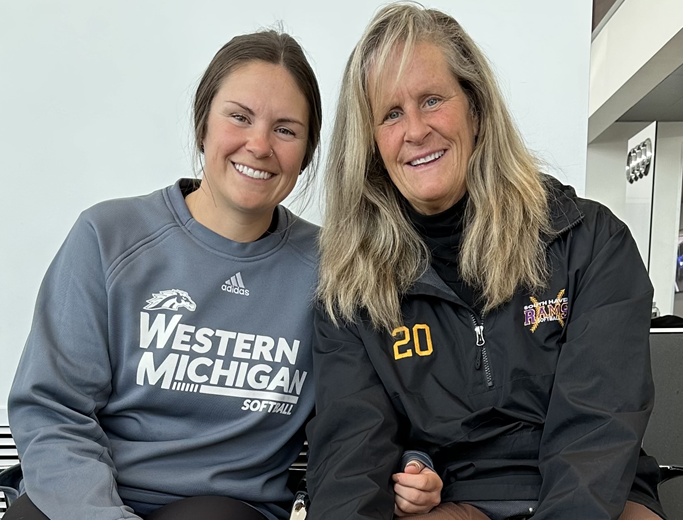 “I coached her when she was small, coached her through high school, coached her in travel ball,” Wilma Wilson said. “She’s a very competitive kid, plays really hard. She has that same love for the game that I do, same drive.”
Marlee Wilson said one important thing she learned from her mom was to make softball fun.
“Practices in high school were always really fun,” she remembered. “It was the best part of the day. I couldn’t imagine it being any other way. (I want to) continue that and also develop the student athletes as people.
“There’s not a huge career in softball like there is in baseball and other sports, so you’re going to play four or five years in college then hopefully be prepared for life after sports, which (Mom) did a really good job with me.”
When she has a chance to talk with high school athletes, Marlee Wilson tells them to have fun and learn the basics of the game.
“That’s huge in high school,” she said. “At the college level, we can tell players who went through really good high school programs or travel programs that have those really good fundamentals or softball IQ.
“(Mom) does a really good job of developing players as a whole so when they get to that level, they understand that part of the game.”
Wilson played softball at WMU from 2014-18 and was a three-time academic all-Mid-American Conference honoree, a 2017 MAC Distinguished Scholar-Athlete and a four-time NFCA All-American Scholar.
Sparking like Sparky
Although Wilma Wilson calls him a “co-coach,” Dave Gumpert considers himself her assistant the last 11 years.
“I respect her many years as being a coach,” he said. “We talk things over, but she makes the final decisions.
“It’s been a really good relationship. She bounces things off me, I bounce things off her. It’s been a good run so far.”
Gumpert, who had a seven-year stint as a major league pitcher for the Detroit Tigers, Chicago Cubs and Kansas City Royals, is the one who good-naturedly calls Wilson “Sparky” — and not because of her sparkling personality.
 “She pretty much lets me run practice, and she walks around,” he said, smiling. “I played for (Tigers manager) Sparky Anderson and that’s what he did. He walked around the outfield, just talking to people and doing all the PR stuff while all the other coaches were getting the work done. So I like to tease her.”
Equipment has been another area of change during Wilson’s tenure.
“The equipment has gone crazy from the technology of bats,” she said. “A bat back in the day would be $20, $25. Now they’re $400.
“If take my school budget and buy balls for the season for both our (varsity and JV) teams and a bat, I’ve used two-thirds of my budget.”
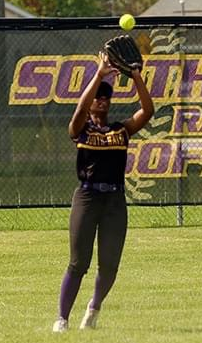
But South Haven is making those bats work. Senior centerfielder Myraql McGee said hitting is among the team’s most noticeable improvements from a year ago.
“Our whole lineup is good power hitters. It doesn’t matter where you are, our lineup is pretty stacked,” said McGee, who will continue her career next season at Missouri Valley College.
“Fielding-wise, we could work on a couple things, but we don’t make as many errors at routine plays as many other teams.”
Other seniors are Sam Beeney and Kayley Gorham, and juniors are Madi Dotson, Grace Strebeck and Molly Verseput. Sophomores are Addison Dekoning and Erin Bos, and they are joined by freshman Ly’Nique Cunningham.
Gumpert was with Wilson when the Rams reached but lost in the Division 2 Final in 2018 and sees some similarities between that and this year’s team.
“Offensively, we had a good team, but I would dare to say this team is as good offensively as that team was,” he said. “It’s going to boil down to how well our pitching does, how well our pitchers progress. If we have the pitching I think we can develop into, I think we’ll be competitive with anybody.”
 Pam Shebest served as a sportswriter at the Kalamazoo Gazette from 1985-2009 after 11 years part-time with the Gazette while teaching French and English at White Pigeon High School. She can be reached at [email protected] with story ideas for Calhoun, Kalamazoo and Van Buren counties.
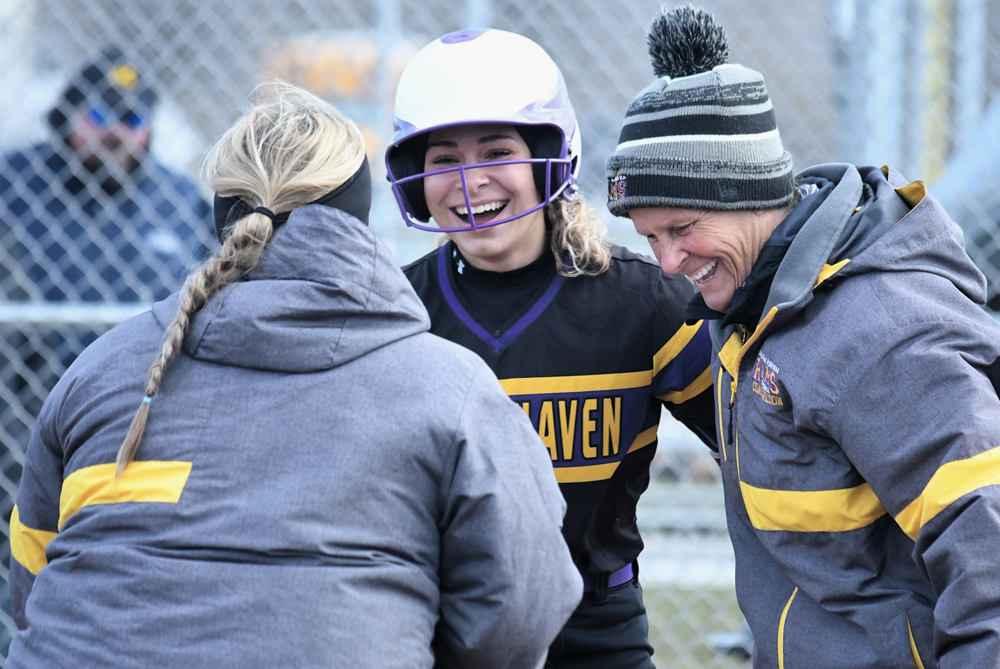
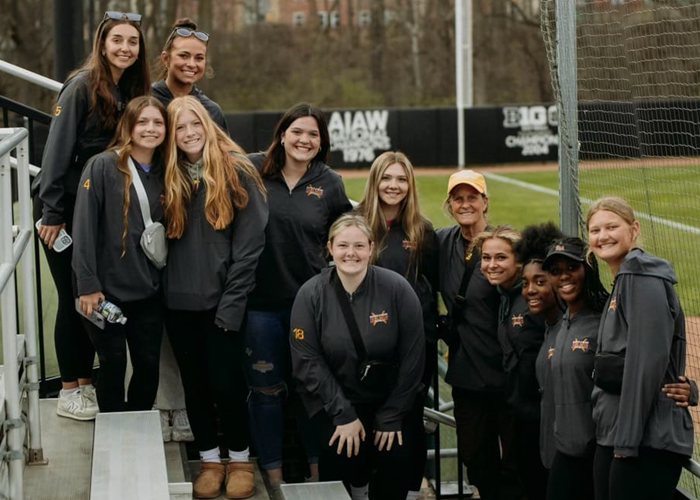
PHOTOS (Top) South Haven softball coach Wilma Wilson, right, welcomes home Kamryn Holland after Holland’s grand slam March 26. (2) The Rams enjoy watching Marlee Wilson’s Western Michigan Broncos this season. (2) Wilson, right, joins daughter Marlee to form an accomplished mother-daughter coaching tree. (4) South Haven senior Myraql McGee settles in under a fly ball. (Top and WMU photos provided by Wilma Wilson, family photo by Pam Shebest, and McGee action photo provided by McGee.)