

Add, Subtract, Divide, Multiply: MHSAA Not Alone
July 25, 2017
By Rob Kaminski
MHSAA benchmarks editor
This is the third part in a series on MHSAA tournament classification, past and present, that will be published over the next two weeks. This series originally ran in this spring's edition of MHSAA benchmarks.
As the MHSAA faces its most recent classification task with 8-Player Football, and opinions continue to swirl about as to the method, timeframe, location and other procedures, a look around the country provides plenty of company among state association brethren factoring variables into their own equations.
In the Pacific Northwest, the Oregon School Activities Association Football Playoffs are under public scrutiny as leadership ponders a five or six classification format beginning with the 2018-19 school year.
The OSAA has crowned six champions on the gridiron since 2006-07. Many of the state’s smaller schools would like to keep it that way, while larger schools lean toward a five-classification system, citing larger leagues, ease of travel and credibility to state championships as the advantages.
Still others would prefer more than six classes, pointing to safety issues and the opportunity to increase participation numbers as positives.
Moving southeast of Oregon, the Nevada Interscholastic Activities Association recently voted to hold serve on a classification proposal that was volleyed to the membership.
However, changes still could be forthcoming by as early as the 2018-19 season which would add a fifth classification in more populated southern Nevada while allowing northern schools to participate in four classifications. Such divisions could mean no state championship for the fifth class in southern Nevada.
Because of that, the NIAA wants equal numbers of schools in each classification on both ends of the state. Complicating the issue is the fact that the 24 largest schools in the state, by enrollment, are all in Clark County in Southern Nevada.
Across Nevada’s border into Arizona, charter schools are asking the Arizona Interscholastic Association to reconsider classification that was voted upon and approved in September 2015. That agreement called for the largest 33 percent of charter schools by enrollment to be placed in the state’s largest school classification, 3A, the middle 33 percent into 2A, and the smallest 33 percent into 1A.
Less than two years later the charter schools have had a change of heart and have asked to be considered the same as other Arizona public schools and be placed appropriately by enrollment beginning with the 2018-19 school year.
The situation in Arizona further illustrates how the public/private debate that all state associations have faced throughout existence now has the added dynamic of rapidly growing charter schools in today’s educational system, along with virtual school enrollment.
In the nation’s heartland, Nebraska has retooled its football classifications by using enrollment of boys students only in its schools rather than total enrollment. The Nebraska School Activities Association football-playing schools will kick off the 2018 season using this alignment.
Nebraska has three classes of 11-player football, with the smallest class divided in two, Class C-1 and C-2. The state also will have 8-player football for boys enrollments under 47, and the NSAA will sponsor a new 6-player tournament in 2018 for schools with 27 or fewer boys.
“This is a good proposal because some schools have a sizable imbalance between the number of boys and girls, and there’s a large gap (in enrollment) between the largest and smallest schools in Classes A and B,” NSAA executive director Jim Tenopir said. “I think this addresses both of those concerns.”
Swimmers in Georgia, meanwhile, will feel like they are moving with the current, rather than upstream in 2017-18, as the Georgia High School Association recently doubled the number of team championship events from two to four.
Swim enthusiasts can also count on longer days at the finals, as the top 30 finishers from the prelims will advance to the finals instead of 20, and all championship events will have three heats versus two.
Slanger Stars in Net as Rockford Caps 1st Finals Run with 1st Championship
By
Brian Freiberger
Special for MHSAA.com
June 12, 2026
EAST LANSING – Rockford – playing in its first MHSAA Final in girls soccer Friday – finally broke through a vaunted Troy defense during the second half to earn its first championship with a 2-0 win over the Colts at DeMartin Stadium.
“Our word this year is relentless. We're so proud of them. Troy was well coached and organized. They played a formation that we didn't see very much,” Rockford coach Stu Quackenbush said. “Troy won the first half and the girls were frustrated, but at halftime, the seniors stepped up. They said the right things. We were having a hard time winning first and second balls, and the seniors did a great job of helping players understand that. Then they bought into different roles. … They were confident in each other, confident in their abilities to make adjustments.”
Both senior-led teams left it all out on the field with everything on the line. Rockford had 16 seniors, while Troy competed with nine.
 Both teams had plenty of chances to find the back of the net in the first half, but quality defensive lines and solid goalkeeper play kept the score 0-0 going into the break.
Rockford (21-2) and Troy (16-4-2) wouldn’t separate until midway through the second half when senior forward Isla Brown found the back of the net thanks to a centering pass from Sawyer Lenon to take a 1-0 lead with 17 minutes remaining.
“This means so much to me. We’ve been working hard for the past four years to bring a state championship home,” Brown said.
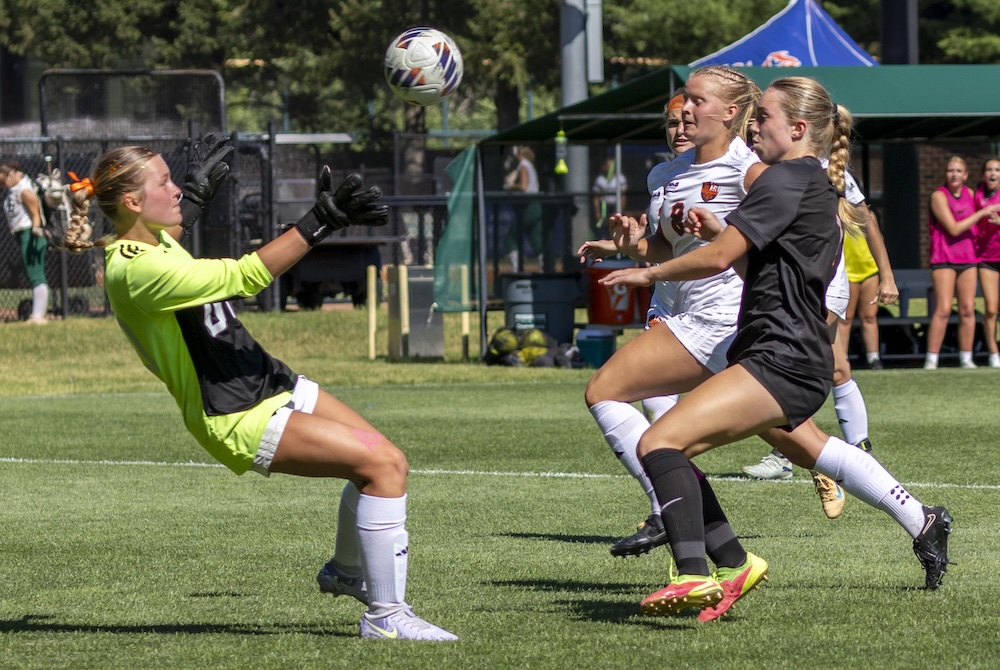
Troy would not back down, nearly scoring multiple times, but the Rams defense and goalkeeper Kaia Slanger wouldn’t let it happen.
“I was just thinking that we got the ball, but we need to stay locked in. Anything can happen,” Slanger said. “It feels really awesome to win a state championship. This shows that all of our hard work led up to this, and we deserved it. I love every single one of those girls. We’ve been playing together for so long, and we are a family. It's gonna be hard to leave this.”
Quackenbush credited Slanger with having the best game of her career.
“(Slanger) played the best game of her life. It's a great time to choose to do that at the state championship. I couldn't be more proud of the kid. We had some question marks going into the year at goalkeeper. … (Slanger) is the player we needed today, and she was confident, she was brave, and the girls are so proud of her,” Quackenbush said.
After a Colts scoring chance, Rockford got on the run with time running out and sent a ball deep in the Colts' zone where senior captain Sydney DeKuiper found Amelia Chapin for the second goal with fewer than two minutes remaining.
 The Colts (16-4-2) held the Rams' potent offense in check for most of the night, besides a few lapses during the evenly-matched game.
“Sometimes that's the cruel reality of the game. The ball doesn't always bounce your way. Rockford had a good game plan. They knew what they were getting themselves into. We knew what we were getting ourselves into, and we knew it was just going to be a heavyweight battle,” Troy coach Tony Casali said. “It's not the trophy we wanted, but there are 110 D1 teams, and there are two teams left standing today. It's definitely an honor to be out here. It's an honor to coach those girls.”
Casali, along with his senior-heavy roster, catapulted the Colts to their first championship game since 2013.
“This is my first year coaching (at Troy), so I didn't have a chance to get to know these seniors as freshmen coming in,” Casali said. “But what I did get the chance to get to know is the commitment they have, the resiliency they have. These girls have laid a big foundation.”
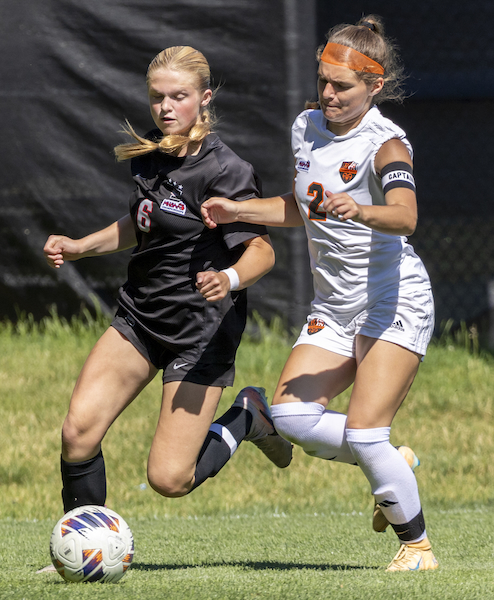
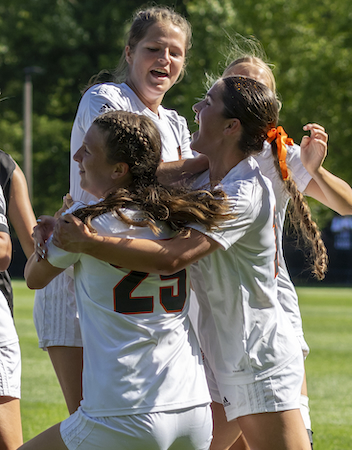
PHOTOS (Top) Rockford goalkeeper Kaia Slanger, far left, makes a stop as Troy and Rockford players pursue the ball Friday at DeMartin Stadium. (Middle) Troy’s Kaylee Worrell (6) controls the ball while Rockford’s Rylan Potter attempts to take possession. (Below) The Rams celebrate their championship win. (Photos by Adam Sheehan/Hockey Weekly Action Photos.)