

Add, Subtract, Divide, Multiply: MHSAA Not Alone
July 25, 2017
By Rob Kaminski
MHSAA benchmarks editor
This is the third part in a series on MHSAA tournament classification, past and present, that will be published over the next two weeks. This series originally ran in this spring's edition of MHSAA benchmarks.
As the MHSAA faces its most recent classification task with 8-Player Football, and opinions continue to swirl about as to the method, timeframe, location and other procedures, a look around the country provides plenty of company among state association brethren factoring variables into their own equations.
In the Pacific Northwest, the Oregon School Activities Association Football Playoffs are under public scrutiny as leadership ponders a five or six classification format beginning with the 2018-19 school year.
The OSAA has crowned six champions on the gridiron since 2006-07. Many of the state’s smaller schools would like to keep it that way, while larger schools lean toward a five-classification system, citing larger leagues, ease of travel and credibility to state championships as the advantages.
Still others would prefer more than six classes, pointing to safety issues and the opportunity to increase participation numbers as positives.
Moving southeast of Oregon, the Nevada Interscholastic Activities Association recently voted to hold serve on a classification proposal that was volleyed to the membership.
However, changes still could be forthcoming by as early as the 2018-19 season which would add a fifth classification in more populated southern Nevada while allowing northern schools to participate in four classifications. Such divisions could mean no state championship for the fifth class in southern Nevada.
Because of that, the NIAA wants equal numbers of schools in each classification on both ends of the state. Complicating the issue is the fact that the 24 largest schools in the state, by enrollment, are all in Clark County in Southern Nevada.
Across Nevada’s border into Arizona, charter schools are asking the Arizona Interscholastic Association to reconsider classification that was voted upon and approved in September 2015. That agreement called for the largest 33 percent of charter schools by enrollment to be placed in the state’s largest school classification, 3A, the middle 33 percent into 2A, and the smallest 33 percent into 1A.
Less than two years later the charter schools have had a change of heart and have asked to be considered the same as other Arizona public schools and be placed appropriately by enrollment beginning with the 2018-19 school year.
The situation in Arizona further illustrates how the public/private debate that all state associations have faced throughout existence now has the added dynamic of rapidly growing charter schools in today’s educational system, along with virtual school enrollment.
In the nation’s heartland, Nebraska has retooled its football classifications by using enrollment of boys students only in its schools rather than total enrollment. The Nebraska School Activities Association football-playing schools will kick off the 2018 season using this alignment.
Nebraska has three classes of 11-player football, with the smallest class divided in two, Class C-1 and C-2. The state also will have 8-player football for boys enrollments under 47, and the NSAA will sponsor a new 6-player tournament in 2018 for schools with 27 or fewer boys.
“This is a good proposal because some schools have a sizable imbalance between the number of boys and girls, and there’s a large gap (in enrollment) between the largest and smallest schools in Classes A and B,” NSAA executive director Jim Tenopir said. “I think this addresses both of those concerns.”
Swimmers in Georgia, meanwhile, will feel like they are moving with the current, rather than upstream in 2017-18, as the Georgia High School Association recently doubled the number of team championship events from two to four.
Swim enthusiasts can also count on longer days at the finals, as the top 30 finishers from the prelims will advance to the finals instead of 20, and all championship events will have three heats versus two.
Allen Park Reclaims Division 2 Championship with Unforgettable Finish
By
Geoff Kimmerly
MHSAA.com senior editor
March 2, 2024
MOUNT PLEASANT – Allen Park competitive cheer coach Julie Goodwin calls Round 3 her team’s “money round.”
And did the Jaguars ever make it pay off Saturday at Central Michigan University’s McGuirk Arena.
Allen Park and Gibraltar Carlson had combined to win every MHSAA Division 2 Final championship over the last 16 seasons – and entered Round 3 this time separated by a mere 54 hundredths of a point.
That was just shy of the margin Carlson won by, over Allen Park, at last year’s championship meet. But the margin of victory this time would not be so close.
The Jaguars cashed in big with a seemingly flawless routine, their 322.40 the highest Round 3 score at the Finals in any division since 2012, and pulled away from the field to finish with 793.34 points and their fourth championship over the last five seasons.
“It felt so incredible. That was the round that we were waiting to perform all season,” Allen Park junior Abigail Obrycki said. “It felt perfect. It felt like everybody gave exactly what they were supposed to do, and it was just perfect.
“It’s what we love to do. We love stunting. We love perfecting it and getting everything exactly how it’s supposed to be.”
Allen Park led by only two tenths of a point after Round 1, with Carlson just behind, and was able to extend that lead only another 34 hundredths of a point in Round 2.
 Carlson – which finished first in the Downriver League ahead of Allen Park before Allen Park won their Regional – also had to absorb a significant penalty that ended up sending the Marauders to fourth in the final standings.
“We had an amazing week of practice, we had an amazing season. It’s been a journey, it wasn’t an instant climb, and they did everything they needed,” said Allen Park coach Julie Goodwin, who was finishing her 20th season and 20th time bringing the team to the Finals. “They needed three clean rounds today, and they did it.”
Carleton Airport finished runner-up, its highest at a Finals since finishing Class B runner-up in 2003.
These last three weeks have seen the Jets certainly land among the state’s elite in just their second season under coach Emily Dusik. Airport won their District two weeks ago, just ahead of Carlson, and then finished behind Allen Park and Carlson at their Regional but with a season-high score that was six points higher than their previous best this season. The Jets also enjoyed their major surge despite moving into Division 2 after competing in Division 3 last season.
“I think (today) gave the girls a drive that they’ve never really experienced before. Being here today, it opened their eyes to their potential and really allowed them to believe in what they’re doing,” Dusik said. “We tell them all year just do your best, and we had a little bit of a tough time today and they still came out and did a great job. I’m just so proud of everything they’ve done.
“It’s kinda unbelievable right now. It’s just incredible. But it’s all the girls. I try to fill their buckets as much as possible and try to give them as much positivity to believe in themselves, and it’s really showing. They’re starting to believe that they’re capable of great things.”
Airport finished with a score of 779.92, with Dearborn Divine Child right behind at 779.84. Carlson was in that mix as well at 778.10, followed by Cedar Springs, Middleville Thornapple Kellogg, Plainwell and Muskegon Reeths-Puffer.
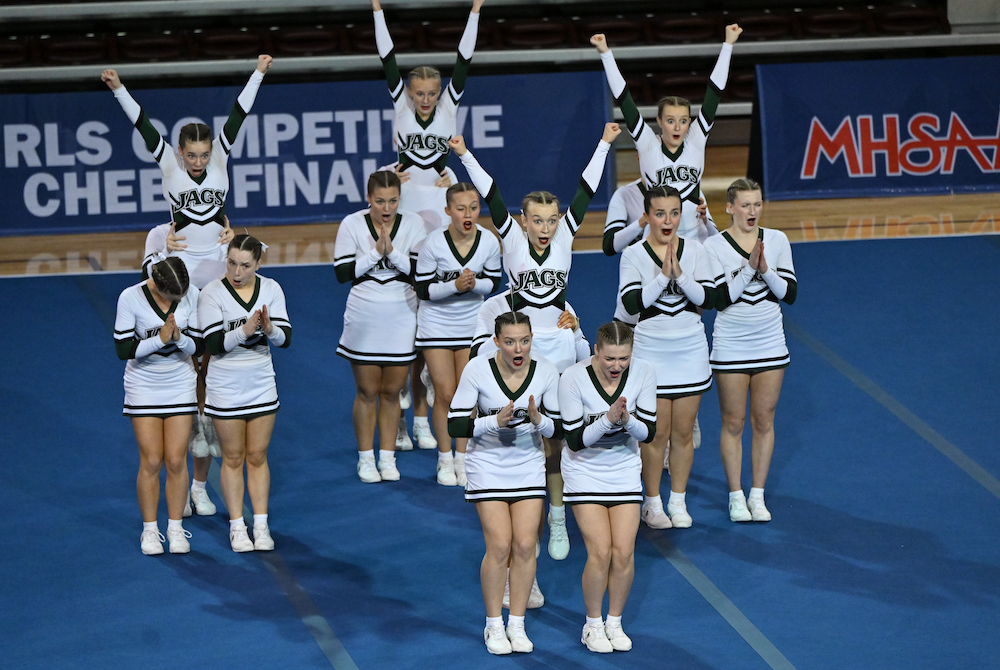
PHOTOS (Top) Allen Park competes during Saturday's Division 2 Finals at McGuirk Arena. (Middle) The Jaguars celebrate their fourth championship in five seasons. (Photos by Hockey Weekly Action Photos.)