

Add, Subtract, Divide, Multiply: MHSAA Not Alone
July 25, 2017
By Rob Kaminski
MHSAA benchmarks editor
This is the third part in a series on MHSAA tournament classification, past and present, that will be published over the next two weeks. This series originally ran in this spring's edition of MHSAA benchmarks.
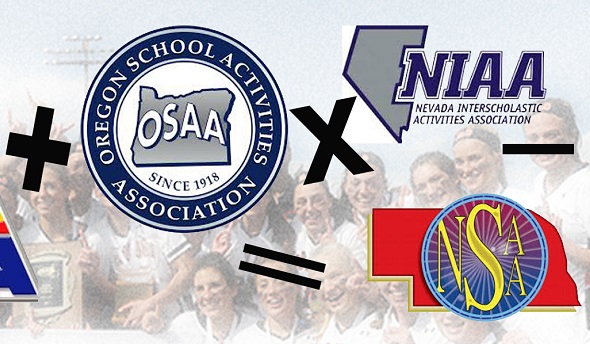
As the MHSAA faces its most recent classification task with 8-Player Football, and opinions continue to swirl about as to the method, timeframe, location and other procedures, a look around the country provides plenty of company among state association brethren factoring variables into their own equations.
In the Pacific Northwest, the Oregon School Activities Association Football Playoffs are under public scrutiny as leadership ponders a five or six classification format beginning with the 2018-19 school year.
The OSAA has crowned six champions on the gridiron since 2006-07. Many of the state’s smaller schools would like to keep it that way, while larger schools lean toward a five-classification system, citing larger leagues, ease of travel and credibility to state championships as the advantages.
Still others would prefer more than six classes, pointing to safety issues and the opportunity to increase participation numbers as positives.
Moving southeast of Oregon, the Nevada Interscholastic Activities Association recently voted to hold serve on a classification proposal that was volleyed to the membership.
However, changes still could be forthcoming by as early as the 2018-19 season which would add a fifth classification in more populated southern Nevada while allowing northern schools to participate in four classifications. Such divisions could mean no state championship for the fifth class in southern Nevada.
Because of that, the NIAA wants equal numbers of schools in each classification on both ends of the state. Complicating the issue is the fact that the 24 largest schools in the state, by enrollment, are all in Clark County in Southern Nevada.
Across Nevada’s border into Arizona, charter schools are asking the Arizona Interscholastic Association to reconsider classification that was voted upon and approved in September 2015. That agreement called for the largest 33 percent of charter schools by enrollment to be placed in the state’s largest school classification, 3A, the middle 33 percent into 2A, and the smallest 33 percent into 1A.
Less than two years later the charter schools have had a change of heart and have asked to be considered the same as other Arizona public schools and be placed appropriately by enrollment beginning with the 2018-19 school year.
The situation in Arizona further illustrates how the public/private debate that all state associations have faced throughout existence now has the added dynamic of rapidly growing charter schools in today’s educational system, along with virtual school enrollment.
In the nation’s heartland, Nebraska has retooled its football classifications by using enrollment of boys students only in its schools rather than total enrollment. The Nebraska School Activities Association football-playing schools will kick off the 2018 season using this alignment.
Nebraska has three classes of 11-player football, with the smallest class divided in two, Class C-1 and C-2. The state also will have 8-player football for boys enrollments under 47, and the NSAA will sponsor a new 6-player tournament in 2018 for schools with 27 or fewer boys.
“This is a good proposal because some schools have a sizable imbalance between the number of boys and girls, and there’s a large gap (in enrollment) between the largest and smallest schools in Classes A and B,” NSAA executive director Jim Tenopir said. “I think this addresses both of those concerns.”
Swimmers in Georgia, meanwhile, will feel like they are moving with the current, rather than upstream in 2017-18, as the Georgia High School Association recently doubled the number of team championship events from two to four.
Swim enthusiasts can also count on longer days at the finals, as the top 30 finishers from the prelims will advance to the finals instead of 20, and all championship events will have three heats versus two.
Preview: Several of History's Best Back to Make More, New Contenders Seek to Join Them
By
Geoff Kimmerly
MHSAA.com senior editor
June 11, 2026
An impressive sampling of MHSAA girls soccer history's championship leaders will be finishing the 2026 seasons this weekend at Michigan State’s DeMartin Stadium.
The most titanic matchup of this Finals weekend may be in Division 2, where 13-time champion Hudsonville Unity Christian will face nine-time champion Bloomfield Hills Marian in the season’s final match Saturday afternoon. They rank first and third, respectively, in Finals titles in this sport.
Detroit Country Day is making its 12th trip to a championship match, Troy is making its eighth and Royal Oak Shrine Catholic will be playing in its fourth.
On the other side are Rockford, Grand Rapids West Catholic and Harbor Springs, all seeking their first championship in this sport.
Following is this weekend’s schedule at Michigan State University:
Division 1 - Friday - 4 p.m.
Troy vs. Rockford
Division 2 - Saturday - 4 p.m.
Bloomfield Hills Marian vs. Hudsonville Unity Christian
Division 3 - Saturday - 1 p.m.
Detroit Country Day vs. Grand Rapids West Catholic
Division 4 - Friday - 1 p.m.
Royal Oak Shrine Catholic vs. Harbor Springs
Tickets cost $11 and may be purchased online only at GoFan. One ticket is good for all soccer, softball and baseball games at MSU’s Old College Field that day. All four Finals will be broadcast and available with subscription from MHSAA.tv.
Below is a glance at all eight contenders, with statistics through Regionals:
Division 1
ROCKFORD
Record/rank: 21-2, No. 10
League finish: First in Ottawa-Kent Conference Red
Coach: Stu Quackenbush, sixth season (72-15-13)
Championship history: Has never played in an MHSAA Final.
Players to watch: Audrey Muterspaugh, sr. F (10 goals, 22 assists); Grace Young, sr. D (6 goals, 4 assists); Laney Carlson, sr. M (9 goals, 7 assists); Sawyer Lenon, sr. M (8 goals, 3 assists).
Outlook: Rockford has followed up its first Regional championship with its first trip to the Finals and built toward this over the last three seasons with a third-straight league title and second-straight District championship kicking off this run. Carlson, Lenon, Muterspaugh and Young all earned all-state honorable mentions last season and make up part of an overall balanced lineup. Ten players had scored between 5-10 goals entering this week, including as well seniors Reese Petack (10 goals, 7 assists) and Sydney DeKuiper (10/4). Senior keeper Kaia Slanger entered the week with nine shutouts and a 0.41 goals-against average while splitting time in net.
TROY
Record/rank: 17-3-2, No. 8
League finish: Third in Oakland Activities Association Red
Coach: Tony Casali, first season (17-3-2)
Championship history: Three MHSAA titles (most recent 2013), four runner-up finishes.
Players to watch: Olivia Jasniewicz, sr. F (13 goals, 11 assists); Sabrina Gaul, sr. F (15 goals, 7 assists); Emma Rozek, sr. D (1 goal, 3 assists); Maren Swan, sr. M (7 goals, 9 assists).
Outlook: This will be Troy’s first Final since its most recent championship season, and the Colts earned it in part with wins over No. 3 Rochester Adams and No. 13 Troy Athens along the way. Casali took over the program this year after leading Sterling Heights Stevenson to a league title in 2025, and Troy is seven wins better this spring than last. Jasniewicz made the all-state first team last season, and Rozek and Gaul earned honorable mentions. Senior Kennedy Brudenell and junior Kiera Gallihugh have combined in goal to give up fewer than one per game.
Division 2
BLOOMFIELD HILLS MARIAN
Record/rank: 21-2, No. 3
League finish: First in Catholic High School League Central
Coach: Danny Price, third season (52-9-4)
Championship history: Nine MHSAA titles (most recent 2021), five runner-up finishes.
Players to watch: Clair Dauer, sr. CM (10 goals, 4 assists), Leah Nalichowski, jr. F (28 goals, 15 assists); Nia Bordogna, jr. M (10 goals, 21 assists); Emma Wyciskalla, soph. F (20 goals, 10 assists);
Outlook: Marian has finished runner-up twice, in 2022 and 2024, since winning its most recent championship, and the Mustangs enter this decider having won its first five postseason games by a combined score of 26-2. That run has included defeating No. 5 DeWitt, No. 10 New Boston Huron and No. 13 Waterford Kettering. Bordogna and Dauer both made the all-state first team last season, while sophomore keeper Olivia Bussa (0.26 goals-against average) and Wyciskalla earned honorable mentions.
HUDSONVILLE UNITY CHRISTIAN
Record/rank: 23-0, No. 1
League finish: First in O-K Black
Coach: Randy Heethuis, 37th season (687-105-44)
Championship history: Thirteen MHSAA titles (most recent 2025), four runner-up finishes.
Players to watch: Ava Steen, sr. D (6 goals, 5 assists); Addison Pell, sr. M (7 goals, 2 assists); Kyla Kobrzycki, jr. M/F (18 goals, 23 assists); Tessa Ponstein, sr. F (21 goals, 8 assists).
Outlook: Unity Christian is pursuing a fourth-straight Finals championship – which would tie for the second-longest streak behind its record six straight from 2005-10. The Crusaders also haven’t lost a game since May 22, 2024, a run of 54 without a defeat and only three ties among them. A shutout of Marian would also give Unity a fourth-straight playoffs without giving up a goal. Steen made the all-state first team last year, Kobrzycki and Ponstein made the second and Pell earned an honorable mention. Sophomore Olivia Walters had added 11 goals and 10 assists entering the week, and senior keeper Payton Barendsen has given up only one goal all season.
Division 3
DETROIT COUNTRY DAY
Record/rank: 13-4-3, No. 3
League finish: Does not play in a conference.
Coach: Laura Hamway, 11th season (113-58-19)
Championship history: Six MHSAA titles (most recent 2021), five runner-up finishes.
Players to watch: Jenna Shaban, sr.; Megan Mateer, jr.; Charlotte Hartley, jr.; Georgia Hopkins, jr.; Julia Goetz, jr. (No positions or statistics provided.)
Outlook: Country Day defeated top-ranked Goodrich 1-0 in their Semifinal to advance to Finals weekend for the first time since 2021. The Yellowjackets have given up only one goal over five playoff games and have shutouts in seven of their last nine overall. Shaban and Mateer made the all-state first team last season, and Hartley, Hopkins and Goetz earned honorable mentions.
GRAND RAPIDS WEST CATHOLIC
Record/rank: 18-5-2, No. 7
League finish: Third in O-K Gold.
Coach: Ryan Smith, seventh season (74-44-16)
Championship history: Has not played in an MHSAA Final.
Players to watch: Katelyn Adams, sr. GK (0.72 goals-against average, 12 shutouts); Lexy Druelle, fr. M (13 goals, 14 assists); Hadley Giradot, jr. M (8 goals, 13 assists); Kenley Slanger, soph. F (34 goals, 7 assists).
Outlook: West Catholic won its first Regional title as well this spring and got here with wins over No. 2 Grand Rapids NorthPointe Christian, No. 5 Grand Rapids West Michigan Aviation Academy and No. 10 Traverse City St. Francis. It’s also been a great jump off last season’s 8-9-4 finish. Slanger made the all-state second team last spring and Adams earned an honorable mention, and they’ve played major parts in the Falcons taking that big step. Junior Avery Dusseau (10 goals/3 assists) is another top scorer.
Division 4
HARBOR SPRINGS
Record/rank: 19-1-1, No. 9
League finish: First in Northern Shores Conference
Coach: Aaron Riley, 11th season (122-74-12)
Championship history: Division 4 runner-up 2001.
Players to watch: Stefi Reskevics, jr. F (25 goals, 8 assists); Fran Warren, sr. M; Maeve Riley, fr. F (16 goals, 19 assists); Lilly Barnadyn, sr. M (12 goals, 4 assists). (Limited statistics provided.)
Outlook: Harbor Springs is up to a combined 34-4-2 over the last two seasons and won its first Regional title since 2003. The Rams have defeated No. 7 Kalamazoo Christian and No. 13 Elk Rapids on the way, with their lone loss to Leland at the end of April. Reskevics made the all-state second team last season, and Warren earned an honorable mention. Warren also is one of only four senior starters.
ROYAL OAK SHRINE CATHOLIC
Record/rank: 11-8-3, No. 8
League finish: Sixth in CHSL AA
Coach: Mark Soma, 23rd season (record N/A)
Championship history: Division 4 champion 2019 and 2022, runner-up 2021.
Players to watch: Julia Kraemer, soph. F (27 goals, 9 assists); Leah Proctor, jr. M (6 goals, 12 assists): Rowan Armstrong, soph. F (7 goals, 5 assists); Jo Malcolm, jr. M (9 goals, 6 assists).
Outlook: After just a few years away, Shrine is back in East Lansing to play in its fourth championship game over the last seven seasons. Wins over No. 15 Auburn Hills Oakland Christian and No. 10 Schoolcraft were big along the way, but the best week of the run came when the Knights defeated No. 3 Bath and No. 2 Clarkston Everest Collegiate back-to-back in the Regional. Kraemer earned an all-state honorable mention last season, and senior Caitlin Wetzel is another playmaker in the midfield entering this week with one goal but 18 assists.
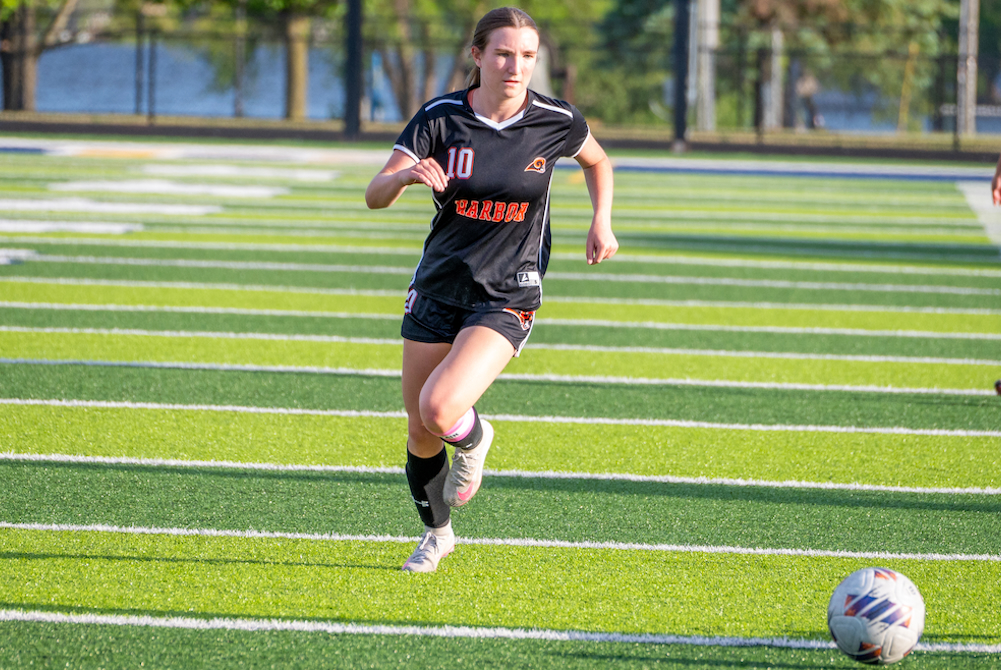
PHOTO Harbor Springs' Fran Warren makes a run upfield during her team's Division 4 Regional Final win over Ovid-Elsie. (Photo by Sarah Shepherd.)