


Add, Subtract, Divide, Multiply: MHSAA Not Alone
July 25, 2017
By Rob Kaminski
MHSAA benchmarks editor
This is the third part in a series on MHSAA tournament classification, past and present, that will be published over the next two weeks. This series originally ran in this spring's edition of MHSAA benchmarks.
As the MHSAA faces its most recent classification task with 8-Player Football, and opinions continue to swirl about as to the method, timeframe, location and other procedures, a look around the country provides plenty of company among state association brethren factoring variables into their own equations.
In the Pacific Northwest, the Oregon School Activities Association Football Playoffs are under public scrutiny as leadership ponders a five or six classification format beginning with the 2018-19 school year.
The OSAA has crowned six champions on the gridiron since 2006-07. Many of the state’s smaller schools would like to keep it that way, while larger schools lean toward a five-classification system, citing larger leagues, ease of travel and credibility to state championships as the advantages.
Still others would prefer more than six classes, pointing to safety issues and the opportunity to increase participation numbers as positives.
Moving southeast of Oregon, the Nevada Interscholastic Activities Association recently voted to hold serve on a classification proposal that was volleyed to the membership.
However, changes still could be forthcoming by as early as the 2018-19 season which would add a fifth classification in more populated southern Nevada while allowing northern schools to participate in four classifications. Such divisions could mean no state championship for the fifth class in southern Nevada.
Because of that, the NIAA wants equal numbers of schools in each classification on both ends of the state. Complicating the issue is the fact that the 24 largest schools in the state, by enrollment, are all in Clark County in Southern Nevada.
Across Nevada’s border into Arizona, charter schools are asking the Arizona Interscholastic Association to reconsider classification that was voted upon and approved in September 2015. That agreement called for the largest 33 percent of charter schools by enrollment to be placed in the state’s largest school classification, 3A, the middle 33 percent into 2A, and the smallest 33 percent into 1A.
Less than two years later the charter schools have had a change of heart and have asked to be considered the same as other Arizona public schools and be placed appropriately by enrollment beginning with the 2018-19 school year.
The situation in Arizona further illustrates how the public/private debate that all state associations have faced throughout existence now has the added dynamic of rapidly growing charter schools in today’s educational system, along with virtual school enrollment.
In the nation’s heartland, Nebraska has retooled its football classifications by using enrollment of boys students only in its schools rather than total enrollment. The Nebraska School Activities Association football-playing schools will kick off the 2018 season using this alignment.
Nebraska has three classes of 11-player football, with the smallest class divided in two, Class C-1 and C-2. The state also will have 8-player football for boys enrollments under 47, and the NSAA will sponsor a new 6-player tournament in 2018 for schools with 27 or fewer boys.
“This is a good proposal because some schools have a sizable imbalance between the number of boys and girls, and there’s a large gap (in enrollment) between the largest and smallest schools in Classes A and B,” NSAA executive director Jim Tenopir said. “I think this addresses both of those concerns.”
Swimmers in Georgia, meanwhile, will feel like they are moving with the current, rather than upstream in 2017-18, as the Georgia High School Association recently doubled the number of team championship events from two to four.
Swim enthusiasts can also count on longer days at the finals, as the top 30 finishers from the prelims will advance to the finals instead of 20, and all championship events will have three heats versus two.
Holland West Ottawa Athletics Complex Recognized with National Award
December 12, 2023
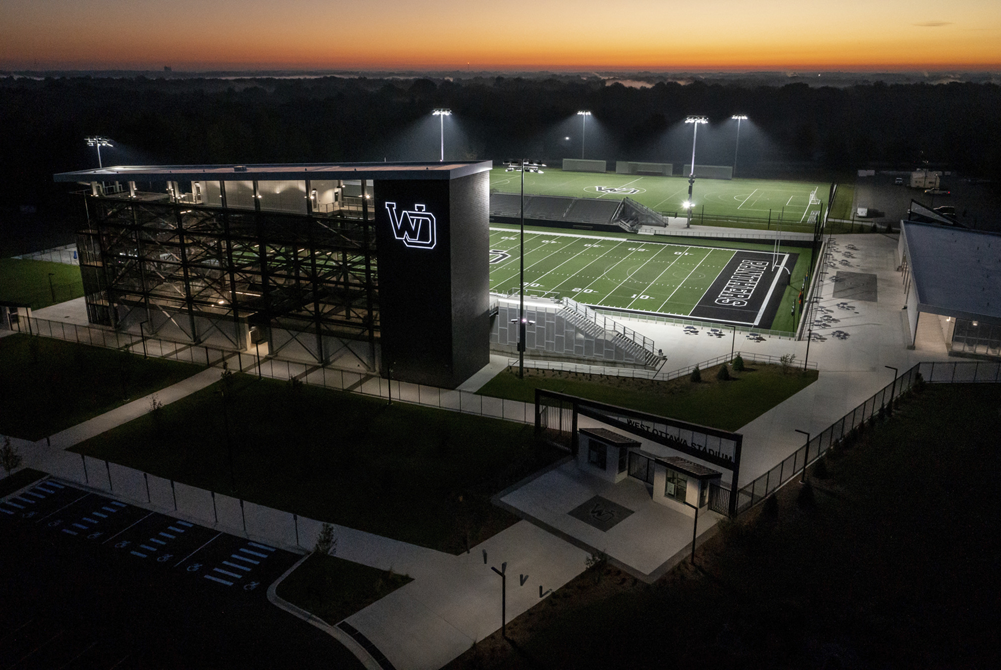
Holland West Ottawa Public Schools’ new athletics complex, with architectural firm GMB, has been recognized as the top multi-field facility nationally by the American Sports Builders Association (ASBA), the national organization for builders and suppliers of materials for athletic facilities.
West Ottawa’s new stadium consists of two turf playing fields. The west field was designed deliberately without a surrounding track to bring the stands and field closer together with a central tunnel beneath the grandstands for the home team to enter onto the field. The same synthetic turf, light posts, and state-of-the-art audio/video systems are utilized on both fields for an equitable experience for all users.
 Multiple ground-level entry points with access to the fields, barrier-free locker rooms and multiple seating options with elevator access also create accessibility for spectators, players, coaches, and support staff.
“This facility allows our students the opportunity to play in one of the premier complexes in the state of Michigan,” said Jeff Malloch, assistant superintendent of business services at West Ottawa Public Schools. “We have seen continued interest in lacrosse, football, and soccer, and this complex will be utilized by our community youth from elementary age to high school student-athletes.”
Adding elevated fan experiences, such as a concourse level between the upper and lower sections of the home stands, bigger bleachers, and updated concession stands and restrooms establish a venue for multiple sports and attract the entire community to utilize the facility.
“This is a one-of-a-kind facility for West Michigan, and it’s been wonderful to see student-athletes from across the state enjoy the complex’s unique amenities,” said Nate Bosch, a landscape architect with GMB. “The collaboration needed to make this project come to life was an inspiring process to be a part of, and we are so pleased to celebrate this accomplishment with West Ottawa.”
This is the first time a GMB project has been awarded a multi-field facility of the year honor by the ASBA. GMB also has received four Project of the Year honors in the outdoor tennis category and 20 distinguished awards from ASBA for other athletic facility projects over the past 12 years.
(Photos by M-Buck Studio.)