

Add, Subtract, Divide, Multiply: MHSAA Not Alone
July 25, 2017
By Rob Kaminski
MHSAA benchmarks editor
This is the third part in a series on MHSAA tournament classification, past and present, that will be published over the next two weeks. This series originally ran in this spring's edition of MHSAA benchmarks.
As the MHSAA faces its most recent classification task with 8-Player Football, and opinions continue to swirl about as to the method, timeframe, location and other procedures, a look around the country provides plenty of company among state association brethren factoring variables into their own equations.
In the Pacific Northwest, the Oregon School Activities Association Football Playoffs are under public scrutiny as leadership ponders a five or six classification format beginning with the 2018-19 school year.
The OSAA has crowned six champions on the gridiron since 2006-07. Many of the state’s smaller schools would like to keep it that way, while larger schools lean toward a five-classification system, citing larger leagues, ease of travel and credibility to state championships as the advantages.
Still others would prefer more than six classes, pointing to safety issues and the opportunity to increase participation numbers as positives.
Moving southeast of Oregon, the Nevada Interscholastic Activities Association recently voted to hold serve on a classification proposal that was volleyed to the membership.
However, changes still could be forthcoming by as early as the 2018-19 season which would add a fifth classification in more populated southern Nevada while allowing northern schools to participate in four classifications. Such divisions could mean no state championship for the fifth class in southern Nevada.
Because of that, the NIAA wants equal numbers of schools in each classification on both ends of the state. Complicating the issue is the fact that the 24 largest schools in the state, by enrollment, are all in Clark County in Southern Nevada.
Across Nevada’s border into Arizona, charter schools are asking the Arizona Interscholastic Association to reconsider classification that was voted upon and approved in September 2015. That agreement called for the largest 33 percent of charter schools by enrollment to be placed in the state’s largest school classification, 3A, the middle 33 percent into 2A, and the smallest 33 percent into 1A.
Less than two years later the charter schools have had a change of heart and have asked to be considered the same as other Arizona public schools and be placed appropriately by enrollment beginning with the 2018-19 school year.
The situation in Arizona further illustrates how the public/private debate that all state associations have faced throughout existence now has the added dynamic of rapidly growing charter schools in today’s educational system, along with virtual school enrollment.
In the nation’s heartland, Nebraska has retooled its football classifications by using enrollment of boys students only in its schools rather than total enrollment. The Nebraska School Activities Association football-playing schools will kick off the 2018 season using this alignment.
Nebraska has three classes of 11-player football, with the smallest class divided in two, Class C-1 and C-2. The state also will have 8-player football for boys enrollments under 47, and the NSAA will sponsor a new 6-player tournament in 2018 for schools with 27 or fewer boys.
“This is a good proposal because some schools have a sizable imbalance between the number of boys and girls, and there’s a large gap (in enrollment) between the largest and smallest schools in Classes A and B,” NSAA executive director Jim Tenopir said. “I think this addresses both of those concerns.”
Swimmers in Georgia, meanwhile, will feel like they are moving with the current, rather than upstream in 2017-18, as the Georgia High School Association recently doubled the number of team championship events from two to four.
Swim enthusiasts can also count on longer days at the finals, as the top 30 finishers from the prelims will advance to the finals instead of 20, and all championship events will have three heats versus two.
Swierkos Dominates, Hartland Celebrates Decisive Title Clincher
By
Tom Kendra
Special for MHSAA.com
June 17, 2023
EAST LANSING – Hartland senior pitcher Kylie Swierkos entered this weekend as one of the finalists for the state’s Miss Softball Award.
After the dominating, two-game performance she delivered at Michigan State University’s Secchia Stadium, she might have secured the prestigious honor – but that was the furthest thing from her mind Saturday afternoon.
“All I care about is that we won this for our school,” said Swierkos, who tossed her second consecutive four-hitter to lead Hartland to a 9-1 victory over Brownstown Woodhaven in the Division 1 Final.
“We have such a close group of girls; it’s not just me. Now I hope the younger girls take this and keep going with it.”
 Swierkos, who improved to 23-1 on the season with a 0.81 ERA, shut out Lake Orion in Thursday’s Semifinal and came within two outs of another shutout Saturday before Woodhaven scored its only run in the top of the seventh inning.
Swierkos, who has committed to pitch at Grand Valley State University, struck out 13 batters on Saturday (20 for the weekend) and didn’t walk a single batter in either game.
“We know Kylie is going to do her job,” said fifth-year Hartland coach Taylor Wagner, who led the school to its first Softball Finals title since winning Class A in 1996. “Then we just have to bat a little bit behind her, and we did that all the way through the order, from one to nine.”
Hartland, 35-4-1, delivered nine hits, with two apiece from Abby Gardner, Kate McIntyre and Reese Dunny.
Senior Riley Phillips smacked a two-run triple for the second consecutive game, this one coming in the second inning. Sophomore catcher Sadie Malik also had two RBIs, including a run-scoring single as Hartland put the game away with three runs in the bottom of the sixth inning.
“I could not have asked for a more perfect ending to my senior year,” said Gardner, one of four seniors on the Hartland roster, along with Faith DeLanoy, Phillips and Swierkos.
The nine runs were more than enough offense for Swierkos, who pitched eight consecutive innings of perfect ball – starting with the fourth inning Thursday through the fourth inning Saturday, when the Warriors managed the first of their four hits.
 Woodhaven, 35-5 and playing in its first Final, scored its only run in the top of the seventh inning after a leadoff double by Grace Walker.
The Warriors struggled to figure out Swierkos, then hurt themselves with three costly errors.
“We definitely put Woodhaven softball on the map, and we will be back,” said second-year coach Ken Kroll. “It was atypical of us to make those errors. But we just didn’t put enough hits together. When we did start to get something going, we got shut down.”
Grace Usher, a junior, allowed nine hits and struck out six over six innings. She finished the season 18-4 with a 1.40 ERA. Alaina Craig had her team’s lone RBI.
Just before her team took the podium to accept the championship trophy, Wagner was asked for two words to describe her feelings after guiding her team to its first Finals title in 27 years. Hartland also had finished Division 1 runner-up in 2018.
She answered with just one:
“Blessed,” said Wagner, who was assisted by Lindsay Brandon. “I am blessed to go through this with these girls and to be a small part of it.”
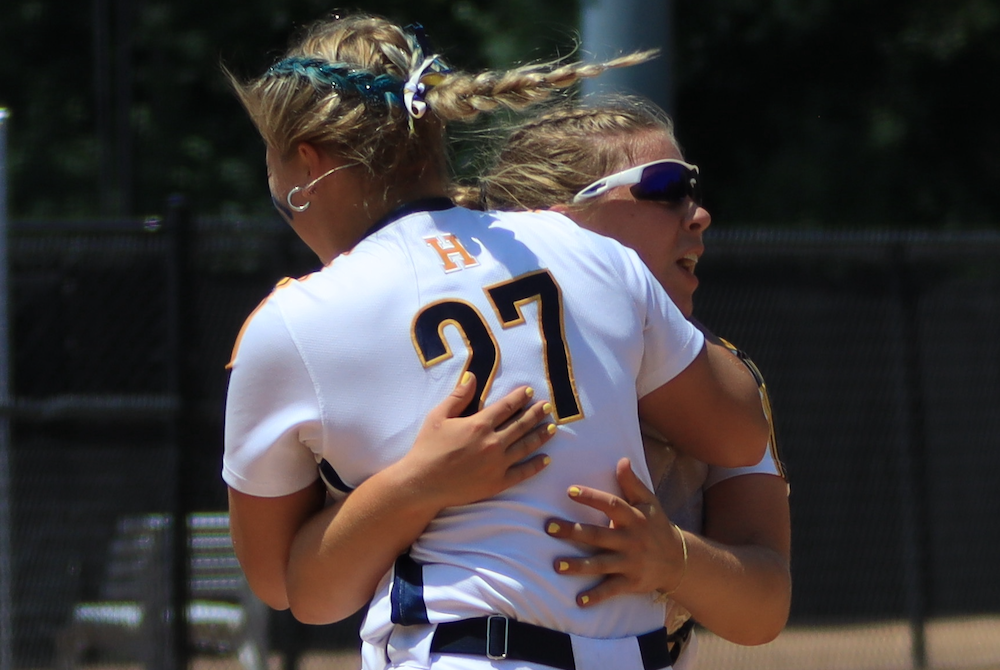
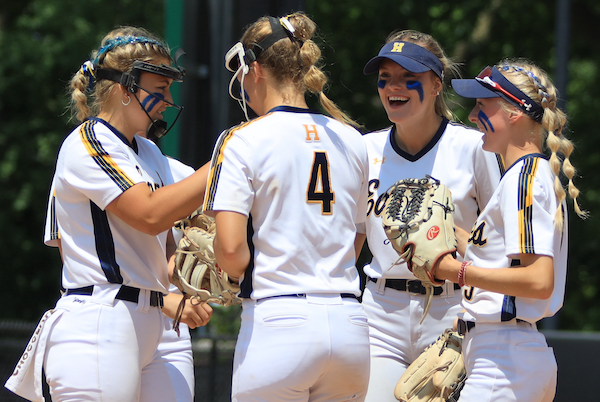
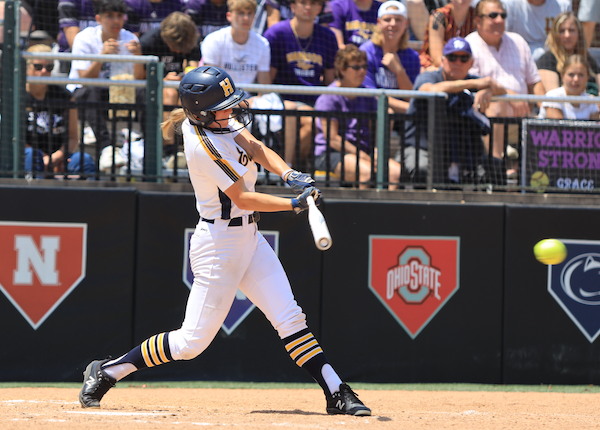
PHOTOS (Top) Hartland’s Kylie Swierkos (27) leaps into the arms of catcher Sadie Malik on Saturday. (Middle) The Eagles huddle in the pitching circle during the Division 1 Final. (Below) A Hartland hitter drives the ball. (Photos by Olivia Napier/Hockey Weekly Action Photos.)