

Add, Subtract, Divide, Multiply: MHSAA Not Alone
July 25, 2017
By Rob Kaminski
MHSAA benchmarks editor
This is the third part in a series on MHSAA tournament classification, past and present, that will be published over the next two weeks. This series originally ran in this spring's edition of MHSAA benchmarks.
As the MHSAA faces its most recent classification task with 8-Player Football, and opinions continue to swirl about as to the method, timeframe, location and other procedures, a look around the country provides plenty of company among state association brethren factoring variables into their own equations.
In the Pacific Northwest, the Oregon School Activities Association Football Playoffs are under public scrutiny as leadership ponders a five or six classification format beginning with the 2018-19 school year.
The OSAA has crowned six champions on the gridiron since 2006-07. Many of the state’s smaller schools would like to keep it that way, while larger schools lean toward a five-classification system, citing larger leagues, ease of travel and credibility to state championships as the advantages.
Still others would prefer more than six classes, pointing to safety issues and the opportunity to increase participation numbers as positives.
Moving southeast of Oregon, the Nevada Interscholastic Activities Association recently voted to hold serve on a classification proposal that was volleyed to the membership.
However, changes still could be forthcoming by as early as the 2018-19 season which would add a fifth classification in more populated southern Nevada while allowing northern schools to participate in four classifications. Such divisions could mean no state championship for the fifth class in southern Nevada.
Because of that, the NIAA wants equal numbers of schools in each classification on both ends of the state. Complicating the issue is the fact that the 24 largest schools in the state, by enrollment, are all in Clark County in Southern Nevada.
Across Nevada’s border into Arizona, charter schools are asking the Arizona Interscholastic Association to reconsider classification that was voted upon and approved in September 2015. That agreement called for the largest 33 percent of charter schools by enrollment to be placed in the state’s largest school classification, 3A, the middle 33 percent into 2A, and the smallest 33 percent into 1A.
Less than two years later the charter schools have had a change of heart and have asked to be considered the same as other Arizona public schools and be placed appropriately by enrollment beginning with the 2018-19 school year.
The situation in Arizona further illustrates how the public/private debate that all state associations have faced throughout existence now has the added dynamic of rapidly growing charter schools in today’s educational system, along with virtual school enrollment.
In the nation’s heartland, Nebraska has retooled its football classifications by using enrollment of boys students only in its schools rather than total enrollment. The Nebraska School Activities Association football-playing schools will kick off the 2018 season using this alignment.
Nebraska has three classes of 11-player football, with the smallest class divided in two, Class C-1 and C-2. The state also will have 8-player football for boys enrollments under 47, and the NSAA will sponsor a new 6-player tournament in 2018 for schools with 27 or fewer boys.
“This is a good proposal because some schools have a sizable imbalance between the number of boys and girls, and there’s a large gap (in enrollment) between the largest and smallest schools in Classes A and B,” NSAA executive director Jim Tenopir said. “I think this addresses both of those concerns.”
Swimmers in Georgia, meanwhile, will feel like they are moving with the current, rather than upstream in 2017-18, as the Georgia High School Association recently doubled the number of team championship events from two to four.
Swim enthusiasts can also count on longer days at the finals, as the top 30 finishers from the prelims will advance to the finals instead of 20, and all championship events will have three heats versus two.
Lawton's Rueff Caps Career Among State's All-Time Leading Rushers, Scorers
By
Geoff Kimmerly
MHSAA.com senior editor
April 28, 2023
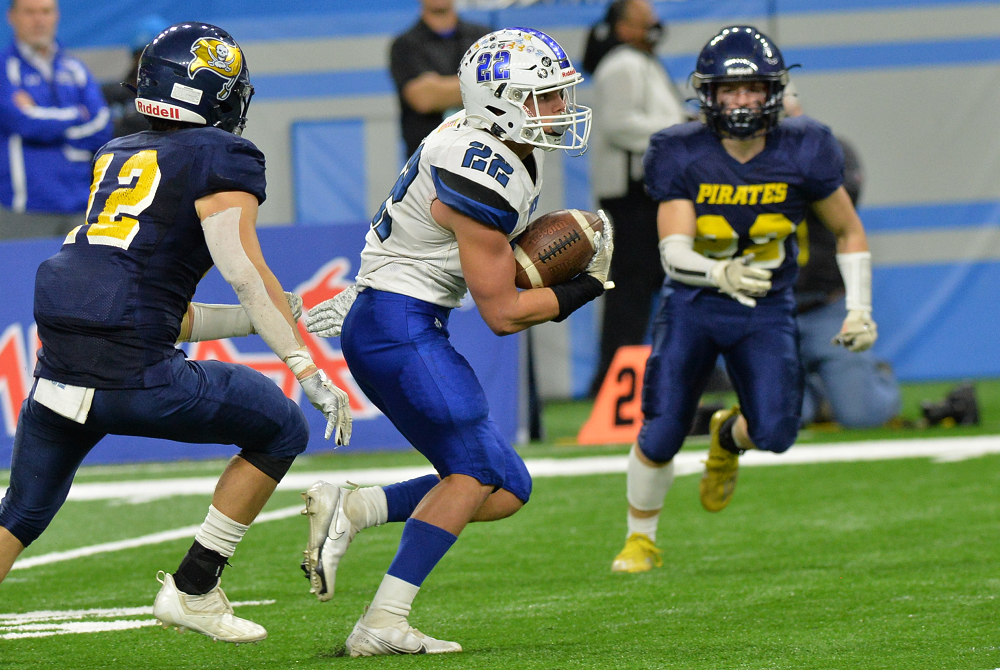
Lawton’s run to the 2021 Division 7 championship game frequently came on the legs of then-senior Jake Rueff, who posted some of the top performances in MHSAA football history.
He scored 298 points – fifth-most in 11-player history – with his 49 total touchdowns ranking fourth and his 46 rushing touchdowns third. He also made records lists with 2,370 rushing yards, 71 career touchdowns and 430 career points.
Lawton as a team scored 92 touchdowns, tying the record with 10 in one game, gained 5,662 yards of total offense and ran for 4,725 yards over 14 games.
Rueff plays at Michigan Tech.
See below for more recent additions to the 11-player football record book:
Football
Aiden Brunin stacked up many contributions on both sides of the field for Cedar Springs in 2021. But his less frequently-mentioned punting earned the senior a spot in the record book as he booted an 83-yard punt during a Nov. 6 playoff win over Muskegon that ranks as the fourth-longest in state history. The kick flew 62 yards in the air before taking a series of bounces and rolls. Brunin currently is a freshman baseball player at Spring Arbor.
Sturgis’ Jacob Thompson became the 10th to return two kickoffs for touchdowns in one game as a junior in 2021, scoring from 97 and 83 yards out against Paw Paw. Thompson also was added to the records for six rushing touchdowns in a Sept. 9, 2022, win over Plainwell – and he also threw for a score in the 55-34 victory.
Twenty years later, Coleman’s Joshua Moore has been added for a pair of interception returns for touchdowns Oct. 11, 2002, against Mount Pleasant Sacred Heart. Moore was a senior that season and scored off those turnovers during the third and fourth quarters.
Nearly a decade later, Cheboygan’s Ben Pearson also was added to the record book for a 99-yard rushing touchdown that tied the record for longest run. Pearson took the handoff deep in his own end zone and scored against Gaylord on Aug. 29, 2013. Pearson, a senior that season, went on to play at Northwood.
A trio of past Grand Ledge standouts have been entered for their achievements going back decades. Mitch Gulker made the record book for 1,002 receiving yards as a senior in 1976. Nick Kissane was added for his 170 completions, 297 pass attempts, 2,452 yards and 29 touchdowns through the air in 2008. Corey Arnouts made the tackles for loss list with 28 as a senior in 2011. Grand Ledge’s Division 1 championship run in 2000 came in part on the arm of Matt Bohnet, and he’s been added for his 2,052 yards passing that season. He went on to play at Iowa and Eastern Michigan. Arnouts went on to play at Ferris State, and Kissane went on to play baseball at Aquinas College.
Justin Brown had multiple returns for touchdowns as a junior at East Lansing in 2018, including a 99-yarder on Sept. 14. That kickoff return tied the record for longest on a list that now stands at 20 players.
Carson Roose earned his 10th record book listing when he threw for five touchdowns during the first half of Grosse Pointe Woods University Liggett’s 58-22 win over New Haven on Oct. 22, 2021. Roose graduated last spring.
Frankenmuth’s run to the Division 6 championship game in the fall saw the Eagles make team record book lists with 544 points and 72 touchdowns over 14 games, featuring as well a kicker who will bring an impressive extra point streak into the upcoming season. Junior Will Soulliere made 69 of 70 extra-point tries and has connected on 61 straight as he prepares for his senior season. Additionally, the Eagles’ defense was added after not allowing a first down during its Semifinal win over Detroit Country Day. Sam Barger was added for a 98-yard kickoff return in 2021, and Ryan Brenner was added for 45 extra points during the abbreviated 2020 season. Barger also is a senior this school year.
West Bloomfield’s run to the 2021 Regional Final was fueled in part by a tough defense, including a pair of pass rushers who rank among the all-time leaders in single-season sacks. Michael Williams II recorded 24 that fall, tied for fourth-most for one season, while Brandon Davis-Swain tied for 12th with 18. Williams, a senior that fall, plays for South Florida, while Davis-Swain is finishing his junior year at West Bloomfield.
PHOTO Lawton’s Jake Rueff (22) breaks into the open during his team’s Division 7 Final matchup with Pewamo-Westphalia in 2021.