


Add, Subtract, Divide, Multiply: MHSAA Not Alone
July 25, 2017
By Rob Kaminski
MHSAA benchmarks editor
This is the third part in a series on MHSAA tournament classification, past and present, that will be published over the next two weeks. This series originally ran in this spring's edition of MHSAA benchmarks.
As the MHSAA faces its most recent classification task with 8-Player Football, and opinions continue to swirl about as to the method, timeframe, location and other procedures, a look around the country provides plenty of company among state association brethren factoring variables into their own equations.
In the Pacific Northwest, the Oregon School Activities Association Football Playoffs are under public scrutiny as leadership ponders a five or six classification format beginning with the 2018-19 school year.
The OSAA has crowned six champions on the gridiron since 2006-07. Many of the state’s smaller schools would like to keep it that way, while larger schools lean toward a five-classification system, citing larger leagues, ease of travel and credibility to state championships as the advantages.
Still others would prefer more than six classes, pointing to safety issues and the opportunity to increase participation numbers as positives.
Moving southeast of Oregon, the Nevada Interscholastic Activities Association recently voted to hold serve on a classification proposal that was volleyed to the membership.
However, changes still could be forthcoming by as early as the 2018-19 season which would add a fifth classification in more populated southern Nevada while allowing northern schools to participate in four classifications. Such divisions could mean no state championship for the fifth class in southern Nevada.
Because of that, the NIAA wants equal numbers of schools in each classification on both ends of the state. Complicating the issue is the fact that the 24 largest schools in the state, by enrollment, are all in Clark County in Southern Nevada.
Across Nevada’s border into Arizona, charter schools are asking the Arizona Interscholastic Association to reconsider classification that was voted upon and approved in September 2015. That agreement called for the largest 33 percent of charter schools by enrollment to be placed in the state’s largest school classification, 3A, the middle 33 percent into 2A, and the smallest 33 percent into 1A.
Less than two years later the charter schools have had a change of heart and have asked to be considered the same as other Arizona public schools and be placed appropriately by enrollment beginning with the 2018-19 school year.
The situation in Arizona further illustrates how the public/private debate that all state associations have faced throughout existence now has the added dynamic of rapidly growing charter schools in today’s educational system, along with virtual school enrollment.
In the nation’s heartland, Nebraska has retooled its football classifications by using enrollment of boys students only in its schools rather than total enrollment. The Nebraska School Activities Association football-playing schools will kick off the 2018 season using this alignment.
Nebraska has three classes of 11-player football, with the smallest class divided in two, Class C-1 and C-2. The state also will have 8-player football for boys enrollments under 47, and the NSAA will sponsor a new 6-player tournament in 2018 for schools with 27 or fewer boys.
“This is a good proposal because some schools have a sizable imbalance between the number of boys and girls, and there’s a large gap (in enrollment) between the largest and smallest schools in Classes A and B,” NSAA executive director Jim Tenopir said. “I think this addresses both of those concerns.”
Swimmers in Georgia, meanwhile, will feel like they are moving with the current, rather than upstream in 2017-18, as the Georgia High School Association recently doubled the number of team championship events from two to four.
Swim enthusiasts can also count on longer days at the finals, as the top 30 finishers from the prelims will advance to the finals instead of 20, and all championship events will have three heats versus two.
Preview: Reigning Champions Seeking Repeat Performances at Midland Tennis Center
By
Geoff Kimmerly
MHSAA.com senior editor
May 26, 2026
As with the MHSAA boys championship tournaments this past fall, the Lower Peninsula Girls Tennis Finals over the next two weeks will have a new look – although familiarity reigns as last year’s four team champions are the favorites again in their respective divisions.
Northville, Birmingham Seaholm, Detroit Country Day and Ann Arbor Greenhills will look to maintain their supremacy all at Midland Tennis Center, beginning with Division 4 today and Thursday, followed by Division 1 this Friday and Saturday, and then Division 2 on June 3 and 4 and Division 3 over June 5 and 6.
Below are details on those top-ranked teams and more contenders to watch during all four Finals:
Division 1
Top-ranked: 1. Northville, 2. Utica Eisenhower, 3. Novi.
Northville is the reigning champion, and Utica Eisenhower has finished second the last two seasons and is seeking its first title. Northville claimed last year’s team trophy by just a point, and third-place Novi was only four back of the lead and also enters this weekend seeking a first Finals championship.
Northville: The Mustangs will pursue a repeat with six seeded flights and potentially powered by doubles with juniors Sravya Doppalapudi and Francine Ong seeded first at No. 2 and senior Michelle Lee and junior Emma Murphy seeded first at No. 4. All four doubles pairs are seeded third or higher, as is sophomore Grace Xu at No. 3 singles. Doppalapudi and Ong were champions at No. 3 doubles last season, Murphy was part of the No. 4 champion, juniors Lucia Lachapelle and Aadya Pullalarevu were runners-up at No. 2 and are second-seeded at No. 3 this time, and junior Emmi Dober is part of the third-seeded No. 1 pair after finishing second at No. 3 singles in 2025.
Utica Eisenhower: The Eagles just missed a first title last year, and they are loaded especially at singles with six flights total seeded for the weekend. Senior Gabriella Sadowski is seeded second at No. 1 singles after winning the flight as a sophomore and finishing runner-up a year ago. Sophomore Morgan Emerick is seeded first at No. 2 and the reigning champion in that bracket, and senior Sofia Gardner is seeded second at No. 4. Sadowski and Emerick are undefeated this spring. Senior Alexis Gabriel has been part of No. 1 and No. 2 doubles champions over the last two seasons and is seeded fourth at No. 1 this time with junior Kara Lu.
Ann Arbor Pioneer: The Pioneers were ranked No. 4 in the most recent poll and seeded to make a move after finishing seventh a year ago. They are seeded at all four singles flights and two doubles flights, with sophomores Maryn Etheridge and Ayla Altinsel the top seed at No. 3 doubles.
Saline senior Emerson Jones: She’s the top seed at No. 1 singles and 18-0 in her only season playing high school tennis, with 11 wins (including her last four) by 6-0, 6-0 scores.
Clarkston junior Kayla Lemke: The third seed at No. 1 singles is 20-2 with her only losses to Saline’s Jones and Eisenhower’s Sadowski.
Rochester Hills Stoney Creek junior Larissa Yoshino/sophomore Yousong Choi: The top-seeded pair at No. 1 doubles is 19-1 with its only loss in three sets to Eisenhower’s Gabriel and Lu.
Division 2
Top-ranked: 1. Birmingham Seaholm, 2. Grand Rapids Forest Hills Northern, 3. Farmington Hills Mercy.
Reigning champion Seaholm has won two of the last three titles and finished first or second the last four seasons. Forest Hills Northern most recently won this tournament in 2024 and owns three of the five championships in Division 2 this decade. Mercy finished runner-up to Seaholm last year and is seeking its first team Finals title in this sport.
Birmingham Seaholm: The Maples will be tough to catch with seven top-seeded flights – sophomore Devon Rusk at No. 2 singles, junior Sabrina Dunn at No. 3, junior Izzy Bloom at No. 4, senior Lucy Jen and junior Sophia Arndt at No. 1 doubles, senior Anna Olekszyk and junior Katie Joyce at No. 2, junior Cate French and senior Kate Crowley at No. 3 and junior Alina Villaire and senior Jacqueline Supancich the top-seeded No. 4 pair. Senior Jada Josifovski is the sixth-seeded player at No. 1 singles and won No. 2 a year ago. Olekszyk and Arndt won No. 2 doubles last spring, Crowley and French won No. 3, Joyce and Villaire won No. 4 and Jen was part of the runner-up at No. 1. Bloom was the runner-up at No. 4 singles in 2025.
Grand Rapids Forest Hills Northern: The Huskies finished third a year ago and will make a run at the top spots led by four second-seeded flights – senior Harriet Ogilvie at No. 1 singles, sophomore Audrey Kowatch at No. 4, sophomore Hayla Messelink and senior Hailey Pfeiffle at No. 3 doubles and senior Maddie Decker and freshman Mercedes Acevedo at No. 4. Senior Ava Targosz and sophomore Sadie Wolfe are seeded fifth at No. 2 doubles after finishing runner-up at No. 4 last year.
Farmington Hills Mercy: The Marlins will look to make up seven points from last year’s runner-up finish with five flights seeded among the top three in their respective brackets. Seniors Alexa Dueweke and Scarlett Manchinger are second seeds at Nos. 2 and 3 singles, respectively, and sophomore Anna Naida and senior Gabby Owens are second-seeded at No. 2 doubles. Owens was the champion at No. 4 singles last season, and senior Keira Kirkland was the runner-up at No. 2 and is seeded third at No. 1 this weekend.
Ana Cheng, Mattawan senior: The top-seeded player at No. 1 singles is 24-2 with a win over Ogilvie just two weeks ago but a loss to Kirkland at the start of May. Cheng reached the quarterfinals at No. 1 last season as the seven seed.
Division 3
Top-ranked: 1. Detroit Country Day, 2. East Grand Rapids, 3. Bloomfield Hills Marian.
Country Day is seeking to run its latest championship streak to three, and East Grand Rapids in 2009 is the last team not Country Day or Bloomfield Hills Cranbrook Kingswood to win the Division 3 title. The Pioneers are seeking to make a jump from sixth last season. Marian finished third a year ago and most recently won a championship in 2016 in Division 2.
Detroit Country Day: Five top seeds will lead the Yellowjackets’ pursuit. Sophomore Chloe Conniff is on the top line at No. 1 singles after finishing second at No. 2 last year, and sophomore Karishma Vakhariya is the top seed at No. 2 coming off the championship at No. 3. Junior Quinn Norlander and senior Helen Benjamin are top-seeded at No. 1 doubles and familiar with this stage as well; Benjamin has won two singles titles including at No. 4 last season, and Norlander was part of last spring’s No. 1 doubles runner-up. Sophomore Grace Kalkanis was part of the No. 4 champion last season and is seeded first at No. 2 with sophomore Zoe Bergg, and senior Jiya Gill and sophomore Zoe Grebinski are top-seeded at No. 4 this time. Sophomore Addie Grebinski is seeded third at No. 3 singles and senior Noor Mahmoud is part of the third-seeded pair at No. 3 doubles after they teamed up to finish runner-up at No. 2 doubles in 2025.
East Grand Rapids: Seven of eight EGR flights are seeded, and all seven are seeded fourth or higher with freshman Evelyn Gingras leading the way on the top line at No. 3 singles. Sophomore Mia Owings also is forecasted to play for a flight championship as the second seed at No. 4 singles.
Bloomfield Hills Marian: Seven flights are seeded and with several championship match expectations. Freshman Gwen Slapak is the top seed at No. 4 singles, with senior Emerson Turkot and junior Stella Glorio the second seed at No. 2 doubles, freshman Emerson Villalba and junior Lexa Hindo second-seeded at No. 3 and juniors Lizzie Plunkett and Clare Reaume the second seed at No. 4. Glorio and Hindo were the champions at No. 3 last season.
Henley Honholt, Grand Rapids Christian sophomore: The second seed at No. 1 singles is 16-1 with her only loss to Country Day’s Conniff. Honholt reached the semifinals as the third seed last season.
Lilah Zaskowski, Ada Forest Hills Eastern junior: After reaching the quarterfinals last season as the sixth seed, she’s back as the third in the No. 1 singles bracket with three of her four loses to Honholt or Conniff.
Division 4
Top-ranked: 1. Ann Arbor Greenhills, 2. Pontiac Notre Dame Prep, 3. Allegan.
Greenhills has won the last four Division 4 championships, and Notre Dame Prep has finished second the last two seasons – which have been the Fighting Irish’s highest Finals finishes as they continue to pursue a first title. Allegan is seeking its first as well and has four runner-up finishes, its most recent in 2013 in Division 3.
Ann Arbor Greenhills: Junior Nina Malani at No. 1 singles and freshman Jahan Soofi at No. 4 are on the top lines of their respective brackets, and similarly seniors Danica Rakic-Dennis and Lauren Ye are seeded first at No. 1 doubles and senior Aoife Tang and sophomore Linnea Bengtson are the top seed at No. 4. The other four flights are seeded second or third in their brackets. Malani won No. 4 singles last season and sophomore Hazel Morgan is seeded third at No. 2 this time after winning No. 3 in 2025. Rakic-Dennis was part of the champion at No. 1 doubles and Ye part of the winning pair at No. 3 last spring with junior Alyssa Hong, who is joined by junior Jessica Lou on the third-seeded No. 2 doubles pair.
Pontiac Notre Dame Prep: The Irish will attempt to cut into Greenhills’ advantage led by sophomores Vanessa Artinian and Regina Carpenese holding down the top seed at No. 2 doubles and senior Nina Shanidze seeded second at No. 3 singles. Artinian was part of the No. 4 doubles champion last year – with sophomore Elena Vandieren, who is playing No. 1 doubles with sophomore Adriana Dedukaj – and senior Adriana Johnson was part of the runner-up at No. 3 and with freshman Adrienne Hofley is seeded sixth at that flight this time. Junior Ana Jarvis is playing No. 1 singles after finishing runner-up at No. 3 a year ago.
Allegan: The Tigers are seeded at six flights and especially powerful in doubles. Seniors Sophia Augustine and Emma Scheffler are the top seed at No. 3, with junior Ireland Dewey and senior Madison Cook the second seed at No. 1 and seniors Taylor Fuller and Hanna Kievit second-seeded at No. 2.
Sonya Jayakar, Grosse Pointe Woods University Liggett sophomore: After opening this season with a pair of defeats – including the first to Malani – Jayakar has run off 12 straight wins. She reached the quarterfinals at No. 1 while unseeded as a freshman.
Eliana McClellan, Traverse City St. Francis junior: She finished runner-up at No. 2 singles last season, and her only losses this spring were during the first event – against Malani and Saline’s Jones.
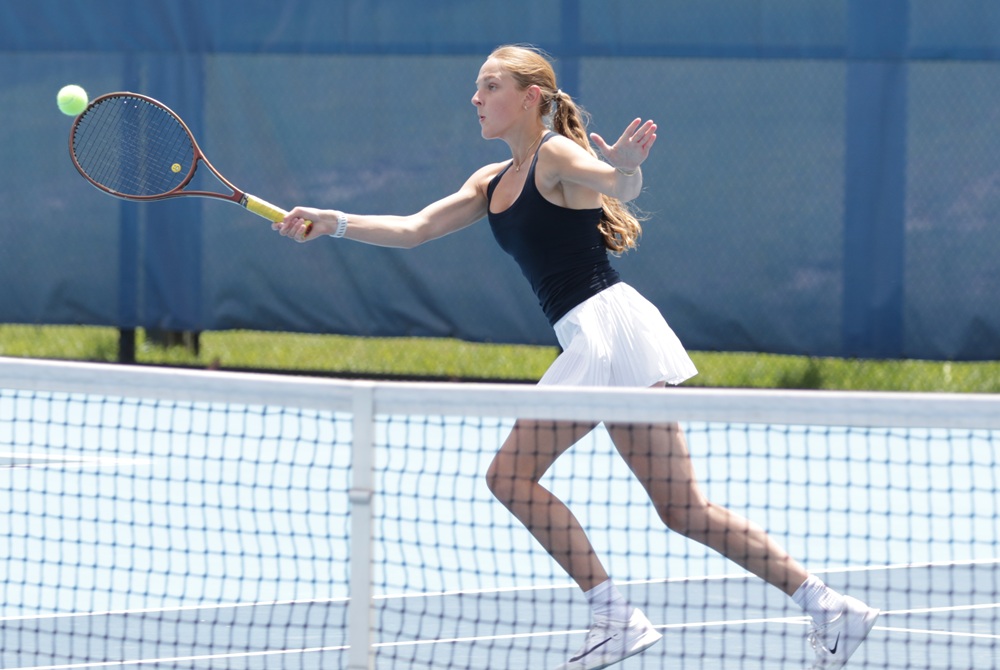
PHOTO Detroit Country Day's Quinn Norlander gets to a ball near the net during the 2025 Division 3 Finals. (Click for more from High School Sports Scene.)