


Add, Subtract, Divide, Multiply: MHSAA Not Alone
July 25, 2017
By Rob Kaminski
MHSAA benchmarks editor
This is the third part in a series on MHSAA tournament classification, past and present, that will be published over the next two weeks. This series originally ran in this spring's edition of MHSAA benchmarks.
As the MHSAA faces its most recent classification task with 8-Player Football, and opinions continue to swirl about as to the method, timeframe, location and other procedures, a look around the country provides plenty of company among state association brethren factoring variables into their own equations.
In the Pacific Northwest, the Oregon School Activities Association Football Playoffs are under public scrutiny as leadership ponders a five or six classification format beginning with the 2018-19 school year.
The OSAA has crowned six champions on the gridiron since 2006-07. Many of the state’s smaller schools would like to keep it that way, while larger schools lean toward a five-classification system, citing larger leagues, ease of travel and credibility to state championships as the advantages.
Still others would prefer more than six classes, pointing to safety issues and the opportunity to increase participation numbers as positives.
Moving southeast of Oregon, the Nevada Interscholastic Activities Association recently voted to hold serve on a classification proposal that was volleyed to the membership.
However, changes still could be forthcoming by as early as the 2018-19 season which would add a fifth classification in more populated southern Nevada while allowing northern schools to participate in four classifications. Such divisions could mean no state championship for the fifth class in southern Nevada.
Because of that, the NIAA wants equal numbers of schools in each classification on both ends of the state. Complicating the issue is the fact that the 24 largest schools in the state, by enrollment, are all in Clark County in Southern Nevada.
Across Nevada’s border into Arizona, charter schools are asking the Arizona Interscholastic Association to reconsider classification that was voted upon and approved in September 2015. That agreement called for the largest 33 percent of charter schools by enrollment to be placed in the state’s largest school classification, 3A, the middle 33 percent into 2A, and the smallest 33 percent into 1A.
Less than two years later the charter schools have had a change of heart and have asked to be considered the same as other Arizona public schools and be placed appropriately by enrollment beginning with the 2018-19 school year.
The situation in Arizona further illustrates how the public/private debate that all state associations have faced throughout existence now has the added dynamic of rapidly growing charter schools in today’s educational system, along with virtual school enrollment.
In the nation’s heartland, Nebraska has retooled its football classifications by using enrollment of boys students only in its schools rather than total enrollment. The Nebraska School Activities Association football-playing schools will kick off the 2018 season using this alignment.
Nebraska has three classes of 11-player football, with the smallest class divided in two, Class C-1 and C-2. The state also will have 8-player football for boys enrollments under 47, and the NSAA will sponsor a new 6-player tournament in 2018 for schools with 27 or fewer boys.
“This is a good proposal because some schools have a sizable imbalance between the number of boys and girls, and there’s a large gap (in enrollment) between the largest and smallest schools in Classes A and B,” NSAA executive director Jim Tenopir said. “I think this addresses both of those concerns.”
Swimmers in Georgia, meanwhile, will feel like they are moving with the current, rather than upstream in 2017-18, as the Georgia High School Association recently doubled the number of team championship events from two to four.
Swim enthusiasts can also count on longer days at the finals, as the top 30 finishers from the prelims will advance to the finals instead of 20, and all championship events will have three heats versus two.
Mustangs Pull Ahead During Final Events with Championship-Clinching Speed
By
Dan D'Addona
Special for Second Half
November 19, 2022
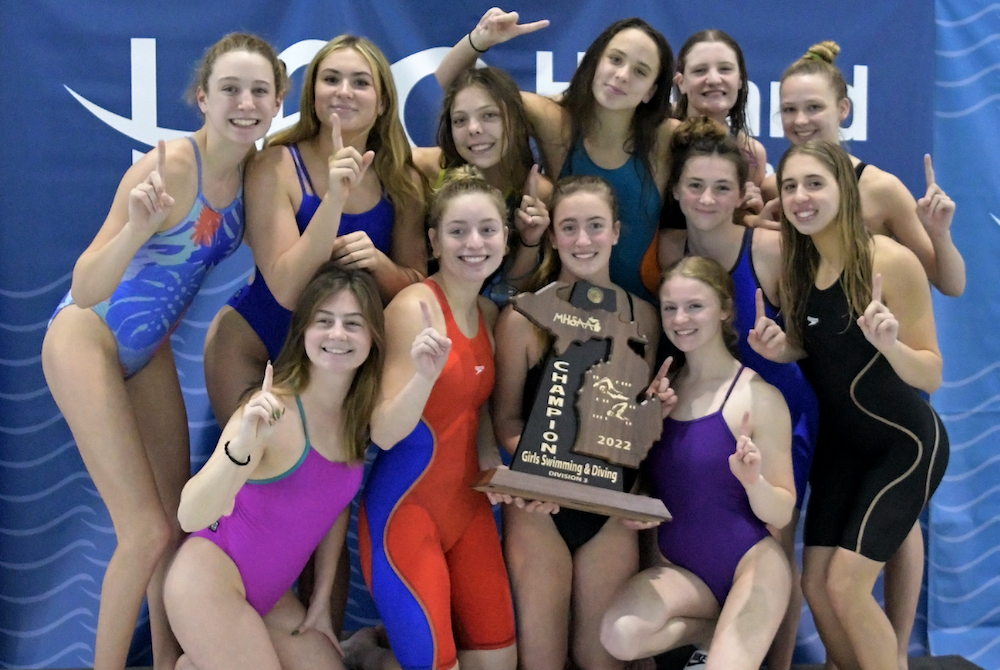
HOLLAND – Bloomfield Hills Marian and Holland Christian were in a fight to the finish at the Saturday’s Lower Peninsula Division 3 Swimming & Diving Finals.
Marian used a late surge to hold off the home-pool Maroons and win the championship with 245 points.
Holland Christian was second with 230.5, followed by Milan (208), while Adrian (154.5), Grand Rapids Christian (148.5), Wayland (130), Bloomfield Hills Cranbrook Kingswood (128.5), Pontiac Notre Dame Prep (90), Detroit Country Day (87) and Dundee (82) rounded out the top 10.
"When it came down to it, I knew we needed a lead going into the 400 free relay. Milan and Holland Christian perform so well every year," Marian coach Dave Eichenhorn said. "We knew it would be a major task. The girls bought in. There was nothing but faith and trust. I am not surprised by the performance, but I am surprised at how great it was."
The meet started with Bloomfield Hills Marian winning the 200 medley relay. Lily Low, Rachel Bello, Marianna Becharas and Axelle Ballarin won the event in 1:48.67. Holland Christian was second (1:49.63) and Wayland was third (1:49.94).
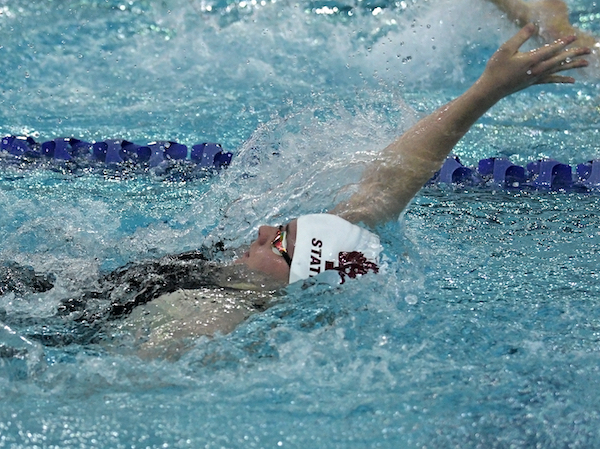 Bello won the 100 breaststroke as well to help clinch the title, overcoming the points deficit on paper heading into the Finals. Marian entered the meet ranked No. 3 behind Holland Christian and Milan.
"It is the overall energy of the team. It is so positive and encouraging," Bello said. "The energy never stopped. It means so much to us. We haven't won since 2014, and it was such a close meet. I couldn't ask for a better state meet."
The Maroons were close and led a couple of times late before Marian's stellar final three events. The runner-up finish was Holland Christian's highest since 1997.
"We talked about being content with whatever we walked away with. Today, this is what we had and they just happened to have some really talented girls who swam really well this weekend," Holland Christian coach Lisa Myrick said. "They had more than we had today.”
Here is a look at how the events unfolded:
The 200 freestyle was won by Milan's Annabelle Williams (1:54.09), finishing ahead of Detroit Country Day's Ella Dziobak (1:54.45) and Trenton's Sophia Shaul (1:54.51).
Bello claimed the 200 IM in 2:06.08, ahead of Flat Rock's Lauren McNamara (2:07.21) and Standish's Scarlet Maison (2:08.30).
Wayland's Laney Wolf won the 50 freestyle in 23.89, ahead of Adrian's Ella Salenbien (24.39) and Ogemaw Heights' Kiera Danitz.
Grosse Ile's Kaitlyn Molnar won diving (360.05), ahead of Haslett's Ali Viaches (340.00) and Hamilton's Anevay Hager (336.5).
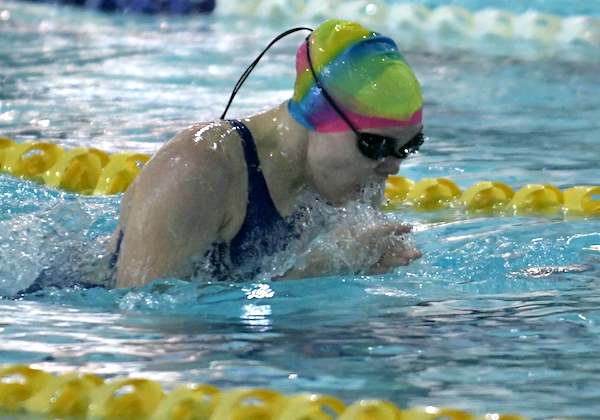 In the 100 butterfly, Flat Rock's McNamara won in 55.26, ahead of Notre Dame Prep's Emma Ciesla (58.29) and South Haven's Abby Wettlaufer (59.46).
Wolf doubled up after winning the 50 free and claimed the 100 free in 51.93. St. John's Ella Schafer was second (52.24), followed by Milan's Annabelle Williams (52.46).
Dziobak won the 500 freestyle in 5:04.23, followed by Shaul (5:04.30) and Milan's Phoebe Rhoney (5:18.18).
Marian's Low, Ballarin, Lena McKenney and Bello won the 200 freestyle relay (1:38.72) ahead of Holland Christian (1:39.55) and Milan (1:39.77).
Cranbrook Kingswood's Julijana Jelic won the 100 backstroke in 57.35, ahead of Ionia's Madeline McGee (59.19) and Dundee's Joslyn Ball (59.49).
Bello won the 100 breaststroke in 1:05.44, ahead of Mason (1:06.91) and Schaefer (1:07.24).
Adrian's Francesca Scarabottolo, Eleanora Andre, Emily Hess and Ella Salenbien won the 400 free relay (3:37.18). Milan was second (3:37.83), and Marian was third (3:41.85).
PHOTOS by High School Sports Scene.