

Add, Subtract, Divide, Multiply: MHSAA Not Alone
July 25, 2017
By Rob Kaminski
MHSAA benchmarks editor
This is the third part in a series on MHSAA tournament classification, past and present, that will be published over the next two weeks. This series originally ran in this spring's edition of MHSAA benchmarks.
As the MHSAA faces its most recent classification task with 8-Player Football, and opinions continue to swirl about as to the method, timeframe, location and other procedures, a look around the country provides plenty of company among state association brethren factoring variables into their own equations.
In the Pacific Northwest, the Oregon School Activities Association Football Playoffs are under public scrutiny as leadership ponders a five or six classification format beginning with the 2018-19 school year.
The OSAA has crowned six champions on the gridiron since 2006-07. Many of the state’s smaller schools would like to keep it that way, while larger schools lean toward a five-classification system, citing larger leagues, ease of travel and credibility to state championships as the advantages.
Still others would prefer more than six classes, pointing to safety issues and the opportunity to increase participation numbers as positives.
Moving southeast of Oregon, the Nevada Interscholastic Activities Association recently voted to hold serve on a classification proposal that was volleyed to the membership.
However, changes still could be forthcoming by as early as the 2018-19 season which would add a fifth classification in more populated southern Nevada while allowing northern schools to participate in four classifications. Such divisions could mean no state championship for the fifth class in southern Nevada.
Because of that, the NIAA wants equal numbers of schools in each classification on both ends of the state. Complicating the issue is the fact that the 24 largest schools in the state, by enrollment, are all in Clark County in Southern Nevada.
Across Nevada’s border into Arizona, charter schools are asking the Arizona Interscholastic Association to reconsider classification that was voted upon and approved in September 2015. That agreement called for the largest 33 percent of charter schools by enrollment to be placed in the state’s largest school classification, 3A, the middle 33 percent into 2A, and the smallest 33 percent into 1A.
Less than two years later the charter schools have had a change of heart and have asked to be considered the same as other Arizona public schools and be placed appropriately by enrollment beginning with the 2018-19 school year.
The situation in Arizona further illustrates how the public/private debate that all state associations have faced throughout existence now has the added dynamic of rapidly growing charter schools in today’s educational system, along with virtual school enrollment.
In the nation’s heartland, Nebraska has retooled its football classifications by using enrollment of boys students only in its schools rather than total enrollment. The Nebraska School Activities Association football-playing schools will kick off the 2018 season using this alignment.
Nebraska has three classes of 11-player football, with the smallest class divided in two, Class C-1 and C-2. The state also will have 8-player football for boys enrollments under 47, and the NSAA will sponsor a new 6-player tournament in 2018 for schools with 27 or fewer boys.
“This is a good proposal because some schools have a sizable imbalance between the number of boys and girls, and there’s a large gap (in enrollment) between the largest and smallest schools in Classes A and B,” NSAA executive director Jim Tenopir said. “I think this addresses both of those concerns.”
Swimmers in Georgia, meanwhile, will feel like they are moving with the current, rather than upstream in 2017-18, as the Georgia High School Association recently doubled the number of team championship events from two to four.
Swim enthusiasts can also count on longer days at the finals, as the top 30 finishers from the prelims will advance to the finals instead of 20, and all championship events will have three heats versus two.
East Grand Rapids, Chelsea's Alford Take Next Steps as 1st-Time Finals Winners
November 5, 2022
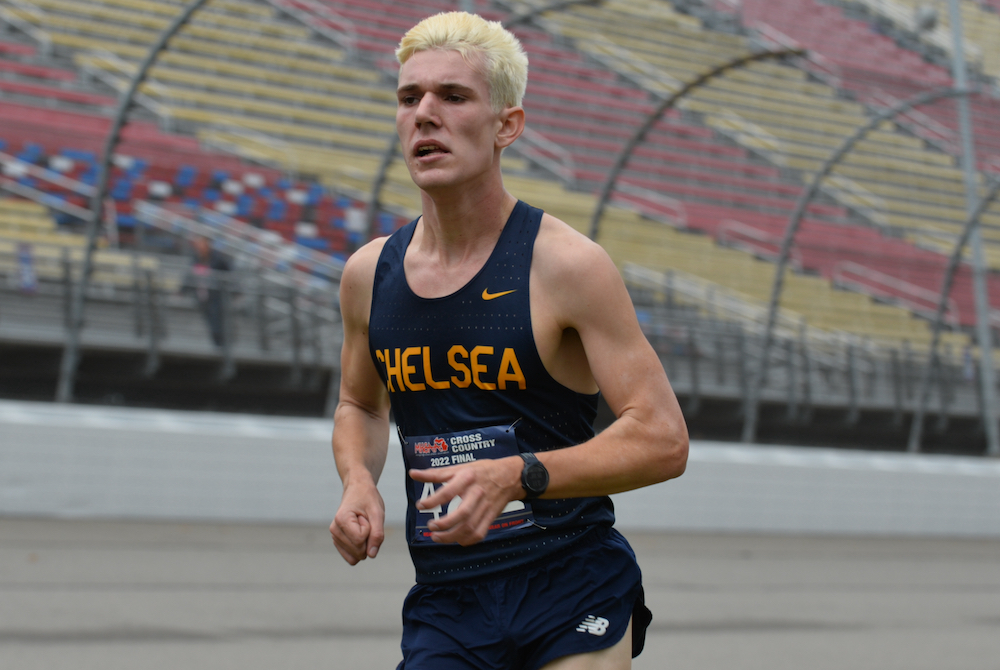
BROOKLYN – The seeds that bore fruit Saturday for Chelsea junior Connell Alford were planted five years ago.
After making his first trip to watch the MHSAA Lower Peninsula Cross Country Finals at Michigan International Speedway as a sixth grader, Alford began setting lofty goals for himself.
“In 2017, Chelsea won the team title,” Alford said. “That was my first state meet. Then I saw one of our runners get fifth. I thought, ‘You know what, I want to be a state champion one day.’ Since then, it’s always been a goal.”
Alford isn’t the only runner to dream of becoming a state champion, but he was able to make that dream a reality.
He dominated the field in the Lower Peninsula Division 2 meet, posting a time of 15:12.61 to outpace runner-up Carter McCalister of Monroe Jefferson by 24.93 seconds.
Running solo up front meant having to bear the full brunt of a strong wind. But Alford didn’t want to leave anything to chance after getting outkicked for fourth place last year by Dearborn Divine Child’s Michael Hegarty. Hegarty was fourth this year.
 “I feel like there’s always a wind like that in the last 100 meters, like last year when I got fourth and got outkicked,” Alford said. “My game plan this year was don’t be in the final straight with anyone so I can’t be outkicked.”
Alford was the prohibitive favorite in Division 2 all season after winning eight of nine meets on his way to MIS and breaking 15 minutes twice. He didn’t see it that way.
“I still can’t totally believe it happened,” he said. “I knew with my performances there would be a shot, but after Regionals it was all open. It could have been anyone. We had super-fast Regionals. I knew there were crazy-fast people in the Regionals. It was still up for grabs in my mind.”
For the second-straight year, a runner from the Southeastern Conference White won the Division 2 title. Alford was preceded atop the podium by Pinckney’s Caleb Jarema, who now runs for the University of Michigan.
“I think last year I had Caleb Jarema in almost every race I ran,” Alford said. “That really helped. I learned stuff he did. I knew I could go off of what he did. He was such a strong runner. I used him as a model of, ‘Hey, I’m going to train so I can do that, too.’”
The SEC White flexed its collective muscles again in Division 2, with three of the top four teams hailing from that six-school division.
East Grand Rapids won the meet with 132 points, but the next three teams were from the SEC White. Chelsea was only five points out of first, Pinckney was 11 back and Adrian was 32 back.
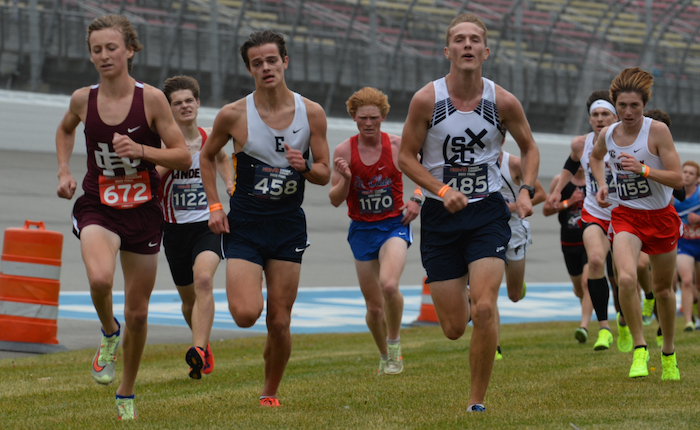
While Chelsea, Pinckney and Adrian had runners in the top 10, East Grand Rapids won with the strength of its pack.
The Pioneers didn’t have a finisher until junior Ryan Brinker crossed in 28th place in 16:19.01, but he soon had company. Junior Alex Thole was 33rd (16:28.79), senior Elijah Robinson was 36th (16:30.52), freshman Jonah Workman was 45th (16:38.09) and junior Davis Christy was 46th (16:40.83).
The team title was the first in boys cross country for the Pioneers.
PHOTOS (Top) Chelsea’s Connell Alford travels the final paces of his LPD2 championship run Saturday. (Middle) East Grand Rapids’ Davis Christy (458) is among leaders of a pack heading toward the finish. (Click for more from Dave McCauley/RunMichigan.com.)