


Add, Subtract, Divide, Multiply: MHSAA Not Alone
July 25, 2017
By Rob Kaminski
MHSAA benchmarks editor
This is the third part in a series on MHSAA tournament classification, past and present, that will be published over the next two weeks. This series originally ran in this spring's edition of MHSAA benchmarks.
As the MHSAA faces its most recent classification task with 8-Player Football, and opinions continue to swirl about as to the method, timeframe, location and other procedures, a look around the country provides plenty of company among state association brethren factoring variables into their own equations.
In the Pacific Northwest, the Oregon School Activities Association Football Playoffs are under public scrutiny as leadership ponders a five or six classification format beginning with the 2018-19 school year.
The OSAA has crowned six champions on the gridiron since 2006-07. Many of the state’s smaller schools would like to keep it that way, while larger schools lean toward a five-classification system, citing larger leagues, ease of travel and credibility to state championships as the advantages.
Still others would prefer more than six classes, pointing to safety issues and the opportunity to increase participation numbers as positives.
Moving southeast of Oregon, the Nevada Interscholastic Activities Association recently voted to hold serve on a classification proposal that was volleyed to the membership.
However, changes still could be forthcoming by as early as the 2018-19 season which would add a fifth classification in more populated southern Nevada while allowing northern schools to participate in four classifications. Such divisions could mean no state championship for the fifth class in southern Nevada.
Because of that, the NIAA wants equal numbers of schools in each classification on both ends of the state. Complicating the issue is the fact that the 24 largest schools in the state, by enrollment, are all in Clark County in Southern Nevada.
Across Nevada’s border into Arizona, charter schools are asking the Arizona Interscholastic Association to reconsider classification that was voted upon and approved in September 2015. That agreement called for the largest 33 percent of charter schools by enrollment to be placed in the state’s largest school classification, 3A, the middle 33 percent into 2A, and the smallest 33 percent into 1A.
Less than two years later the charter schools have had a change of heart and have asked to be considered the same as other Arizona public schools and be placed appropriately by enrollment beginning with the 2018-19 school year.
The situation in Arizona further illustrates how the public/private debate that all state associations have faced throughout existence now has the added dynamic of rapidly growing charter schools in today’s educational system, along with virtual school enrollment.
In the nation’s heartland, Nebraska has retooled its football classifications by using enrollment of boys students only in its schools rather than total enrollment. The Nebraska School Activities Association football-playing schools will kick off the 2018 season using this alignment.
Nebraska has three classes of 11-player football, with the smallest class divided in two, Class C-1 and C-2. The state also will have 8-player football for boys enrollments under 47, and the NSAA will sponsor a new 6-player tournament in 2018 for schools with 27 or fewer boys.
“This is a good proposal because some schools have a sizable imbalance between the number of boys and girls, and there’s a large gap (in enrollment) between the largest and smallest schools in Classes A and B,” NSAA executive director Jim Tenopir said. “I think this addresses both of those concerns.”
Swimmers in Georgia, meanwhile, will feel like they are moving with the current, rather than upstream in 2017-18, as the Georgia High School Association recently doubled the number of team championship events from two to four.
Swim enthusiasts can also count on longer days at the finals, as the top 30 finishers from the prelims will advance to the finals instead of 20, and all championship events will have three heats versus two.
Hamlin Breaks Escanaba's 48-Year-Old High Jump Record, Climbing List of State's Best
By
Adam Hinch
Special for MHSAA.com
May 7, 2026
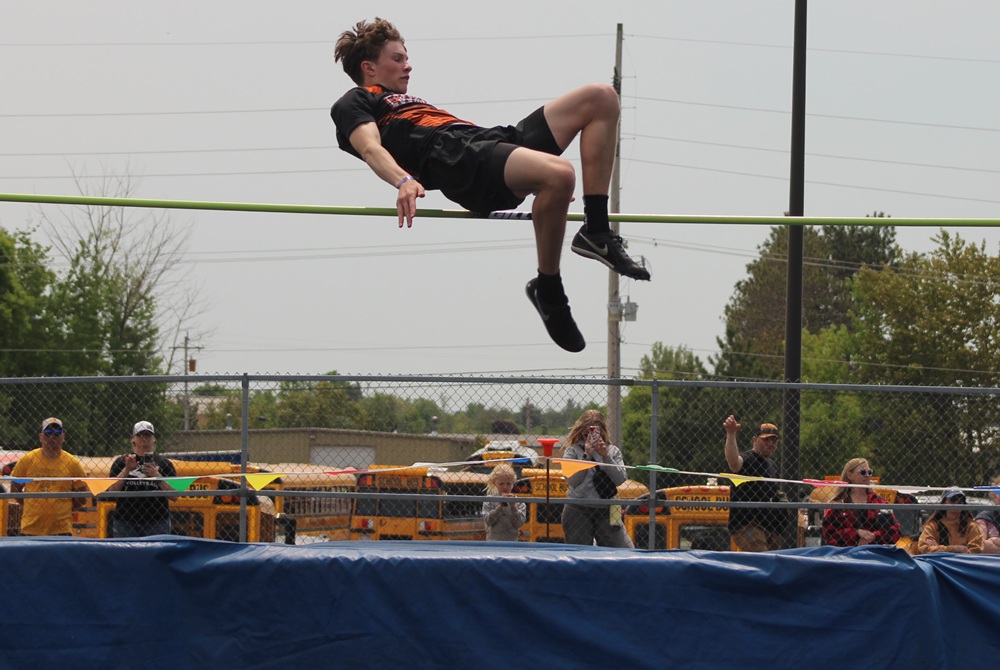
ESCANABA — Over the last three seasons, Escanaba sophomore Andrew Hamlin has shown big gains annually in the high jump – and this year he has broken Escanaba High School’s record not once but twice, with plenty of opportunities remaining to better his best performance.
 Hamlin took his first jumps in seventh grade but did not actively start competing until his eighth-grade year at Holy Name School in Escanaba.
“I remember the meet in Bark River,” Hamlin said. “I used to go off my right side with my left leg and then switched halfway through the season and ended up breaking the record.”
Hamlin broke Holy Name’s school record at the Escanaba Junior High Invitational with a jump of 5-foot-7 on May 14, 2024.
He also came in 11th at the Upper Peninsula Division 3 Finals that spring with a jump of 5-4 as one of only two eighth graders to compete in the Division 3 boys high jump that day.
“I knew Andrew since he was in fourth grade,” Holy Name athletic director Tony Derkos said. “He is a great kid, and track really gives him a chance to be his own athlete.”
Hamlin switched to Escanaba High School as a freshman and had a jump of 6-foot at the Division 1 Regional in Escanaba last spring. He then came through with a jump of 6-2 at the UP Finals in Kingsford where he was finished second as one of only two freshmen to place among the top 10.
“I really enjoy the competitiveness of the sport,” Hamlin said. “It definitely helps to fuel you as an athlete to improve every time out.”
Hamlin also has a personal coach, Hugo Munoz, who was a member of the Peru national team and competed in the 1996 and 2000 Summer Olympics.
Hamlin has competed in two high jump camps, one in Wisconsin and most recently one in New Prague, Minn.
 Now a sophomore, he broke the high jump record for Escanaba High School with a jump of 6-6 on April 21at the Delta County Invite in Gladstone. The previous record was set in 1978 by Keenan Failing.
“It meant a lot to get the record,” Hamlin said. “It was one of the goals for the season coming in, and I was just kind of surprised that it happened this early in the season.”
That record lasted for 10 days until the Escanaba Invitational on May 1, when Hamlin completed a jump of 6-7. That height ranks eighth statewide this season and first among Upper Peninsula jumpers.
“I have to adjust my goals for the season,” Hamlin said. “I never thought I would hit this high of a height this early in the season, so now I’m just trying to stay consistent and improve my height when I can.”
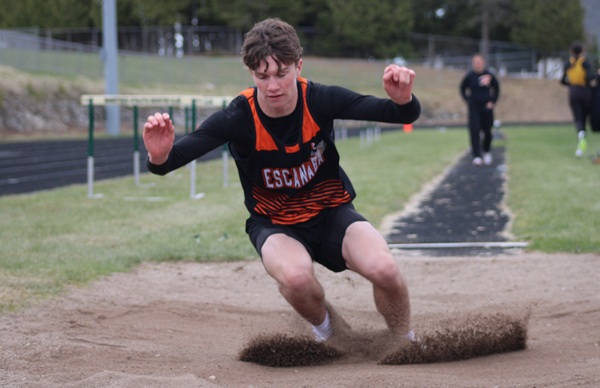
Hamlin will be taking part in the Nike Nationals this summer as well as some other high jump events. He also competes for Escanaba in the long jump, 400 meters and 1,600 relay, and plays football and basketball for his school.
“He’s everything you want in an athlete,” Eskymos track coach Scott Dykema said. “He is a good competitor and is always working on his game and what he can do to improve every time he goes out.”
Hamlin has overcome various injuries but works to get back in action as soon as he can.
“He never lets injuries keep him down,” Derkos said. “He is a tough kid and battles through injuries, and that is the sign of a natural competitor – which is what he is.”
Hamlin has aspirations of taking the high jump to the collegiate level and said he also enjoys distance running. He competes in 5K races and said he would enjoy running a marathon at some point.
“I think it would be fun to run a marathon,” Hamlin said. “That would come after college as there is so much time and training that goes into preparing for a marathon, but definitely something I would have interest in down the road.”
Hamlin has at least four track meets left this season as Escanaba will compete in Negaunee on May 8, at the Division 1 Regional at Manistique on May 13, and at Gladstone and Gaylord as well before finishing at the UP Finals on May 30 in Kingsford.
PHOTOS (Top) Escanaba’s Andrew Hamlin soars over the high jump bar during a meet. (Middle) Hamlin completes a turn in the long jump pit. (Photos by Adam Hinch.)