

Add, Subtract, Divide, Multiply: MHSAA Not Alone
July 25, 2017
By Rob Kaminski
MHSAA benchmarks editor
This is the third part in a series on MHSAA tournament classification, past and present, that will be published over the next two weeks. This series originally ran in this spring's edition of MHSAA benchmarks.
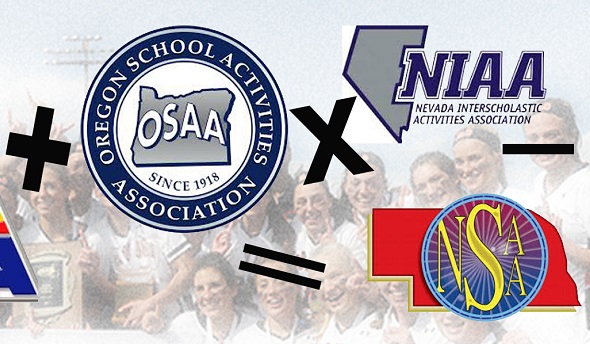
As the MHSAA faces its most recent classification task with 8-Player Football, and opinions continue to swirl about as to the method, timeframe, location and other procedures, a look around the country provides plenty of company among state association brethren factoring variables into their own equations.
In the Pacific Northwest, the Oregon School Activities Association Football Playoffs are under public scrutiny as leadership ponders a five or six classification format beginning with the 2018-19 school year.
The OSAA has crowned six champions on the gridiron since 2006-07. Many of the state’s smaller schools would like to keep it that way, while larger schools lean toward a five-classification system, citing larger leagues, ease of travel and credibility to state championships as the advantages.
Still others would prefer more than six classes, pointing to safety issues and the opportunity to increase participation numbers as positives.
Moving southeast of Oregon, the Nevada Interscholastic Activities Association recently voted to hold serve on a classification proposal that was volleyed to the membership.
However, changes still could be forthcoming by as early as the 2018-19 season which would add a fifth classification in more populated southern Nevada while allowing northern schools to participate in four classifications. Such divisions could mean no state championship for the fifth class in southern Nevada.
Because of that, the NIAA wants equal numbers of schools in each classification on both ends of the state. Complicating the issue is the fact that the 24 largest schools in the state, by enrollment, are all in Clark County in Southern Nevada.
Across Nevada’s border into Arizona, charter schools are asking the Arizona Interscholastic Association to reconsider classification that was voted upon and approved in September 2015. That agreement called for the largest 33 percent of charter schools by enrollment to be placed in the state’s largest school classification, 3A, the middle 33 percent into 2A, and the smallest 33 percent into 1A.
Less than two years later the charter schools have had a change of heart and have asked to be considered the same as other Arizona public schools and be placed appropriately by enrollment beginning with the 2018-19 school year.
The situation in Arizona further illustrates how the public/private debate that all state associations have faced throughout existence now has the added dynamic of rapidly growing charter schools in today’s educational system, along with virtual school enrollment.
In the nation’s heartland, Nebraska has retooled its football classifications by using enrollment of boys students only in its schools rather than total enrollment. The Nebraska School Activities Association football-playing schools will kick off the 2018 season using this alignment.
Nebraska has three classes of 11-player football, with the smallest class divided in two, Class C-1 and C-2. The state also will have 8-player football for boys enrollments under 47, and the NSAA will sponsor a new 6-player tournament in 2018 for schools with 27 or fewer boys.
“This is a good proposal because some schools have a sizable imbalance between the number of boys and girls, and there’s a large gap (in enrollment) between the largest and smallest schools in Classes A and B,” NSAA executive director Jim Tenopir said. “I think this addresses both of those concerns.”
Swimmers in Georgia, meanwhile, will feel like they are moving with the current, rather than upstream in 2017-18, as the Georgia High School Association recently doubled the number of team championship events from two to four.
Swim enthusiasts can also count on longer days at the finals, as the top 30 finishers from the prelims will advance to the finals instead of 20, and all championship events will have three heats versus two.
South Lyon United's Radcliffe Approaching Milestone Win, Another History-Making Moment
By
Keith Dunlap
Special for MHSAA.com
May 7, 2026
Originally, Deanna Radcliffe got into coaching lacrosse simply because it was a nice summer job.
 From that simple beginning, Radcliffe is now on the verge of making high school sports history within the state of Michigan.
No girls or boys lacrosse coach has reached 300 career victories since the sport became MHSAA-sponsored in 2005. But Radcliffe is oh-so-close. Following a win over Haslett on Wednesday, Radcliffe has 299 career victories.
The milestone 300th win likely will come Saturday when South Lyon United plays in a tournament at Saline.
In order to get their names etched in the record book, any high school coach in Michigan has had to reach at least 300 wins since the MHSAA brought the sport into its championship lineup. So Radcliffe is literally about to become the first and only coach in the MHSAA coaching records for lacrosse.
Radcliffe is in her 10th season coaching for South Lyon Unified and also coached at Hartland from 2013 to 2022. This is actually her second stint at South Lyon, where she spent seven years as head coach before taking the Hartland job.
“It just means I’ve been doing this for a long time,” Radcliffe said. “What it really represents to me is all the players, coaches and families I’ve had the opportunity to coach. I’ve been fortunate to coach in an area that was willing to embrace the sport. I have been able to catch some really great teams and athletes across all levels from youth to high school and even collegiately. That’s the part that means the most, those relationships and experiences. The wins are just a byproduct of that.”
Radcliffe got her start in lacrosse very young, saying she picked up the game at 3-4 years old while growing up in Pennsylvania. She was introduced to the game by her aunt.
 “It just became part of my life early on,” she said.
Radcliffe eventually became good enough as a player to earn a college opportunity, ultimately being named the Atlantic 10 Offensive Player of the Year in 2003 while playing for Temple.
Radcliffe eventually started a career as a special education teacher and was a high school coach in Pennsylvania before moving to Michigan in 2006, where she has coached club, high school and even college lacrosse as she spent time as an assistant at Cleary University.
“I just enjoyed being around the game and the competitive environment, so I kept doing it,” Radcliffe said of what has kept her coaching. “Over time, it stopped being something I was just doing in the summers and became something I really valued and stayed connected to. It’s grown naturally from there, and I’ve been fortunate to continue coaching while also working in education.”
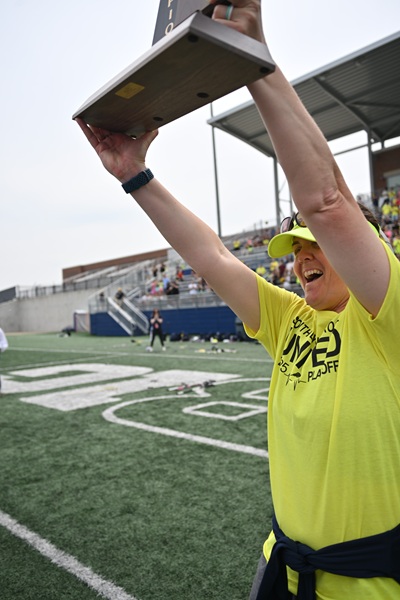
The most noteworthy win of her career came last June, when South Lyon Unified earned a 6-3 Division 1-clinching victory over Hartland to give Radcliffe her first MHSAA Finals championship as head coach in a matchup between the two programs she built up.
South Lyon Unified is 18-0 this season and has won 39 straight games going back to last spring's opener.
“She has so much knowledge of the sport and really cares for each and every one of us,” said South Lyon United senior captain Teagan Wesner. “Deanna has been one of the best coaches I have ever had, and I am extremely grateful to have had the opportunity to play for her. I am very happy for Deanna, and I am excited to be a part of the team who helped her reach 300 wins.”
When Radcliffe first arrived in Michigan, lacrosse was in its first years as a sanctioned sport by the MHSAA. Now, she has seen it grow by leaps and bounds.
“One of the most rewarding parts has been seeing the long-term impact,” she said. “Many of the players I once coached are now youth, high school or college coaches themselves. Some are officials, and some I’m even coaching against or alongside now. That’s been incredibly meaningful and really speaks to the strength of the community the sport has built.”
 Keith Dunlap has served in Detroit-area sports media for more than two decades, including as a sportswriter at the Oakland Press from 2001-16 primarily covering high school sports but also college and professional teams. His bylines also have appeared in USA Today, the Washington Post, the Detroit Free Press, the Houston Chronicle and the Boston Globe. He served as the administrator for the Oakland Activities Association’s website from 2017-2020. Contact him at [email protected] with story ideas for Oakland, Macomb and Wayne counties.
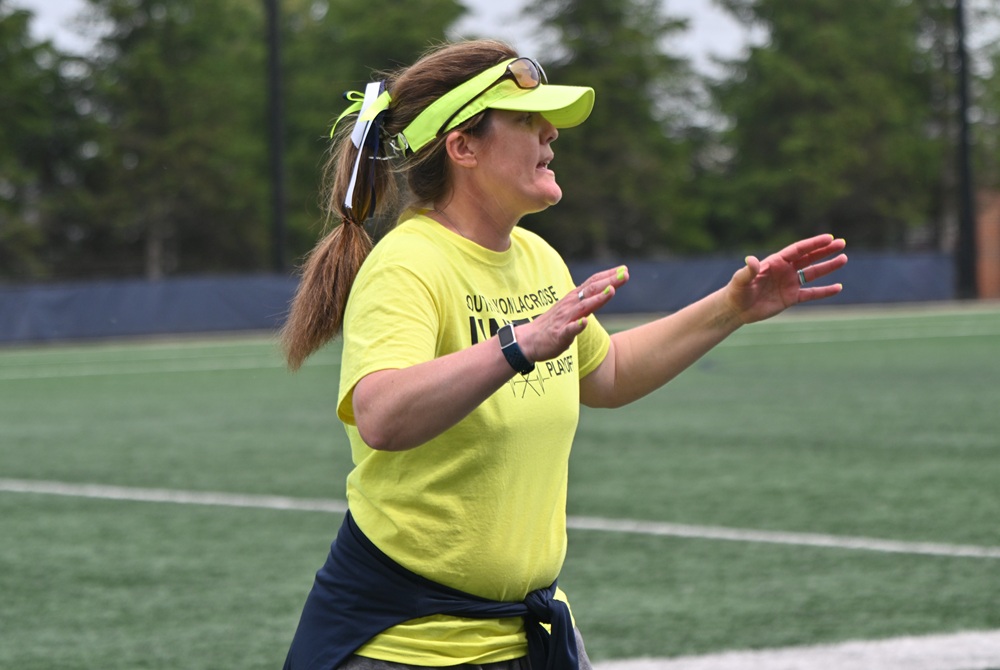
PHOTOS (Top) Deanna Radcliffe, here during the 2025 Division 1 Final, has reached 299 career coaching wins. (Middle) Radcliffe raises the championship trophy after last season’s clincher.