


Add, Subtract, Divide, Multiply: MHSAA Not Alone
July 25, 2017
By Rob Kaminski
MHSAA benchmarks editor
This is the third part in a series on MHSAA tournament classification, past and present, that will be published over the next two weeks. This series originally ran in this spring's edition of MHSAA benchmarks.
As the MHSAA faces its most recent classification task with 8-Player Football, and opinions continue to swirl about as to the method, timeframe, location and other procedures, a look around the country provides plenty of company among state association brethren factoring variables into their own equations.
In the Pacific Northwest, the Oregon School Activities Association Football Playoffs are under public scrutiny as leadership ponders a five or six classification format beginning with the 2018-19 school year.
The OSAA has crowned six champions on the gridiron since 2006-07. Many of the state’s smaller schools would like to keep it that way, while larger schools lean toward a five-classification system, citing larger leagues, ease of travel and credibility to state championships as the advantages.
Still others would prefer more than six classes, pointing to safety issues and the opportunity to increase participation numbers as positives.
Moving southeast of Oregon, the Nevada Interscholastic Activities Association recently voted to hold serve on a classification proposal that was volleyed to the membership.
However, changes still could be forthcoming by as early as the 2018-19 season which would add a fifth classification in more populated southern Nevada while allowing northern schools to participate in four classifications. Such divisions could mean no state championship for the fifth class in southern Nevada.
Because of that, the NIAA wants equal numbers of schools in each classification on both ends of the state. Complicating the issue is the fact that the 24 largest schools in the state, by enrollment, are all in Clark County in Southern Nevada.
Across Nevada’s border into Arizona, charter schools are asking the Arizona Interscholastic Association to reconsider classification that was voted upon and approved in September 2015. That agreement called for the largest 33 percent of charter schools by enrollment to be placed in the state’s largest school classification, 3A, the middle 33 percent into 2A, and the smallest 33 percent into 1A.
Less than two years later the charter schools have had a change of heart and have asked to be considered the same as other Arizona public schools and be placed appropriately by enrollment beginning with the 2018-19 school year.
The situation in Arizona further illustrates how the public/private debate that all state associations have faced throughout existence now has the added dynamic of rapidly growing charter schools in today’s educational system, along with virtual school enrollment.
In the nation’s heartland, Nebraska has retooled its football classifications by using enrollment of boys students only in its schools rather than total enrollment. The Nebraska School Activities Association football-playing schools will kick off the 2018 season using this alignment.
Nebraska has three classes of 11-player football, with the smallest class divided in two, Class C-1 and C-2. The state also will have 8-player football for boys enrollments under 47, and the NSAA will sponsor a new 6-player tournament in 2018 for schools with 27 or fewer boys.
“This is a good proposal because some schools have a sizable imbalance between the number of boys and girls, and there’s a large gap (in enrollment) between the largest and smallest schools in Classes A and B,” NSAA executive director Jim Tenopir said. “I think this addresses both of those concerns.”
Swimmers in Georgia, meanwhile, will feel like they are moving with the current, rather than upstream in 2017-18, as the Georgia High School Association recently doubled the number of team championship events from two to four.
Swim enthusiasts can also count on longer days at the finals, as the top 30 finishers from the prelims will advance to the finals instead of 20, and all championship events will have three heats versus two.
Senior-Dominated Iron Mountain Soars to UPD2 Finals Repeat
By
Steve Brownlee
Special for MHSAA.com
September 30, 2022
ISHPEMING — There was both a single reason and a singles reason why Iron Mountain won the championship at the MHSAA Upper Peninsula Division 2 Girls Tennis Finals played at Westwood High School on Thursday.
The difference is subtle — just a single letter “s” — but rings true both ways.
It was easy to see what the Mountaineers’ secret was — sweep the titles at every singles flight while adding one more in doubles just to be on the safe side.
IM finished with 19 points, while Ishpeming outdueled West Iron County in several late finals to eke out second place by one point, 14 to 13.
Gwinn posted five points to take fourth, while Munising had four, Norway one and Ironwood did not score.
Mountaineers coach Marcus Celello credited senior leadership for the team’s repeat championship.
“We have eight seniors on our team, including all four of our regular singles players and both our No. 1 doubles players, along with one each on Nos. 3 and 4 doubles,” the IM coach said.
He noted that all those singles flights were winners with the team’s championship in doubles also coming with the pair of seniors at No. 1.
“We won this last year and returned our core, so I knew we would at least be very competitive this year,” Celello said. “We won or tied every dual meet this season.”
He said that included a 4-4 tie against eventual U.P. Division 1 champion Negaunee to give the Miners the only blemish on their dual-meet record this fall.
“But sometimes when you haven’t faced adversity, it can be scary,” the coach continued. “You don’t always know how you’re going to react.”
 No. 2 singles player Aziza Burgoon — of course, a senior — completed an undefeated season by winning a marathon final over WIC’s Seanna Stine, 7-5, 7-5.
IM also got singles titles from No. 3 Natalia Brown and No. 4 Rediet Husing, along with a doubles championship from No. 1 Elle Lofholm and Anja Kleiman.
But the biggest cheers and shrieks came after IM finished its singles sweep when No. 1 Callie Bianco pulled off a 6-4, 6-4 win over Gwinn’s Miaha Schiefel.
Schiefel led 4-2 in the second set looking to force a deciding third before Bianco won the final four games.
“I just was trying to stay focused, work the ball and follow through,” Bianco said. “And maybe the most important thing was to be patient, not panic.
“I’m known for being an impatient player. When I’m on, I like to be aggressive, but I know that when I’m not on, I have to focus on being patient.”
Asked if she was “on” Thursday, she was emphatic with her “Yes I was!”
One coach trying to be patient but excited for next season is Ishpeming’s Kaitlin Rich, who watched her junior-laden team set the groundwork for a big season next fall.
“We’ve already made a big improvement from last year,” she said. “I’m proud of how hard our girls have worked to make that improvement.
“Half of our players are dual-sport athletes, which means they’re playing another sport this fall, too, so they really have to balance their workload.”
The Hematites carted off one championship, one of the last finishing finals matches at No. 3 doubles when Kaitlyn VanDeuren and Paige Palomaki had to win a third-set tiebreaker to defeat WIC’s Bailey Hoffart and Aubrey Richardson 6-4, 3-6, 7-6 (7-1).
That result decided the runner-up position team-wise as a Wykons’ win would’ve reversed their point totals and places in the standings.
“We had five finalists, at Nos. 3 and 4 singles and Nos. 1, 2 and 3 doubles,” Rich said. “We return nine of our juniors next year, so I’m really looking forward to next year. I think we should be ready to make a run at the U.P.’s (title) next year.
“Kaitlyn and Paige, those two by far are the most improved players from last year,” the Ishpeming coach added.
 WIC veteran coach Joe Serbentas was philosophical after his players won a pair of doubles titles, at No. 2 with sisters Autumn Smith and Kaitlyn Smith and at No. 4 with Destiny Lemery and Olivia Lamay.
“We’ve played well at the U.P.’s the last five or six years, but we also seemed to come up that point short,” he said. “Iron Mountain is so senior-loaded, you just knew that they were the big favorites today.
“We had a 5-7-1 record in dual meets, but we play a lot of the best teams in the U.P., so I still think that’s pretty good.”
Gwinn made a run at a U.P. flight championship for the first time in a number of years with Schiefel at No. 1 singles, much to her coach’s delight.
“She has such a passion for the sport, and she’s such an avid athlete,” Modeltowners coach Darcia Mattson said. “She runs track and is a phenomenal basketball player. She trains at AdvantEdge (athletic training facility in Marquette).
“She used to play tennis against her brother, Jared Rolland.
“And she’s not a big girl at all, but her heart is twice as big as she is.”
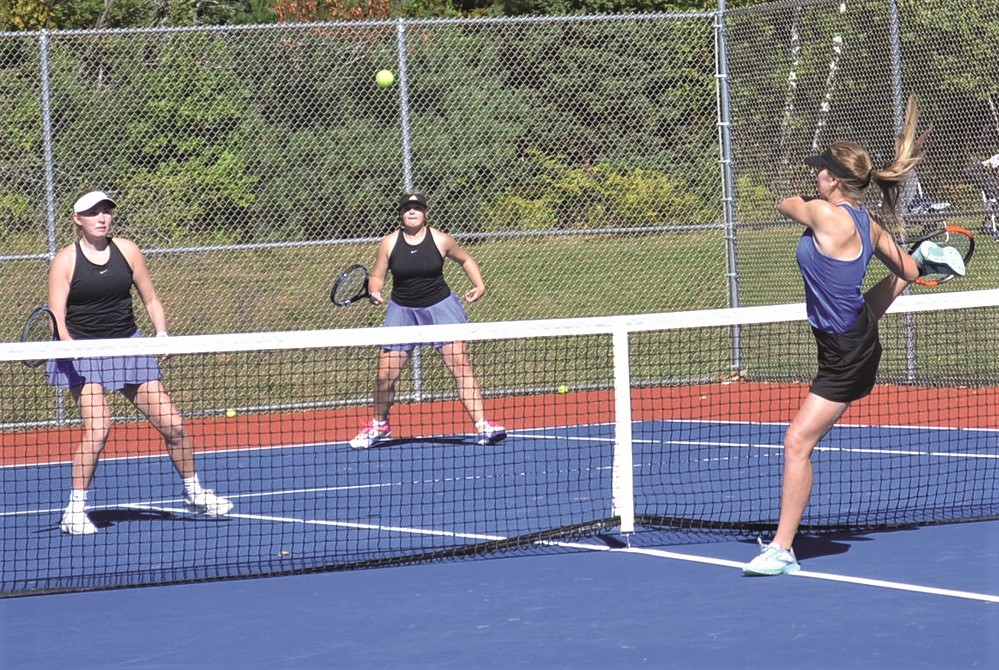
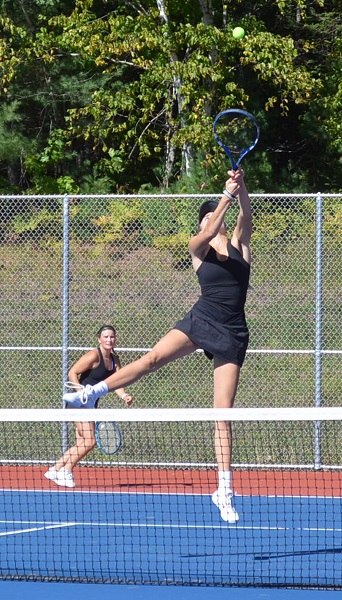
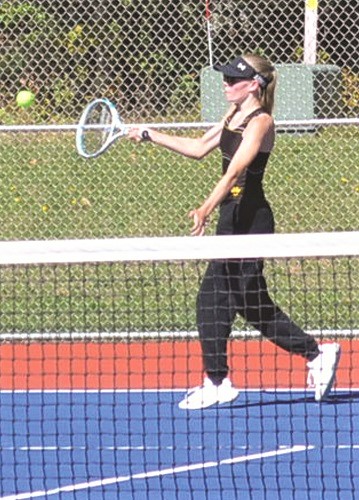
PHOTOS (Top) The Iron Mountain and Ishpeming No. 2 doubles pairs face off during a semifinal. (Middle) Anja Kleiman gets a racket on the ball during her and partner Elle Lofholm’s match at No. 1 doubles. (Below) Gwinn’s Miaha Schiefel returns a volley at No. 1 singles. (Photos by Steve Brownlee.)